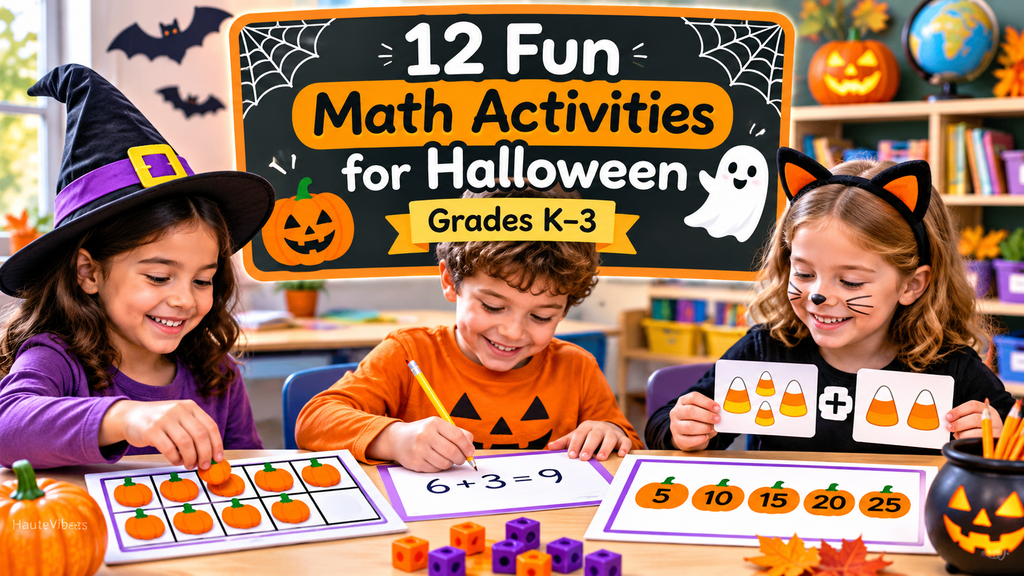
Halloween brings plenty of excitement to the classroom, but it can also be a great opportunity to practice math. Pumpkins become counting tools, paper ghosts turn into subtraction stories, and a pretend Halloween store gives children a reason to work with money.
The best math activities for Halloween combine seasonal fun with skills students are already learning. You do not need expensive supplies or elaborate decorations. Paper shapes, dice, counters, pencils, and a few simple instructions are enough for most of these games.
Below are 12 hands-on Halloween math activities for kindergarten through third grade. Each includes a learning goal, materials, directions, and an easy way to adjust the challenge.
Quick guide: Choose an activity by math skill
| Math skill | Halloween activity | Suggested grades |
|---|---|---|
| Counting and number recognition | Pumpkin Counting Mats | K |
| Number bonds and making ten | Halloween Ten-Frame Challenge | K–1 |
| Shapes and geometry | Haunted House Shape Hunt | K–2 |
| Addition | Candy Corn Addition | K–2 |
| Subtraction | Ghost Subtraction Stories | 1–2 |
| Skip counting | Bat Skip-Counting Trail | 1–3 |
| Graphing and data | Halloween Picture Graph | K–3 |
| Measurement | Pumpkin Measurement Lab | 1–3 |
| Equal groups and multiplication | Spider-Leg Multiplication | 2–3 |
| Place value | Monster Mystery Numbers | 1–3 |
| Counting money | Halloween Classroom Store | 2–3 |
| Mixed math review | Halloween Math Scavenger Hunt | K–3 |
These grade suggestions are flexible. Choose activities according to what your students already understand, then increase or decrease the difficulty.
Easy Halloween Math Activities for Kindergarten
Kindergarten students learn math best when they can see and move quantities. Start with counting, number relationships, and familiar shapes before introducing more complicated equations.
1. Pumpkin Counting Mats
Math skill: Counting objects and matching numbers to quantities
Time: 5–10 minutes
Materials: Paper pumpkin outlines, number cards, and orange paper counters
Write the numbers 1–10 on separate cards. Give each child a pumpkin outline and ask them to choose a number card.
Students place the matching number of counters on the pumpkin, touching or moving each counter as they count.
Example: A student chooses the number 6 and places exactly six orange counters on the pumpkin.
Ask, “How do you know you have six?” Have the child recount the counters and point to the numeral.
Make it easier: Work with numbers 1–5.
Add a challenge: Ask students to make six in two groups, such as four orange counters and two yellow counters.
This simple pumpkin math activity develops one-to-one correspondence rather than just memorizing number words.
2. Halloween Ten-Frame Challenge
Math skill: Number bonds and making ten
Time: 10 minutes
Materials: Ten-frame sheets and two colors of paper counters
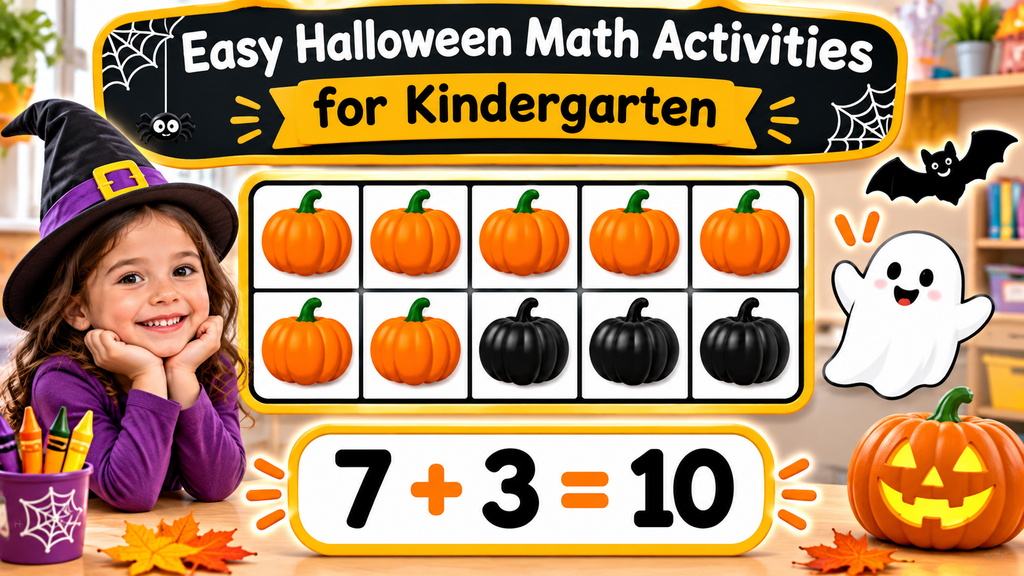
Draw a rectangle divided into two rows of five boxes.
Place seven orange counters in the ten frame. Ask students to fill the remaining spaces with black counters.
Children should discover that three more counters complete the frame.
7 + 3 = 10
Ask:
- How many spaces were filled at the beginning?
- How many spaces were empty?
- How do you know the total is ten?
Repeat using different starting numbers.
Make it easier: Begin with five counters so students can see one full row and one empty row.
Add a challenge: Give students the number ten and ask them to find several pairs that make it, such as 6 + 4 and 8 + 2.
For additional year-round number games, teachers can explore our kindergarten math activities.
3. Haunted House Shape Hunt
Math skill: Recognizing and describing two-dimensional shapes
Time: 10–15 minutes
Materials: Construction paper, crayons, glue, and pre-cut shapes
Give students paper triangles, squares, rectangles, and circles.
Ask them to build a friendly haunted house using the shapes.
For example, a house might have:
- One triangular roof
- Two square windows
- One rectangular door
- One circular doorknob
After arranging the pieces, students identify and count each shape.
Math question: If the house has two square windows and you add one more square window, how many square windows will it have?
Answer: 3 windows.
Make it easier: Use only circles, squares, and triangles.
Add a challenge: Ask students to describe the number of sides and corners of each shape or explain why different-looking shapes belong to the same category.
The finished houses can become a classroom display, but the learning goal remains identifying and discussing shapes.
Halloween Addition and Subtraction Activities
Once students understand basic counting, Halloween themes can make addition, subtraction, and number patterns more engaging.
4. Candy Corn Addition
Math skill: Adding two groups
Time: 10 minutes
Materials: Orange and yellow paper triangles, number cards, and pencils
Students draw two number cards and represent each number with paper candy corn shapes.
For example:
First group: 6 candy corn shapes
Second group: 3 candy corn shapes
Ask students to combine the groups and find the total.
6 + 3 = 9
Encourage them to explain whether they counted all nine shapes or started at six and counted on three more.
Make it easier: Keep sums within ten and provide counters.
Add a challenge: Use two-digit numbers or ask students to explain how a known fact helps them find a new sum.
Paper shapes work just as well as real candy and avoid food-allergy concerns.
5. Ghost Subtraction Stories
Math skill: Subtraction through storytelling
Time: 10–15 minutes
Materials: Paper ghost cutouts or counters
Place 13 paper ghosts on a table.
Tell students:
“Thirteen friendly ghosts were playing in the yard. Five floated away. How many ghosts are still there?”
Students remove five ghosts and count what remains.
13 − 5 = 8
Have students write the subtraction sentence after acting out the story.
Make it easier: Begin with five ghosts and remove two.
Add a challenge: Ask students to create their own subtraction stories or find the missing number in an equation such as 13 − ___ = 8.
This activity helps children connect a written equation with an action they can see.
6. Bat Skip-Counting Trail
Math skill: Skip counting by 2s, 5s, and 10s
Time: 10 minutes
Materials: Paper bat cutouts and a number line or floor space
Write the numbers 5, 10, 15, 20, and 25 on five paper bats.
Mix them up and ask students to arrange the bats in the correct order.
Then have them read the sequence aloud.
5 → 10 → 15 → 20 → 25
Ask, “What number would come next?”
Answer: 30.
Make it easier: Begin with counting by twos to 20.
Add a challenge: Remove several bats and ask students to determine the missing numbers. Third graders can connect the pattern to multiplication facts.
The movement involved in arranging the bats gives students another way to explore number patterns.
Hands-On Halloween Math Games for Grades 1–3
Older elementary students are ready for activities involving measurements, graphs, place value, equal groups, and practical problem-solving.
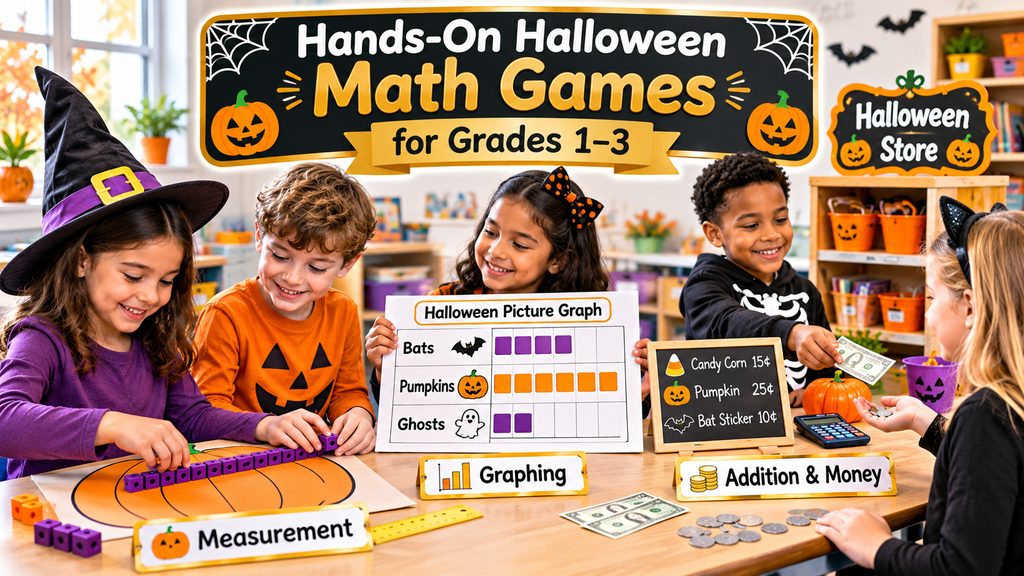
7. Halloween Picture Graph
Math skill: Sorting, graphing, and comparing data
Time: 15 minutes
Materials: Paper cards showing bats, pumpkins, and ghosts, plus graph paper
Give a group ten picture cards containing:
- 5 bats
- 3 pumpkins
- 2 ghosts
Students sort the cards and create a picture graph using one picture or symbol for each card.
Then ask:
Which category has the most? Bats.
How many pictures are there altogether? 10.
How many more bats than ghosts are there?
5 − 2 = 3
Answer: 3 more bats.
Make it easier: Count and compare two categories.
Add a challenge: Ask students to write three questions about the graph and exchange them with a partner. Grade 3 students can collect their own class data and represent it using an appropriate graph.
This activity turns Halloween picture sorting into meaningful data practice.
8. Pumpkin Measurement Lab
Math skill: Estimation and measuring length
Time: 15 minutes
Materials: Paper pumpkin cutouts, linking cubes, and rulers for older students
Prepare pumpkin shapes in different sizes.
Ask students to predict which pumpkin is wider.
Then measure each pumpkin across its widest point using linking cubes placed in a straight line with no gaps or overlaps.
For example:
Large pumpkin: 8 cubes wide
Small pumpkin: 5 cubes wide
Ask, “How many cubes wider is the large pumpkin?”
8 − 5 = 3
Answer: 3 cubes wider.
Make it easier: Ask children to compare two pumpkins using “wider” and “narrower” without numbers.
Add a challenge: Have students measure using centimeters, record their estimates, and compare their measurements with the actual results.
You can also use real pumpkins for comparing weight or circumference, but teach those as different measurements rather than treating them as interchangeable with width.
9. Spider-Leg Multiplication
Math skill: Equal groups, repeated addition, and multiplication
Time: 10 minutes
Materials: Paper spiders and pencils
Show students three paper spiders, each with eight legs.
Ask, “How many legs do the three spiders have altogether?”
Children can add equal groups:
8 + 8 + 8 = 24
Students who are ready for multiplication can write:
3 × 8 = 24
Answer: 24 legs.
Make it easier: Use two spiders and count each leg, then group the legs by spider.
Add a challenge: Use four or five spiders and ask students to show the total using repeated addition, multiplication, and a drawing.
This activity introduces multiplication as equal groups, making it especially useful for children preparing for or learning third-grade multiplication.
10. Monster Mystery Numbers
Math skill: Place value and number reasoning
Time: 10 minutes
Materials: Number cards, pencils, and optional base-ten blocks
Write a mystery number on a card and give students clues.
For example:
- My number is greater than 40.
- My number is less than 50.
- I have four tens and seven ones.
Students use the clues to discover:
40 + 7 = 47
Answer: 47.
Make it easier: Use numbers within ten. “I am greater than five but less than seven” leads to six.
Add a challenge: Ask students to create three-digit mystery numbers using hundreds, tens, and ones.
Children can take turns making clues while classmates explain how they found the answer.
11. Halloween Classroom Store
Math skill: Counting money and solving addition or subtraction problems
Time: 15–20 minutes
Materials: Play coins, price tags, paper items, and baskets
Create a pretend store with classroom items or paper Halloween decorations.
Give students a small play-money budget.
For example:
Pumpkin sticker: 15¢
Bat pencil: 25¢
Ask students to calculate the total.
15¢ + 25¢ = 40¢
If they start with 50¢, ask how much money remains.
50¢ − 40¢ = 10¢
Answer: 10¢ left.
Make it easier: Use whole-dollar prices and simple addition before introducing coin values.
Add a challenge: Give students a spending limit and ask them to purchase three items while staying within budget.
For more detailed money lessons, our classroom money and budgeting projects provide additional ways to practice financial decision-making with pretend money.
12. Halloween Math Scavenger Hunt
Math skill: Reviewing several math concepts
Time: 15–20 minutes
Materials: Task cards, pencils, and recording sheets
Place math challenge cards around the classroom.
Students move from card to card, solve each problem, and record their answers.
Sample challenges might include:
- Count ten paper pumpkins.
- Find a triangle in the classroom.
- Solve 8 + 6.
- Measure a paper bat using cubes.
- Find two number pairs that make ten.
Choose tasks that match the current math unit so students are practicing familiar skills.
Make it easier: Provide picture clues and hands-on counters.
Add a challenge: Include multi-step word problems or ask students to explain their reasoning in writing.
To check understanding, review one task with the class and ask students to show a second way to reach the answer.
How to Plan a Halloween Math Lesson or Center
You do not need to complete all 12 activities in one day. Choose two or three that reinforce your current learning objectives.
A simple 30-minute Halloween math lesson can look like this:
| Time | Classroom activity |
|---|---|
| 4 minutes | Introduce the math goal and demonstrate one example |
| 7 minutes | First math center |
| 7 minutes | Second math center |
| 7 minutes | Third math center |
| 5 minutes | Review answers and complete an exit ticket |
For a first-grade class practicing addition, you might choose ten frames, candy corn addition, and ghost subtraction. A third-grade class could rotate through multiplication, measurement, and the classroom store.
Adjust Activities for Different Grade Levels
| Grade | Best focus | Useful adaptation |
|---|---|---|
| Kindergarten | Counting, shapes, numbers to ten | Use large pictures and physical counters |
| Grade 1 | Addition, subtraction, and number patterns | Introduce number sentences and counting strategies |
| Grade 2 | Two-digit operations, measurement, money, and graphs | Include word problems and recording sheets |
| Grade 3 | Multiplication, data interpretation, and multi-step reasoning | Ask students to show and explain more than one strategy |
These activities can support skills found in the Common Core State Standards for Mathematics, although teachers should match each task to their own state standards and current lessons.
Keep Halloween Math Inclusive and Low-Prep
Not every classroom or family celebrates Halloween. Offer the same math task with an autumn theme when appropriate.
You can replace ghosts with leaves, bats with birds, and candy corn shapes with colored paper squares without changing the learning objective.
Other practical tips:
- Use paper shapes or reusable counters instead of requiring real candy.
- Avoid frightening imagery for children who prefer friendly characters.
- Supervise small manipulatives and choose age-appropriate materials.
- Prepare only the number of stations you have time to explain and manage.
- Ask students to show their thinking rather than rewarding only speed.
The theme should make math approachable, not distract from the skill being taught.
Halloween Math Practice Questions With Answers
These eight questions provide a quick review of counting, addition, subtraction, number patterns, measurement, place value, and multiplication.
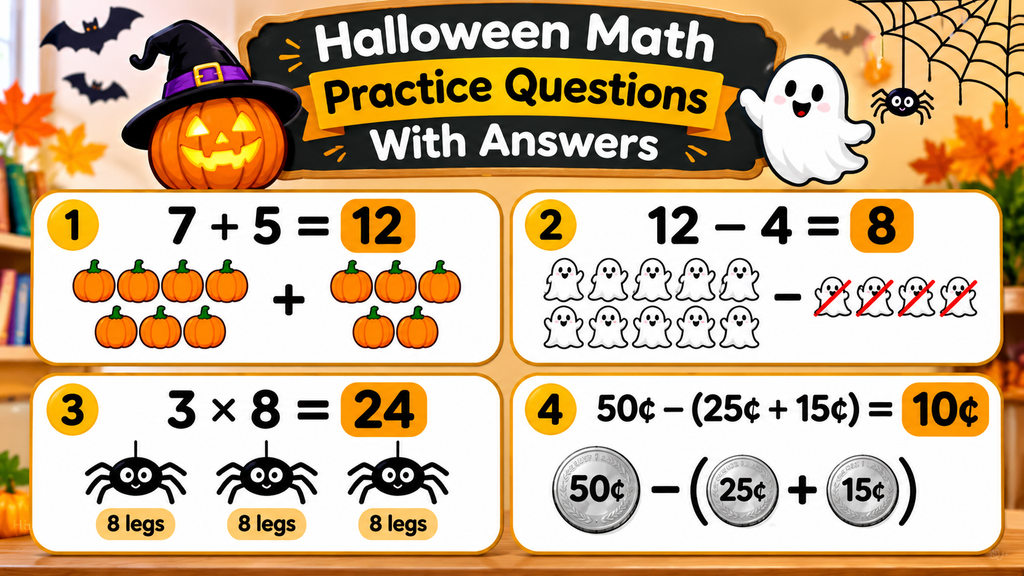
Choose questions that suit your students’ grade level. Younger learners can use drawings or counters, while older students can explain their calculations.
| # | Question |
|---|---|
| 1 | There are 7 orange pumpkins and 5 white pumpkins. How many pumpkins are there altogether? |
| 2 | Twelve paper ghosts are on a wall. Four are taken down. How many remain? |
| 3 | Complete the counting pattern: 5, 10, 15, ___, 25. |
| 4 | Three spiders each have 8 legs. How many legs are there altogether? |
| 5 | A picture graph shows 4 bats, 6 pumpkins, and 2 ghosts. How many more pumpkins than ghosts are shown? |
| 6 | One paper pumpkin is 9 cubes wide. Another is 6 cubes wide. What is the difference in their widths? |
| 7 | A mystery number has 3 tens and 7 ones. What is the number? |
| 8 | Two pretend store items cost 25¢ and 15¢. If you have 50¢, how much money will remain after buying both? |
Answer Key
| # | Answer | Calculation |
|---|---|---|
| 1 | 12 pumpkins | 7 + 5 = 12 |
| 2 | 8 ghosts | 12 − 4 = 8 |
| 3 | 20 | Count by fives |
| 4 | 24 legs | 3 × 8 = 24 |
| 5 | 4 more pumpkins | 6 − 2 = 4 |
| 6 | 3 cubes | 9 − 6 = 3 |
| 7 | 37 | 30 + 7 = 37 |
| 8 | 10¢ | 50¢ − (25¢ + 15¢) = 10¢ |
Quick Exit Ticket
Before students leave the lesson, ask them to complete one final task:
“Draw two groups of Halloween objects that add up to ten. Write an addition equation to match your drawing.”
One correct response would show six pumpkins and four bats:
6 + 4 = 10
Ask students to explain how their drawing matches the equation. This gives teachers a quick way to check whether children understand the quantities, not just the answer.
Make Halloween Math About Learning, Not Just the Theme
The most useful Halloween math activities are simple to prepare, matched to students’ abilities, and focused on a clear mathematical goal.
A paper pumpkin can teach counting. A group of friendly ghosts can demonstrate subtraction. A pretend store can turn money practice into a real-world problem.
Start with one or two activities that fit your current lessons, provide the materials students need, and give children time to explain their reasoning. That combination makes seasonal math practice both enjoyable and worthwhile.

Written by johan
Jonas is an Educational Content Writer and STEM Learning Contributor at Haute Vibes (hautevibes.com), focusing on elementary education, early mathematics, science exploration, and hands-on learning activities. His writing breaks down educational concepts into simple, engaging lessons that help children develop curiosity, logical thinking, and problem-solving skills. Jonas emphasizes age-appropriate teaching methods, practical classroom resources, and interactive learning experiences that support both teachers and parents. Through his articles, he aims to make STEM education accessible, enjoyable, and meaningful while encouraging young learners to explore, experiment, and build confidence in their abilities.
View all articles →