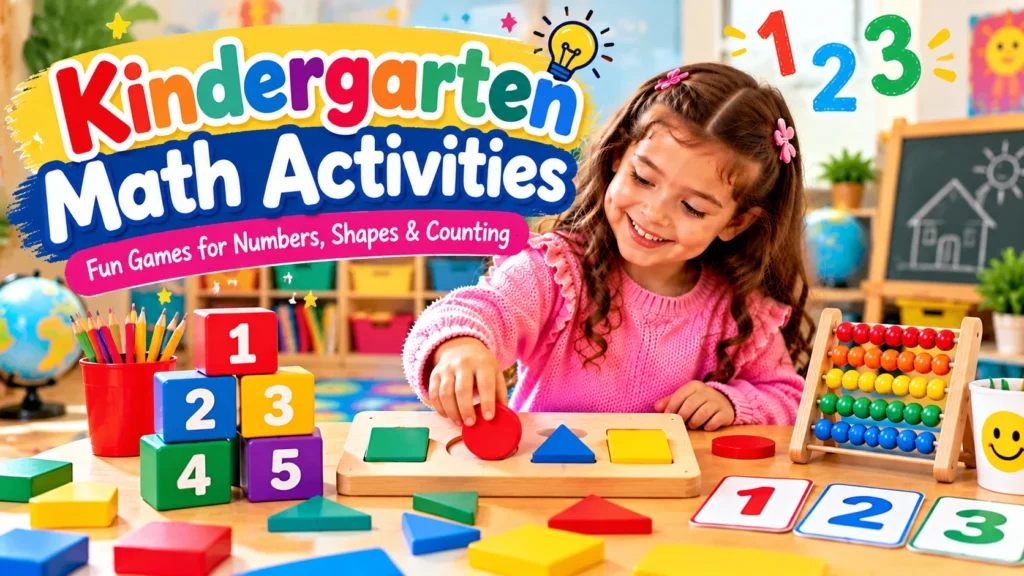
Kindergarten math becomes more meaningful when children can touch, move, build, count, and explore. Instead of memorizing numbers or completing one worksheet after another, young learners can discover mathematical ideas through everyday objects and playful experiences.
The best kindergarten math activities help children connect numbers with quantities, recognize shapes, discover patterns, and understand simple addition and subtraction. A child might count colorful blocks, fill a ten frame, sort shapes, or clap along to a number pattern—all while developing important early math skills.
Whether you’re planning classroom lessons or looking for activities to practice at home, these games use simple materials and clear instructions. Most can be adapted for children who are just beginning to count and those ready for a greater challenge.
What Math Skills Should Kindergarteners Learn?
Kindergarten mathematics focuses on building a strong foundation for later learning. Children need opportunities to explore concepts in different ways before they are expected to use numbers and symbols confidently.
Important kindergarten math skills include:
| Math skill | What children practice | Example activity |
|---|---|---|
| Counting | Connecting number words to objects | Count and Match |
| Number recognition | Identifying numerals and their quantities | Number Hunt |
| Number comparison | Recognizing more, fewer, and equal quantities | Compare Ten Frames |
| Addition and subtraction | Combining and separating small groups | Part-Part-Whole Games |
| Number decomposition | Finding different parts of a whole number | Build Number Partners |
| Geometry | Recognizing and describing shapes | Shape Detective |
| Patterns | Creating and extending sequences | Clap and Repeat |
| Measurement | Comparing length, height, and other attributes | Household Measurement Hunt |
For example, a child who places seven counters on a table and counts each one is connecting numbers to real quantities. When that child separates the counters into groups of four and three, they begin exploring how numbers are composed.
Effective math for kindergarten starts with these concrete experiences and gradually introduces drawings, number sentences, and more independent problem-solving.
Fun Counting and Number Recognition Activities
Counting is one of the first mathematical skills children develop. However, being able to recite number names is different from understanding what those numbers represent.
These counting games give children opportunities to recognize numerals, count objects accurately, and compare quantities.
1. Number Hunt Around the Classroom
Learning goal: Recognize written numbers and connect them with quantities.
Materials: Number cards from 1 to 10 and a basket.
How to play:
- Place number cards in different areas of the classroom.
- Ask children to search for a specific number, such as six.
- When they find the card, they bring it to the teacher or point to it.
- Ask them to collect or show the matching number of objects.
For example, a child who finds the number four can collect four blocks and count them aloud.
Teaching tip: Start with numbers 1–5. Gradually introduce higher numbers as children become more confident.
2. Count and Match With Building Blocks
Learning goal: Practice one-to-one correspondence and number recognition.
Materials: Building blocks and number cards.
Place number cards on a table. Children choose a card and build a tower containing the matching number of blocks.
If a child selects seven, they build a tower using seven blocks.
After building, ask:
- How many blocks are in your tower?
- What happens if you add one more?
- Can you build a tower with two fewer blocks?
These questions introduce early addition, subtraction, and number comparison without requiring formal written calculations.
3. Number Line Hop
Learning goal: Understand number order and counting forward or backward.
Materials: Large numbered floor cards or a tape number line.
Arrange numbers from 0 to 10 on the floor with enough space between them for safe movement.
Ask a child to stand on three and hop forward two spaces. Encourage the child to say the number reached.
Next, try moving backward.
This movement-based activity helps children see how numbers increase and decrease along a number line.
Variation: Begin from a number other than one to develop flexible counting skills.
Ten Frame Activities for Kindergarten
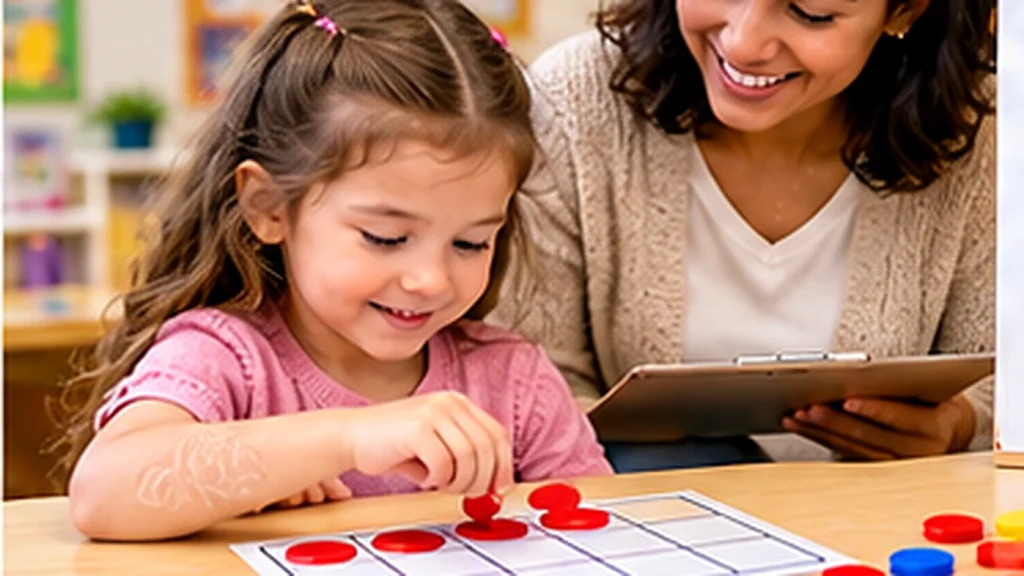
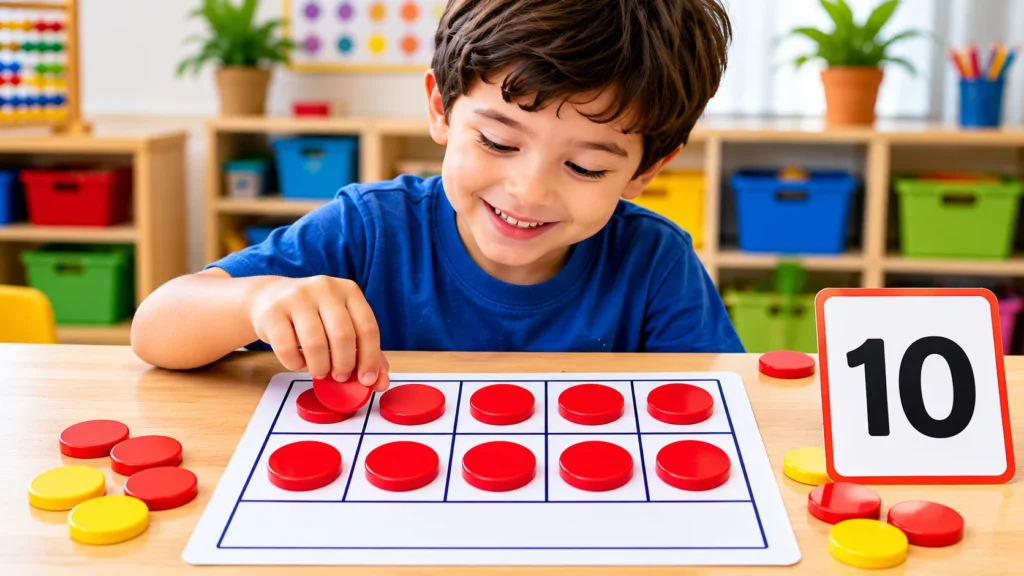
A ten frame is a simple mathematical tool that helps children visualize quantities.
It consists of ten spaces arranged in two rows of five. Children place counters in the spaces to represent numbers from zero to ten.
Ten frames help students recognize quantities, compare numbers, and understand combinations that make ten.
For example, when children fill a ten frame with seven counters, they can see that three spaces remain empty.
4. Fill the Ten Frame
Learning goal: Connect numbers with visual quantities.
Materials: Ten-frame mats, counters, and number cards.
How to play:
- Give each child an empty ten frame.
- Show a number card, such as seven.
- Ask children to place seven counters on their frames, filling the top row from left to right before continuing on the bottom row.
- Count the counters together.
- Ask how many spaces remain empty.
Children discover that seven filled spaces leave three empty spaces.
This is a useful introduction to the relationship between seven, three, and ten.
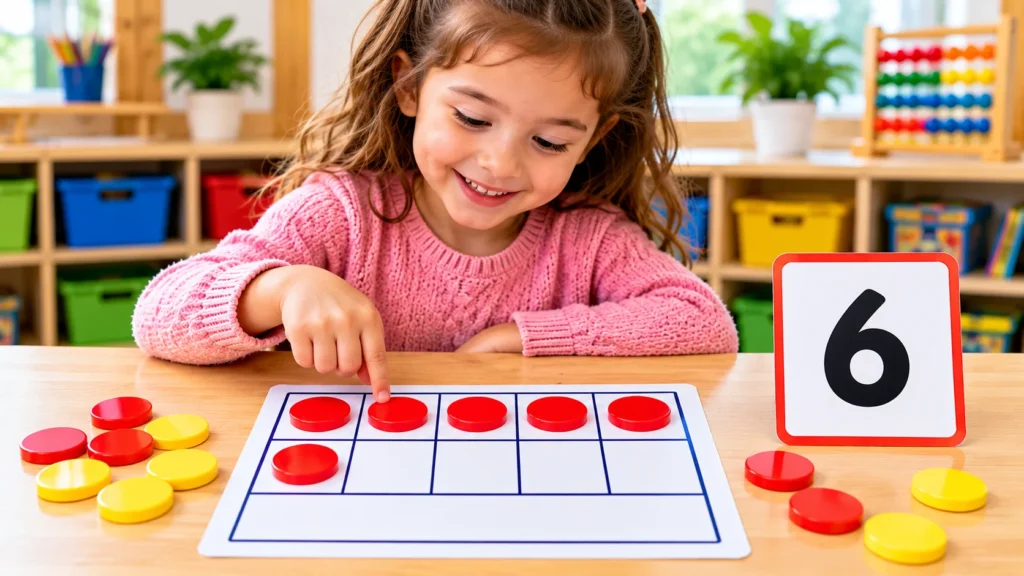
5. How Many Counters Are Missing?
Learning goal: Find the number needed to make ten.
Start with a ten frame containing six counters.
Ask children to count the empty spaces.
Guide them toward the number sentence:
6 + 4 = 10
Repeat with different quantities.
A beginner may count every empty space. As understanding develops, children may recognize a full row of five and use that structure to work out the answer more efficiently.
imag
6. Roll and Cover Ten Frame Game
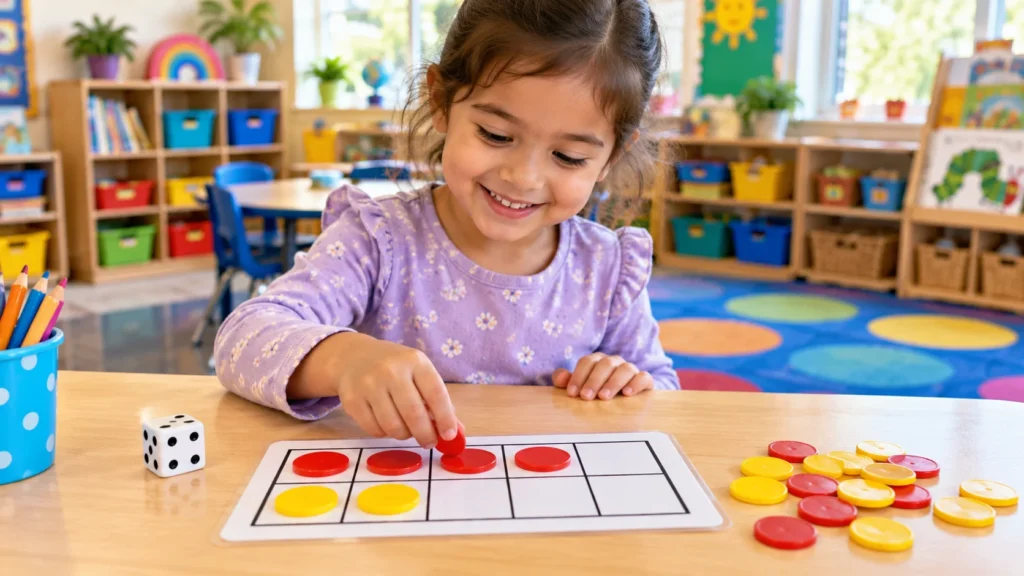
Learning goal: Connect dice quantities with ten-frame representations.
Materials: Ten-frame sheet, die, and counters.
Children roll a die and place that number of counters on their ten frame.
They roll again and add more counters, stopping when the frame is full.
For example, a child rolls four, then three, then two, and finally one:
4 + 3 + 2 + 1 = 10
If a roll would make the total greater than ten, the child can roll again or discuss how many counters are actually needed.
This activity encourages counting, addition, and number relationships.
7. Make Ten With Two Colors
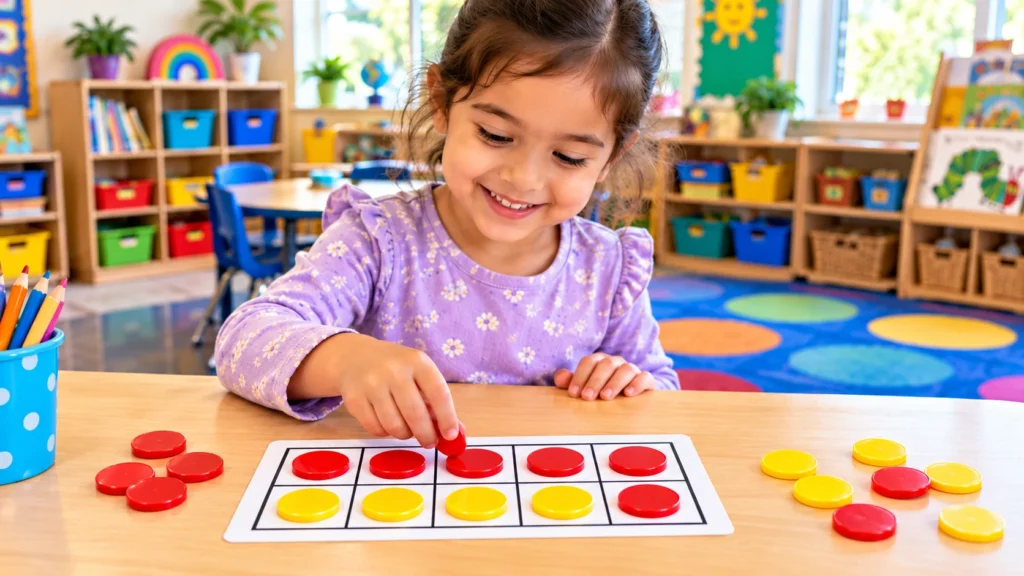
Learning goal: Explore different combinations that total ten.
Provide red and blue counters.
Ask children to fill the entire ten frame using both colors.
One child might use six red counters and four blue counters. Another might use eight red counters and two blue counters.
Record the combinations:
- 6 + 4 = 10
- 8 + 2 = 10
- 5 + 5 = 10
- 7 + 3 = 10
Ask children what stays the same and what changes between the arrangements.
Shapes for Kindergarteners: Fun Geometry Activities
Shapes are everywhere children look. Windows, wheels, books, building blocks, and food containers provide opportunities to explore geometry.
Learning shapes for kindergarten involves more than memorizing names. Children should also notice attributes such as straight or curved edges, corners, faces, and how shapes are positioned.
Common 2D and 3D Shapes for Kindergarten
| Shape | Important feature | Everyday example |
|---|---|---|
| Circle | Round, with no straight sides | Clock face |
| Triangle | Three straight sides | Triangular sign |
| Square | Four equal sides and four square corners | Square floor tile |
| Rectangle | Four square corners, with opposite sides equal | Book cover |
| Hexagon | Six straight sides | Honeycomb cell |
| Cube | Six square faces | Number die |
| Sphere | Round three-dimensional shape | Ball |
| Cylinder | Two circular faces and a curved surface | Food can |
| Cone | Circular base tapering to a point | Party hat |
Explain that two-dimensional shapes are flat, while three-dimensional shapes are solid and occupy space.
Also show shapes in different sizes and orientations. A rotated square is still a square, and a triangle does not always point upward.
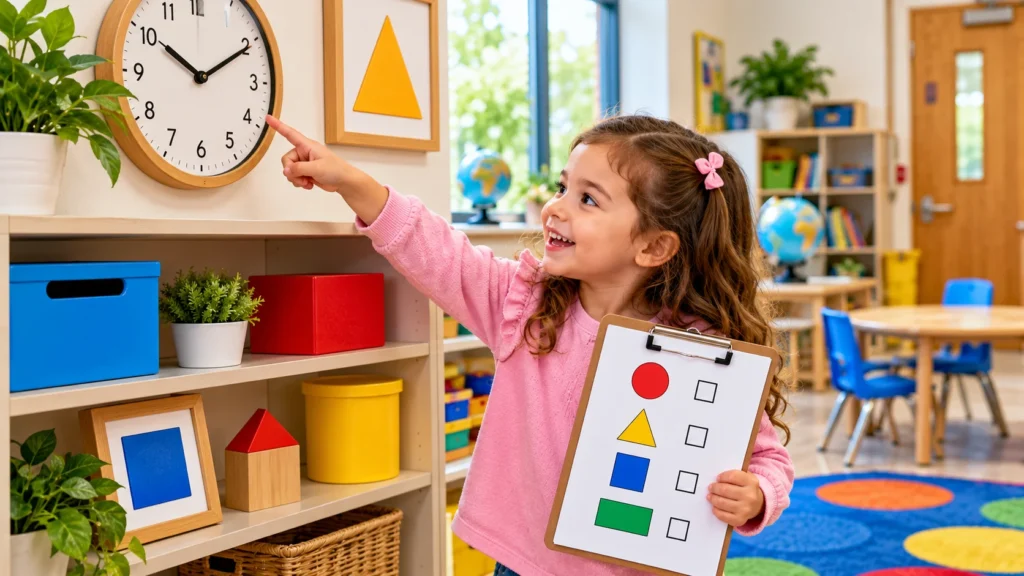
8. Shape Detective Scavenger Hunt
Learning goal: Identify geometric shapes in everyday surroundings.
Materials: Shape cards or a simple shape checklist.
Show children a circle, triangle, square, and rectangle.
Ask them to search the classroom for objects that resemble each shape.
For example:
- Circle: Wall clock
- Rectangle: Classroom door
- Square: Square floor tile
- Triangle: Triangular building piece
Encourage children to explain what makes each object a particular shape.
Teaching tip: Ask children to describe the visible face or outline of an object. A real object may be three-dimensional even when its front looks rectangular.
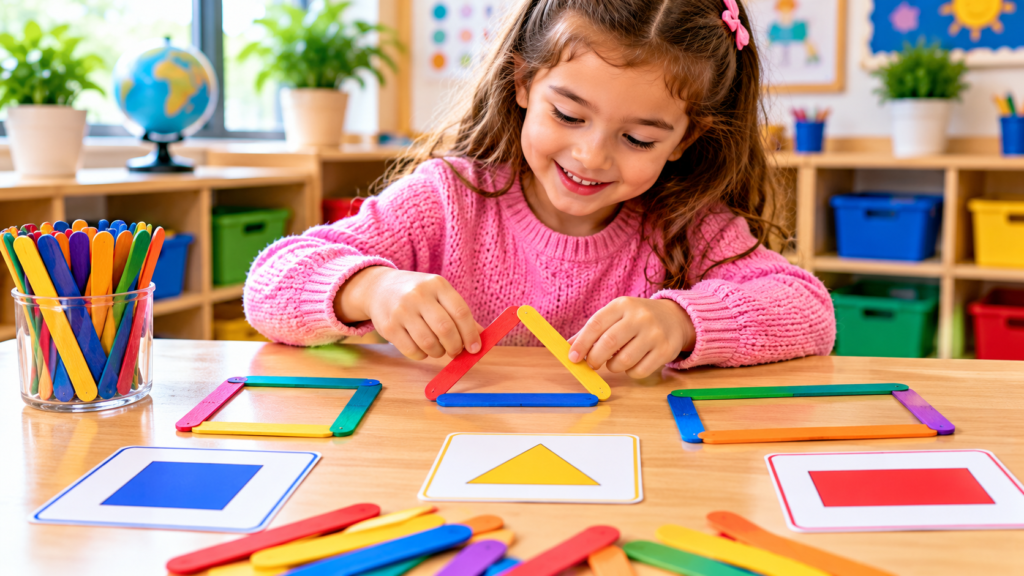
9. Build Shapes With Craft Sticks
Learning goal: Recognize the sides and corners of shapes.
Materials: Large craft sticks and reusable modeling clay.
Give children craft sticks and ask them to create triangles, squares, and rectangles.
After building each shape, ask:
- How many sides does it have?
- How many corners can you count?
- Are all the sides the same length?
- Can you make a larger version?
Children can also join two triangles to form a larger shape.
This activity connects geometry with construction and visual reasoning.
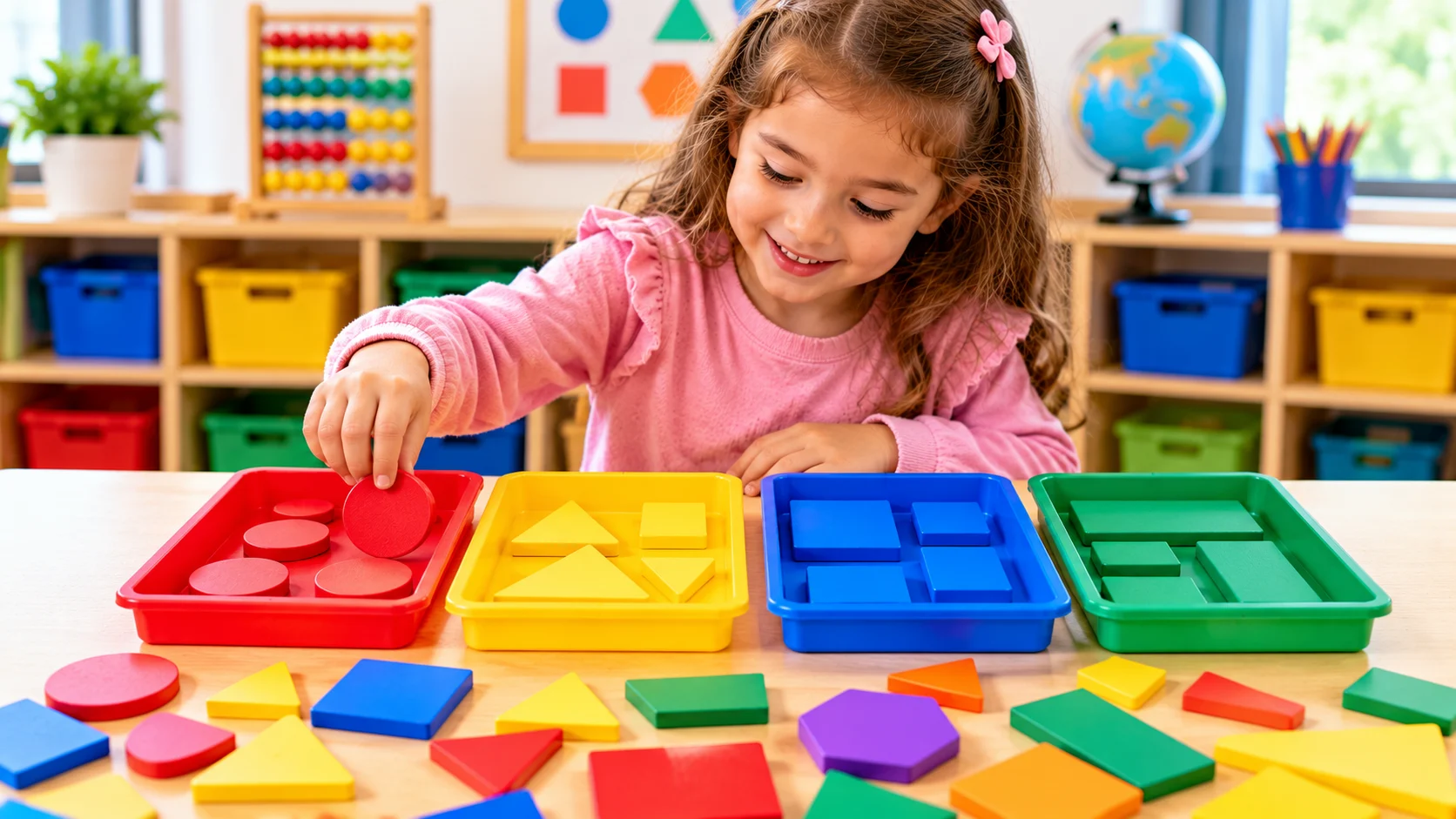
10. Shape Sorting Challenge
Learning goal: Compare shapes based on their attributes.
Materials: Assorted shape cutouts and sorting mats.
Children sort shapes into different groups.
Start by sorting circles, triangles, squares, and rectangles.
Next, ask children to create their own sorting rules:
- Shapes with three sides
- Shapes with four sides
- Shapes with straight edges
- Shapes with curved boundaries
A more advanced challenge is to identify shapes that belong to more than one group.
For example, a square is also a special type of rectangle because it has four right angles.
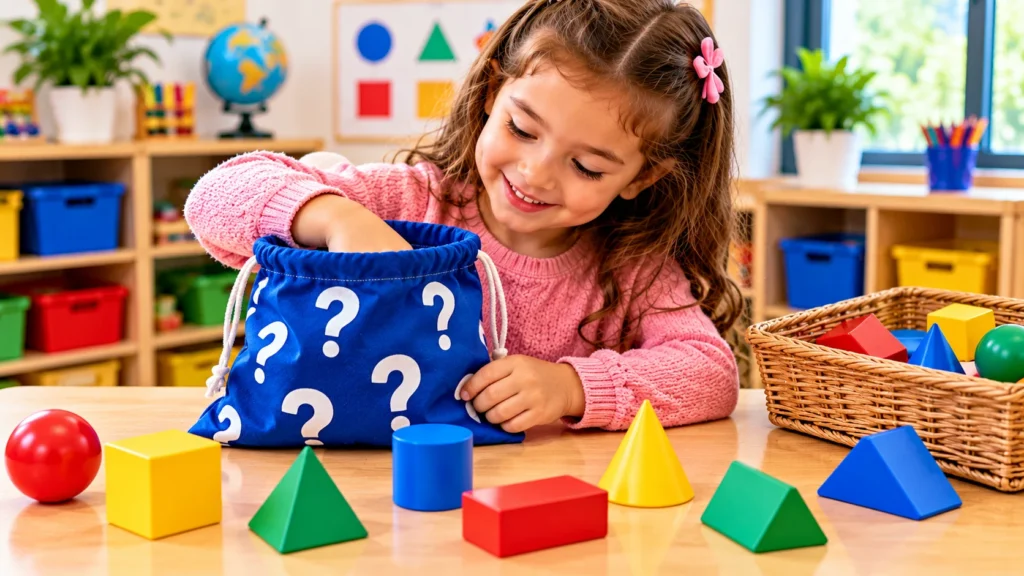
11. 3D Shape Mystery Bag
Learning goal: Identify solid shapes through touch and observation.
Materials: A fabric bag containing large, child-safe 3D shape models.
Place a cube, sphere, cylinder, and cone inside the bag.
Ask children to reach inside, feel one object, and describe it without looking.
They might say:
“It feels round.”
“It has flat faces.”
“It has a point.”
After making a prediction, they remove the object and identify its shape.
Decomposing Numbers: Easy Kindergarten Math Activities
Decomposing numbers means separating a number into smaller parts.
For example, the number six can be broken into:
- 1 and 5
- 2 and 4
- 3 and 3
- 4 and 2
- 5 and 1
- 6 and 0
Each pair represents the same total.
Understanding decomposing numbers helps children develop number sense and prepares them to solve addition and subtraction problems.
12. Break Apart Five
Learning goal: Discover different ways to separate five into two groups.
Materials: Five large counters and two small mats.
Give each child five counters.
Ask them to place some counters on the first mat and the remaining counters on the second.
A child might place two counters on one mat and three on the other.
Ask:
“How many counters are on the first mat?”
“How many are on the second mat?”
“How many counters do we have altogether?”
Record:
2 + 3 = 5
Repeat with other combinations.
Begin with quantities up to five before increasing the total to ten.
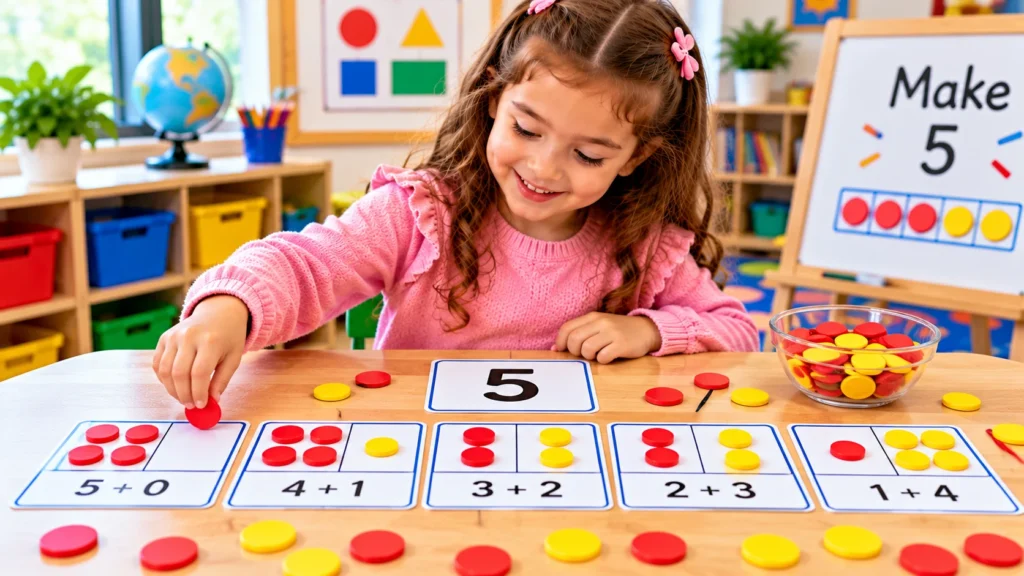
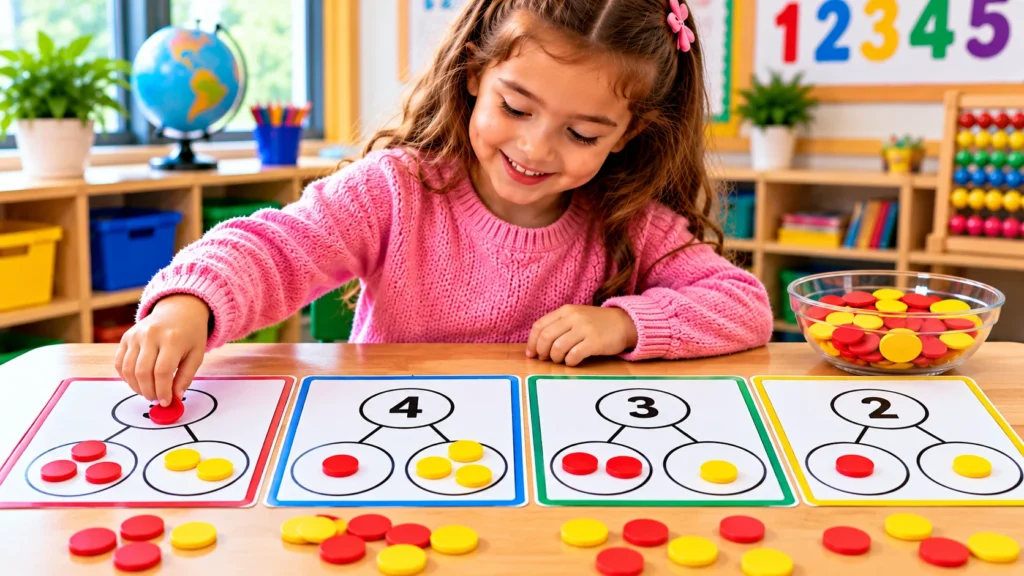
13. Part-Part-Whole Number Mats
Learning goal: Understand how two smaller quantities form a whole.
Materials: Part-part-whole mats and counters.
Draw one large circle labeled “Whole” and two smaller circles labeled “Part.”
Put eight counters in the whole circle.
Ask children to move the counters into the two smaller circles.
One possible answer is:
Whole: 8
Part 1: 5
Part 2: 3
Explain that five and three are parts of eight.
Invite children to discover other combinations.
14. Number Rainbow Partners
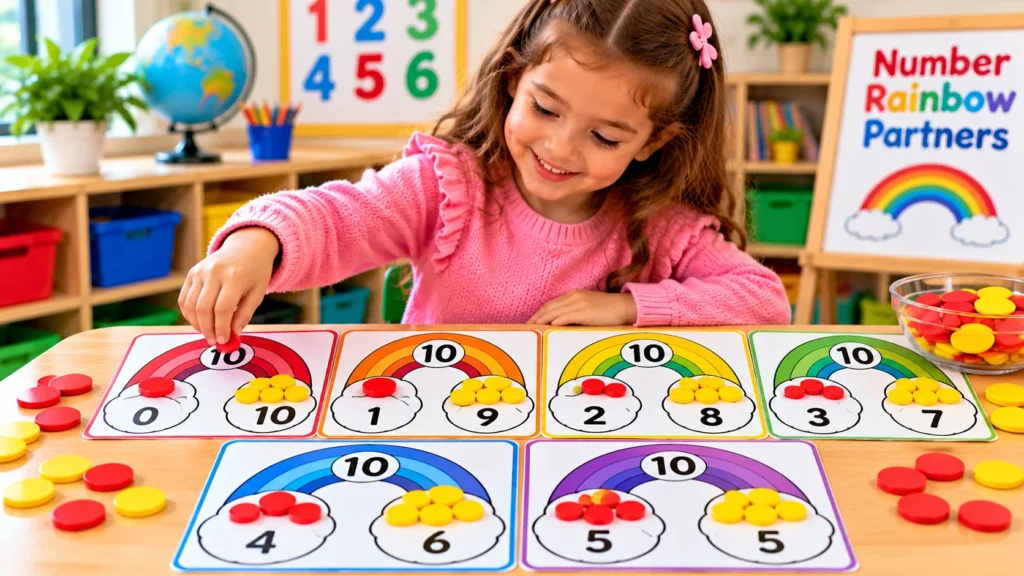
Learning goal: Identify number pairs that make a given total.
Draw the numbers zero through ten in a row.
Use colorful curved lines to connect pairs that total ten:
0 and 10, 1 and 9, 2 and 8, 3 and 7, 4 and 6, and 5 and 5.
Children can use counters to check each pair.
The rainbow creates a visual representation of number relationships.
For learners who are still developing counting confidence, begin with number partners for five.
Kindergarten Math Hidden Partners Activities
Hidden partners are a useful way to introduce missing-part problems.
The idea is simple: children know the total number of objects, but one part of that number is hidden.
For example:
8 = 5 + ?
If five objects are visible, children must determine how many more are needed to make eight.
This activity connects concrete counting with early subtraction and number relationships.
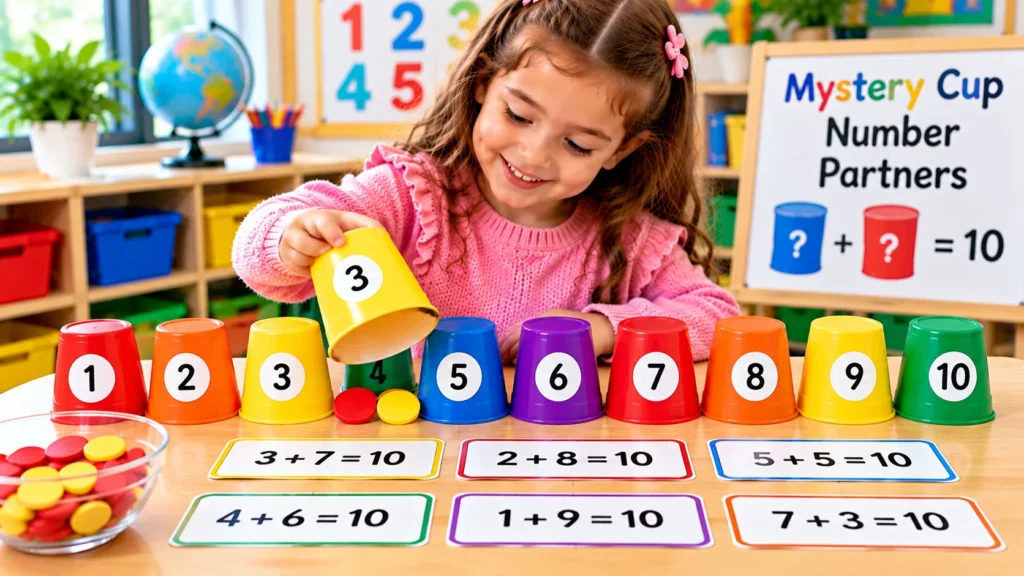
15. Mystery Cup Number Partners
Learning goal: Find a hidden part of a known total.
Materials: Eight counters and an opaque cup.
How to play:
- Place eight counters on the table.
- Count all eight counters with the children.
- Ask children to close their eyes.
- Hide three counters under the cup.
- Show the five remaining counters.
- Ask, “We started with eight. Five are showing. How many are hiding?”
Allow children to solve the problem using fingers, drawings, or another set of counters.
Reveal the hidden objects to check the answer.
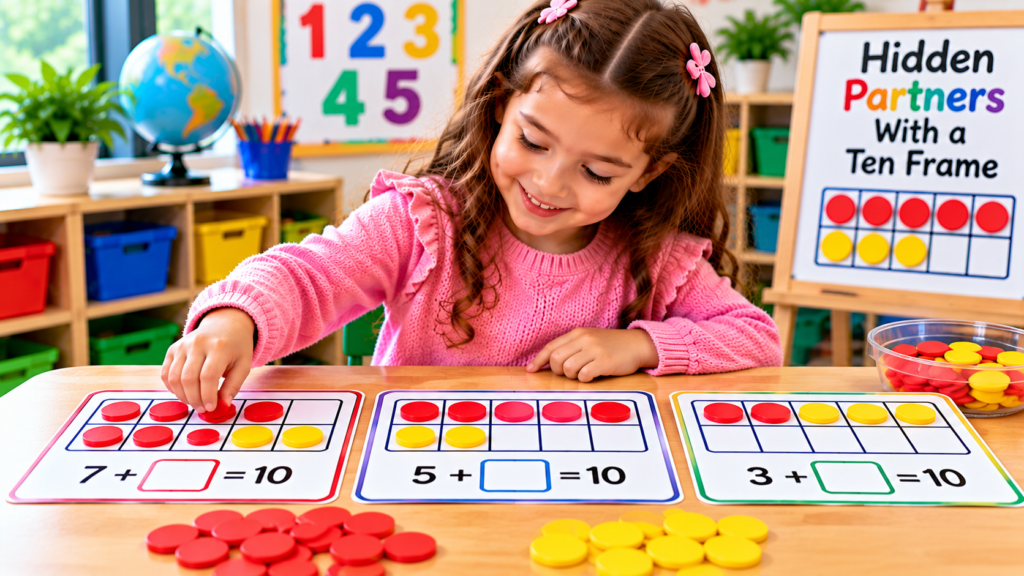
16. Hidden Partners With a Ten Frame
Learning goal: Connect missing-part problems to visual number models.
Show children a ten frame with nine counters.
Cover four counters with a card while leaving five visible.
Ask how many counters are covered.
Children can work out that:
5 + 4 = 9
Repeat with smaller numbers and gradually increase the difficulty.
Teaching tip: Always establish the total before hiding a group. Otherwise, children may not have enough information to identify the missing part.
Math and Music: Learning Numbers Through Rhythm
Music provides an enjoyable way to explore mathematical patterns, counting sequences, and movement.
The connection between music and mathematics is especially useful in kindergarten because children can hear and perform patterns before describing them with mathematical language.
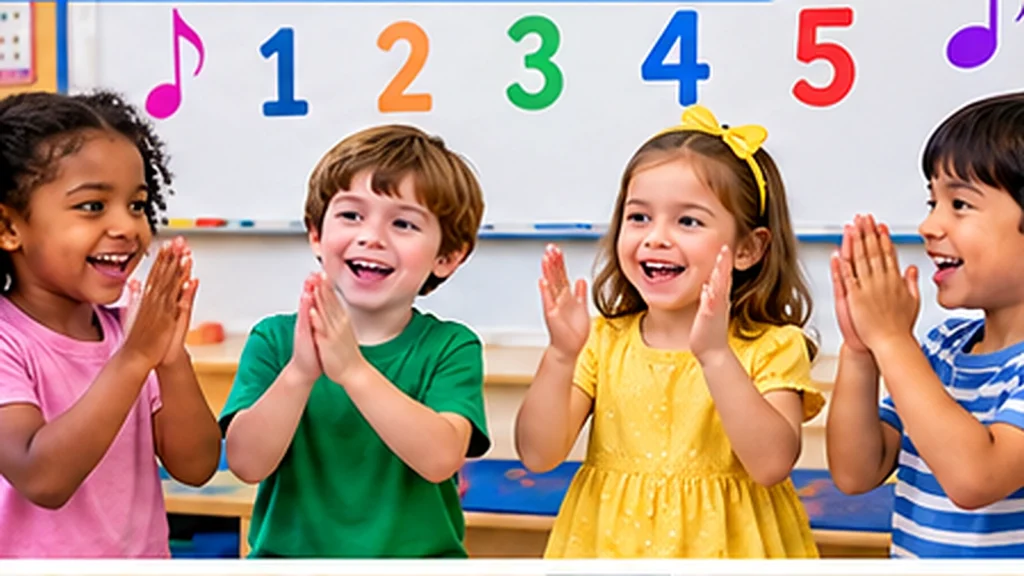
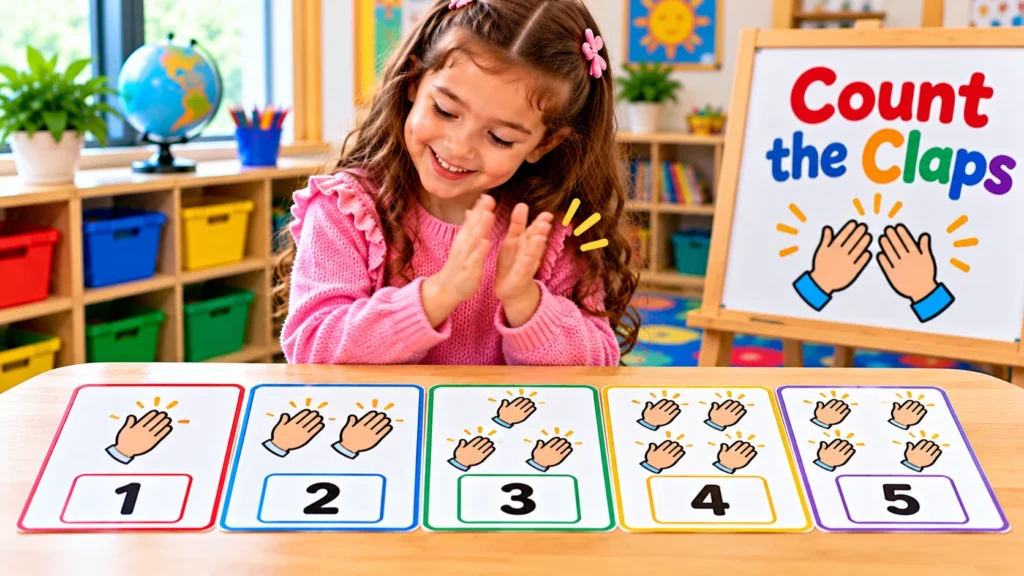
17. Count the Claps
Learning goal: Practice counting and recognizing quantities through sound.
How to play:
Clap a small number of times, such as four.
Ask children to listen carefully and identify how many claps they heard.
Repeat with different numbers.
Next, show a number card and ask children to clap that many times.
Encourage everyone to clap slowly enough to count accurately.
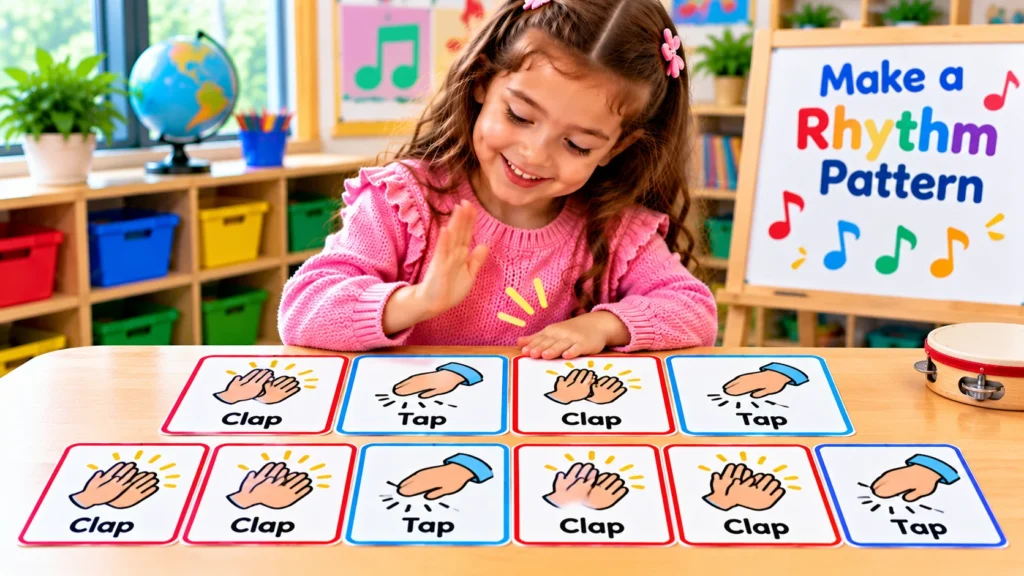
18. Make a Rhythm Pattern
Learning goal: Recognize, copy, and extend repeating patterns.
Begin with a simple pattern:
Clap – Tap – Clap – Tap
Ask children to repeat the pattern.
Then try:
Clap – Clap – Tap – Clap – Clap – Tap
Ask children what comes next.
Use the labels A and B for a simple alternating pattern or AAB for two claps followed by one tap.
Children can make their own patterns using claps, foot taps, or classroom percussion instruments.
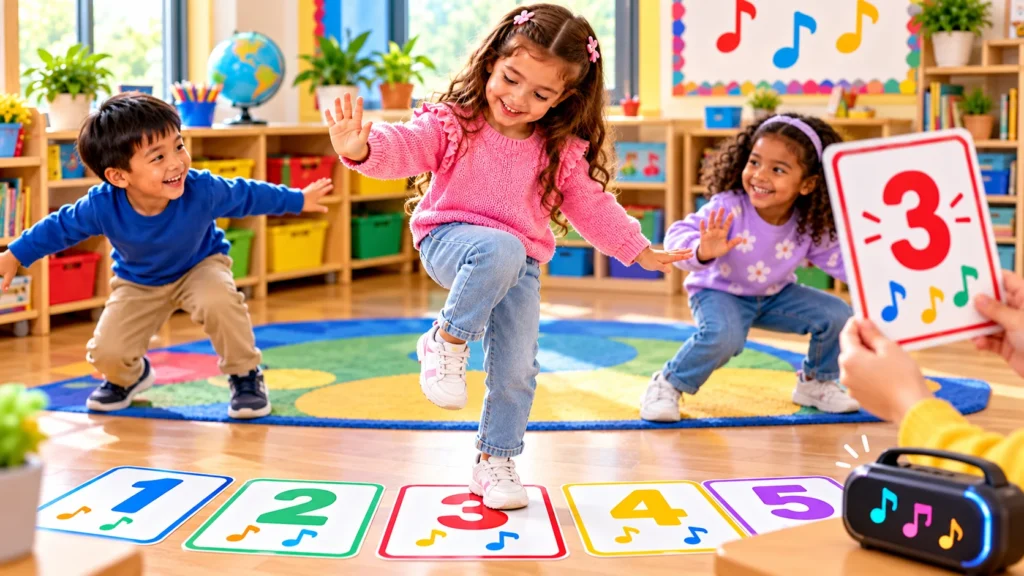
19. Musical Number Freeze
Learning goal: Connect movement, listening, and number recognition.
Play instrumental music while children move safely around an open space.
Pause the music and show a number card.
Children must perform the matching number of actions.
For example:
- Number 3: Three claps
- Number 5: Five toe taps
- Number 2: Two gentle jumps
Vary the actions to keep the activity engaging.
Basketball Games With Math for Kindergarten
Active math games allow children to practice counting and early addition while participating in movement-based activities.
Basketball-inspired games can be adapted for kindergarten using lightweight foam balls, low targets, and simple scoring rules.
Children should receive math practice opportunities whether or not they successfully throw a ball into a basket.
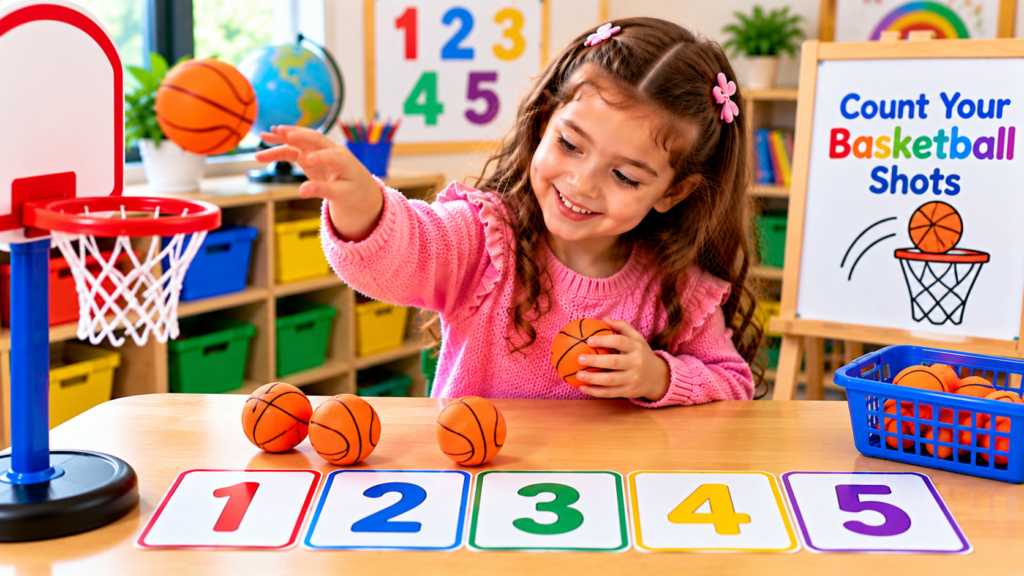
20. Count Your Basketball Shots
Learning goal: Count attempts, successful shots, and differences between quantities.
Materials: Low basketball hoop and soft foam balls.
Give each child five attempts to throw the ball toward the basket.
Ask them to count every attempt.
Next, count the successful shots.
For example:
Five attempts
Two successful shots
Three missed shots
Ask children to show that:
2 + 3 = 5
Use counters to represent the results if needed.
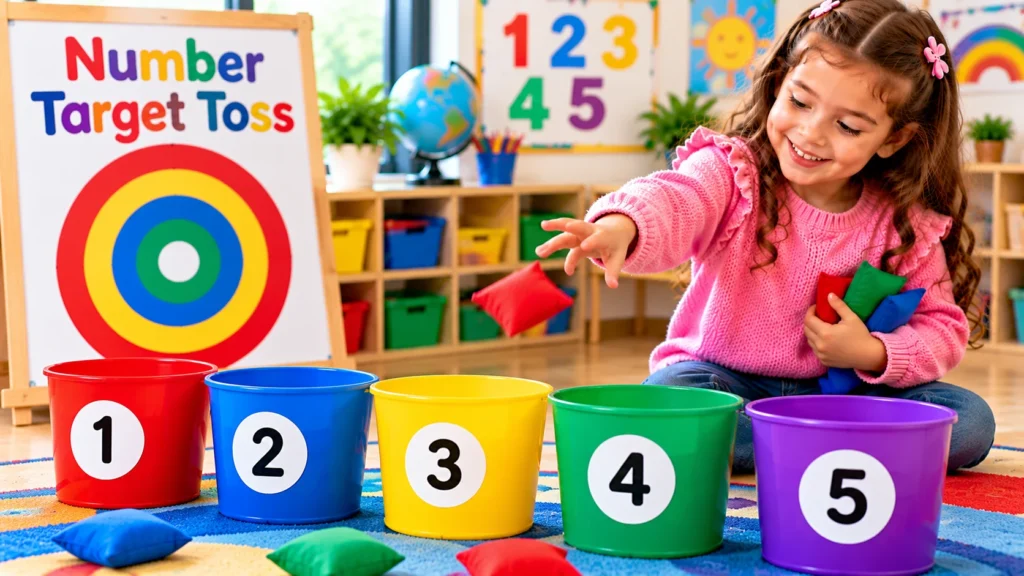
21. Number Target Toss
Learning goal: Recognize numbers and match them with quantities.
Materials: Large numbered floor targets and soft beanbags.
Arrange targets labeled one through ten.
Call out a number and ask children to toss a beanbag toward the matching target.
After each turn, ask the child to identify the numeral and count out the same number of counters.
This helps connect number recognition with physical play.
22. Basketball Number Partner Challenge
Learning goal: Find pairs that add up to ten.
Write numbers from zero to ten on large cards.
Choose a target number, such as ten.
A child picks a card displaying six.
Ask the group:
“What number goes with six to make ten?”
Children can use counters to solve the problem before tossing a soft ball into the basket.
The correct partner is four.
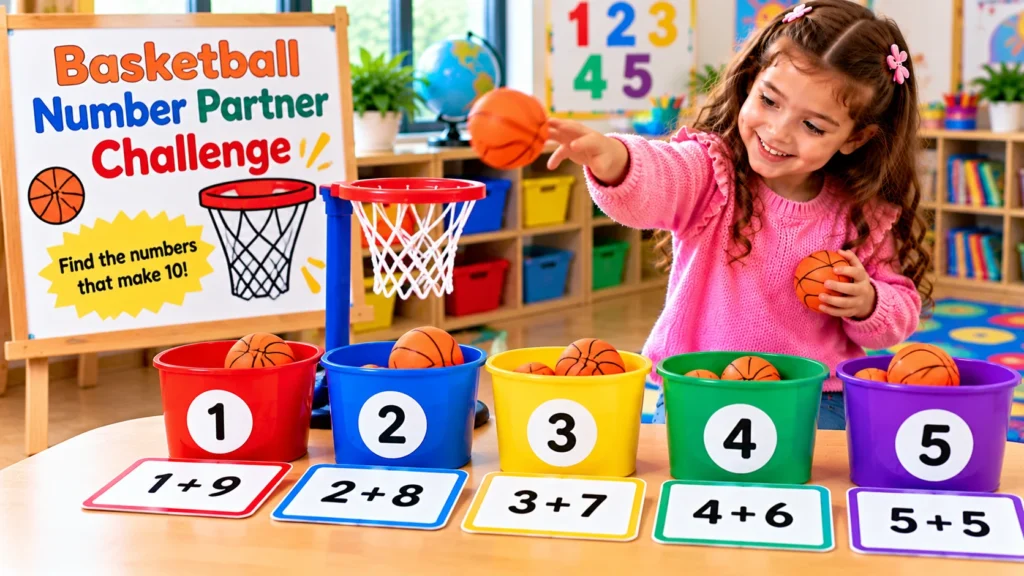
16:9 image showing a safe kindergarten indoor basketball counting activity with foam balls, a low hoop, and numbered targets.
Easy Kindergarten Math Activities at Home
Parents do not need expensive educational materials to support early math learning.
Everyday routines offer opportunities to practice counting, comparing, sorting, and recognizing shapes.
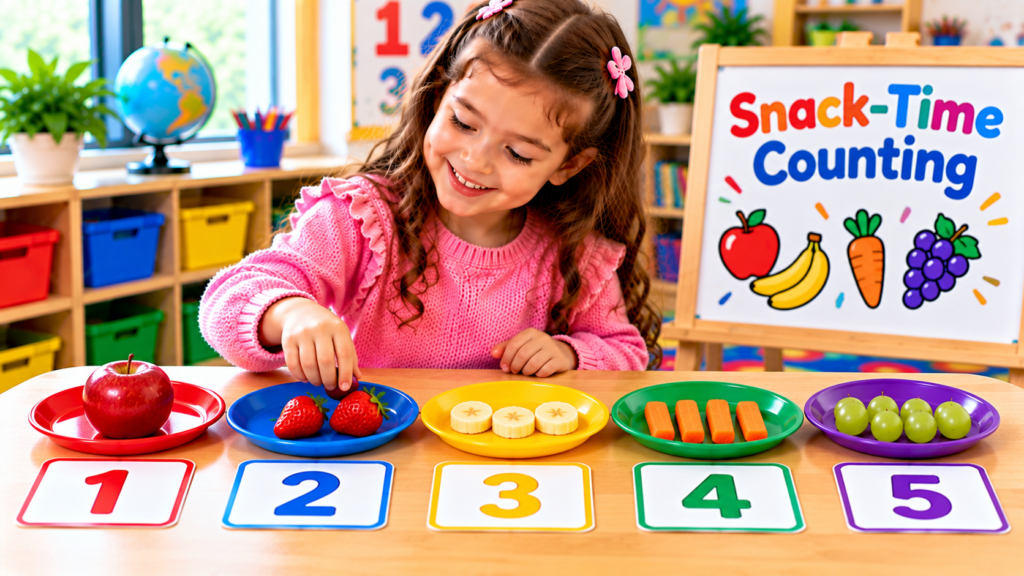
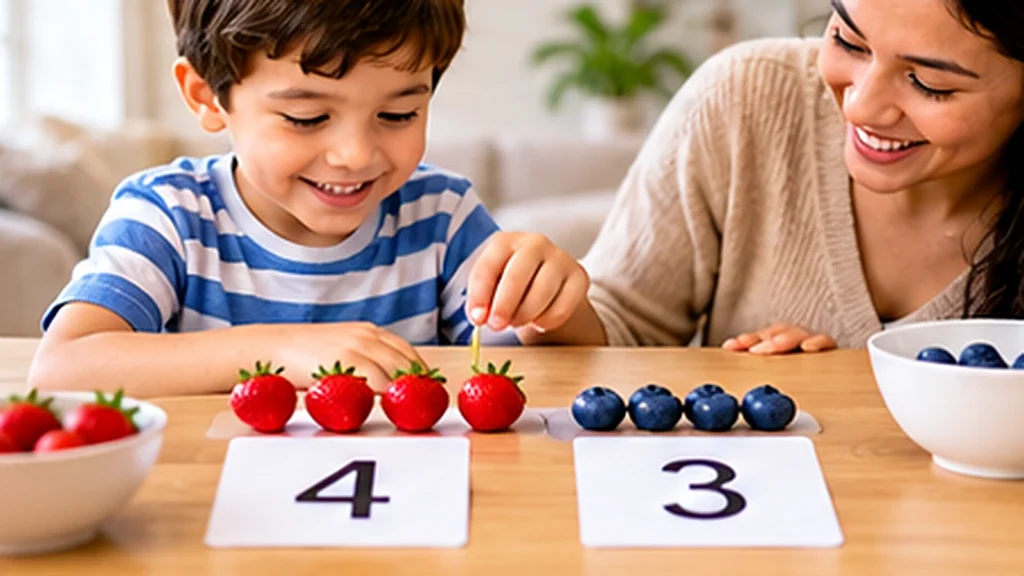
23. Snack-Time Counting
Give children a small group of age-appropriate snack pieces and ask them to count how many they have.
Then ask them to arrange the pieces into two groups.
For example:
Four crackers and three crackers make seven crackers.
This reinforces counting and simple number combinations.
Use foods appropriate for the child’s age and dietary needs, and supervise eating.
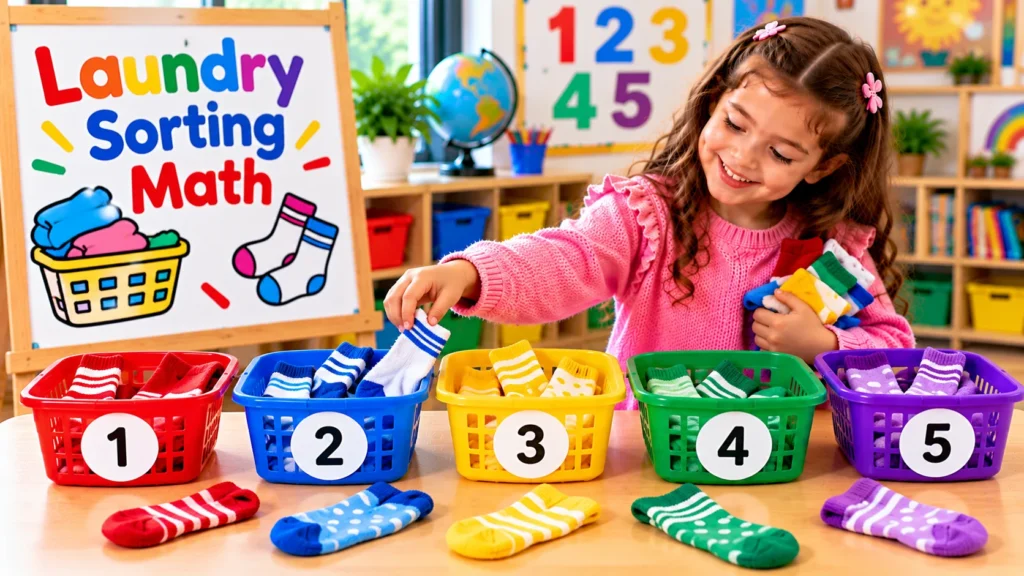
24. Laundry Sorting Math
Invite children to sort clean laundry items by color, size, or type.
Ask them to count the socks, compare groups, or make simple patterns.
For example:
Blue sock – White sock – Blue sock – White sock
Ask what comes next.
This activity connects math with ordinary household tasks.
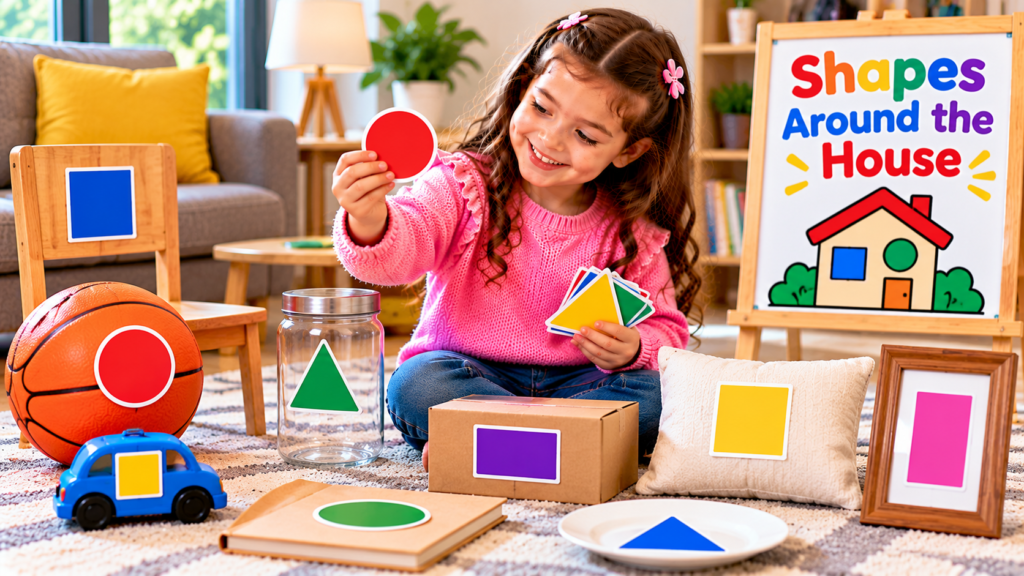
25. Shapes Around the House
Walk around the house and look for familiar shapes.
Ask questions such as:
“What shape is this clock face?”
“How many corners does this book cover have?”
“Can you find an object shaped like a cylinder?”
Use these observations to reinforce both shape vocabulary and spatial reasoning.
How to Adapt Math Activities for Different Learning Levels
Not every kindergartener learns mathematical concepts at the same pace.
Some children need repeated practice with small quantities, while others are ready to explore larger numbers and more complex relationships.
The same activity can often be adjusted without changing the basic materials.
| Learning level | Suggested approach | Example |
|---|---|---|
| Beginner | Use small quantities and physical objects | Count five blocks |
| Developing | Introduce visual models and number combinations | Fill a ten frame |
| Confident | Ask children to solve and explain problems in multiple ways | Find several pairs that make ten |
Children who struggle with verbal instructions may benefit from visual examples and short demonstrations.
For children ready for a challenge, ask open-ended questions such as:
“Can you find another answer?”
“How do you know?”
“Can you show that using a different method?”
The goal is to support understanding rather than simply increase the number of questions children complete.
A Simple Five-Day Kindergarten Math Activity Plan
Teachers and parents can use the following plan as a starting point for a week of playful math practice.
| Day | Main activity | Learning goal | Suggested time |
|---|---|---|---|
| Monday | Number Hunt and Block Matching | Counting and number recognition | 10–15 minutes |
| Tuesday | Fill the Ten Frame | Understanding quantities to ten | 10–15 minutes |
| Wednesday | Shape Detective and Sorting | Shape recognition and attributes | 10–15 minutes |
| Thursday | Hidden Partners and Number Mats | Number decomposition | 10–15 minutes |
| Friday | Rhythm Patterns and Basketball Math | Review through music and movement | 10–15 minutes |
These times are suggestions rather than fixed requirements. Activities may be shortened, repeated, or divided into smaller groups according to students’ attention, readiness, and classroom routines.
How to Check Kindergarten Math Progress
Simple observations can help teachers understand whether children are developing important mathematical skills.
Rather than relying only on worksheets, observe children while they participate in activities.
Look for the following abilities:
- Counting: Does the child count each object once and know that the final number represents the total?
- Number recognition: Can the child match numerals with groups of objects?
- Ten frames: Can the child represent a given number and identify empty spaces?
- Shapes: Can the child name shapes and describe their important attributes?
- Number decomposition: Can the child show two parts that make a whole number?
- Patterns: Can the child copy, continue, and explain a repeating sequence?
For instance, when a child fills a ten frame with eight counters, ask how many spaces remain and how they determined the answer.
A child who explains that five counters fill the top row and three fill the bottom is demonstrating an understanding of number structure.
Take brief notes over several activities rather than judging learning from one response.
Common Mistakes to Avoid When Teaching Kindergarten Math
Introducing Abstract Problems Too Early
Children may struggle when number sentences are presented without physical or visual examples.
Begin with counters, drawings, fingers, or blocks before moving toward symbolic equations.
Focusing Only on Memorization
Knowing number names is important, but children also need to understand quantities and number relationships.
Ask children to demonstrate numbers with objects instead of only reciting them.
Using Shapes in Only One Position
If children always see a triangle with its point at the top, they may struggle to recognize rotated triangles.
Present shapes in different orientations, colors, and sizes.
Making Games Too Competitive
Activities should encourage participation and mathematical thinking rather than rewarding only the fastest children.
Use cooperative challenges, individual progress goals, and multiple ways to demonstrate answers.
Skipping Reflection Questions
After an activity, ask children what they noticed or how they solved a problem.
A short conversation can reveal whether a child understands the concept or is simply following a demonstrated procedure.
Frequently Asked Questions About Kindergarten Math Activities
What are the best math activities for kindergarten?
Some useful activities include counting with blocks, number hunts, ten-frame games, shape sorting, number decomposition activities, simple pattern games, and movement-based counting. The best choice depends on the skill a child is learning and their current understanding.
How do you make kindergarten math fun?
Use hands-on materials, stories, music, movement, and familiar objects. Give children opportunities to explore, make predictions, and explain their thinking. Activities should be challenging enough to encourage learning without creating unnecessary frustration.
What are ten frames used for in kindergarten?
Ten frames help children visualize numbers up to ten, recognize smaller groups within a larger quantity, compare quantities, and identify combinations that make ten. They are especially helpful for developing number sense and understanding early addition and subtraction.
What shapes should kindergarteners learn?
Common kindergarten shapes include circles, triangles, squares, rectangles, and hexagons, along with three-dimensional shapes such as cubes, spheres, cones, and cylinders. Children should learn to identify shapes by their attributes rather than relying only on appearance.
How do you explain decomposing numbers to kindergarteners?
Start with a group of objects and separate it into two smaller groups. For example, five blocks can be divided into two blocks and three blocks. Explain that both parts still make the original total of five.
What are hidden partners in kindergarten math?
Hidden partners are activities in which children know the total quantity and one visible part but must determine the missing part. For example, if eight counters were on a table and three are hidden, children work out that five remain visible.
How can music help with kindergarten math?
Music offers opportunities to practice counting, repeating patterns, sequencing, and matching actions with quantities. Clapping games, rhythmic patterns, and counting movements can make these concepts more concrete.
Are worksheets necessary for teaching kindergarten math?
Worksheets can provide additional practice, but they should not replace hands-on exploration and discussion. Children can develop many early math skills through counters, blocks, drawings, puzzles, movement, and everyday activities.
How long should a kindergarten math activity last?
A short activity of around 5–15 minutes may be practical for a focused game, although appropriate duration varies by child, activity, and classroom setting. Complex activities can be divided into smaller sessions or revisited over several days.
Final Thoughts
Kindergarten math does not have to be complicated to be meaningful. Simple counting games, ten frames, shape hunts, number-part activities, and rhythmic movement can give children valuable opportunities to explore mathematical ideas.
The most effective kindergarten math activities encourage children to do more than find the correct answer. They invite children to notice patterns, compare quantities, describe shapes, and explain how they solved a problem.
Begin with familiar materials and small numbers, give children time to explore, and gradually introduce new challenges. With consistent opportunities for hands-on practice, mathematical learning can become an enjoyable part of everyday classroom and home experiences.