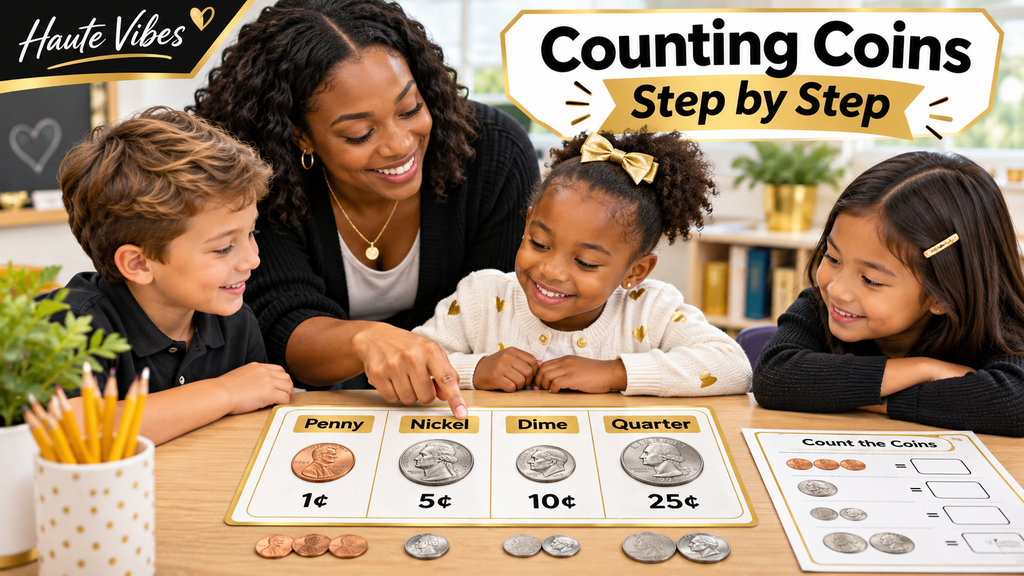
Counting coins is an important money skill for elementary students, but it can be confusing at first. A dime is smaller than a nickel, yet it is worth more. Children may also recognize individual coins but struggle when several different coins appear together.
The easiest way to learn counting coins is to understand each coin’s value, practice counting similar coins, and then combine pennies, nickels, dimes, and quarters.
For example, one quarter, one dime, one nickel, and three pennies have a total value of:
25¢ + 10¢ + 5¢ + 3¢ = 43¢
This guide explains how to count U.S. coins step by step, provides worked examples, and includes simple classroom activities and practice questions for kids.
What Are U.S. Coins and How Much Are They Worth?
Before teaching children how to count coins, help them recognize the four common U.S. coins used in elementary money math lessons.
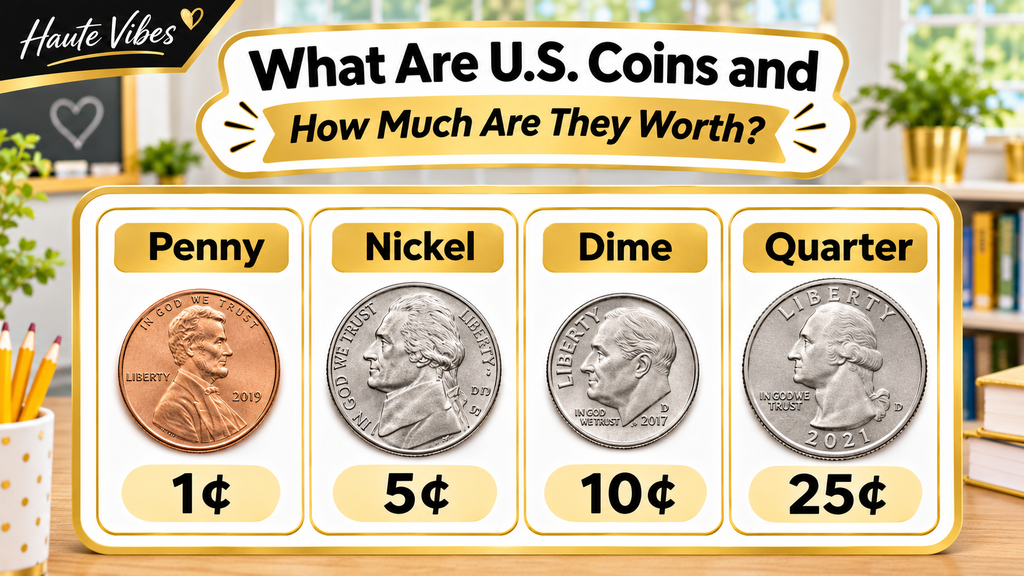
Each coin has a different value.
| Coin | Value | How to recognize it |
|---|---|---|
| Penny | 1 cent (1¢) | Usually copper-colored |
| Nickel | 5 cents (5¢) | Silver-colored and larger than a dime |
| Dime | 10 cents (10¢) | The smallest of these four coins |
| Quarter | 25 cents (25¢) | The largest of these four coins |
Remember these coin values:
- 1 penny = 1¢
- 1 nickel = 5¢
- 1 dime = 10¢
- 1 quarter = 25¢
The most important lesson is that a coin’s size does not determine its value.
A dime is physically smaller than a nickel, but one dime is worth the same as two nickels.
Understanding Equivalent Coin Values
Different combinations of coins can represent the same amount of money.
For example:
5 pennies = 1 nickel = 5¢
2 nickels = 1 dime = 10¢
2 dimes + 1 nickel = 1 quarter = 25¢
Students can practice these relationships using real coins, play coins, or picture cards.
How Many Cents Are in One Dollar?
One U.S. dollar equals 100 cents.
100¢ = $1
You can make one dollar using:
- 4 quarters
- 10 dimes
- 20 nickels
- 100 pennies
These combinations help children understand that different coins can have equal total values.
Coin designs may look different depending on the year. Teach students to recognize each coin’s denomination and value rather than depending only on one familiar portrait.
How to Count Coins Step by Step
Once students understand coin values, they can learn a repeatable method for counting mixed coins.
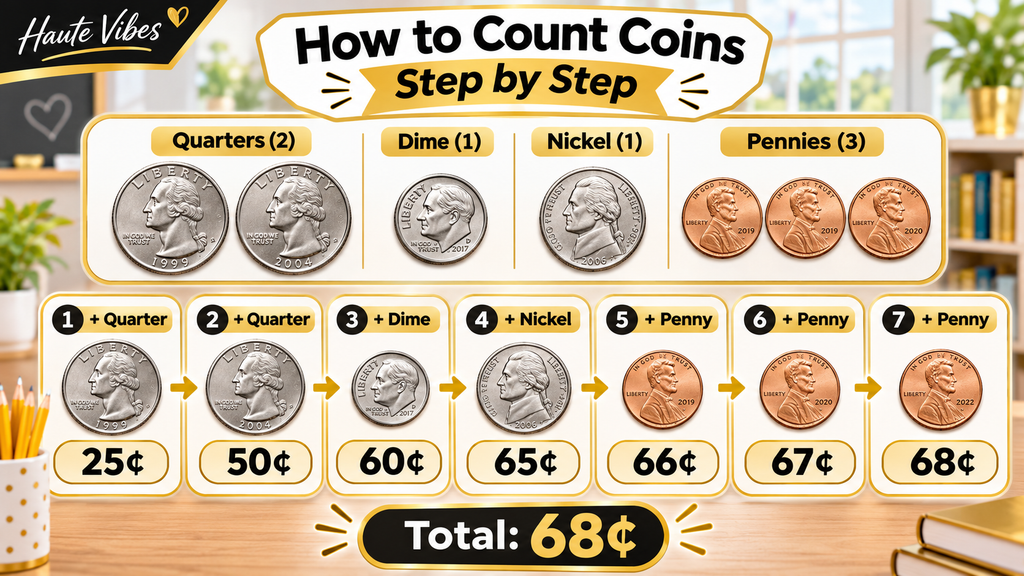
Starting with the highest-value coin often makes counting easier, although coins can be added in any order.
Step 1: Identify the Coins
Look at the group and name each coin.
For this example, imagine you have:
- 2 quarters
- 1 dime
- 1 nickel
- 3 pennies
Step 2: Sort the Coins by Value
Arrange the quarters together, followed by the dimes, nickels, and pennies.
Sorting helps students keep track of which coins they have already counted.
Step 3: Count the Quarters
Each quarter is worth 25 cents.
Count:
25, 50
The two quarters are worth 50¢.
Step 4: Add the Dime and Nickel
A dime adds 10 cents.
50 + 10 = 60
A nickel adds another 5 cents.
60 + 5 = 65
The running total is now 65¢.
Step 5: Add the Pennies
Each penny adds one cent.
Count:
66, 67, 68
Final answer: 68¢
You can check the total by adding the coin values:
25 + 25 + 10 + 5 + 1 + 1 + 1 = 68
This method teaches children to count by 25s, 10s, 5s, and 1s as they move through the coins.
Common Coin-Counting Mistakes
| Mistake | How to help |
|---|---|
| Counts the number of coins rather than their value | Ask students to say each coin’s value aloud |
| Thinks a larger coin must be worth more | Compare a nickel with a smaller dime |
| Starts counting again after changing coin types | Write the running total after each group |
| Counts a coin twice | Move each coin into a separate pile after counting |
| Confuses cents and dollars | Practice writing amounts with ¢ and $ symbols |
If students struggle to count by fives and tens, practice those number patterns separately before returning to mixed coins.
For additional number-strategy practice, see our math fact fluency guide.
Counting Coins Examples With Pennies, Nickels, Dimes, and Quarters
The best way to improve coin-counting skills is to practice with different combinations.
Start with simple groups, then introduce mixed coins and everyday money problems.
Example 1: Counting Nickels and Pennies
You have three nickels and two pennies.
Each nickel is worth 5 cents.
Count the nickels:
5, 10, 15
Add the pennies:
16, 17
Answer: 17¢
Equation:
5 + 5 + 5 + 1 + 1 = 17¢
Example 2: Counting Quarters, Dimes, and Pennies
You have one quarter, two dimes, and four pennies.
Start with the quarter:
25¢
Add the dimes:
25 + 10 + 10 = 45
Add the pennies:
45 + 4 = 49
Answer: 49¢
Count aloud: 25, 35, 45, 46, 47, 48, 49.
Example 3: Counting Coins Close to One Dollar
You have three quarters, two dimes, and four pennies.
Three quarters:
25 + 25 + 25 = 75
Two dimes:
75 + 10 + 10 = 95
Four pennies:
95 + 4 = 99
Answer: 99¢
Ask students how much more money they would need to make one dollar.
Since one dollar equals 100 cents, they need one more penny.
Example 4: Different Coins, Same Value
Can you make 25 cents without using a quarter?
Yes.
Two dimes and one nickel equal:
10 + 10 + 5 = 25
Therefore:
1 quarter = 2 dimes + 1 nickel
This example helps students understand that different groups of coins can have the same value.
Example 5: Classroom Store Word Problem
A pencil costs 65 cents.
You have two quarters, one dime, and one nickel.
Do you have enough money to buy the pencil?
Count the coins:
25 + 25 = 50
50 + 10 = 60
60 + 5 = 65
Answer: Yes. You have exactly 65¢.
Ask students whether they could make the same amount using different coins.
This encourages flexible thinking instead of relying on only one coin combination.
Fun Counting Coins Activities for Elementary Students
Learning how to count money becomes more meaningful when children can move, sort, and exchange coins.
These activities work in classrooms and can also be adapted for practice at home.
1. Coin Value Sorting
Best for: Beginning learners
Materials: Real coins, play coins, or printed coin pictures.
Place four labeled containers or spaces on a table: Penny, Nickel, Dime, and Quarter.
Students sort the coins, name each one, and say its value.
After sorting, ask questions such as:
“Which coin is worth ten cents?”
“Which is worth more, a nickel or a dime?”
This activity strengthens coin recognition before students begin mixed counting.
2. Count and Cover
Best for: Grades 1–2
Materials: Coins and a number chart.
Give each student a small group of coins.
Students count the coins and cover the matching total on the chart.
For example, a student with one dime, one nickel, and two pennies covers 17.
Encourage students to explain their counting sequence before moving to the next problem.
3. Classroom Store
Best for: Grade 2
Materials: Play coins and classroom objects with price labels.
Create a small store with pencils, bookmarks, erasers, or other familiar items.
Label each item with a price, such as 15¢, 30¢, or 45¢.
Students choose an item and collect the coins needed to pay for it.
For a 30-cent item, they might use:
- 1 quarter and 1 nickel
- 3 dimes
- 6 nickels
Ask students to find two ways to pay the same amount.
This connects counting coins with everyday shopping situations.
4. Same Value, Different Coins
Best for: Students who know basic coin values
Materials: Mixed play coins or coin picture cards.
Give students a target amount, such as 40 cents.
Challenge them to create two different combinations.
For example:
4 dimes = 40¢
1 quarter + 1 dime + 1 nickel = 40¢
Students explain how they know both combinations are equal.
5. Find the Coin-Counting Mistake
Best for: Partner practice
Show students this incorrect calculation:
A student has one quarter, one dime, and one nickel.
The student counts:
25, 35, 40, 45
Then says the total is 45 cents.
Ask:
“What mistake did the student make?”
The student added an extra 5 cents.
The correct sequence is:
25, 35, 40
Correct answer: 40¢
Discussing mistakes teaches students to check their running totals carefully.
Adapting Activities for Different Learners
For children who are just beginning, practice one denomination at a time. Introduce two coin types before moving to a full mixture.
Children who need additional support can use large play coins, a coin-value reference chart, or a number line.
Students who are ready for a challenge can count unsorted coins, compare two different collections, or find multiple combinations for the same amount.
When using real coins with young children, supervise the activity because small coins can be a choking hazard.
Counting Coins Practice Problems With Answers
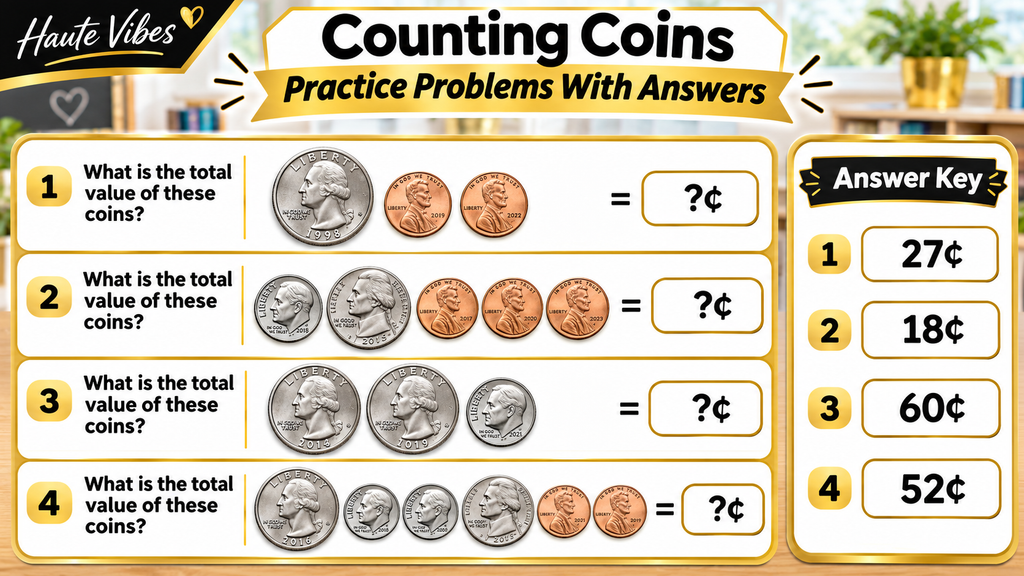
Use these 10 counting coins questions for a short math lesson, homework, or independent practice.
Encourage students to show their counting steps, especially when different coin types are mixed together.
| # | Practice question | Student answer |
|---|---|---|
| 1 | How much are 4 pennies worth? | _____ |
| 2 | How much are 2 nickels worth? | _____ |
| 3 | How much are 3 dimes worth? | _____ |
| 4 | What is 1 quarter and 2 pennies worth? | _____ |
| 5 | Count 1 dime, 1 nickel, and 3 pennies. | _____ |
| 6 | Count 2 quarters and 1 dime. | _____ |
| 7 | Count 1 quarter, 2 dimes, 1 nickel, and 2 pennies. | _____ |
| 8 | Count 3 quarters, 2 nickels, and 4 pennies. | _____ |
| 9 | Ava has 2 dimes and 1 nickel. Ben has 1 quarter. Who has more money? | _____ |
| 10 | A marker costs 65¢. Do 2 quarters, 1 dime, and 1 nickel provide enough money? | _____ |
Answer Key
| # | Answer | Explanation |
|---|---|---|
| 1 | 4¢ | 1 + 1 + 1 + 1 |
| 2 | 10¢ | 5 + 5 |
| 3 | 30¢ | 10 + 10 + 10 |
| 4 | 27¢ | 25 + 1 + 1 |
| 5 | 18¢ | 10 + 5 + 3 |
| 6 | 60¢ | 25 + 25 + 10 |
| 7 | 52¢ | 25 + 20 + 5 + 2 |
| 8 | 89¢ | 75 + 10 + 4 |
| 9 | Same amount | Both have 25¢ |
| 10 | Yes, exactly | 50 + 10 + 5 = 65¢ |
Extra Challenge: Make 50 Cents
Find three different ways to make 50 cents using U.S. coins.
Possible answers include:
- 2 quarters
- 5 dimes
- 1 quarter, 2 dimes, and 1 nickel
All three combinations equal 50 cents.
For teachers and parents, the goal is not just to help children reach the correct total. Ask them to explain which coins they counted first, how they kept track of the running total, and how they checked their work.
Counting coins becomes easier when children recognize each denomination, understand its value, and practice combining different coins.
Start with pennies, nickels, dimes, and quarters individually. Then introduce mixed coins, real-world problems, and simple money games.
With regular practice and clear explanations, students can become more confident counting U.S. money independently.

Written by johan
Jonas is an Educational Content Writer and STEM Learning Contributor at Haute Vibes (hautevibes.com), focusing on elementary education, early mathematics, science exploration, and hands-on learning activities. His writing breaks down educational concepts into simple, engaging lessons that help children develop curiosity, logical thinking, and problem-solving skills. Jonas emphasizes age-appropriate teaching methods, practical classroom resources, and interactive learning experiences that support both teachers and parents. Through his articles, he aims to make STEM education accessible, enjoyable, and meaningful while encouraging young learners to explore, experiment, and build confidence in their abilities.
View all articles →