

Addition in the binary system follows the same basic idea as ordinary addition, but there is one important difference: binary numbers use only two digits, 0 and 1.
In decimal addition, we carry when a column reaches 10. In binary addition, we carry when a column reaches 2.
For example:
1₂ + 1₂ = 10₂
The answer looks like ten, but 10₂ means two in the decimal system.
Once you understand this rule, adding longer binary numbers becomes much easier.
This guide explains binary addition rules, how carrying works, step-by-step examples, and practice questions with answers. It is designed for beginners learning computer science, number systems, or digital arithmetic.
What Is Addition in the Binary System?
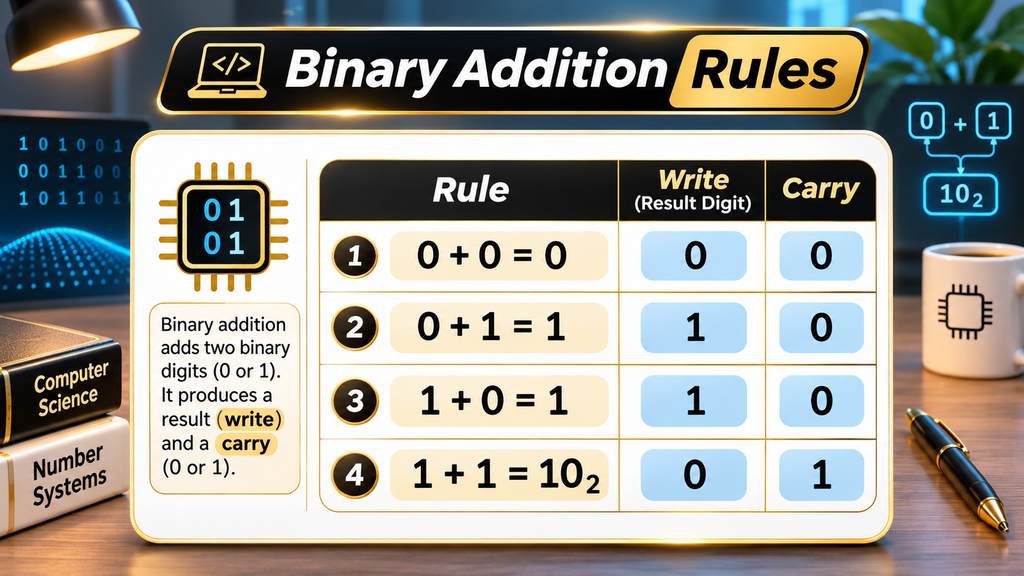
Binary addition is the process of adding numbers written in base 2 using the digits 0 and 1.
The binary number system is also called the base-2 number system. Computers use binary representations because digital electronic systems can work with two distinct states, commonly represented as 0 and 1.
Unlike the decimal system, which uses ten digits from 0 to 9, binary uses only:
- 0: Zero
- 1: One
Every position in a binary number represents a power of 2.
Understanding Binary Place Values
Reading a binary number from right to left, the place values are:
1, 2, 4, 8, 16, 32, 64, and so on.
Each place is worth twice as much as the place immediately to its right.
Consider the binary number 1011₂.
| Binary digit | 1 | 0 | 1 | 1 |
|---|---|---|---|---|
| Place value | 8 | 4 | 2 | 1 |
| Value contributed | 8 | 0 | 2 | 1 |
Add the values:
8 + 0 + 2 + 1 = 11
Therefore:
1011₂ = 11₁₀
The subscript 2 means that the number is written in binary. The subscript 10 means decimal.
A few other examples are:
| Binary number | Decimal value |
|---|---|
| 1₂ | 1 |
| 10₂ | 2 |
| 11₂ | 3 |
| 100₂ | 4 |
| 101₂ | 5 |
| 1000₂ | 8 |
Understanding these place values makes it easier to check your answers after adding binary numbers.
Why Does Binary Addition Use Carrying?
In ordinary decimal addition, you regroup when the total in a column reaches 10.
For example:
8 + 7 = 15
You write 5 and carry 1 ten into the next column.
Binary works similarly, except that each column can contain only 0 or 1.
When a binary column totals two, you write 0 in the current column and carry 1 to the next column on the left.
That is because:
1 + 1 = 10₂
The two ones have been regrouped into one group of two.
If the idea of exchanging place-value units is unfamiliar, our adding with regrouping guide explains the same underlying concept using familiar decimal numbers.
Binary Addition Rules and Table
There are four basic rules for adding two binary digits.
These rules form the foundation of binary arithmetic.
The Four Basic Binary Addition Rules
| Binary operation | Result in binary | Write in current column | Carry left |
|---|---|---|---|
| 0 + 0 | 0 | 0 | 0 |
| 0 + 1 | 1 | 1 | 0 |
| 1 + 0 | 1 | 1 | 0 |
| 1 + 1 | 10 | 0 | 1 |
The first three rules are straightforward.
The fourth rule is the one beginners need to remember:
1 + 1 = 10₂
You do not write a decimal 2 in a binary column.
Instead:
- Write 0 in the current column.
- Carry 1 into the next column on the left.
This is how binary addition stays within the digits 0 and 1.
What Happens When You Add 1 + 1 + 1?
Sometimes a column already has a carried 1 from the previous calculation.
In that case, you may need to add three binary digits.
For example:
1 + 1 + 1 = 11₂
The decimal total is 3, and the binary representation of 3 is 11.
So you:
- Write 1 in the current column.
- Carry 1 into the next column.
Remember: When the current column totals 2, write 0 and carry 1. When it totals 3, write 1 and carry 1.
Binary Addition With an Incoming Carry
This reference table includes every combination of two input bits and an incoming carry.
| First bit | Second bit | Incoming carry | Write | Carry left |
|---|---|---|---|---|
| 0 | 0 | 0 | 0 | 0 |
| 0 | 1 | 0 | 1 | 0 |
| 1 | 0 | 0 | 1 | 0 |
| 1 | 1 | 0 | 0 | 1 |
| 0 | 0 | 1 | 1 | 0 |
| 0 | 1 | 1 | 0 | 1 |
| 1 | 0 | 1 | 0 | 1 |
| 1 | 1 | 1 | 1 | 1 |
You do not have to memorize every row immediately.
Start with the four basic rules, then practice including the incoming carry in each column.
How to Add Binary Numbers Step by Step
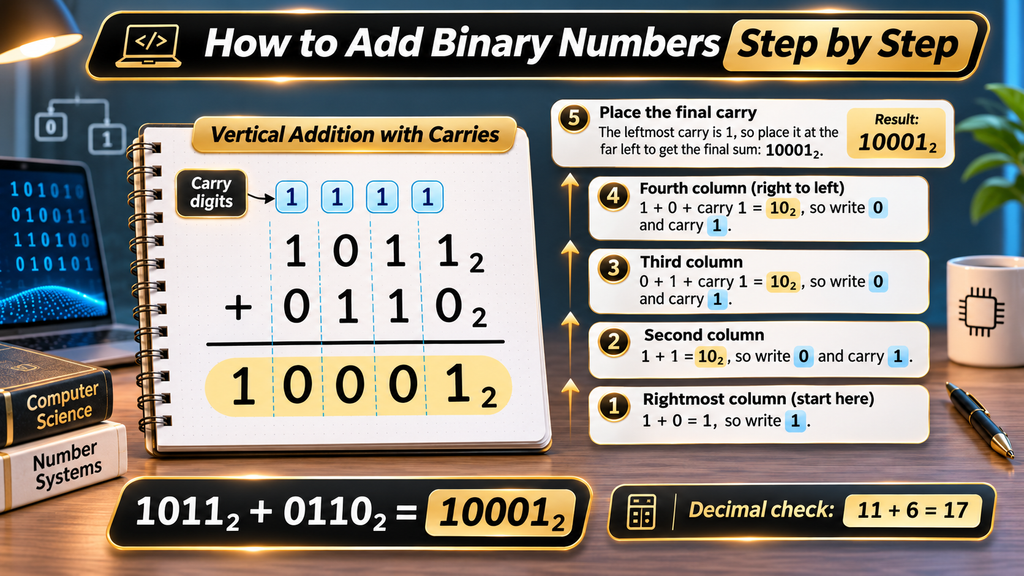
Let’s solve the following binary addition problem:
1011₂ + 0110₂
The correct answer is:
10001₂
We will work through each column to understand why.
Step 1: Line Up the Binary Digits
Write one binary number beneath the other.
Align the digits from the right, just as you would when adding decimal numbers.
For this example, the two numbers have four positions:
| Place value | 8 | 4 | 2 | 1 |
|---|---|---|---|---|
| First number | 1 | 0 | 1 | 1 |
| Second number | 0 | 1 | 1 | 0 |
The leading zero in 0110₂ does not change its value. It simply helps align the columns.
Always begin adding from the rightmost digit.
Step 2: Add the Rightmost Column
The first column contains:
1 + 0 = 1
Write 1 in the answer.
No carry is needed.
Step 3: Add the Next Column
Move one position to the left.
The next column contains:
1 + 1 = 10₂
This means:
- Write 0 in the current answer position.
- Carry 1 to the next column on the left.
Step 4: Include the Carried Digit
The next column contains:
0 + 1 + 1 carried = 10₂
Again:
- Write 0.
- Carry 1 to the next column.
Step 5: Add the Final Original Column
The leftmost original column contains:
1 + 0 + 1 carried = 10₂
Write 0 and carry 1 into a new position on the left.
There are no remaining original digits, so write that final carried 1 at the beginning of the answer.
Step 6: Read the Final Answer
The completed result is:
1011₂ + 0110₂ = 10001₂
Here is the full column-by-column breakdown.
| Column | First bit | Second bit | Incoming carry | Write | Carry left |
|---|---|---|---|---|---|
| Ones (1) | 1 | 0 | 0 | 1 | 0 |
| Twos (2) | 1 | 1 | 0 | 0 | 1 |
| Fours (4) | 0 | 1 | 1 | 0 | 1 |
| Eights (8) | 1 | 0 | 1 | 0 | 1 |
| Sixteens (16) | 0 | 0 | 1 | 1 | 0 |
Read the Write column from the bottom upward to obtain the binary result:
10001₂
Step 7: Check the Answer in Decimal
Converting both binary numbers to decimal is an easy way to verify the calculation.
First number:
1011₂ = 8 + 2 + 1 = 11
Second number:
0110₂ = 4 + 2 = 6
Add them:
11 + 6 = 17
Now convert the binary answer:
10001₂ = 16 + 1 = 17
Both calculations produce 17.
The answer is correct: 10001₂.
Binary Addition Examples With and Without Carry
Different examples help beginners recognize when carrying is needed and how it affects the final result.
Example 1: Binary Addition Without Carry
Solve: 1001₂ + 0010₂
Start from the right:
- 1 + 0 = 1
- 0 + 1 = 1
- 0 + 0 = 0
- 1 + 0 = 1
No column reaches two, so no carrying is needed.
Answer: 1011₂
Check in decimal:
1001₂ = 9
0010₂ = 2
9 + 2 = 11
1011₂ = 11
The calculation is correct.
Example 2: Binary Addition With One Carry
Solve: 1010₂ + 0010₂
Start with the rightmost column:
0 + 0 = 0
In the next column:
1 + 1 = 10₂
Write 0 and carry 1 to the next column.
Now add:
0 + 0 + 1 carried = 1
In the final column:
1 + 0 = 1
Answer: 1100₂
Decimal check:
10 + 2 = 12
1100₂ = 8 + 4 = 12
Example 3: Binary Addition With Repeated Carrying
Solve: 1111₂ + 0001₂
This example demonstrates a carry passing through several consecutive columns.
Starting from the right:
1 + 1 = 10₂
Write 0 and carry 1.
Next:
1 + 0 + 1 carried = 10₂
Write 0 and carry 1 again.
The next two columns repeat the same process.
The final carry creates a new digit on the left.
Answer: 10000₂
Check:
1111₂ = 15
0001₂ = 1
15 + 1 = 16
10000₂ = 16
Example 4: Binary Addition With 1 + 1 + 1
Solve: 1101₂ + 0111₂
The rightmost column contains:
1 + 1 = 10₂
Write 0 and carry 1.
The next column contains:
0 + 1 + 1 carried = 10₂
Write 0 and carry 1.
The third column contains:
1 + 1 + 1 carried = 11₂
This time, write 1 and carry 1.
The fourth original column contains:
1 + 0 + 1 carried = 10₂
Write 0 and carry 1 into a new position on the left.
Answer: 10100₂
Check:
1101₂ = 13
0111₂ = 7
13 + 7 = 20
10100₂ = 16 + 4 = 20
This example is especially useful for understanding why 1 + 1 + 1 produces a written 1 and a carried 1.
Example 5: Adding Longer Binary Numbers
Solve: 10110₂ + 01011₂
Follow the same right-to-left process, adding each pair of digits and including any carry.
The calculation produces:
10110₂ + 01011₂ = 100001₂
Check in decimal:
10110₂ = 16 + 4 + 2 = 22
01011₂ = 8 + 2 + 1 = 11
22 + 11 = 33
100001₂ = 32 + 1 = 33
Therefore, the binary answer is correct.
What Happens If the Answer Has More Bits?
Sometimes addition produces a result containing more binary digits than either original number.
For example:
1111₂ + 1₂ = 10000₂
Both inputs can fit within four bits, but the complete result needs five bits.
In ordinary written arithmetic, simply include the additional digit.
In a computer system with a fixed number of bits, the result may not fit within the available width. For example, an unsigned four-bit result cannot represent decimal 16.
This situation can cause an overflow or carry-out condition, depending on the system and arithmetic representation.
For beginner practice, the important rule is simple: do not forget the final carry on the left.
Binary Addition Practice Problems With Answers
Practice is the best way to become comfortable adding binary numbers.
Start with single-bit calculations, then move to longer problems involving multiple carries.
Practice Questions
All numbers in this exercise are binary (base 2).
| # | Binary addition problem | Your answer |
|---|---|---|
| 1 | 0 + 0 | ______ |
| 2 | 1 + 1 | ______ |
| 3 | 101 + 010 | ______ |
| 4 | 101 + 011 | ______ |
| 5 | 1001 + 0010 | ______ |
| 6 | 110 + 101 | ______ |
| 7 | 111 + 001 | ______ |
| 8 | 1010 + 0101 | ______ |
| 9 | 1101 + 0111 | ______ |
| 10 | 1111 + 0001 | ______ |
| 11 | 10110 + 01011 | ______ |
| 12 | 101101 + 011011 | ______ |
Try the problems independently before checking the answer key.
Binary Addition Answer Key
| # | Correct binary answer | Decimal check |
|---|---|---|
| 1 | 0 | 0 + 0 = 0 |
| 2 | 10 | 1 + 1 = 2 |
| 3 | 111 | 5 + 2 = 7 |
| 4 | 1000 | 5 + 3 = 8 |
| 5 | 1011 | 9 + 2 = 11 |
| 6 | 1011 | 6 + 5 = 11 |
| 7 | 1000 | 7 + 1 = 8 |
| 8 | 1111 | 10 + 5 = 15 |
| 9 | 10100 | 13 + 7 = 20 |
| 10 | 10000 | 15 + 1 = 16 |
| 11 | 100001 | 22 + 11 = 33 |
| 12 | 1001000 | 45 + 27 = 72 |
Common Binary Addition Mistakes
| Mistake | Why it happens | How to correct it |
|---|---|---|
| Writing 2 after adding 1 + 1 | Mixing decimal and binary notation | Write 0 and carry 1 |
| Forgetting an incoming carry | Moving to the next column too quickly | Mark each carry before continuing |
| Writing 10 as the result of a single column | Confusing a complete binary number with a column digit | Write only the rightmost result bit and carry the other bit |
| Misaligning digits | Adding digits from different place values | Align the numbers from the right |
| Forgetting the final carry | Stopping after the leftmost original column | Write the final carried 1 in a new position |
| Confusing binary 10 with decimal 10 | Ignoring the number system | Use subscripts and check place values |
Challenge: Find the Mistake
A student is asked to add:
111₂ + 001₂
The student writes:
110₂
The student correctly adds the rightmost digits but forgets to include the carries in the next two columns.
The correct process is:
1 + 1 = 10₂: write 0, carry 1.
1 + 0 + 1 carried = 10₂: write 0, carry 1.
1 + 0 + 1 carried = 10₂: write 0, carry 1.
Write the final carry to the left.
Correct answer: 1000₂
Decimal check:
7 + 1 = 8
1000₂ = 8
Quick Understanding Check
Before finishing, answer these three questions without using a calculator:
1. Why does 1 + 1 equal 10 in binary?
Because binary uses base 2. Two ones are represented as one group of two and zero ones.
2. What should you write when a column totals three?
Write 1 in the current column and carry 1 to the next column.
3. How can you verify a binary addition answer?
Convert the two input numbers and their result to decimal, then check whether the decimal addition agrees.
If you can explain all three answers, you understand the central ideas behind binary addition.
Final Takeaway
Addition in the binary system uses the same place-value principles as decimal addition, but its carry threshold is two instead of ten.
Remember these essential rules:
- 0 + 0 = 0
- 0 + 1 = 1
- 1 + 0 = 1
- 1 + 1 = 10₂
- 1 + 1 + 1 = 11₂
Line up the numbers, begin on the right, include every incoming carry, and write any final carry in a new position on the left.
With these rules and regular practice, you can confidently add binary numbers and check your answers.

Written by johan
Jonas is an Educational Content Writer and STEM Learning Contributor at Haute Vibes (hautevibes.com), focusing on elementary education, early mathematics, science exploration, and hands-on learning activities. His writing breaks down educational concepts into simple, engaging lessons that help children develop curiosity, logical thinking, and problem-solving skills. Jonas emphasizes age-appropriate teaching methods, practical classroom resources, and interactive learning experiences that support both teachers and parents. Through his articles, he aims to make STEM education accessible, enjoyable, and meaningful while encouraging young learners to explore, experiment, and build confidence in their abilities.
View all articles →