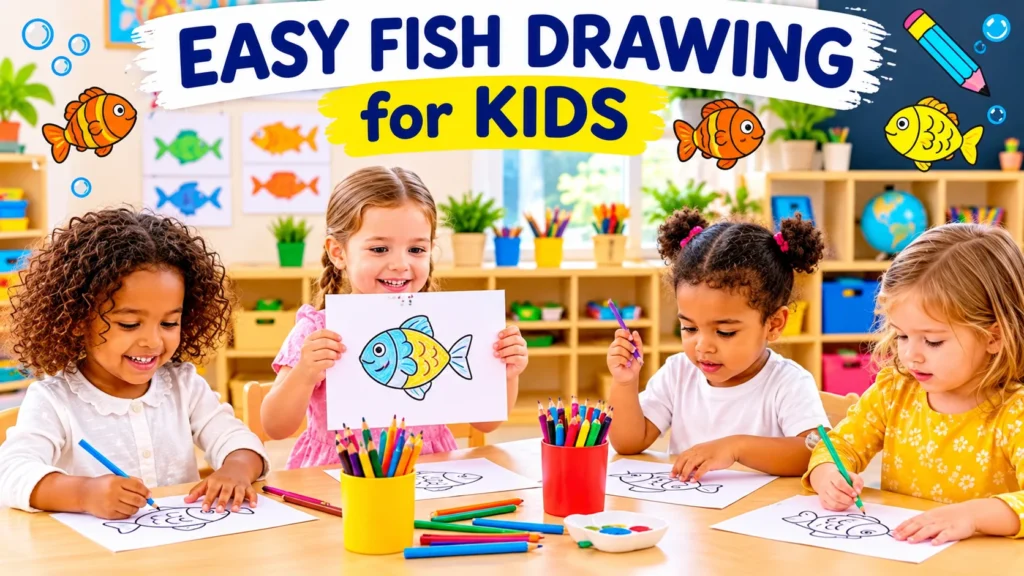
Fish are one of the best first subjects for young artists. They are made of simple shapes, they come in endless colors, and kids already know what they look like. This guide gives you a repeatable method, an age-by-age skill ladder, and a checklist you can print for your classroom or kitchen table.
Quick answer: To draw a fish, start with an oval or almond shape for the body. Add a triangle for the tail, a small circle for the eye, and one or two fins. Finish with a curved mouth, gill line, and scales or stripes.
The 3-Shape Fish Method
Most fish drawing tutorials list ten or more steps. Young children lose focus long before the last one. This framework reduces a fish to three shapes, so kids can finish a drawing they are proud of in under ten minutes.
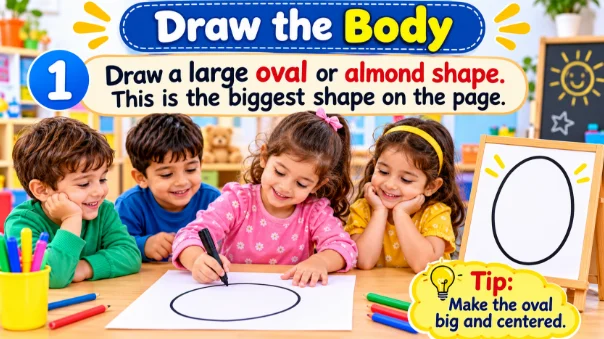
Step 1: Draw the Body
Draw a large oval or almond shape. This is the biggest shape on the page.
Step 2: Add the Tail
Attach a triangle to one end. The point of the triangle touches the body.
Step 3: Add the Fins
Add one small triangle on top and one smaller one underneath.
Add the Details
Once the three shapes are down, kids add details in any order they like:
- A small circle for the eye, placed near the front of the body
- A curved line behind the eye for the gill
- A short curve for the mouth
- Scales, stripes, or dots for patterns
Encourage children to draw lightly in pencil first, then trace over the final lines with a marker or crayon. Lightly drawn shapes are easy to adjust, which takes away the fear of making mistakes.
Skill Ladder by Age
Children develop drawing control at different speeds, so treat these ranges as a rough guide and not a rule. The ladder below shows what to expect and how to support each stage.
| Age range | What they can usually do | How to help |
| 3 to 4 | Scribble-based shapes, a rough oval with a tail | Offer a fish template to trace and chunky crayons |
| 5 to 6 | Draw the body, tail, and eye on their own | Teach the 3-Shape Method and add simple stripes |
| 7 to 8 | Add fins, gills, and patterns with some planning | Introduce different fish species and shading |
| 9 and up | Draw from reference photos and add backgrounds | Try overlapping shapes, water, and seaweed |
If you teach preschool or kindergarten, pair fish drawing with other hands-on projects like easy STEM activities for preschoolers to build a full ocean theme week.
Five Fish to Draw, Ranked by Difficulty
Giving children a choice keeps them engaged. Here is a comparison of five popular fish and what makes each one easy or tricky.
| Fish | Key shape | Difficulty | Fun detail to add |
| Goldfish | Round oval body, fan-shaped tail | Easy | Orange scales and bubbles |
| Clownfish | Oval with three white bands | Easy | Black outlines on the stripes |
| Pufferfish | Circle body with tiny spikes | Medium | Spikes drawn as short lines |
| Angelfish | Tall triangle body, long fins | Medium | Thin vertical stripes |
| Shark | Long body, tall triangle fin | Medium to hard | Rows of teeth and wavy water |
Where to Start
Start with the goldfish or clownfish. Both use the basic three-shape structure with almost no changes, so children feel successful straight away.
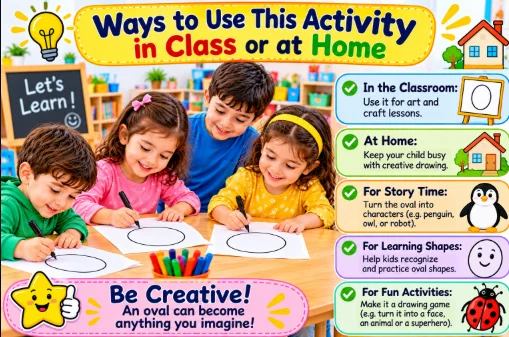
Ways to Use This Activity in Class or at Home
A single drawing can become a whole learning session. A few ideas that work well:
Counting and Math
Ask kids to draw a set number of fish, such as five fish with three stripes each, and count the total stripes together.
Storytelling
Have each child name their fish and tell a short story about it. This connects naturally with teaching story retelling in early grades.
Ocean Mural
Cut out finished drawings and glue them onto a big blue paper to make a shared underwater scene.
Pattern Practice
Ask children to repeat a pattern on their fish, such as red-blue-red-blue stripes, to build early pattern recognition.
Mix the Media
Try torn tissue paper for scales or a watercolor wash behind the fish for a water effect.
For more project ideas, browse our Kids’ Activities & Crafts section.
Printable Checklist for Young Artists
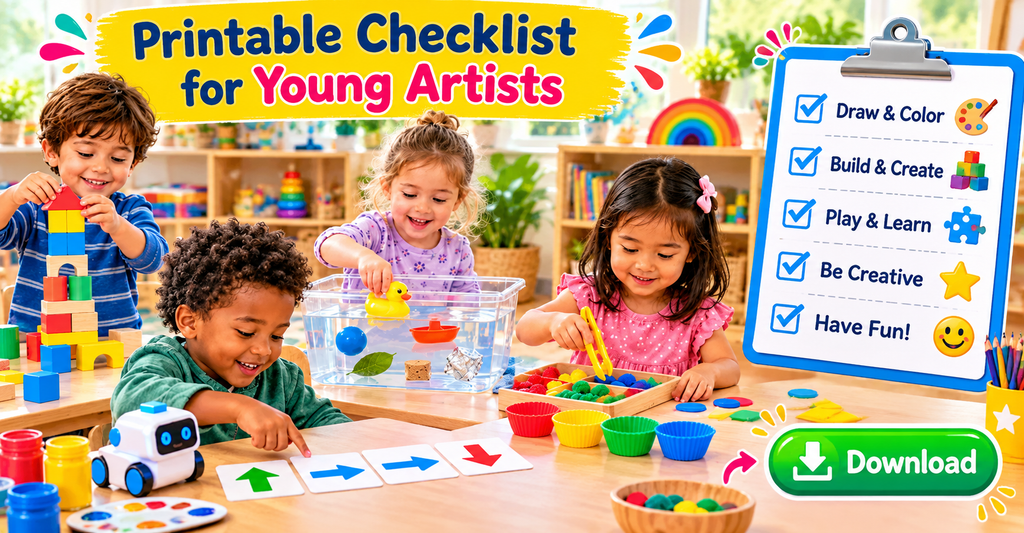
Copy this list into a worksheet or pin it on your art wall. It helps children review their own work without needing constant adult feedback.
- I drew a big body shape
- My fish has a tail
- My fish has at least one fin
- My fish has an eye
- I added a mouth and a gill line
- I added patterns or scales
- I colored my fish
- I gave my fish a name
Check off all eight, and the drawing is complete. Teachers can use the same list as a simple, friendly rubric for art centers.
Pencils Down, Fins Up
Fish drawing works because it is simple enough for beginners and flexible enough to grow with them. Start with the three shapes, let children choose their own colors and patterns, and keep the focus on effort and creativity instead of perfection. A wobbly oval with a big smile and a bright tail is a good fish.
Pick one species this week, run it through the 3-Shape Method, and see how much more confident your young artists feel by the end of the page.