Kindergarten is one of the most exciting stages of early childhood education. Children begin to recognize letters, explore numbers, make friends, and discover how the world works. But many parents have an important question: What do kindergarteners learn, and what skills should they develop before first grade?
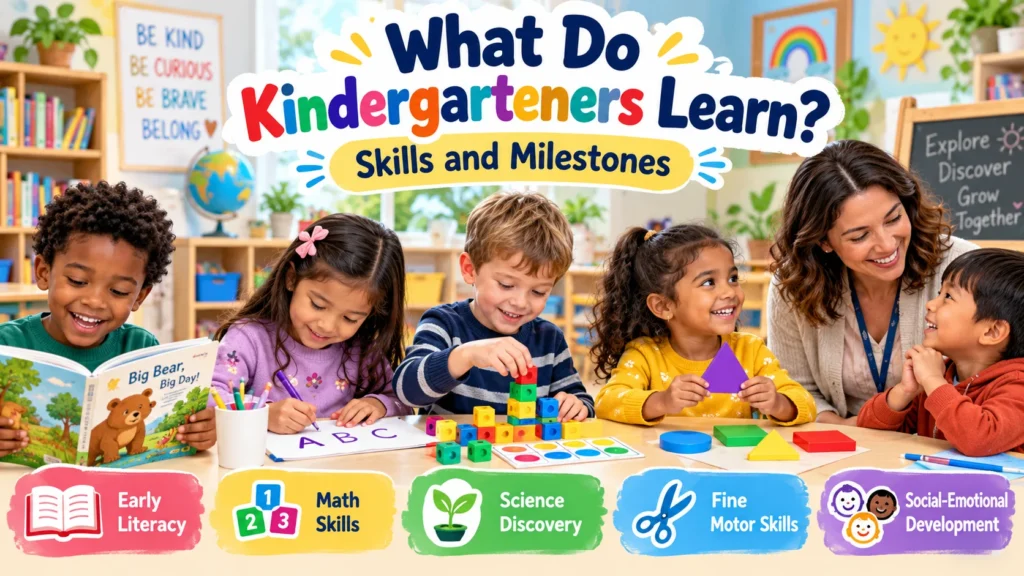
In kindergarten, children typically learn foundational reading, writing, math, science, and social studies skills. They also develop communication, independence, creativity, and social-emotional abilities through classroom routines, hands-on activities, and guided play.
Most kindergarteners are around 5 or 6 years old. However, learning expectations can vary depending on the school, state, curriculum, and individual child’s development.
This guide explains the essential kindergarten learning skills, common milestones, classroom activities, assessments, and simple ways parents can support learning at home.
What Do Kindergarteners Learn in School?
Kindergarten introduces children to academic subjects while helping them develop confidence, curiosity, and independence.
Rather than focusing entirely on worksheets or memorization, many teachers combine direct instruction with songs, stories, movement, experiments, and hands-on learning.
Here is an overview of the main skills taught in kindergarten.
| Learning Area | What Kindergarteners Typically Learn | Classroom Example |
|---|---|---|
| Reading | Letters, sounds, phonics, early word reading, story comprehension | Matching letters with pictures |
| Writing | Letter formation, name writing, spelling attempts, simple sentences | Writing about a favorite animal |
| Math | Counting, number recognition, shapes, addition, subtraction | Counting blocks and solving number stories |
| Science | Weather, plants, animals, observation, materials | Growing seeds in cups |
| Social Studies | Families, communities, maps, rules, citizenship | Learning about community helpers |
| Social Skills | Sharing, cooperation, communication, friendship | Working on group projects |
| Emotional Development | Identifying emotions, managing frustration, asking for help | Using a feelings chart |
| Physical Development | Balance, coordination, pencil control, cutting | Cutting paper shapes |
| Creative Arts | Drawing, music, movement, imagination | Painting and rhythm activities |
These areas work together. For example, when children plant seeds, they practice science by observing growth, math by measuring plants, and writing by recording their discoveries.
1. Kindergarten Reading and Literacy Skills
Reading is a major part of kindergarten learning. Children begin developing the skills needed to recognize written words, understand stories, and eventually read independently.
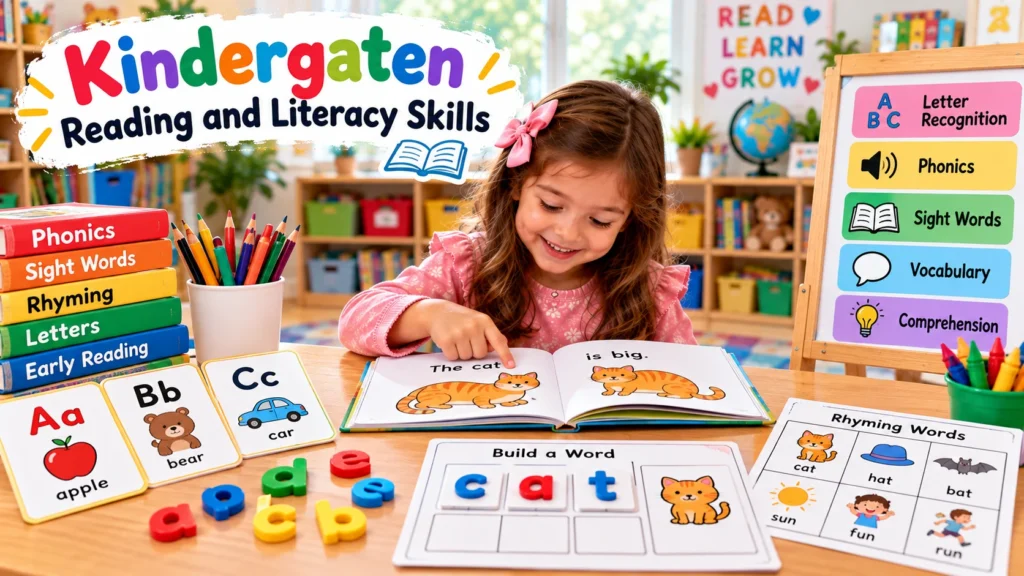
A typical kindergarten reading curriculum focuses on several essential skills.
Recognizing Uppercase and Lowercase Letters
Children practice identifying the 26 letters of the English alphabet in uppercase and lowercase forms.
Teachers may use alphabet cards, magnetic letters, picture books, and letter-matching games.
Example activity: Place uppercase letter cards on a table and ask children to find the matching lowercase letters.
Learning Letter Sounds and Phonics
Phonics teaches children how written letters and letter combinations represent sounds.
For example:
- B represents the /b/ sound in ball.
- M represents the /m/ sound in moon.
- S represents the /s/ sound in sun.
Children also practice recognizing beginning, middle, and ending sounds in simple words.
Blending Sounds to Read Words
As children become familiar with individual sounds, they begin blending them.
For example:
C + A + T = CAT
S + U + N = SUN
D + O + G = DOG
Teachers often introduce consonant-vowel-consonant (CVC) words because they provide opportunities to practice common sound-spelling patterns.
Recognizing High-Frequency Words
Kindergarteners also learn to recognize frequently used words such as the, is, my, see, and and.
Some high-frequency words can be decoded using phonics, while others contain spelling patterns children have not yet learned.
The goal is to help children read these words accurately and increasingly automatically.
Developing Reading Comprehension
Reading involves more than recognizing words.
Kindergarteners practice listening to stories, discussing characters, identifying events, and answering questions.
After reading a story, a teacher might ask:
- Who was the main character?
- Where did the story happen?
- What happened first?
- What happened at the end?
- Why do you think the character felt sad?
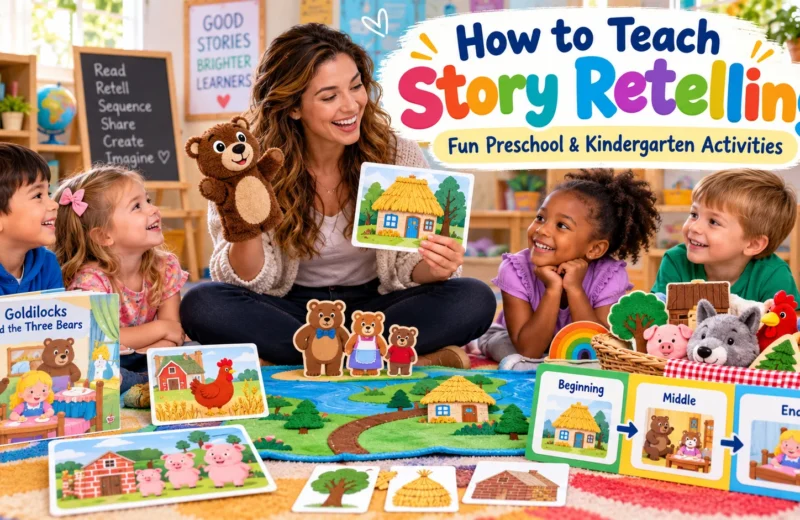
Kindergarten activity: Read a short picture book and ask the child to arrange three picture cards showing the beginning, middle, and end.
What parents should know: Children progress through early reading at different rates. Some read simple books independently, while others still need considerable phonics instruction and adult support.
2. Kindergarten Writing Skills
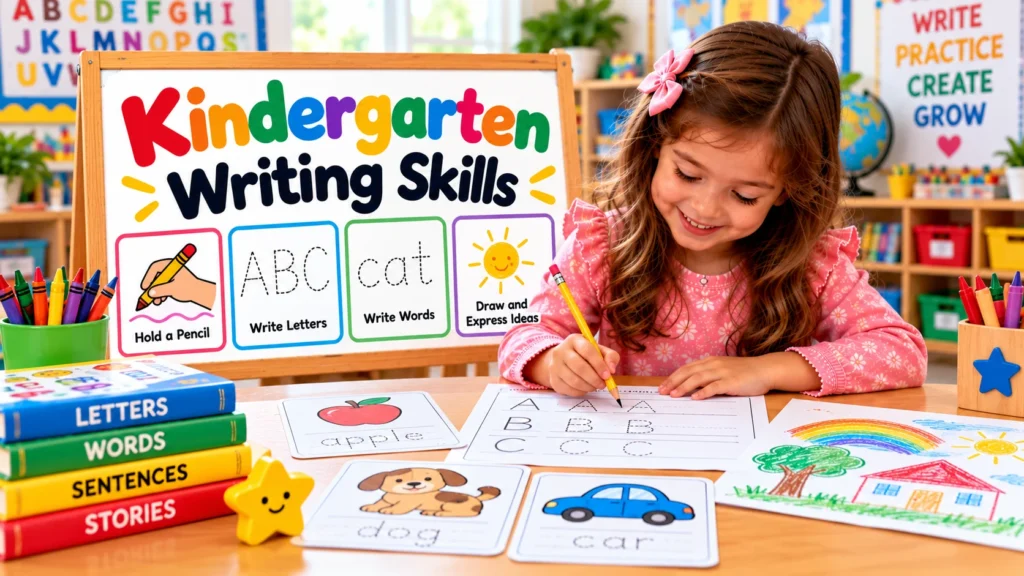
Writing instruction helps children communicate their thoughts through pictures, letters, words, and sentences.
At the beginning of kindergarten, children may still be learning how to hold a pencil comfortably or form recognizable letters.
As the year progresses, their writing usually becomes more purposeful.
Writing Their Names
Many children practice writing their first names during kindergarten.
Teachers may use name cards, tracing sheets, magnetic letters, and dry-erase boards.
Children gradually learn to recognize the letters in their names and write them with increasing independence.
Forming Letters and Numbers
Kindergarten writing activities often include forming uppercase and lowercase letters, recognizing spaces between words, and practicing basic punctuation.
Students may begin with tracing and progress toward independent writing.
Spelling Simple Words
Early writers often use the sounds they hear to represent words.
For example, a child might write “KT” when attempting to spell cat.
Teachers can acknowledge the child’s effort while helping them notice the missing vowel sound and learn the conventional spelling.
Writing Simple Sentences
Children begin expressing ideas through drawing, dictation, and writing.
A child might draw a dog and write:
“My dog is big.”
Another might draw a playground and dictate a sentence for the teacher to record.
These are both meaningful writing experiences.
Kindergarten activity: Ask children to draw their favorite animal, label it, and write or dictate one sentence about it.
Parent tip: Encourage children to express ideas rather than correcting every spelling or handwriting mistake immediately.
3. Kindergarten Math Skills
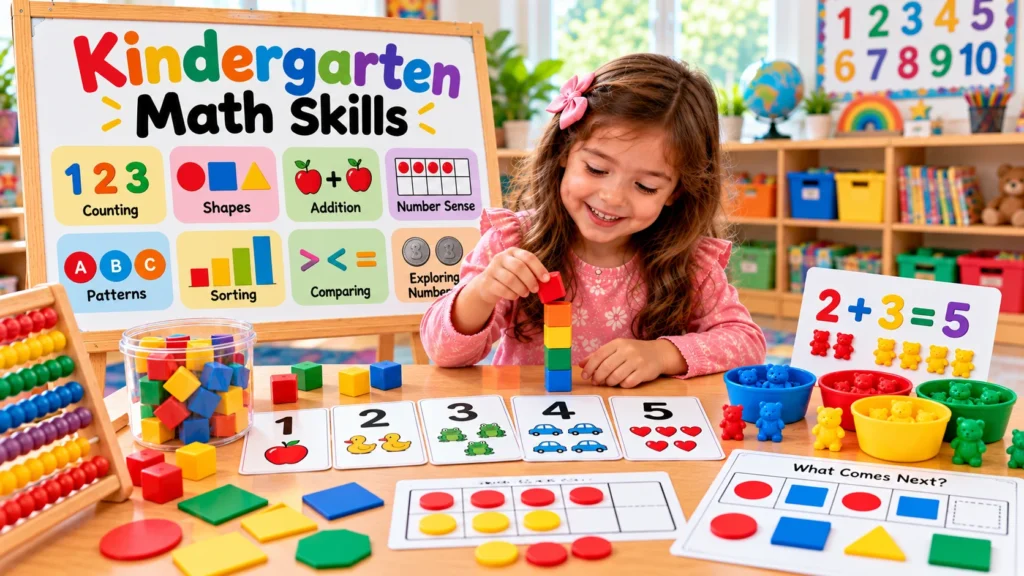
Math in kindergarten introduces children to numbers, quantities, shapes, patterns, and simple problem-solving. Hands-on activities help students understand mathematical concepts before relying entirely on written equations.
Counting and Number Recognition
In Common Core-aligned kindergarten programs, students work toward counting to 100 by ones and tens, writing numbers from 0 to 20, and counting objects accurately.
For example, a child may count 12 blocks and then match the collection to the number 12.
Understanding Number Sense
Number sense means understanding how numbers represent quantities and relate to one another.
Children practice:
- Matching numbers to groups of objects.
- Comparing greater and smaller quantities.
- Recognizing that adding one increases a quantity.
- Understanding that the last number counted represents the total.
- Identifying written numbers.
Example: Place five counters in one group and three counters in another. Ask which group has more and how the child knows.
Basic Addition and Subtraction
Kindergarteners begin exploring addition and subtraction using concrete objects, drawings, fingers, and number stories.
For example:
Addition: Emma has three apples and receives two more.
3 + 2 = 5
Subtraction: Leo has five blocks and gives away two.
5 − 2 = 3
Using objects helps children understand what these operations mean.
Shapes and Spatial Awareness
Students learn to identify, describe, compare, and build shapes.
Common shapes include circles, squares, triangles, rectangles, cubes, spheres, and cylinders.
Teachers may ask children to find shapes around the classroom.
For example, a clock might resemble a circle, while a tissue box resembles a rectangular prism.
Patterns, Sorting, and Measurement
Children also explore repeating patterns, sorting objects, comparing lengths, and describing measurable attributes.
They might arrange blocks in a red-blue-red-blue pattern or compare which pencil is longer.
Kindergarten activity: Give children colorful counters and ask them to create a repeating pattern, then explain what comes next.
4. What Do Kindergarteners Learn in Science?
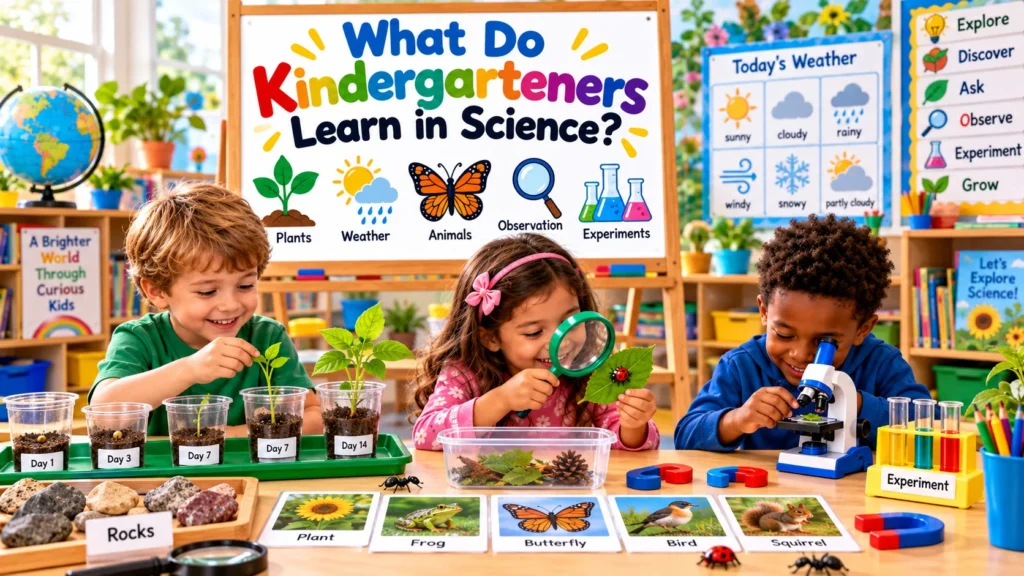
Kindergarten science encourages children to ask questions, make observations, explore materials, and describe what they discover.
Instead of memorizing complicated scientific definitions, children begin developing curiosity and scientific thinking.
Plants and Living Things
Children investigate what plants and animals need to survive.
They may plant seeds, observe changes, and discuss sunlight, water, and growing conditions.
Activity: Grow bean seeds in clear containers and have children draw what they notice every few days.
Weather and Seasons
Students observe daily weather conditions and learn words such as sunny, cloudy, rainy, windy, and snowy. They may also explore how seasonal changes affect clothing, plants, animals, and outdoor activities.
Activity: Create a weather chart and record the weather each morning.
Exploring Materials and Motion
Kindergarteners experiment with everyday materials and observe what happens when objects are pushed, pulled, rolled, or dropped.
A teacher might let children test different toy cars on ramps and compare how far they travel.
These experiences introduce observation, prediction, and cause-and-effect thinking.
Developing Scientific Thinking
Children learn to:
- Ask simple questions.
- Describe what they observe.
- Make predictions.
- Compare objects.
- Record information through drawings.
- Discuss what happened during an experiment.
These foundational habits support future scientific learning.
5. Social Studies Skills in Kindergarten
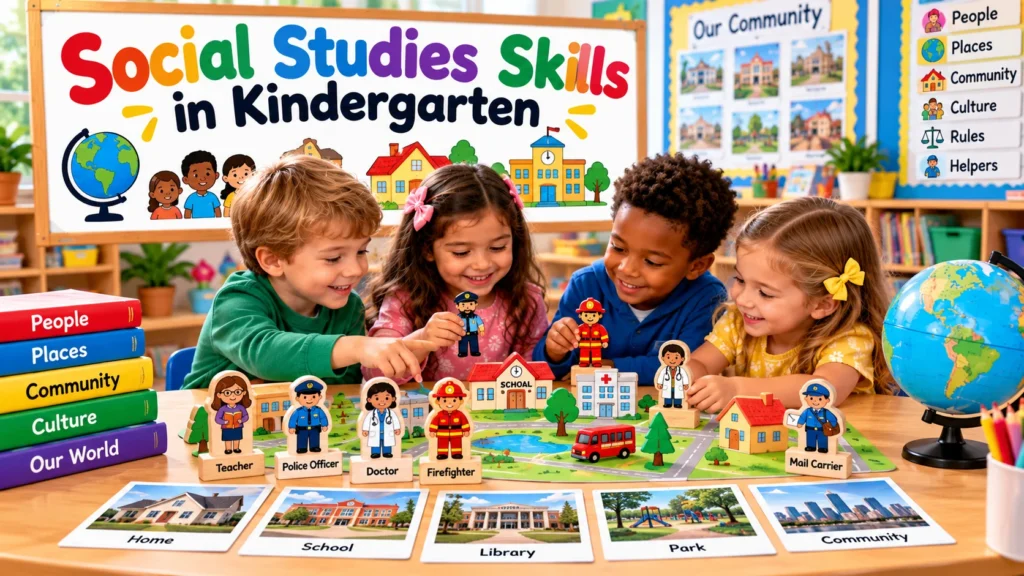
Social studies helps children understand themselves, their families, their communities, and the people around them. Students explore how people work together and why rules and responsibilities are important.
Families and Communities
Children learn that families can have different structures, traditions, and experiences.
Teachers may encourage children to talk about family routines, celebrations, and community life.
Community Helpers
Kindergarteners learn about people who contribute to their communities.
Examples include firefighters, nurses, teachers, sanitation workers, and librarians.
Activity: Ask children to match pictures of community helpers with the tools they use.
Rules and Responsibilities
Students learn why classrooms have rules and how cooperation helps everyone feel safe and included. They practice caring for shared materials, helping classmates, and participating in classroom responsibilities.
Basic Maps and Locations
Kindergarten lessons may introduce simple maps, symbols, directions, and familiar locations.
Children might create a map of their classroom using drawings of tables, doors, and learning centers.
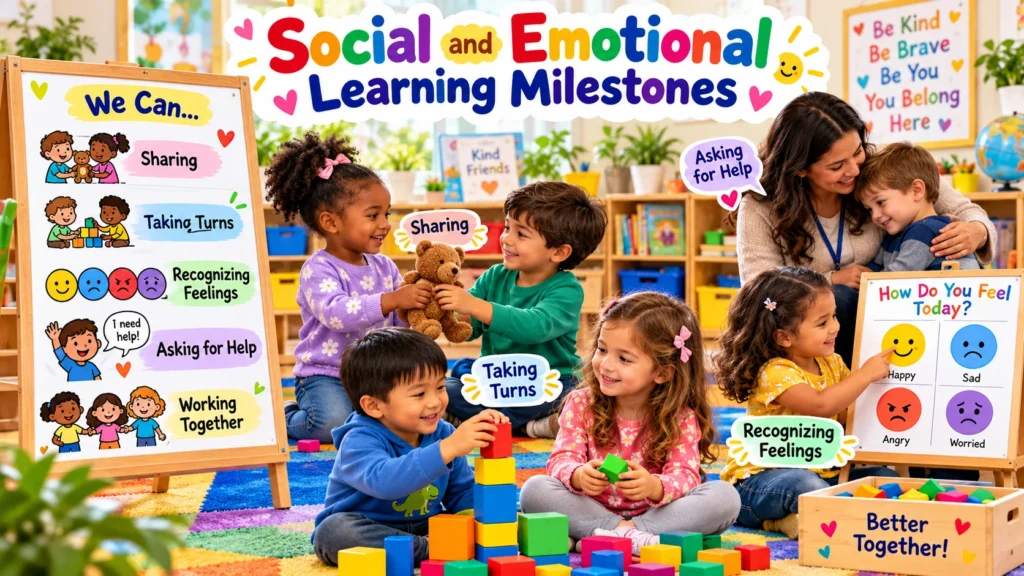
6. Social and Emotional Learning Milestones
One of the most important parts of kindergarten is learning how to interact with others.
Children practice communication, cooperation, emotional awareness, and problem-solving throughout the school day.
Making Friends and Working Together
Kindergarteners learn to participate in group activities, share materials, take turns, and listen to others.
These skills develop gradually and often require repeated practice.
Recognizing and Expressing Emotions
Teachers help children identify emotions such as happiness, sadness, frustration, excitement, and nervousness.
Children practice describing their feelings and asking adults for support.
For example, a student might learn to say:
“I feel frustrated because I cannot finish my puzzle.”
Managing Frustration
Kindergarteners begin practicing strategies such as asking for help, taking a short break, trying another approach, or using calming techniques.
Children still need adult support when emotions become overwhelming.
Building Independence
Students gradually become more comfortable managing everyday classroom responsibilities.
These may include organizing supplies, following routines, putting away belongings, and completing familiar tasks.
Classroom activity: Use a visual morning routine chart showing where to place backpacks, how to choose an activity, and where to sit.
7. Physical Development and Fine Motor Skills
Physical development supports children’s ability to participate in classroom activities and everyday routines.
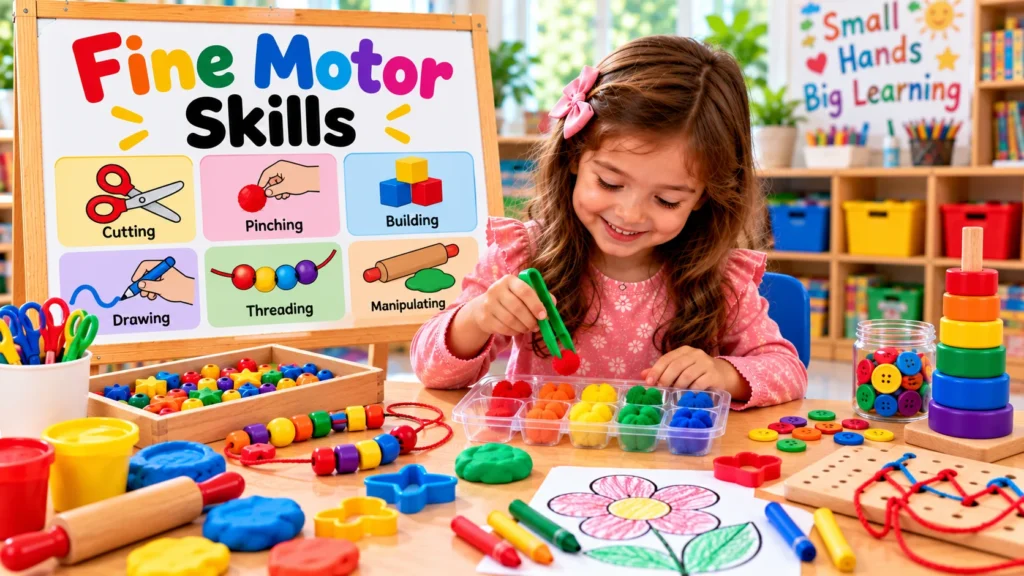
Fine Motor Skills
Fine motor skills involve small movements of the hands and fingers.
Kindergarten activities may include:
- Holding pencils and crayons.
- Cutting along lines.
- Using glue sticks.
- Building with small blocks.
- Opening containers.
- Manipulating clay or playdough.
Activity: Let children use child-safe scissors to cut paper strips, curves, and simple shapes.
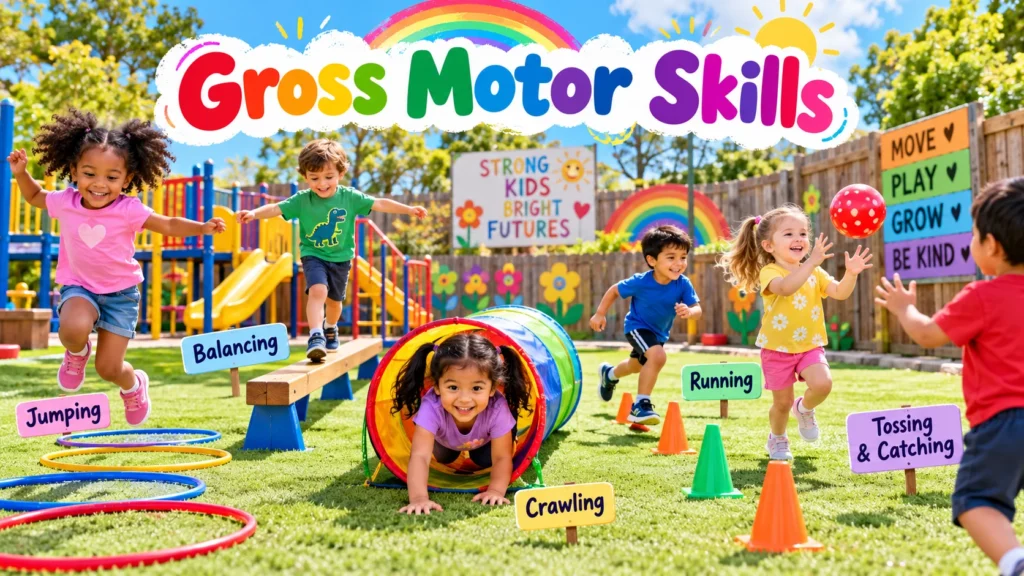
Gross Motor Skills
Gross motor skills involve larger body movements.
Children develop coordination through running, jumping, balancing, dancing, throwing, catching, and outdoor play.
Movement activities also provide opportunities to practice following directions and cooperating with others.
Kindergarten Learning Milestones: Beginning, Middle, and End of Year
Parents often wonder whether their children are progressing as expected.
It helps to look at how learning may develop across the school year instead of focusing on a single test or skill.
| Learning Area | Beginning of Kindergarten | Middle of Kindergarten | End of Kindergarten |
|---|---|---|---|
| Reading | Recognizes some letters and sounds | Blends sounds and begins decoding simple words | Reads some simple texts with growing accuracy and support as needed |
| Writing | Draws and practices letters or name writing | Uses letters to represent sounds in words | Creates simple written messages or sentences |
| Math | Counts objects and recognizes familiar numbers | Compares quantities and models simple number stories | Works toward grade-level counting, number writing, and basic operations |
| Science | Observes familiar objects and nature | Asks questions and makes predictions | Describes observations and simple relationships |
| Social skills | Learns routines and practices turn-taking | Participates more confidently with classmates | Demonstrates growing cooperation and independence |
| Motor skills | Practices pencil and scissor control | Develops greater coordination | Uses classroom tools with increasing control |
These are illustrative learning progressions, not universal developmental deadlines. A child’s teacher can explain the curriculum’s specific expectations.
12 Fun Kindergarten Activities That Build Essential Skills
Kindergarten activities work best when children can move, touch, explore, talk, and experiment.
These learning experiences can be used in classrooms or adapted for home.
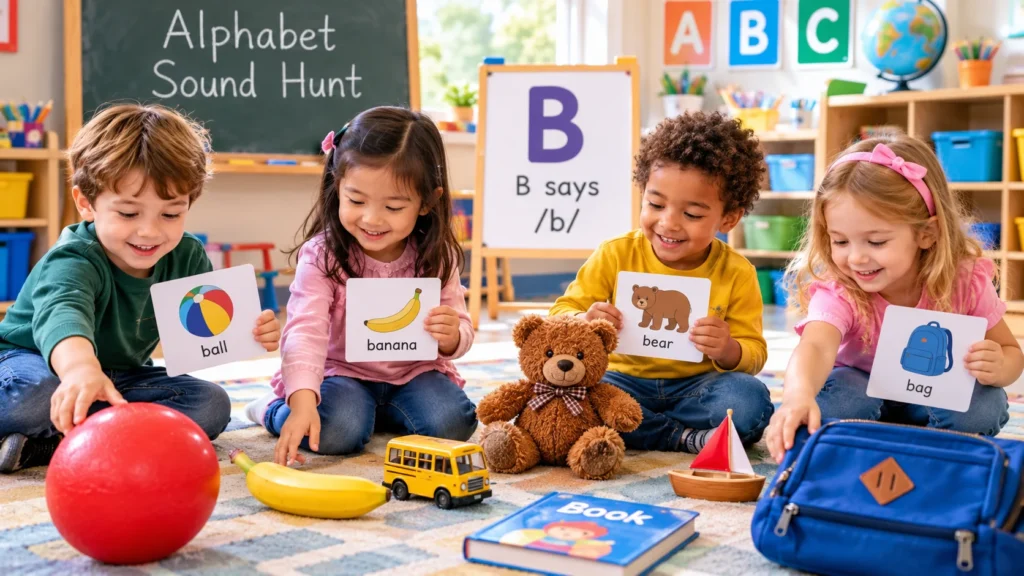
1. Alphabet Sound Hunt
Learning goal: Letter-sound recognition.
Materials: Alphabet cards and familiar household objects.
Choose a letter, such as B, and ask children to find objects beginning with its sound.
They might identify a ball, bag, or book.
Encourage children to say the beginning sound before naming the object.
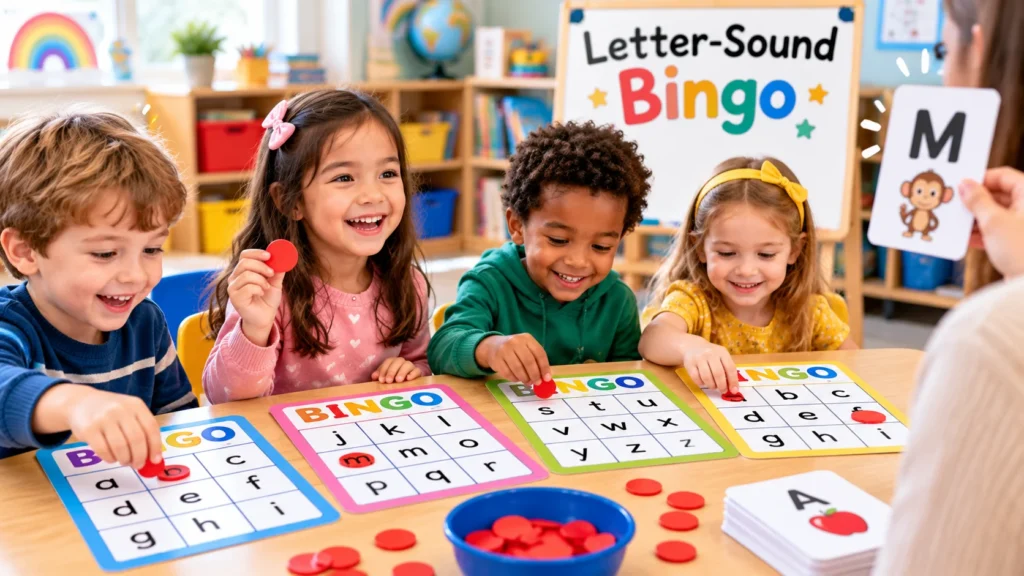
2. Letter-Sound Bingo
Learning goal: Phonics and listening.
Materials: Bingo cards with letters and small counters.
Say a letter sound aloud and ask children to cover the corresponding letter.
For example, say /m/ and let children locate M.
This activity helps connect spoken sounds with printed letters.
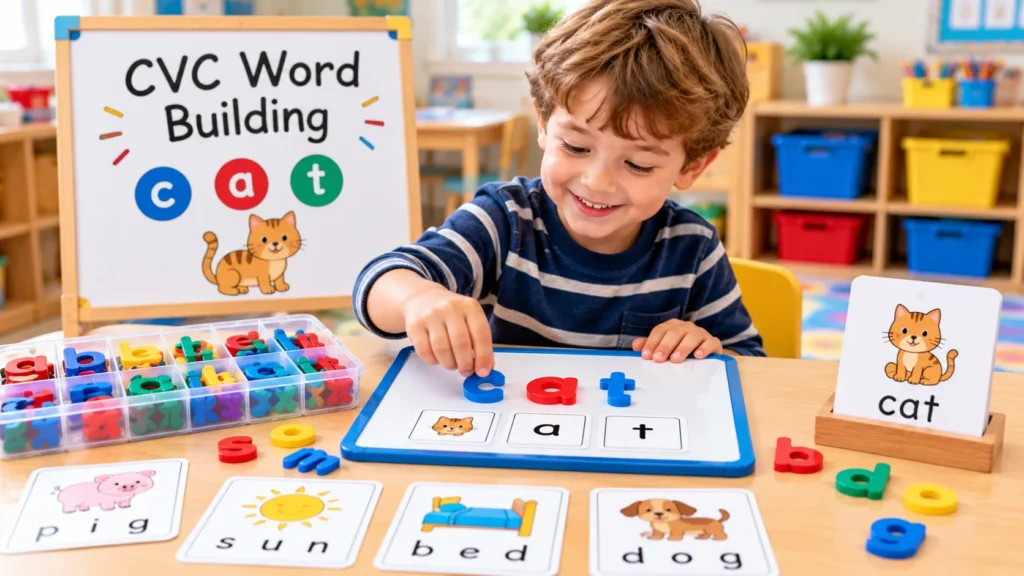
3. CVC Word Building
Learning goal: Blending and spelling simple words.
Materials: Magnetic letters or letter tiles.
Say a word such as sun.
Ask the child to listen for the sounds and build the word with letters.
Then help the child blend the sounds to read the completed word.
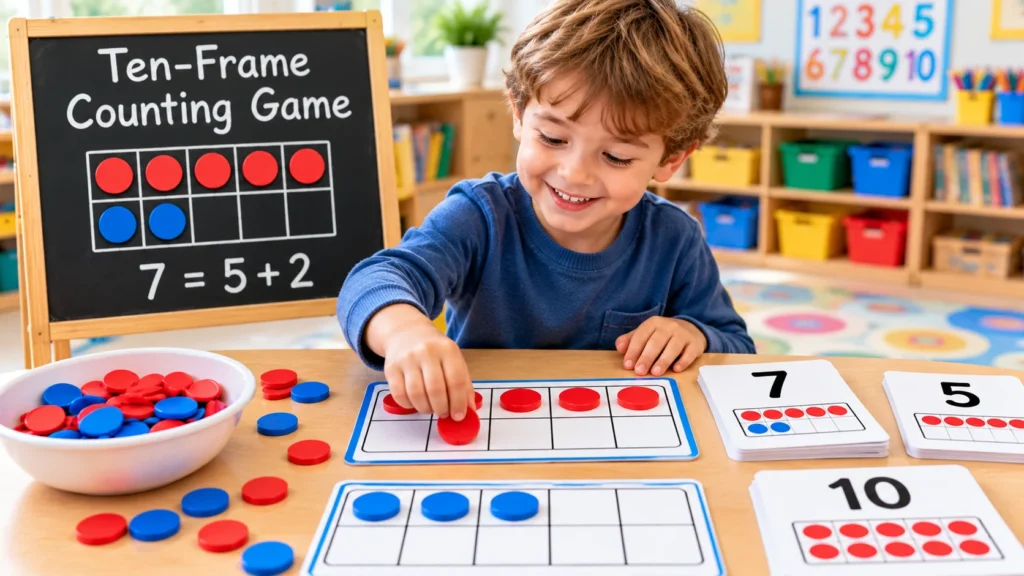
4. Ten-Frame Counting Game
Learning goal: Counting and number sense.
Materials: Ten-frame mat and counters.
Ask children to place seven counters on the mat.
Then ask:
“How many spaces are empty?”
Children can explore the relationship between seven and ten using the counters.
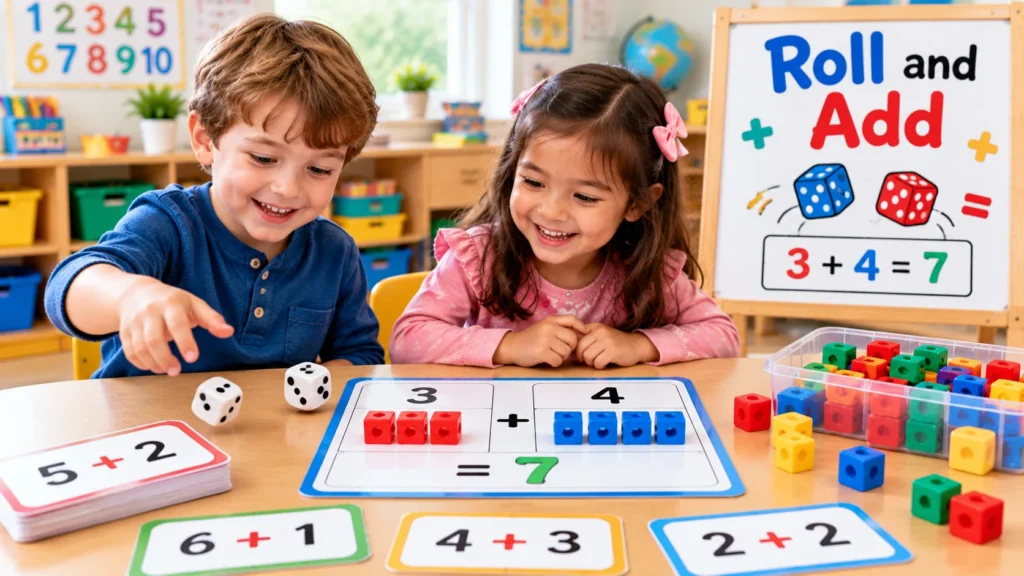
5. Roll and Add
Learning goal: Beginning addition.
Materials: Two dice and counting blocks.
Roll both dice and count the dots.
Build each quantity with separate groups of blocks, then combine the groups to find the total.
For children who need additional support, start with dice showing smaller quantities.
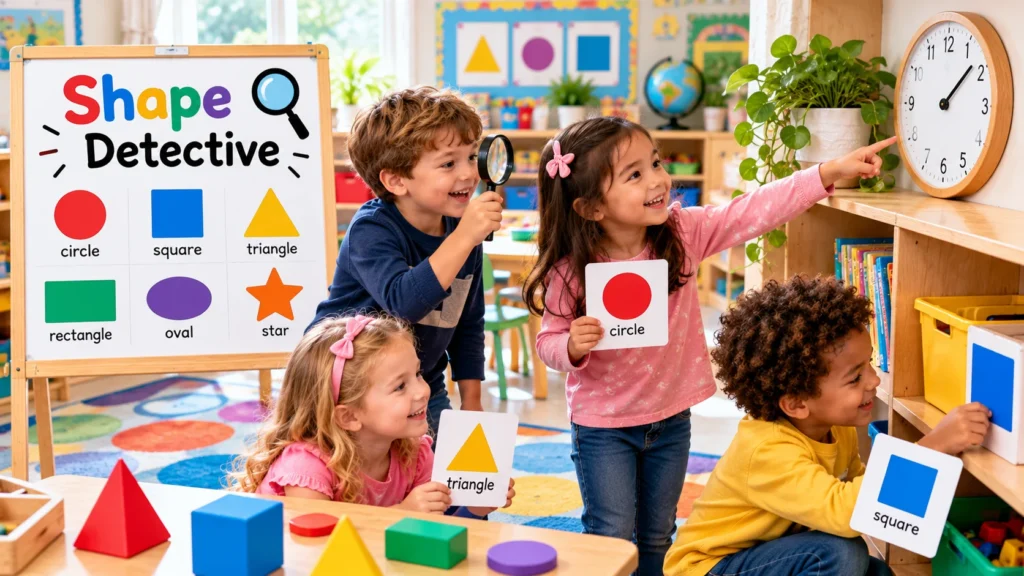
6. Shape Detective
Learning goal: Shape recognition and spatial awareness.
Materials: Shape picture cards.
Show a circle, triangle, rectangle, or square.
Ask children to find matching shapes around the room.
Discuss the number of sides and corners where appropriate.
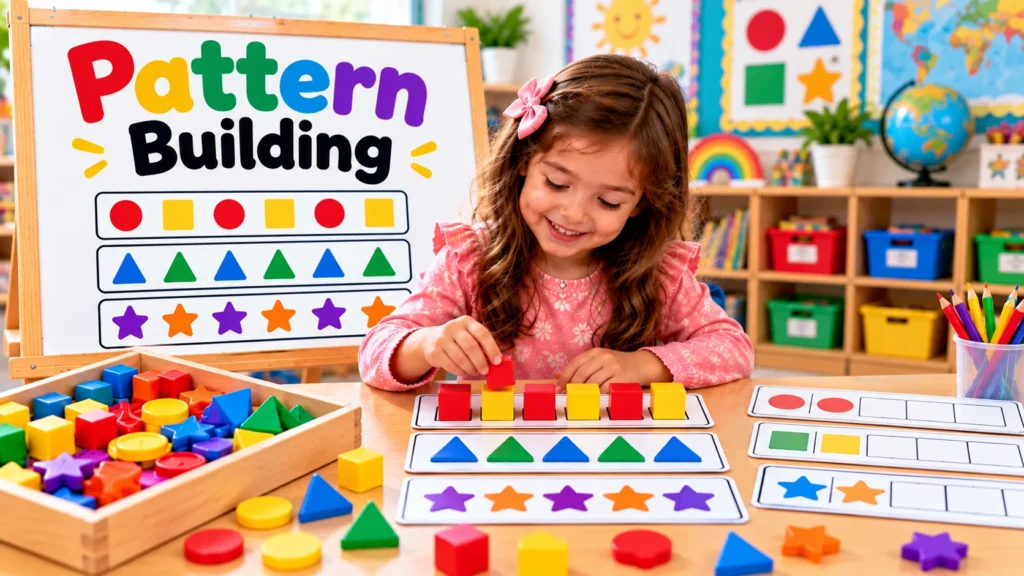
7. Pattern Building
Learning goal: Identifying and extending patterns.
Materials: Colored blocks or counters.
Create a simple pattern:
Red – Blue – Red – Blue
Ask children which color comes next.
Gradually introduce more complex patterns when they are ready.
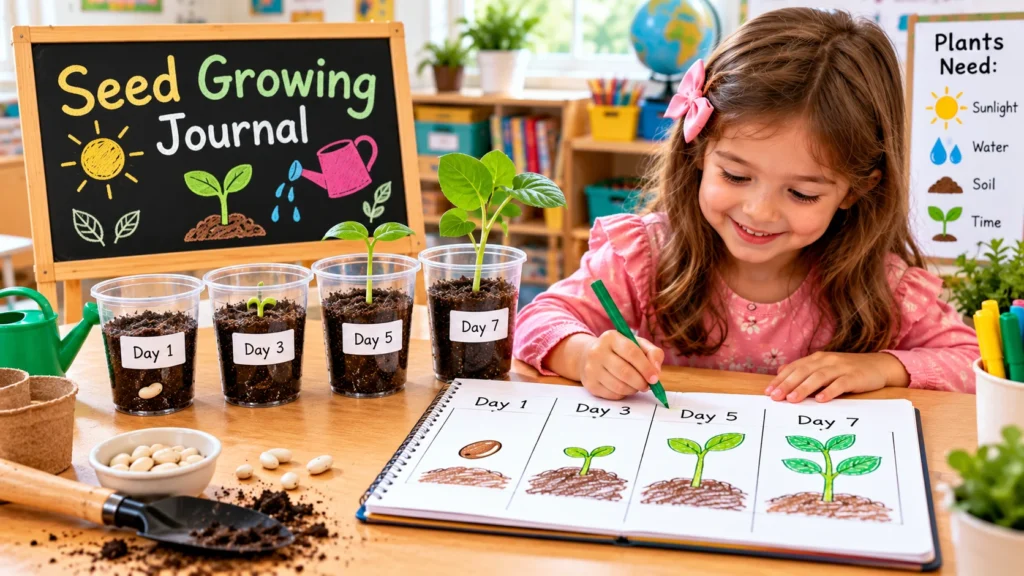
8. Seed Growing Journal
Learning goal: Scientific observation.
Materials: Seeds, soil, clear cups, water, and paper.
Help children plant seeds and observe their growth.
Encourage them to draw the changes and describe what they notice.
Older or more confident writers may add labels or short sentences.
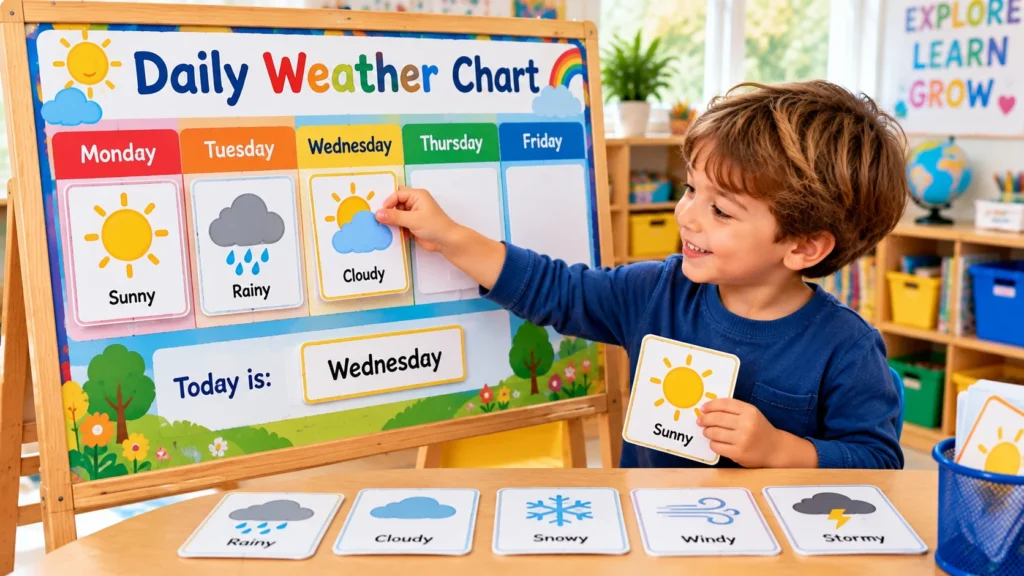
9. Daily Weather Chart
Learning goal: Observation and early data collection.
Materials: Weather pictures and a classroom chart.
Each day, children select a symbol showing the weather.
At the end of the week, count how many days were sunny, rainy, or cloudy.
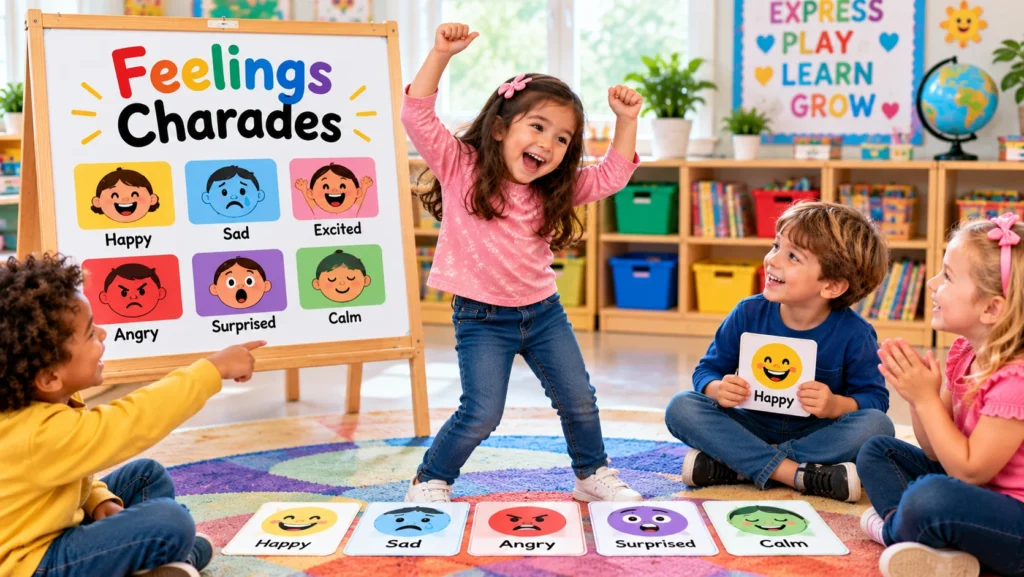
10. Feelings Charades
Learning goal: Emotional recognition and communication.
Materials: Picture cards showing different emotions.
Ask a child to choose a card and act out the emotion.
Other children guess how the character feels.
Discuss respectful ways to respond when someone experiences that emotion.
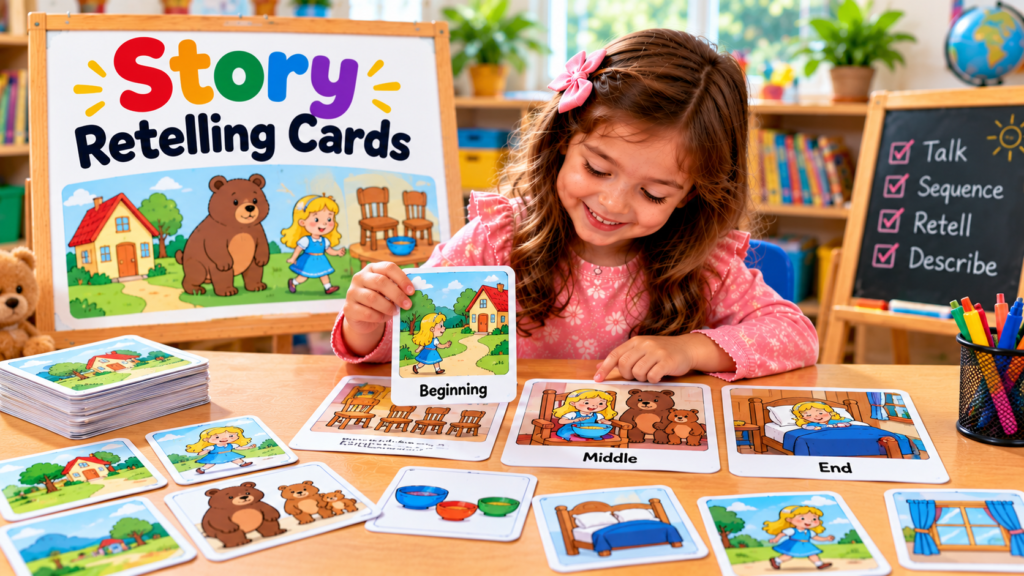
11. Story Retelling Cards
Learning goal: Reading comprehension and sequencing.
Materials: Three to five pictures from a familiar story.
Read the story together.
Mix the cards and ask children to arrange them in the correct order.
Encourage them to explain what happened first, next, and last.
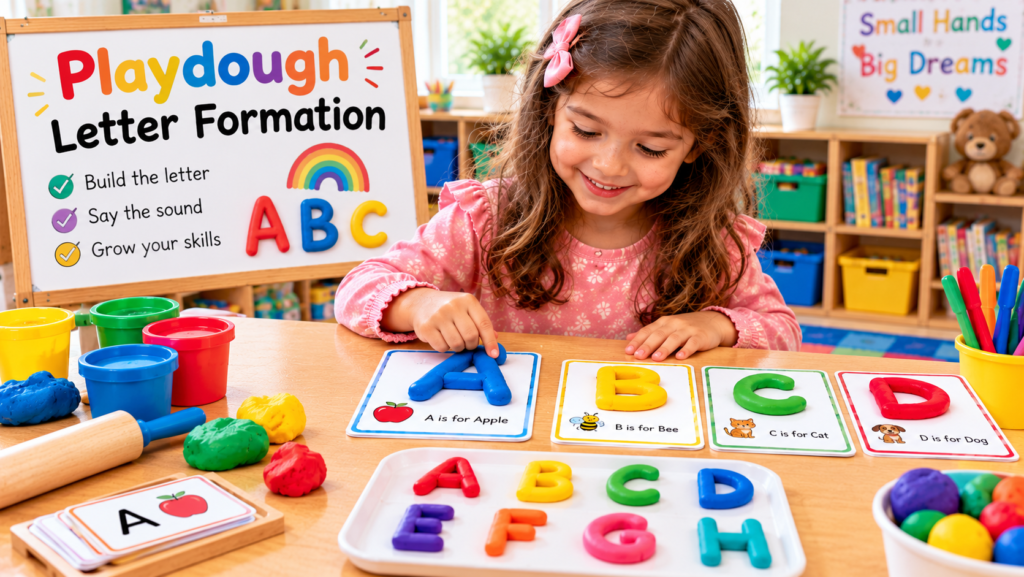
12. Playdough Letter Formation
Learning goal: Fine motor control and letter recognition.
Materials: Playdough and alphabet cards.
Show a letter and ask children to roll playdough into strips.
Help them shape the strips into the letter.
For an additional challenge, ask them to name a word beginning with the letter’s sound.
Teacher tip: Adjust the difficulty of these activities to children’s current abilities. Activities for kindergarten should feel achievable while still offering opportunities to learn something new.
How Do Teachers Teach Kindergarten Skills?
Teaching kindergarten requires a balance of clear instruction, guided practice, play, movement, and supportive classroom routines.
A teacher teaching kindergarten may use several approaches throughout the day.
Whole-Group Lessons
The teacher introduces a concept to the entire class.
For example, students might listen to a picture book, practice a counting song, or discuss the day’s weather.
Small-Group Instruction
Teachers work with smaller groups to provide instruction that matches children’s learning needs.
One group might practice letter sounds while another works on blending simple words.
Learning Centers
Classrooms often include areas for reading, writing, math, building, art, and imaginative play.
Children practice skills through purposeful activities using classroom materials.
Guided Play
During guided play, teachers support children’s exploration while introducing questions, vocabulary, and learning goals.
For example, children building a bridge with blocks might explore shape, balance, measurement, and cooperation.
Observation and Feedback
Teachers observe children’s progress, respond to their needs, and provide instruction or additional practice.
Effective kindergarten teaching recognizes that children develop skills at different rates.
What Is a Kindergarten Test?
A kindergarten test is an assessment used to understand what a child knows or can do.
Unlike many tests given to older students, kindergarten assessments may involve short activities, teacher observations, conversations, and individual tasks.
Their main purpose should be to inform instruction and identify where children may need additional support.
Common Types of Kindergarten Assessments
| Assessment Type | What It May Measure | Example |
|---|---|---|
| Kindergarten entry screening | Early skills and possible support needs | Recognizing letters or counting objects |
| Reading assessment | Letter sounds, decoding, or comprehension | Reading or identifying simple words |
| Math assessment | Counting and number relationships | Counting counters or comparing quantities |
| Writing assessment | Letter formation and early expression | Drawing and writing about a picture |
| Classroom observation | Social, behavioral, and learning skills | Participating in a group activity |
| Progress monitoring | Changes in specific skills over time | Repeating a brief reading task periodically |
Does Every Child Take the Same Kindergarten Test?
No. Kindergarten assessment requirements vary by state, school district, and school.
Some schools use standardized screening tools, while others rely on classroom-based assessments.
Parents can ask teachers what an assessment measures, how results are interpreted, and what support is available.
How Can Parents Prepare Children for Kindergarten Assessments?
The most useful preparation is to support everyday learning.
Read together, play counting games, talk about pictures, and encourage children to explain their thinking.
Avoid making young children feel that one assessment determines their intelligence or future school success.
What Does Kindergarten Work Look Like?
Kindergarten work includes much more than traditional worksheets.
Classroom assignments often combine academic learning with play, discussion, hands-on exploration, and creative expression.
Examples include:
Reading work: Sorting picture cards by beginning sounds, reading decodable words, and retelling stories.
Writing work: Drawing and labeling pictures, writing names, and composing simple sentences.
Math work: Counting manipulatives, building shapes, and solving addition stories.
Science work: Recording weather observations, sorting materials, and describing plant growth.
Social learning: Working with partners, taking responsibility for classroom materials, and participating in collaborative projects.
A completed worksheet may show part of what a child knows, but a teacher’s observations and conversations can reveal additional skills that paper assignments do not capture.
How Can Parents Support Kindergarten Learning at Home?
Parents do not need expensive educational materials or complicated lesson plans to support kindergarten learning.
Everyday activities offer valuable opportunities to practice new skills.
Read Together Every Day
Spend time reading picture books, discussing illustrations, and asking questions about stories.
Encourage children to predict what might happen next and explain their favorite parts.
Use Everyday Math
Count toys while cleaning up, compare the sizes of objects, or sort laundry by color.
For example, ask:
“We have four apples. If we eat one, how many will remain?”
Encourage Drawing and Writing
Keep paper, crayons, pencils, and other suitable writing materials available.
Invite children to create birthday cards, grocery lists, labels, or short stories.
Practice Conversation Skills
Ask open-ended questions and give children time to respond.
Encourage them to describe experiences, explain ideas, and ask questions.
Support Independence
Let children practice manageable responsibilities such as organizing a backpack, putting away supplies, or choosing appropriate clothing.
Provide assistance when needed while allowing opportunities to try independently.
Make Learning Enjoyable
Games, music, outdoor play, art, and imaginative activities can reinforce important skills without turning home life into a second classroom.
Kindergarten Skills Checklist for Parents and Teachers
Use this checklist as a discussion and observation tool rather than a pass-or-fail test.
Reading and Literacy
- Recognizes uppercase and lowercase letters.
- Connects familiar letters with their common sounds.
- Identifies rhyming words and beginning sounds.
- Practices blending sounds into simple words.
- Answers questions about familiar stories.
- Retells important story events.
Writing
- Writes or practices writing their name.
- Forms many recognizable letters.
- Uses drawing and writing to communicate ideas.
- Connects sounds with letters when spelling.
- Creates simple written or dictated sentences.
Math
- Counts objects with one-to-one correspondence.
- Recognizes and writes familiar numbers.
- Compares groups of objects.
- Explores addition and subtraction using objects.
- Identifies and describes common shapes.
- Recognizes or extends simple patterns.
Social and Emotional Skills
- Practices sharing and taking turns.
- Participates in group activities.
- Identifies and communicates feelings.
- Follows familiar classroom routines with support as needed.
- Asks for help when necessary.
- Demonstrates growing independence.
Physical and Creative Development
- Uses crayons, pencils, and scissors with increasing control.
- Participates in movement and outdoor play.
- Explores drawing, painting, music, or imaginative play.
- Practices coordinating movements during games.
A child does not need to demonstrate every item at the same time. Review progress with the classroom teacher and consider the child’s individual learning needs.
What If a Kindergartener Is Struggling With Learning?
Children develop skills at different rates, and some need additional practice or specialized support.
A child who finds reading, counting, communication, or classroom routines difficult is not automatically experiencing a developmental disorder.
Parents can begin by asking the teacher specific questions:
- Which skills are challenging?
- What strategies are helping in class?
- What strengths does my child demonstrate?
- What activities should we practice at home?
- Would additional screening or support be appropriate?
For persistent concerns, families can discuss developmental or learning evaluations with their child’s healthcare professional or school.
The goal is to understand the child’s needs early and provide appropriate encouragement and instruction.
Frequently Asked Questions
What should a 5-year-old know before kindergarten?
Children may enter kindergarten with some knowledge of letters, counting, colors, shapes, and everyday routines. Readiness expectations vary, and children do not need to read independently before starting kindergarten. Communication, curiosity, and emerging independence are also important.
What do kindergarteners learn in math?
Kindergarteners learn counting, number recognition, comparing quantities, basic addition and subtraction, shapes, and introductory measurement. In Common Core-aligned classrooms, goals include counting to 100 by ones and tens and writing numbers from 0 to 20.
What reading skills should kindergarteners learn?
Children typically learn letter names, letter sounds, phonemic awareness, basic decoding, and story comprehension. Many also practice reading simple words and beginner-level texts.
Should kindergarteners know how to read?
Kindergarten is an important year for learning to read, but children develop reading skills at different rates. Some read simple texts independently, while others need continued explicit instruction and support.
How many sight words should kindergarteners know?
There is no single universal number. Schools use different curricula and word lists. Parents should focus on the school’s learning goals and help children develop accurate decoding and recognition of frequently used words.
What is included in a kindergarten test?
A kindergarten assessment may include letter recognition, phonics, counting, number identification, writing tasks, and classroom observations. The exact content depends on the assessment and school.
What are the best kindergarten activities at home?
Reading aloud, alphabet sound games, counting household objects, shape hunts, drawing, storytelling, puzzles, and simple science experiments are useful choices. The best activities match the child’s interests and current abilities.
What does a kindergarten teacher teach every day?
Kindergarten teachers often teach reading, writing, math, science, social studies, and social-emotional skills. They also guide classroom routines, cooperation, communication, creativity, and independence.
What should kindergarteners know by the end of the year?
Common goals include recognizing letters and sounds, developing early reading skills, expressing ideas through writing, counting and comparing numbers, exploring basic operations, and working more independently. Specific grade-level expectations vary by location and curriculum.
How can I tell whether my child is ready for first grade?
Review the school’s learning expectations and speak with your child’s teacher. Consider academic progress alongside communication, independence, social development, and any support needs. No single checklist or test fully captures school readiness.
Final Thoughts: Kindergarten Is About Building a Strong Foundation
Kindergarten is much more than learning the alphabet and counting numbers. Children develop early academic knowledge while discovering how to ask questions, solve problems, express emotions, build friendships, and participate in a classroom community.
Understanding what kindergarteners learn helps parents support their children’s progress with realistic expectations.
The most useful approach is to combine clear instruction, enjoyable kindergarten activities, consistent encouragement, and communication with teachers.
Every child brings different strengths and experiences to the classroom. With appropriate support and opportunities to practice, kindergarten can become a positive foundation for learning in first grade and beyond.