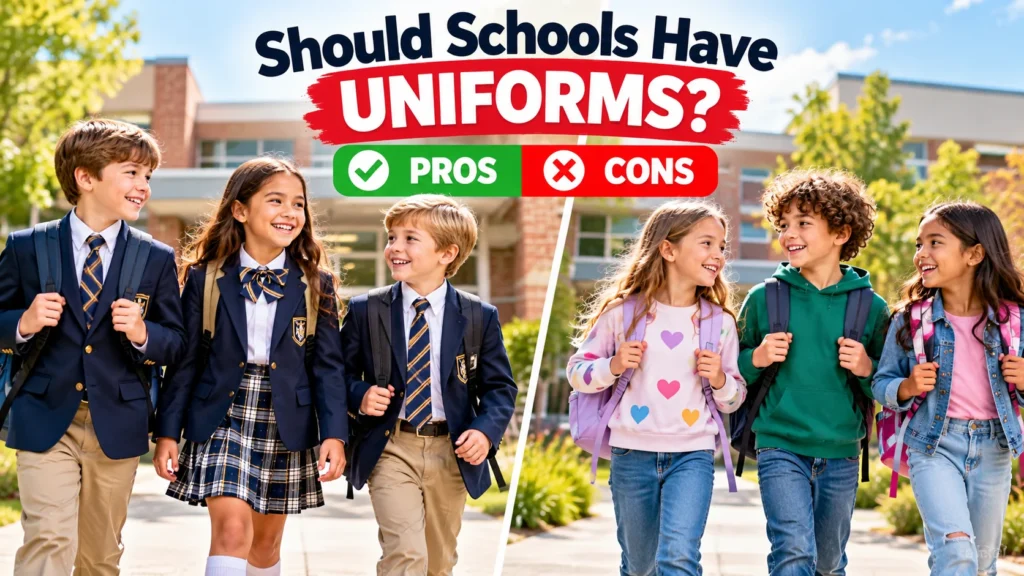
Imagine two students getting ready for school. One spends ten minutes deciding what to wear, while the other puts on the same uniform they wear every weekday. For one family, school uniforms make mornings easier. For another, they introduce extra clothing expenses and limit personal choice.
This everyday difference is at the center of a long-running education debate: Should schools have uniforms?
Supporters believe uniforms can create a sense of community, reduce clothing-related pressure, and simplify school routines. Opponents argue that mandatory uniforms can restrict individuality, create financial burdens, and fail to address the real causes of problems such as bullying.
But what does research actually say?
This guide examines six advantages and six disadvantages of school uniforms, explains their possible effects on students, and helps parents, teachers, and students understand both sides of the debate.
Should Schools Have Uniforms? Quick Answer
Schools can benefit from uniforms when the clothing is affordable, comfortable, practical, and supported by students and families. However, uniforms alone are not proven to improve grades, prevent bullying, or create better behavior.
Some families appreciate the convenience and consistent appearance. Others prefer flexible dress codes that allow children to express themselves.
The best policy depends on the needs of the school community and how fairly the rules are implemented.
School Uniforms: Pros and Cons at a Glance
| Possible Advantages | Possible Disadvantages |
|---|---|
| Easier morning routines | Less freedom of self-expression |
| Shared school identity | Additional costs for some families |
| Less visible competition over clothing | Potential comfort and fit problems |
| Clear clothing expectations | Limited evidence of academic benefits |
| Consistent appearance at school events | Risk of unfair enforcement |
| Predictable clothing choices | Difficulties meeting individual needs |
These are potential benefits and drawbacks, not guaranteed outcomes for every school.

What Are School Uniforms?
School uniforms are standardized clothing items that students are required to wear during the school day.
A typical uniform might include:
- A polo shirt or button-down shirt
- Plain pants, shorts, or a skirt
- A sweater or cardigan
- A specific color combination
- Approved shoes
Some schools require clothing with an official logo, while others allow families to buy ordinary clothing that meets certain color and style requirements.
For example, one school might require a navy polo shirt and khaki pants. Another might require a blazer, tie, and branded sweater.
Uniform rules are more common at some grade levels and schools than others.
According to the National Center for Education Statistics, 18.8% of US public schools required uniforms during the 2019–20 school year.
Although school uniforms are familiar in many countries, they are not required in every American school.
Why Do Some Schools Require Uniforms?
Schools introduce uniform policies for different reasons.
Some administrators want a consistent appearance that reflects the school’s identity. Others hope to reduce clothing distractions or make expectations easier to explain.
Common reasons include encouraging a shared school identity, simplifying dress expectations, reducing competition over fashion, and creating a more orderly school environment.
However, these are policy goals. Whether uniforms actually achieve them depends on implementation and the wider school culture.
A uniform cannot replace effective teaching, supportive relationships, clear behavior expectations, or meaningful student support.

6 Advantages of School Uniforms
Supporters of school uniforms often highlight convenience, school identity, and consistency.
Here are six potential advantages worth considering.
1. School Uniforms Can Make Mornings Easier
Choosing clothes every morning can be difficult for busy families.
When children have a simple uniform, parents and students may spend less time deciding what to wear.
For example, a child who knows they need a white polo shirt and navy pants can prepare their outfit the night before.
This can simplify the morning routine, especially in households with several school-age children.
The main benefit: Fewer clothing decisions may help families get ready more efficiently.
However, laundry schedules and having enough clean uniforms still require planning.
2. Uniforms May Encourage a Shared School Identity
When students wear similar clothing, the uniform can represent membership in a school community.
Some students enjoy identifying with their school, particularly during assemblies, performances, and school celebrations.
A shared uniform may also create a recognizable school identity.
However, feeling that one belongs depends on much more than appearance. Friendships, supportive teachers, inclusion, and respectful treatment are essential.
Example: Students participating in a school event may feel connected through their school’s colors and shared activities.
3. Uniforms May Reduce Some Clothing-Related Pressure
Children can sometimes feel pressure to wear fashionable brands or expensive clothing.
A standardized uniform reduces some visible differences between everyday outfits.
For example, students may have fewer opportunities to compare designer shirts or trendy clothing during the school day.
However, uniforms do not eliminate social differences.
Students can still notice differences in shoes, backpacks, accessories, hairstyles, and other possessions.
Important: Uniforms may reduce certain clothing comparisons, but there is not strong evidence that they automatically prevent bullying.
4. Uniforms Create Clear Clothing Expectations
A consistent uniform policy can make it easier for families to understand which clothes are appropriate for school.
Instead of interpreting a long list of permitted and prohibited styles, parents may simply follow a small set of clothing requirements.
This can reduce uncertainty when the rules are straightforward.
For example, allowing plain polo shirts in several approved colors may be easier than maintaining a complicated dress code.
The policy should still be applied fairly and allow reasonable accommodations.
5. Uniforms Can Give School Events a Consistent Appearance
During assemblies, school photographs, performances, or educational visits, uniforms can make students from the same school visually recognizable.
For teachers organizing a school event, this consistency may be convenient.
However, recognizable clothing is not a substitute for proper supervision, student identification, or established safety procedures.
Example: A group of students wearing matching school colors can look organized during a community presentation or field trip.
6. Simple Uniform Policies May Make Clothing Purchases More Predictable
If a school allows inexpensive, widely available clothing, families may find planning easier.
For instance, parents who know their child needs several plain polo shirts and dark pants can compare prices and buy replacements as necessary.
But affordability depends heavily on the policy.
Uniforms with expensive logos, limited suppliers, or frequent design changes can become a financial burden.
The potential advantage: Simple, flexible uniform requirements can make school clothing purchases more predictable.
6 Disadvantages of School Uniforms
Although uniforms offer possible benefits, mandatory clothing policies can also create challenges for students and families.
1. School Uniforms Can Limit Self-Expression
Clothing is one way children express their personalities, interests, and creativity.
A student may enjoy choosing colors, patterns, or outfits that reflect their preferences.
When everyone must wear nearly identical clothing, those choices become more limited.
For example, a middle-school student who enjoys expressing themselves through fashion may feel frustrated by a strict uniform requirement.
Schools can address this concern by allowing some flexibility in approved colors, accessories, or clothing styles.
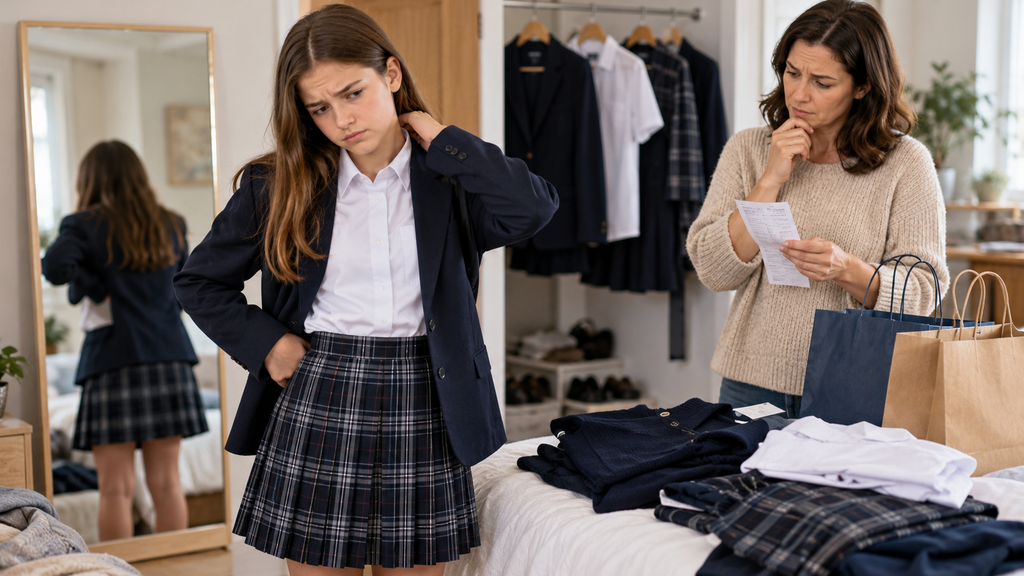
2. Mandatory Uniforms Can Be Expensive
Uniforms are not automatically cheaper than everyday clothing.
Some families already own suitable school clothes. Requiring separate uniforms may create an additional expense.
Costs can increase when schools require:
- Branded shirts or sweaters
- Specific shoes
- Separate physical education uniforms
- Clothing available from only one supplier
- Replacement items as children grow
Families with several children may find these expenses especially difficult.
Example: A parent who already owns five suitable everyday outfits might need to purchase several new uniform items to meet a school’s policy.
Schools should consider affordable, unbranded options and assistance for families who need it.
3. Some Uniforms May Be Uncomfortable or Impractical
Children spend several hours at school sitting, walking, running, playing, and participating in physical activities.
Clothing that is too restrictive, too warm, poorly fitted, or unsuitable for the weather can make these activities uncomfortable.
Younger children may also struggle with complicated buttons or fasteners.
For example, an elementary student might find soft, flexible pants more comfortable than a rigid uniform style.
A practical policy should offer weather-appropriate materials, flexible sizing, and comfortable choices for different activities.
4. Uniforms Do Not Guarantee Better Academic Results
One common argument is that uniforms improve students’ focus and grades.
However, research does not clearly establish that wearing uniforms alone improves academic performance.
The Education Endowment Foundation’s October 2025 evidence review found that the available evidence on academic outcomes was extremely limited.
Uniforms may form part of a school’s wider culture, but learning depends on teaching quality, curriculum, attendance, student support, and many other factors.
Key point: A school should not expect academic improvement simply because students begin wearing matching clothes.
5. Strict Uniform Rules Can Lead to Unfair Discipline
A uniform policy can create problems when minor clothing differences lead to disproportionate punishment.
For example, a student might be disciplined because their family could not immediately replace a damaged uniform shirt.
Strict enforcement may also result in students missing classroom instruction over clothing violations.
Rules can feel especially unfair when they are applied inconsistently.
Schools should focus on supporting students rather than allowing minor uniform issues to interrupt learning.
6. Uniforms May Not Meet Every Student’s Needs
Students have different religious, cultural, sensory, physical, and personal needs.
A single rigid uniform style may not work for everyone.
Some children require softer fabrics or adaptive clothing. Others may need religious garments or accommodations for disability-related needs.
Public school clothing policies must comply with applicable civil rights protections, including protections concerning religious expression.
A fair policy should offer appropriate accommodations rather than requiring every student to wear precisely the same items.
School Uniforms Pros and Cons: Which Arguments Are Strongest?
The following comparison helps readers separate potential advantages from important limitations.
| Question | Argument in Favor | Argument Against |
|---|---|---|
| Do uniforms save time? | Reduce daily outfit decisions | Still require washing and preparation |
| Do they create unity? | Establish a common school appearance | Belonging requires more than clothing |
| Do they prevent bullying? | May reduce some fashion comparisons | Bullying has many causes |
| Do they save money? | Basic uniforms can be predictable | Branded requirements can add costs |
| Do they improve learning? | May support a structured environment | Direct academic benefits remain unproven |
| Are uniforms fair? | Consistent clothing expectations | Inflexible rules can disadvantage some students |
The most persuasive position depends on how the school designs its policy, not simply whether uniforms are required.

Do School Uniforms Reduce Bullying?
There is not enough strong evidence to conclude that school uniforms reliably prevent bullying.
Supporters argue that similar clothing may reduce teasing based on expensive brands or fashion trends.
That possibility makes sense in certain situations, but bullying involves more than clothing.
Students can experience bullying related to friendships, social status, disability, appearance, or other personal differences.
A uniform does not remove those underlying problems.
In a 2022 study published in Early Childhood Research Quarterly, researchers analyzed nationally representative data from 6,320 elementary students. They did not find overall improvements in students’ social behavior or attendance associated with uniform requirements.
The researchers also found evidence of a lower sense of school belonging among fifth-grade students in uniform schools.
These findings do not prove that uniforms cause bullying or a weaker sense of belonging. They do show why schools should be cautious about promising social benefits that research has not consistently demonstrated.
What Can Schools Do Instead?
Effective anti-bullying efforts should include clear reporting procedures, supportive teachers, consistent responses to harmful behavior, and opportunities for students to build positive relationships.
Uniforms may be part of a school’s clothing policy, but they should not be presented as the primary solution to bullying.
Do School Uniforms Improve Student Behavior and Academic Performance?
Parents often ask whether requiring uniforms makes students more disciplined or helps them achieve better grades.
The available research gives a more cautious answer.
The 2022 study involving 6,320 elementary students found no overall association between uniform requirements and better social skills, behavioral outcomes, or attendance.
Researchers did observe a small attendance difference among lower-income students in uniform schools, but this was not a general finding across all students.
The Education Endowment Foundation’s 2025 review also concluded that evidence was too limited to establish a reliable academic improvement from school uniforms.
This doesn’t mean uniforms are necessarily harmful. It means schools should evaluate them primarily as a clothing and community policy rather than a proven academic intervention.
Good teaching, positive relationships, effective classroom routines, and appropriate student support remain central to learning.

Are School Uniforms More Affordable for Families?
The cost of school uniforms depends on what a school requires and what families would otherwise spend.
Consider two hypothetical schools.
School A allows plain navy pants and white polo shirts from any retailer. Families can compare prices, reuse suitable clothing, or purchase secondhand items.
School B requires branded shirts, a specific blazer, special trousers, and separate physical education clothing from an approved supplier.
Even though both schools have uniforms, the financial burden may be very different.
Questions Parents Should Ask
Before agreeing to a new uniform policy, families should consider:
- Can clothing be purchased from multiple retailers?
- Are expensive school logos mandatory?
- Are secondhand items permitted?
- How many uniforms are realistically needed?
- Will the school help families experiencing financial hardship?
- How often will the design or requirements change?
A simple uniform policy can be affordable. A complicated one can create unnecessary expenses.
Schools should consider cost before introducing or changing clothing requirements.
School Uniforms vs. Dress Codes: What’s the Difference?
A school uniform policy requires students to wear specified clothing.
A dress code sets rules about acceptable clothing without necessarily requiring identical outfits.
| Feature | School Uniform | School Dress Code |
|---|---|---|
| Clothing choices | More standardized | Usually more flexible |
| School colors | Often required | Usually optional |
| Logos | Sometimes mandatory | Generally unnecessary |
| Personal style | More limited | More opportunities |
| Family shopping | Depends on uniform requirements | Uses a wider range of clothing |
| Rules | Specific approved items | General clothing expectations |
Which Option Is Better?
A school that wants a consistent appearance may prefer uniforms.
A school that values greater personal choice may prefer a flexible dress code.
A middle option is also possible: schools can allow plain clothing in a few approved colors without requiring branded items.
This approach offers some consistency while giving families more choices about price, comfort, and fit.
What Do Parents, Teachers, and Students Think About School Uniforms?
Different groups may judge a uniform policy using different priorities.
Parents may focus on costs, laundry, convenience, and whether their children feel comfortable.
Teachers may consider whether clothing expectations are easy to manage and whether enforcement distracts from teaching.
Students may care more about individuality, comfort, friendships, and being treated fairly.
School administrators may focus on consistency, community identity, implementation, and family feedback.
There is no reason to assume everyone within one group holds the same opinion.
For example, one student might enjoy wearing a uniform because it removes clothing decisions. Another might prefer choosing an outfit that reflects their personality.
Listening to these different experiences can help schools design more thoughtful policies.
How Can Schools Create a Fair Uniform Policy?
If a school decides to introduce uniforms, the policy should be practical, affordable, and inclusive.
A fair approach should:
- Prioritize affordability: Allow reasonably priced, unbranded clothing whenever possible.
- Offer comfortable options: Provide different fits, appropriate fabrics, and weather-friendly choices.
- Respect individual needs: Make appropriate religious, disability-related, and other legally required accommodations.
- Avoid unnecessary punishment: Do not allow minor clothing problems to become barriers to learning.
- Support families: Consider uniform exchanges, donated clothing, and assistance programs.
- Involve students and parents: Ask for feedback before making major changes.
- Review the policy: Check whether it is creating unexpected costs or enforcement problems.
For example, a school could offer several approved polo colors, allow ordinary dark pants, and establish a clothing exchange for families who need help.
The goal should be a policy that supports the school community without putting unnecessary pressure on children or parents.
Should Schools Have to Wear Uniforms? The Final Verdict
There is no single answer that fits every school.
Uniforms may be worthwhile when families value convenience, students feel comfortable, and the requirements are affordable and inclusive.
However, mandatory uniforms become harder to justify when they create significant expenses, limit necessary accommodations, or lead to students being punished over minor clothing differences.
The available evidence does not support introducing uniforms solely to raise grades, improve attendance, or eliminate bullying.
The strongest approach is to judge a uniform policy by its real effects on students and families—not by assumptions about what matching clothes will accomplish.
Schools considering a change should compare uniforms with flexible dress codes, seek community feedback, and prioritize students’ well-being and learning.
Frequently Asked Questions About School Uniforms
Should schools have uniforms?
Schools may choose uniforms for convenience, consistency, or shared identity, but uniforms are not automatically better than flexible dress codes. Cost, comfort, fairness, and student needs should guide the decision.
What are the main advantages of school uniforms?
Common potential advantages include easier morning routines, consistent clothing expectations, a shared appearance, and less visible competition over everyday fashion.
What are the biggest disadvantages of school uniforms?
The main concerns are restrictions on self-expression, additional family expenses, comfort problems, inflexible rules, and the possibility of unfair enforcement.
Do school uniforms prevent bullying?
There is insufficient strong evidence that uniforms reliably prevent bullying. While they may reduce certain clothing comparisons, schools still need effective anti-bullying policies.
Do school uniforms improve grades?
Research has not established that school uniforms alone improve academic achievement. Teaching quality, student support, and learning conditions play much larger roles.
Are school uniforms cheaper than regular clothes?
Sometimes, but not always. Plain, unbranded uniforms may be affordable, while specialized clothing and branded items can increase costs.
Why do some students dislike school uniforms?
Students may dislike uniforms because they limit personal choice, feel uncomfortable, or don’t reflect their style. Experiences vary between students.
Do public schools in the United States require uniforms?
Some do, but not all. The National Center for Education Statistics reported that 18.8% of US public schools required uniforms during the 2019–20 school year.
What is the difference between uniforms and dress codes?
Uniforms require specific clothing items. Dress codes establish acceptable clothing rules while generally allowing students more choices.
What is the best alternative to school uniforms?
A clear, flexible dress code can provide reasonable clothing expectations while allowing students and parents more freedom over price, fit, and personal style.
Final Thoughts: Should Students Wear School Uniforms?
School uniforms have both advantages and disadvantages.
They may simplify morning routines, create a consistent appearance, and reduce certain clothing decisions. At the same time, they can limit self-expression, create additional costs, and introduce challenges around comfort and fair treatment.
Most importantly, research does not show that uniforms alone guarantee improved learning or behavior.
For parents, teachers, and students, the question should not simply be whether uniforms look professional.
It should be whether the policy makes school life easier, fairer, and more supportive for the children who must follow it.
A good school clothing policy should help students feel comfortable, respected, and ready to learn—whether they wear uniforms or everyday clothes.