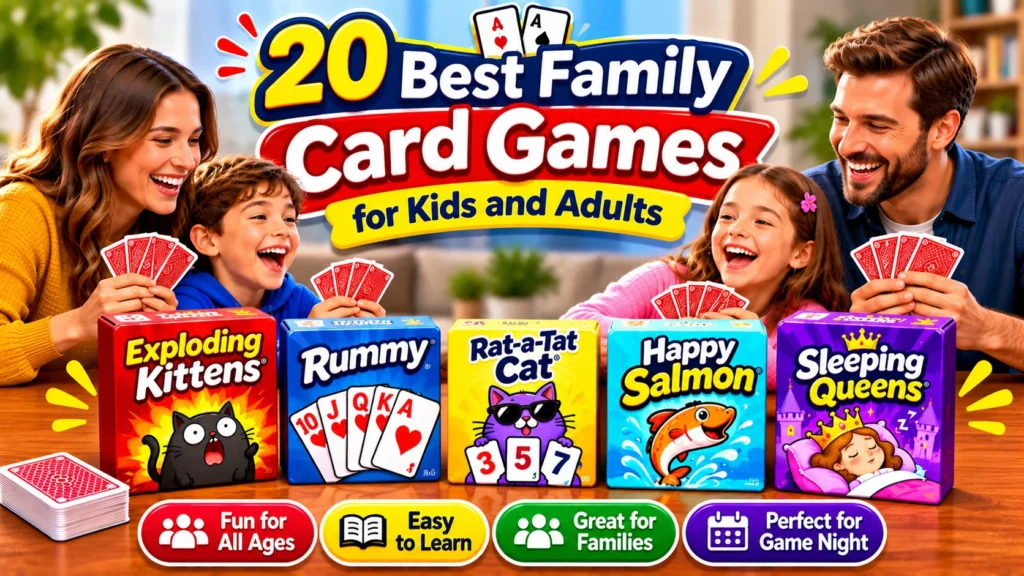
Looking for fun family card games that everyone can enjoy? Whether you’re planning a family game night, entertaining the kids on a rainy afternoon, or spending quality time together during vacation, a good card game can turn an ordinary evening into something memorable.
The best part? You don’t need expensive equipment or a complicated setup. Many card games for families require nothing more than a standard deck of playing cards, while others use colorful, specially designed cards that make the experience even more exciting.
From simple matching games for younger children to strategy-filled favorites for teenagers and adults, this guide covers 25 of the best family card games, with easy instructions, age suggestions, playing times, and practical tips.
Quick answer: Go Fish, Crazy Eights, Old Maid, War, and UNO are excellent starting points for family card game night. For older kids and adults, try Rummy, Skip-Bo, Phase 10, or Sushi Go! If you have a larger group, consider Spoons, Spot It!, or Happy Salmon.
Best Family Card Games at a Glance
Not every game works for every family. Some are better for younger children, while others offer more interesting challenges for older players.
Use this quick comparison table to find a game that suits your family.
Note: Ages for traditional playing-card games are editorial suggestions, not official ratings. Dedicated games use typical publisher age recommendations. Playing times are approximate and depend on experience and house rules.
| Card game | Players | Suggested age | Approx. time | Best for |
|---|---|---|---|---|
| Go Fish | 2–6 | 4+ | 10–15 min | Beginners |
| Old Maid | 2+ | 4+ | 10–15 min | Young kids |
| War | 2 | 5+ | 10–20 min | Number comparison |
| Crazy Eights | 2–5 | 6+ | 10–20 min | Mixed ages |
| Memory | 2+ | 4+ | 10–15 min | Matching and recall |
| Snap | 2+ | 5+ | 5–15 min | Quick reactions |
| Slapjack | 2+ | 6+ | 10–15 min | Active play |
| Spoons | 3+ | 7+ | 10–20 min | Group fun |
| UNO | 2–10 | 7+ | 15–30 min | Family game night |
| Skip-Bo | 2–6 | 7+ | 20–40 min | Number sequencing |
| Phase 10 | 2–6 | 7+ | 30–60+ min | Strategy |
| Spot It! | 2–8 | 6+ | 15 min | Visual matching |
| Sushi Go! | 2–5 | 8+ | 15 min | Light strategy |
| Exploding Kittens | 2–5 | 7+ | 15 min | Humor and surprises |
| Happy Salmon | 3–8 | 6+ | 2–5 min | Large groups |
Easy Family Card Games With a Regular Deck
You don’t have to purchase a new game to have a great family game night. A standard 52-card deck offers dozens of possibilities, from simple matching activities to exciting games that require concentration and quick thinking.
Here are 15 classic options worth trying.
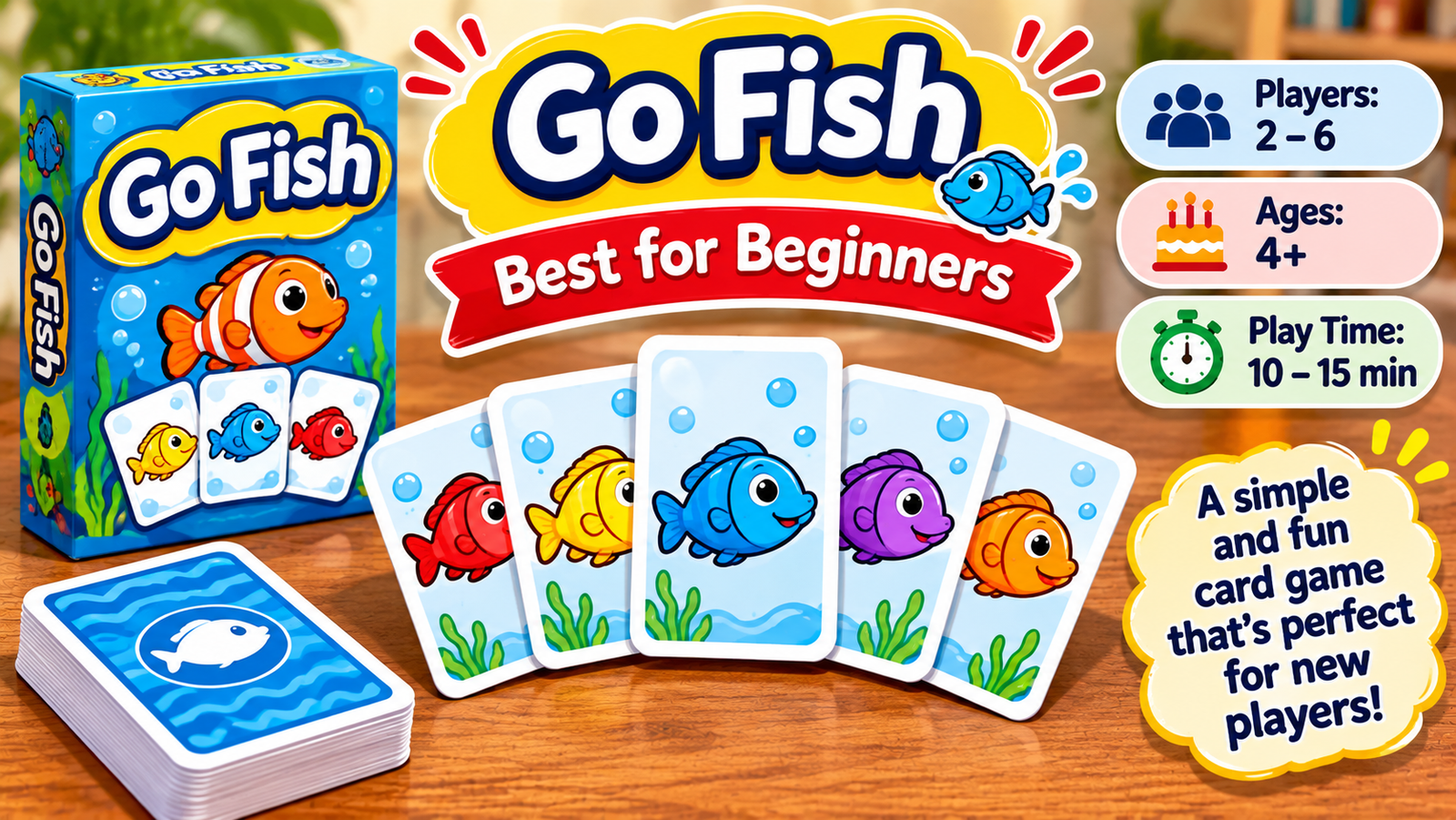
1. Go Fish — Best for Beginners
Players: 2–6 | Suggested age: 4+ | Playing time: 10–15 minutes
Go Fish is one of the easiest family card games to introduce to younger children. The goal is to collect more complete sets of four matching ranks than the other players.
How to play:
- Shuffle a standard deck and deal seven cards to each player in a two- or three-player game, or five cards each when there are more players.
- Place the remaining cards face down in the middle.
- On your turn, ask another player for a rank you already have in your hand, such as, “Do you have any sevens?”
- If they have that rank, they must give you all their cards of that rank, and you can ask again.
- If they don’t, they say “Go Fish,” and you draw from the middle pile. If you draw the rank you requested, you get another turn.
- Place completed sets of four on the table. When play ends, the player with the most completed sets wins.
Why families enjoy it: The rules are simple, the competition is gentle, and children get opportunities to practice recognizing numbers, remembering cards, and taking turns.
Parent tip: For preschoolers, use fewer ranks and collect matching pairs instead of four-of-a-kind sets.
2. Old Maid — Best for Young Children
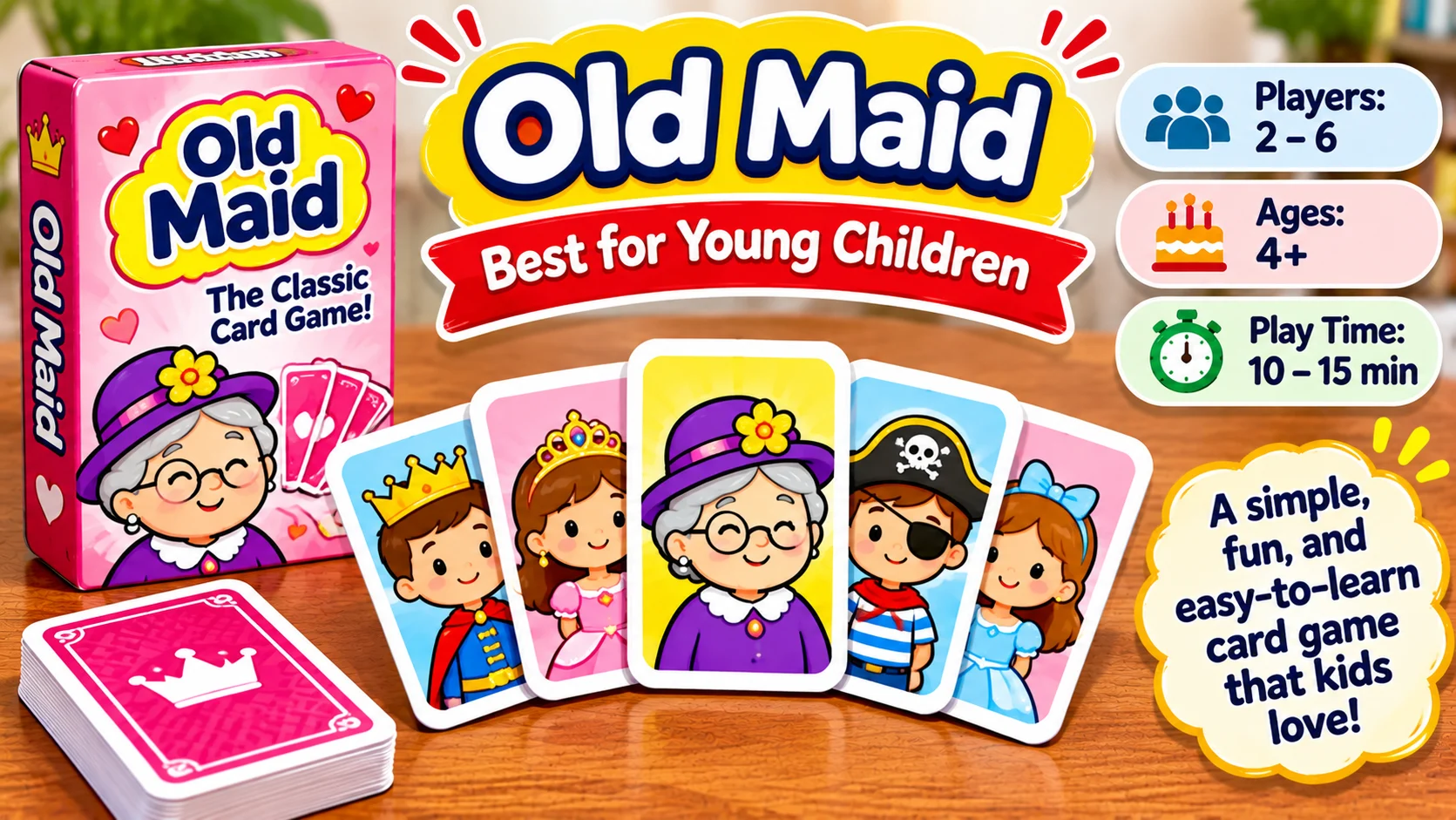
Players: 2 or more | Suggested age: 4+ | Playing time: 10–15 minutes
Old Maid is a traditional matching game in which everyone tries to avoid being the last player holding an unmatched card.
How to play:
- Remove one queen from a standard deck, leaving three queens.
- Deal all the remaining cards among the players.
- Everyone removes pairs of matching ranks from their hands.
- Players take turns drawing one unseen card from the next player’s hand.
- Whenever a new pair forms, discard it.
- Continue until all pairs are gone and one player remains with the unmatched queen.
Why families enjoy it: Old Maid combines anticipation with simple matching. Children don’t need to read instructions or calculate complicated scores.
Parent tip: Encourage children to keep the game lighthearted rather than making the losing player feel embarrassed.
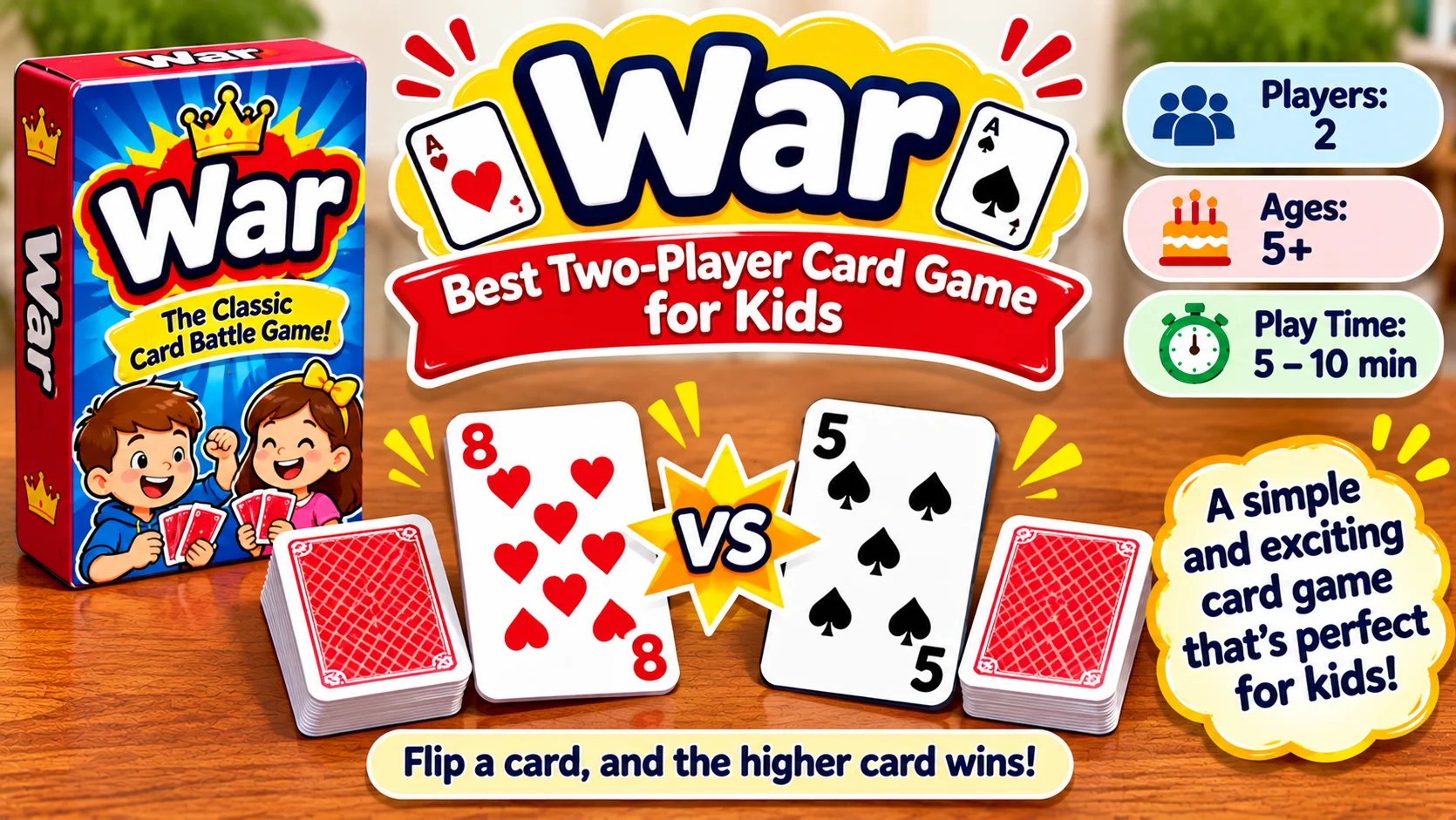
3. War — Best Two-Player Card Game for Kids
Players: 2 | Suggested age: 5+ | Playing time: 10–20 minutes or longer
War is an easy two-player card game where players compare card values. It requires almost no strategy, making it a suitable introduction to playing cards.
How to play:
- Divide a shuffled deck equally between two players.
- Keep each player’s cards face down in a stack.
- Both players reveal their top card simultaneously.
- The higher-ranking card wins both cards, which go to the bottom of the winner’s stack.
- When the cards tie, each player places three cards face down and turns over another card to decide the winner of that battle.
- Continue until one player has all the cards or end after a set time and count cards.
Why families enjoy it: War gives children practice comparing larger and smaller numbers while keeping everyone involved.
Parent tip: Use a five-minute timer if you want a quicker game, since a full game of War can take a long time.
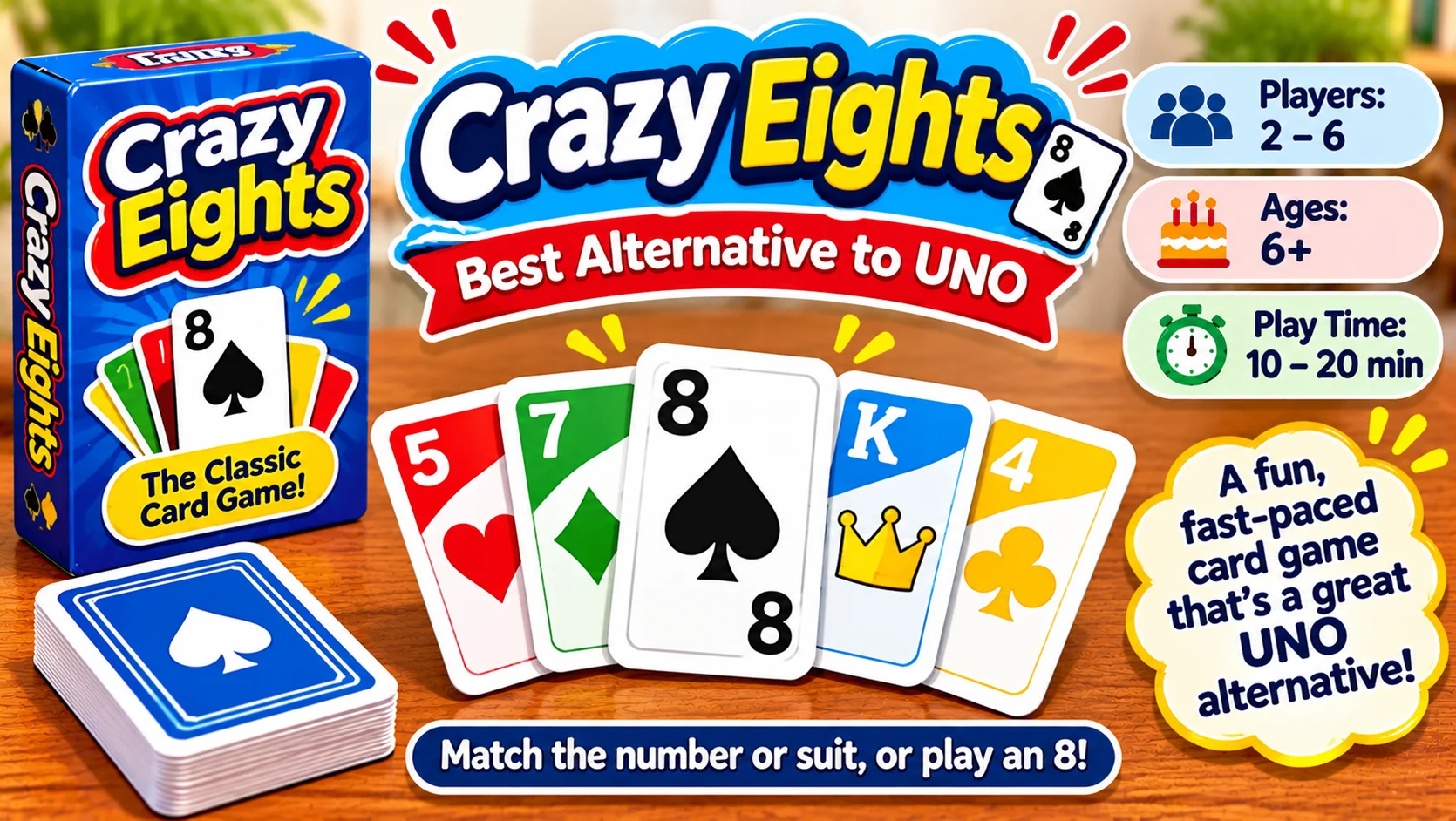
4. Crazy Eights — Best Alternative to UNO
Players: 2–5 | Suggested age: 6+ | Playing time: 10–20 minutes
Crazy Eights is a classic shedding game in which the goal is to get rid of all your cards before anyone else.
How to play:
- Deal seven cards each for two players or five cards each for three or more.
- Place the remaining deck face down and turn one card face up to start a discard pile.
- On your turn, play a card matching the top discard’s rank or suit.
- An eight can be played as a wild card, allowing you to choose the next suit.
- If you cannot play, draw from the deck according to your agreed house rule.
- The first player to empty their hand wins the round.
Why families enjoy it: Players learn color and symbol recognition, decision-making, and basic strategy without complicated equipment.
Parent tip: Agree before starting whether players draw just one card or keep drawing until they can play.
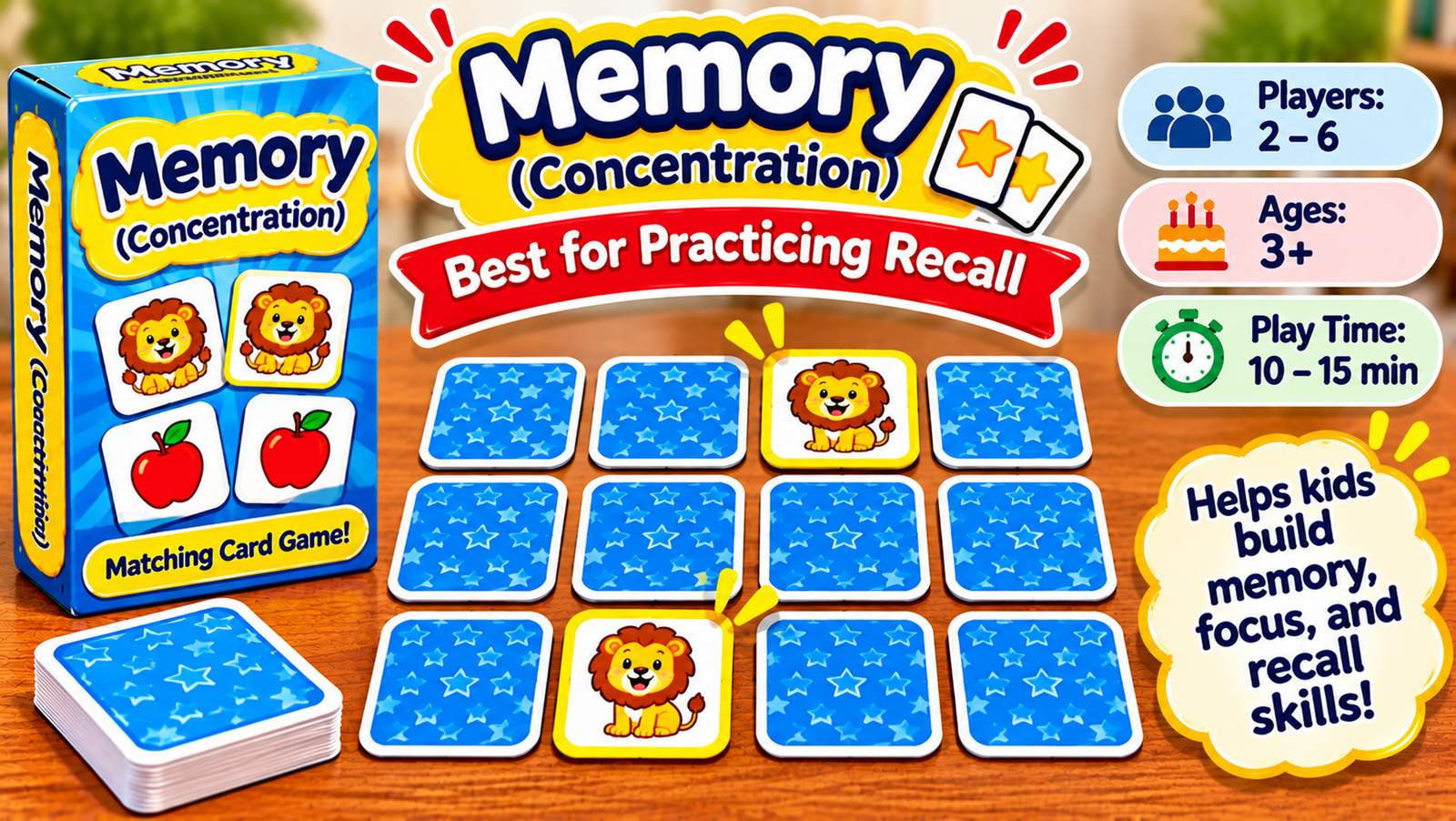
5. Memory (Concentration) — Best for Practicing Recall
Players: 2 or more | Suggested age: 4+ | Playing time: 10–15 minutes
Memory is a quiet matching game that works particularly well with younger children.
How to play:
- Select matching pairs of cards, preferably cards with the same rank.
- Shuffle the selected cards and arrange them face down in a grid.
- Players take turns turning over two cards.
- If the ranks match, the player keeps the pair and takes another turn.
- If they don’t match, turn both cards face down again.
- The person with the most pairs at the end wins.
Why families enjoy it: Memory encourages concentration and visual recall without requiring fast reactions.
Parent tip: Begin with six or eight pairs, then add more as children become comfortable.
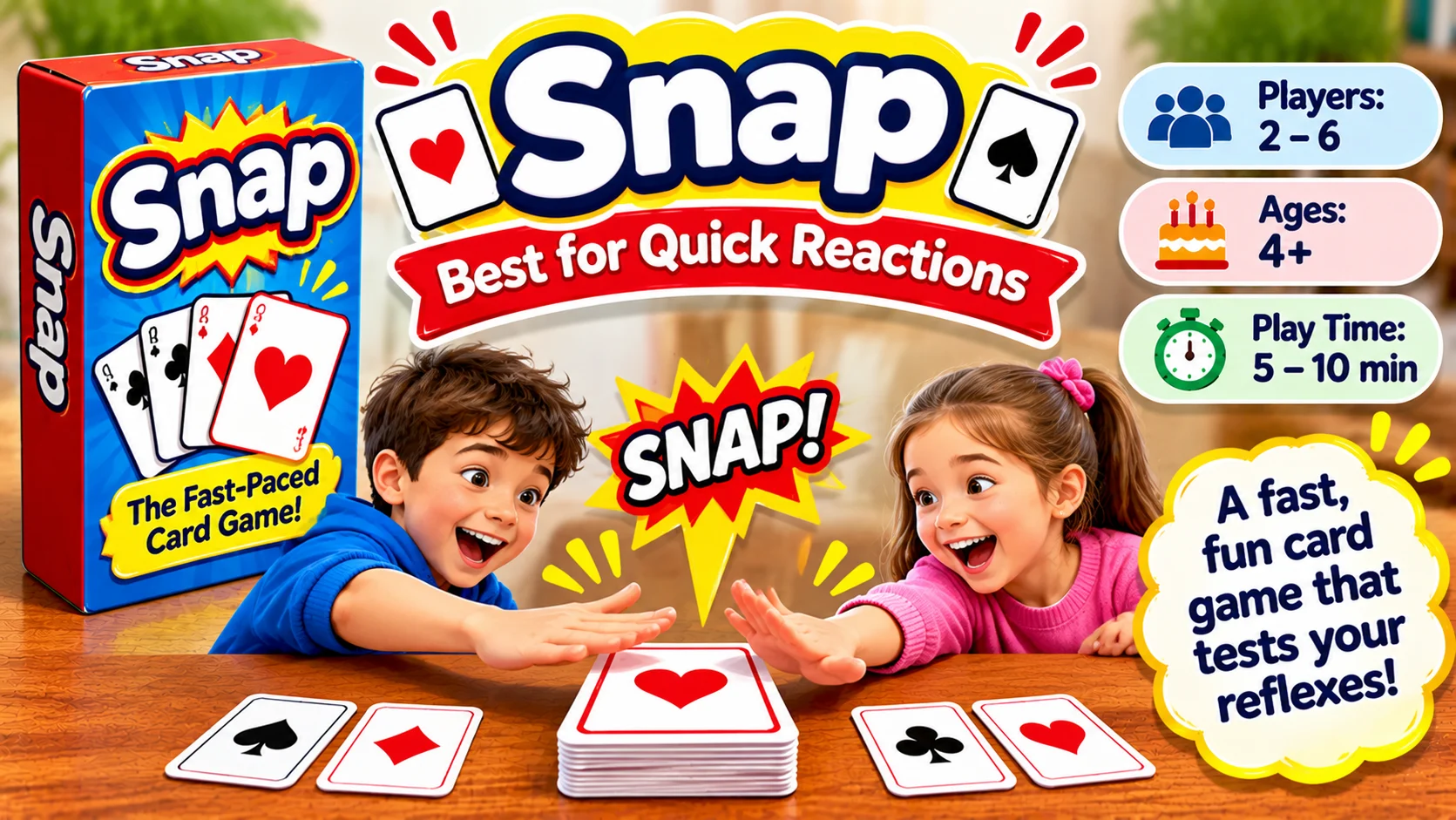
6. Snap — Best for Quick Reactions
Players: 2 or more | Suggested age: 5+ | Playing time: 5–15 minutes
Snap is an energetic card game where players look for matching ranks and react quickly.
How to play:
- Deal the cards equally into face-down stacks.
- Players take turns flipping one card onto their individual face-up piles.
- When two visible top cards show the same rank, players race to call “Snap!”
- The first correct caller collects the matching piles.
- Continue until one player collects all the cards, or play a timed round.
Why families enjoy it: Everyone needs to pay attention, and the rounds are usually lively.
Parent tip: Use a calling-only version instead of slapping cards if younger players have difficulty with fast hand movements.
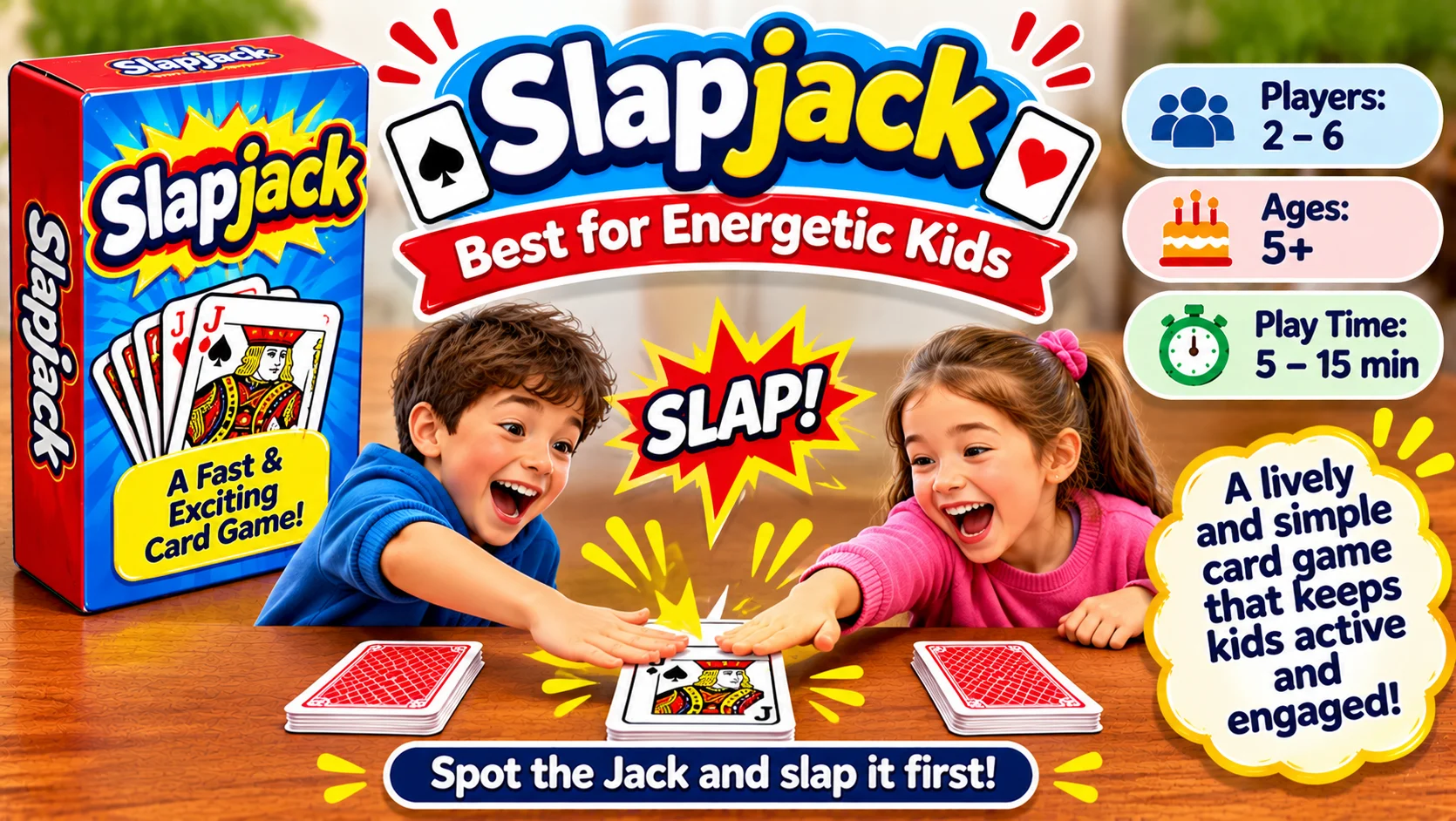
7. Slapjack Best for Energetic Kids
Players: 2 or more | Suggested age: 6+ | Playing time: 10–15 minutes
Slapjack is another quick-reaction game where players watch for jacks appearing in the central pile.
How to play:
- Deal all the cards equally, face down.
- Players take turns placing their top card face up in the center.
- Whenever a jack appears, everyone tries to be first to slap the pile.
- The first correct player collects the central cards.
- Continue until one player has collected all the cards.
Why families enjoy it: Slapjack adds movement and excitement to an ordinary deck of cards.
Parent tip: Make sure everyone uses gentle hands and agrees on what counts as a correct slap
.
8. Spoons — Best for Family Gatherings
Players: 3 or more | Suggested age: 7+ | Playing time: 10–20 minutes
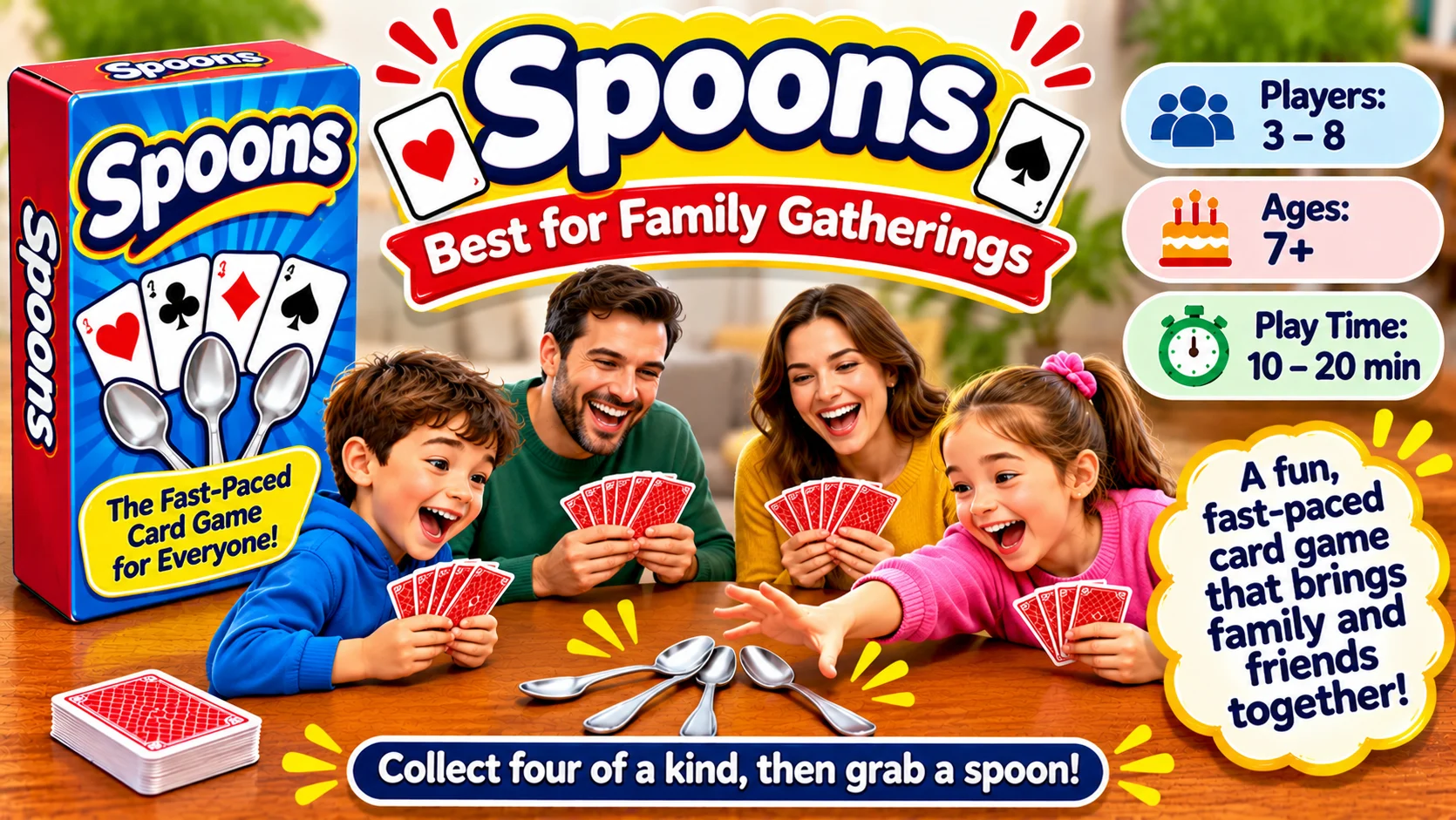
Spoons is a lively matching game that combines card passing with a race to collect an object.
What you need: A standard deck and one fewer spoon than the number of players.
How to play:
- Give each player four cards.
- Place the spoons in the center of the table.
- One player draws from the deck, keeps or passes a card, and the other players pass unwanted cards around the table.
- When someone collects four cards of the same rank, they take a spoon.
- Everyone else races to take one too.
- The player left without a spoon loses that round.
Why families enjoy it: The surprise of someone grabbing a spoon makes each round exciting.
Parent tip: For smaller children, substitute soft objects for metal spoons and keep the game gentle.
9. Pig — Best Simple Group Card Game
Players: 3–8 | Suggested age: 6+ | Playing time: 10–15 minutes
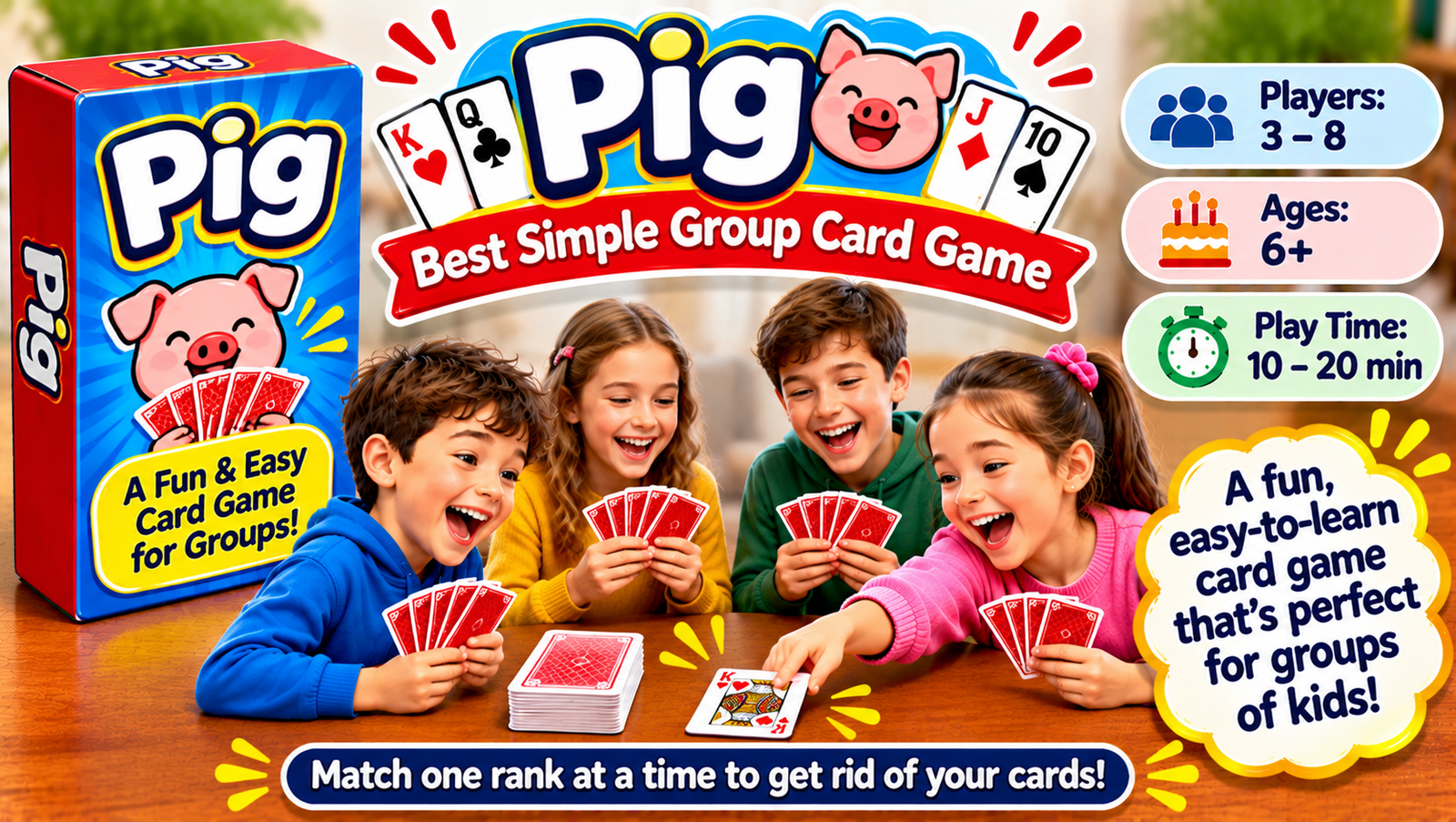
Pig is another four-of-a-kind game, but instead of collecting spoons, players watch for a secret signal.
How to play:
- Select one complete four-card rank for each player, then shuffle those cards.
- Deal four cards to everyone.
- Each player chooses one card and passes it face down to the person on their left.
- Continue passing until someone has four cards of the same rank.
- That player quietly touches their nose.
- The others must notice and copy. The last player to do so loses the round.
Why families enjoy it: Pig combines observation, matching, and silly moments.
10. Sevens — Best for Number Sequencing
Players: 3 or more | Suggested age: 7+ | Playing time: 15–25 minutes
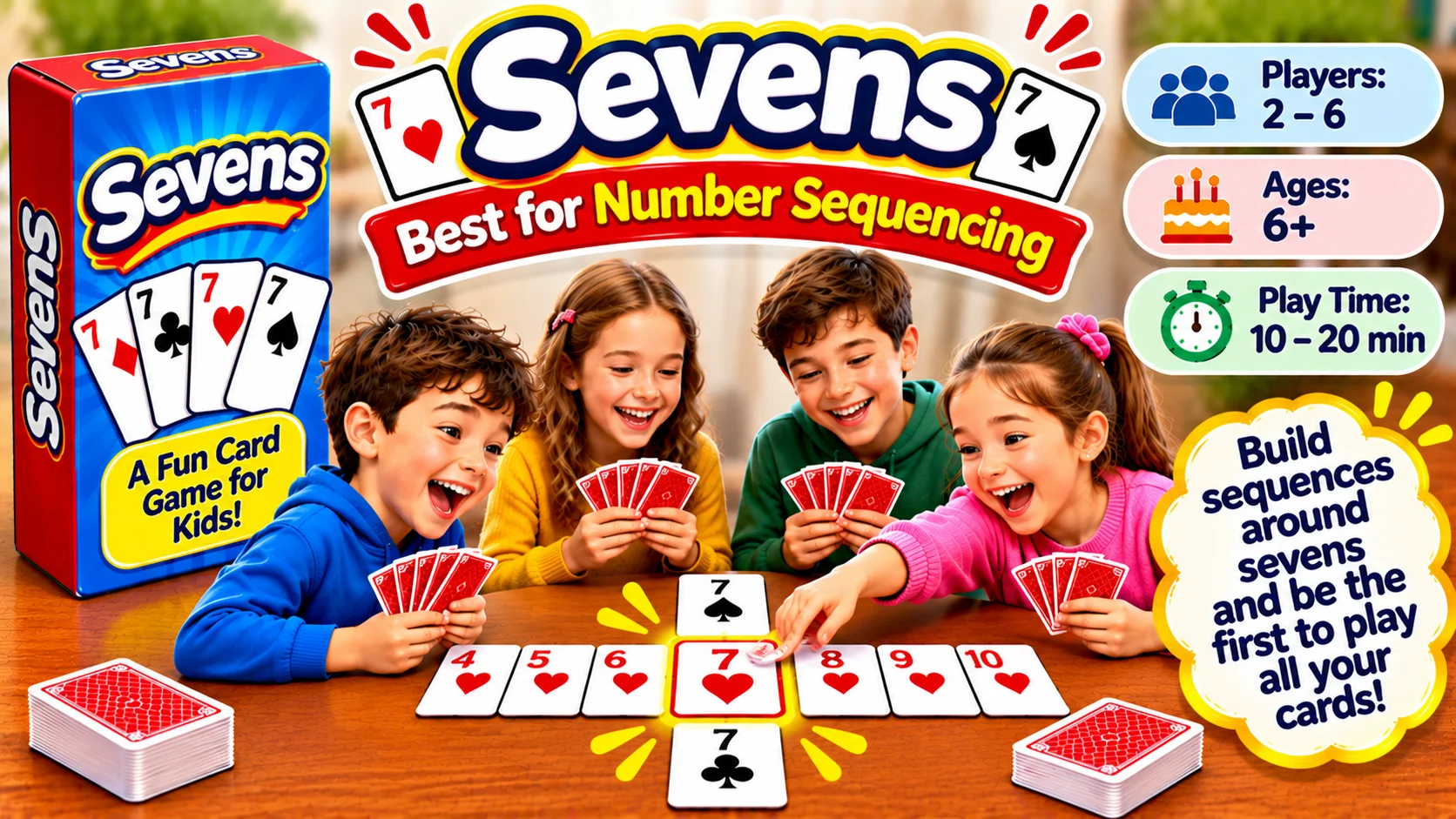
Sevens, sometimes called Fan Tan, is a sequencing game that encourages players to think about which cards to play next.
How to play:
- Deal all 52 cards among the players.
- The player holding the seven of diamonds plays it to begin.
- Players take turns laying down other sevens or cards immediately above or below those already played in the same suit.
- For example, a six or eight of diamonds can be played beside the seven of diamonds.
- If you cannot play, you pass.
- The first player to use all their cards wins.
Why families enjoy it: This game provides an approachable introduction to numerical sequences and planning.
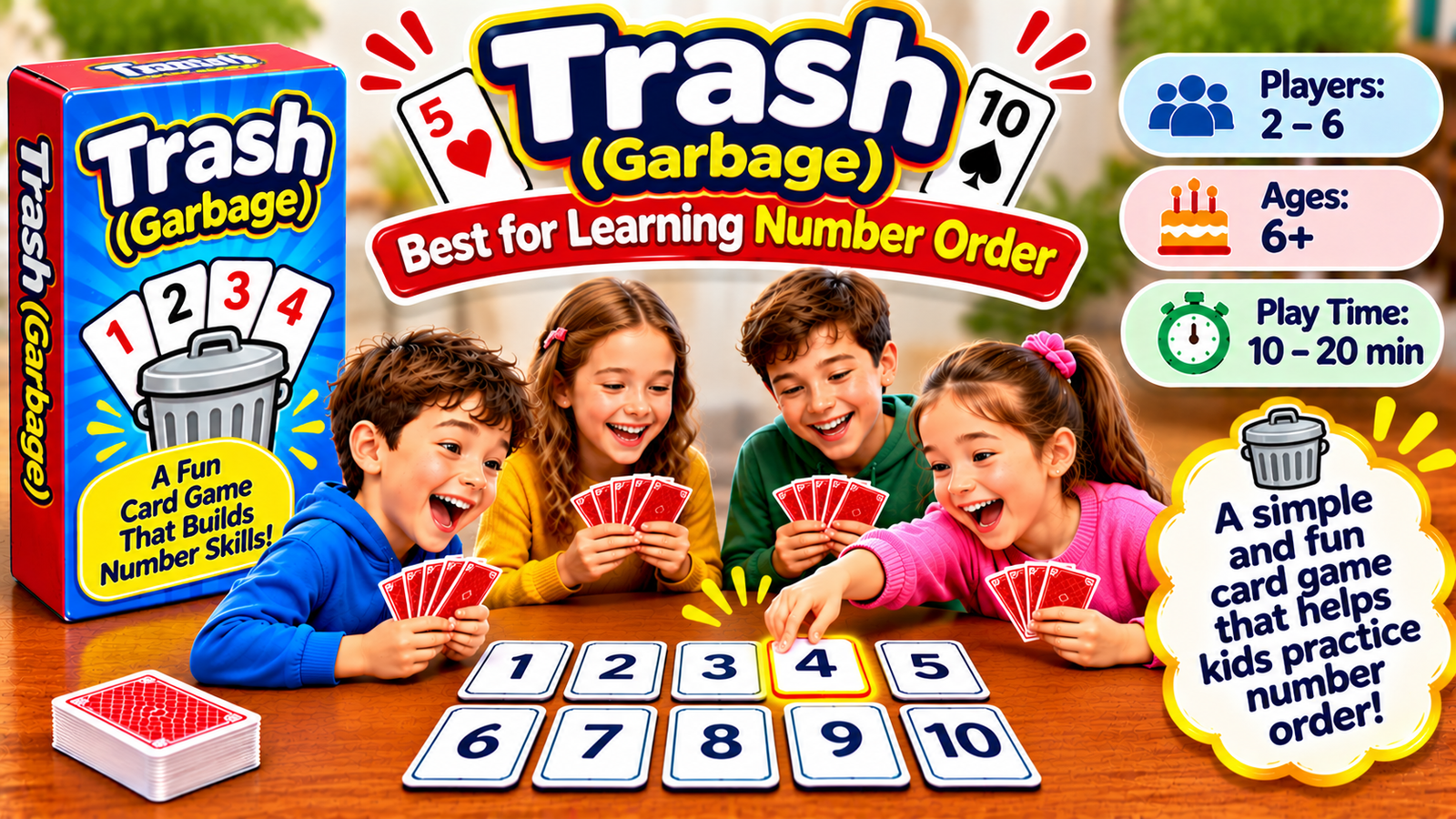
11. Trash (Garbage) — Best for Learning Number Order
Players: 2–4 | Suggested age: 6+ | Playing time: 15–25 minutes
Trash is a fun card game where players try to arrange numbers in the correct positions.
How to play:
- Deal ten cards face down to each player in two rows of five.
- Number the positions mentally from one through ten.
- Players draw cards and replace face-down cards in the corresponding numbered position, using aces for position one.
- Continue using newly revealed cards until a card cannot be placed.
- A player who completes all ten positions wins the round and starts the next with one fewer position.
- The first player to complete their final one-card round wins the game.
Why families enjoy it: Trash gives children a reason to recognize numbers and anticipate what comes next.
Parent tip: Decide in advance whether kings are wild and whether jacks and queens are unusable, as rules vary.
12. Rummy — Best for Developing Strategy
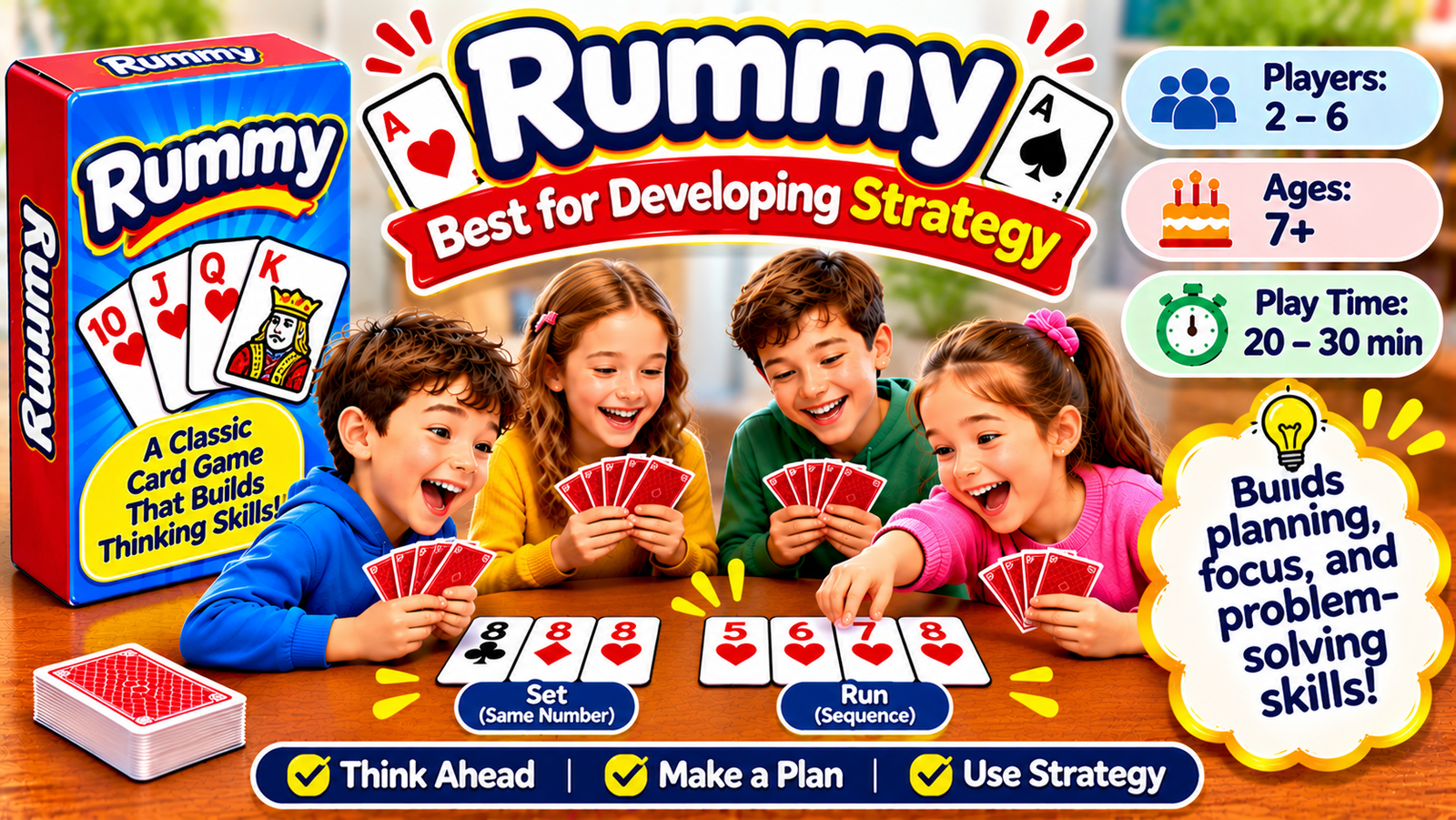
Players: 2–4 | Suggested age: 8+ | Playing time: 20–40 minutes
Rummy is a classic card game that combines matching, sequencing, and decision-making.
How to play:
- For a simple family version, deal seven cards to each player.
- Place the rest face down as a draw pile and turn over one card to begin a discard pile.
- Players take turns drawing a card and discarding one.
- The goal is to form groups of three or four equal ranks or runs of at least three consecutive cards of the same suit.
- Depending on the agreed variation, players lay down valid combinations during play or reveal them when going out.
- Score remaining unmatched cards after a player goes out.
Why families enjoy it: Rummy offers more strategic choices than beginner matching games, making it suitable for older children and adults.
13. Hearts — Best for Older Kids and Adults
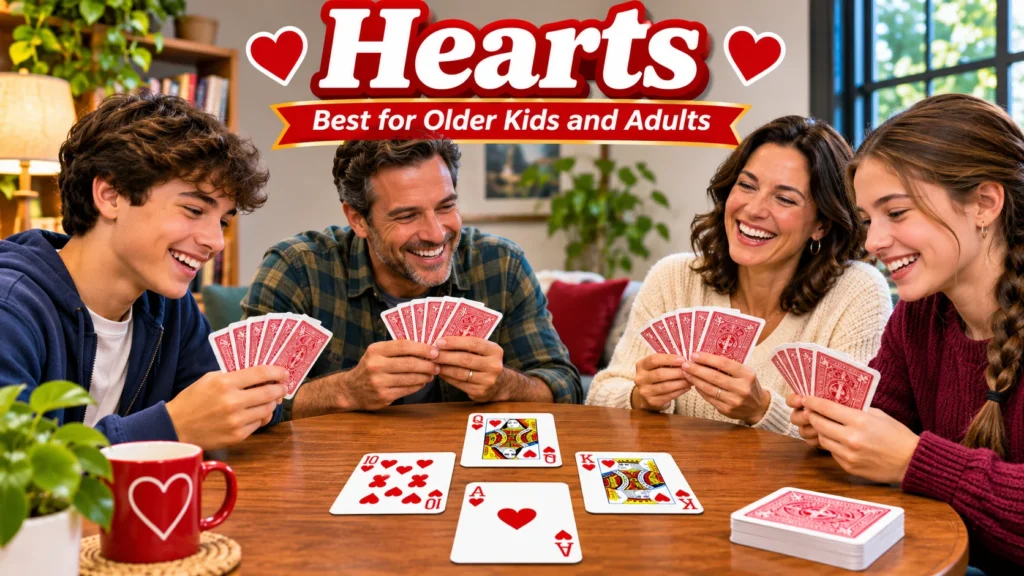
Players: 4 | Suggested age: 10+ | Playing time: 20–40 minutes
Hearts is a trick-taking game where the objective is to avoid collecting penalty cards.
How to play:
- Deal 13 cards to each player.
- Players usually pass three cards before most rounds, following the game’s passing rotation.
- The player holding the two of clubs starts the first trick.
- Each player must follow the leading suit if possible.
- The highest card in the leading suit wins the trick.
- Hearts count as one penalty point each, and the queen of spades counts as 13. The player with the lowest total score after the agreed number of rounds wins.
Why families enjoy it: Hearts introduces older players to strategic choices, observation, and planning.
Popular Card Games for Families Worth Trying
Traditional playing cards are wonderful, but dedicated card games add new themes, special actions, and creative challenges.
Here are ten popular choices for kids, teenagers, and adults.
14. UNO — Best Overall for Mixed-Age Families
Players: 2–10 | Age: 7+ | Playing time: 15–30 minutes
UNO is a colorful matching game where players try to get rid of all their cards.
Players take turns matching the color, number, or symbol shown on the discard pile. Action cards can reverse the direction of play, skip another player, or require someone to draw extra cards.
When a player has just one card left, they must say “UNO!” The first player to empty their hand wins the round.
Why families enjoy it: The rules are approachable, the colors are easy to recognize, and surprise action cards keep the game entertaining.
Best for: Families who want a versatile game for children and adults.

15. Taco Cat Goat Cheese Pizza — Best for Laughs
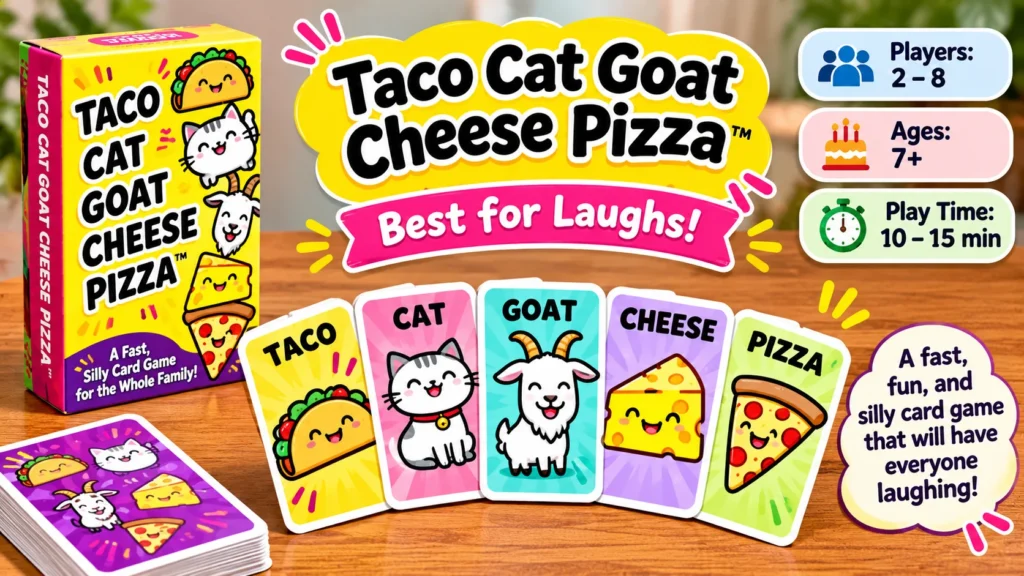
Players: 2–8 | Age: 7+ | Playing time: 10–15 minutes
Taco Cat Goat Cheese Pizza is a silly, fast-paced reaction game.
Players take turns placing cards into the middle while repeating the sequence “Taco, Cat, Goat, Cheese, Pizza.”
When the word spoken matches the card displayed, everyone races to slap the pile.
Special cards introduce additional actions that make the game even more unpredictable.
Why families enjoy it: The funny phrases, fast reactions, and unexpected moments make this game entertaining for groups.
Best for: Energetic families who don’t mind a little noise.
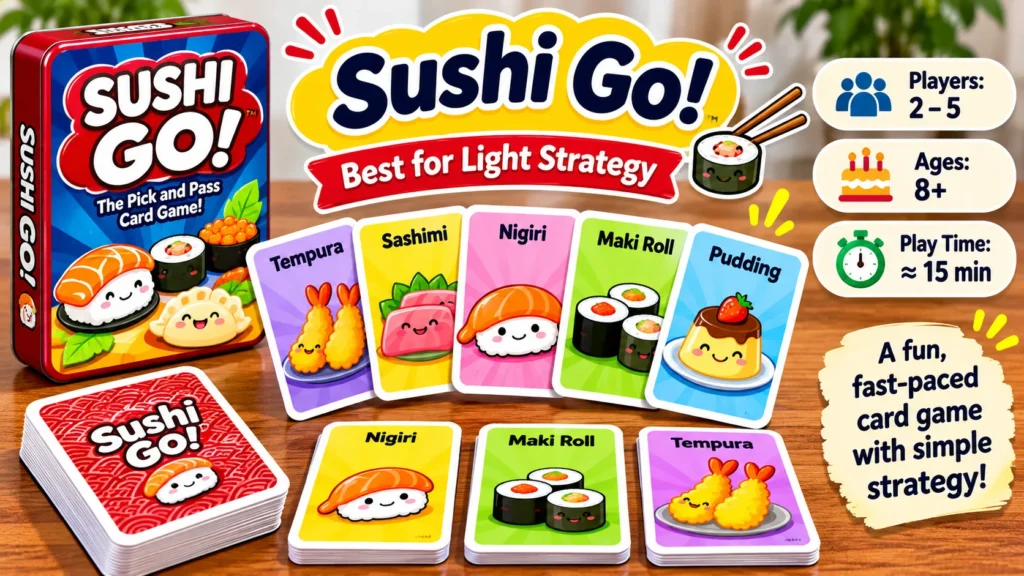
16. Sushi Go! — Best for Light Strategy
Players: 2–5 | Age: 8+ | Playing time: About 15 minutes
Sushi Go! is a colorful card-drafting game featuring different sushi dishes.
Each player receives a hand of cards, secretly chooses one to keep, and passes the remaining cards to the next player.
Players collect combinations that score different numbers of points. After three rounds, the player with the highest total wins.
Why families enjoy it: The illustrated cards are cheerful, and players can learn the basic choose-and-pass process quickly.
Best for: Families ready to move beyond simple matching games.
17. Exploding Kittens — Best for Humor and Surprises
Players: 2–5 | Age: 7+ | Playing time: About 15 minutes
Exploding Kittens is a light strategy game where players try to avoid drawing an Exploding Kitten card.
Players draw cards on their turns and use special action cards to influence the game. A Defuse card can save someone from an explosion.
Without a way to defuse an Exploding Kitten, a player is eliminated. The last remaining player wins.
Why families enjoy it: The unusual illustrations, surprising actions, and playful competition create memorable moments.
Best for: Older kids who enjoy unpredictable games.
Children enjoying Exploding Kittens with illustrated action cards and playful cat artwork.
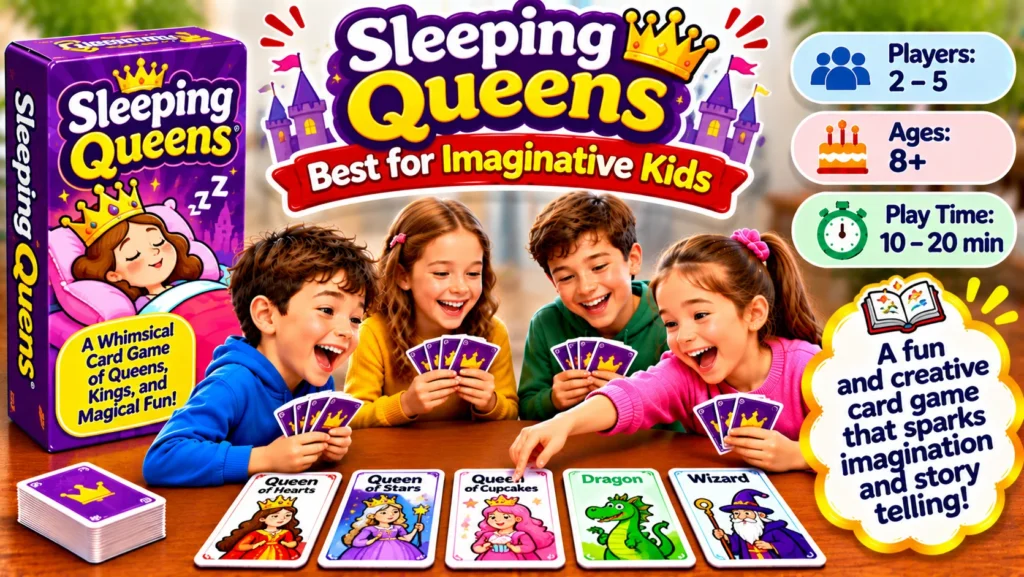
18. Sleeping Queens — Best for Imaginative Kids
Players: 2–5 | Age: 8+ | Playing time: About 20 minutes
Sleeping Queens is a fantasy-themed card game where players try to wake sleeping queens and collect enough queens or points to win.
Players use king cards to awaken queens, while knights, dragons, and other cards introduce additional actions.
Some moves involve making simple arithmetic combinations.
Why families enjoy it: The charming theme makes the game attractive to imaginative children, while the rules encourage planning and number recognition.
Best for: School-age children who enjoy fantasy stories and light strategy.
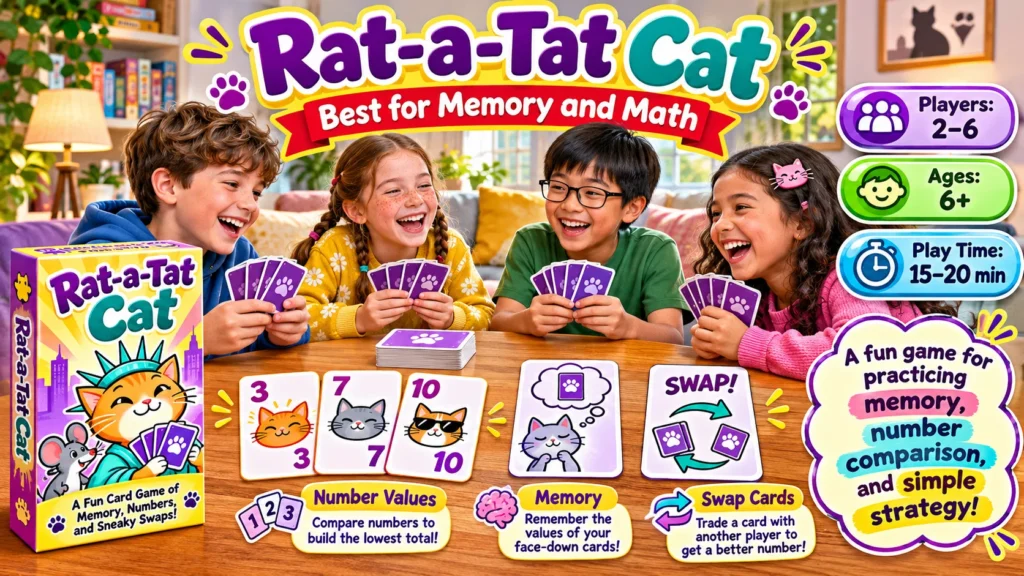
19. Rat-a-Tat Cat — Best for Memory and Math
Players: 2–6 | Age: 6+ | Playing time: About 20 minutes
Rat-a-Tat Cat is a memory and strategy game where players try to finish with the lowest card total.
Players keep a small arrangement of cards, some of which remain hidden. During the game, they draw and swap cards to improve their hands.
Special cards let players peek at hidden cards or exchange cards with opponents.
When a player believes their total is low enough, they can signal the end of the round.
Why families enjoy it: The game combines memory, number comparison, and decision-making.
Best for: Children who are comfortable recognizing numbers and remembering card positions.
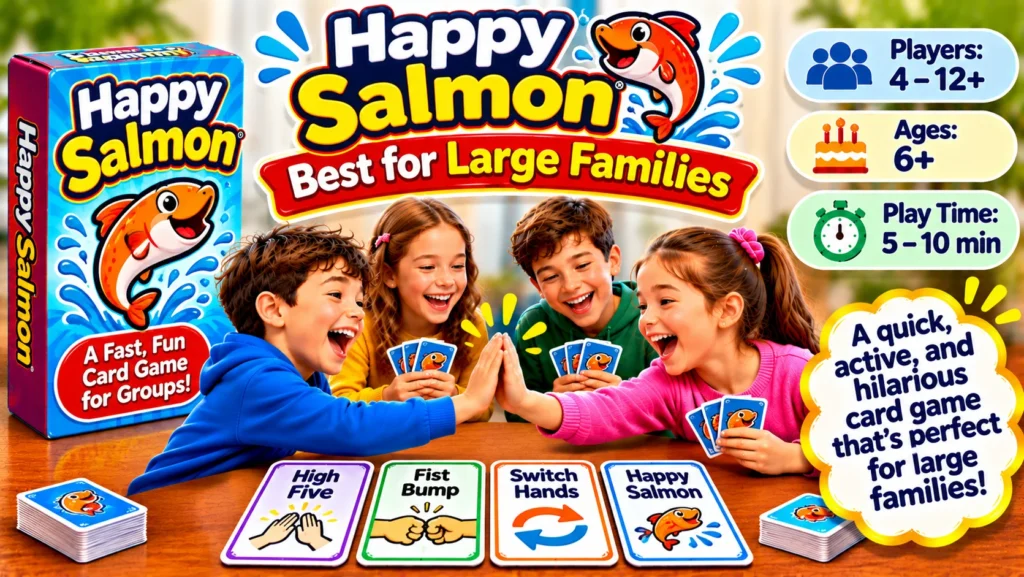
20. Happy Salmon — Best for Large Families
Players: 3–8 | Age: 6+ | Playing time: Around 2 minutes per round
Happy Salmon is a lively card game that encourages players to move, laugh, and interact.
Each player has a deck of action cards. Everyone plays simultaneously, calling out the action shown on their top card.
Players find someone with a matching action and complete it together. The first person to finish their cards wins.
Why families enjoy it: Games are extremely short, making it easy to play several rounds.
Best for: Family gatherings, parties, and groups with energetic children.
Best Family Card Games by Age
Choosing a game becomes much easier when you consider your child’s interests, attention span, and experience with cards.
Ages 4–6: Simple Matching Games
Younger children often enjoy games with recognizable pictures, numbers, and repeated actions.
Good options include Go Fish, Old Maid, Memory, War, and simplified Snap.
Start with a small number of cards and explain one rule at a time. Let children practice a few turns before beginning an actual round.
Ages 7–9: Games With More Choices
Children in this age range may be ready for games that require planning, sequencing, or quick decisions.
Try Crazy Eights, UNO, Skip-Bo, Spot It!, Spoons, and Sleeping Queens.
These games can introduce more choices while keeping the basic objectives understandable.
Ages 10 and Up: Strategy and Competition
Older children and teenagers may appreciate games with longer rounds or more complicated scoring.
Consider Rummy, Hearts, Phase 10, Sushi Go!, Exploding Kittens, and Kings in the Corner.
Some younger children may also enjoy these games with guidance. Ability, experience, and personal interests matter more than age alone.
Best Card Games for a Family of Four
A family of four has plenty of great options.
For younger children: Go Fish, Crazy Eights, UNO, and Memory can keep the rules manageable.
For families with older kids: Rummy, Skip-Bo, Sushi Go!, and Phase 10 offer more decisions and opportunities for strategy.
For a noisy and energetic game night: Spoons, Taco Cat Goat Cheese Pizza, and Happy Salmon can be entertaining choices.
Try starting with a ten-minute game before introducing something more complicated. This helps everyone settle in without feeling overwhelmed.
Quick Family Card Games You Can Play in 15 Minutes
Sometimes you only have a few minutes between dinner, homework, and bedtime.
For a short game session, choose options with simple setup and quick rounds.
| Game | Approximate time | Why it works |
|---|---|---|
| Snap | 5–15 minutes | Easy to start |
| Memory | 10–15 minutes | Quiet, simple matching |
| Go Fish | 10–15 minutes | Beginner-friendly |
| Spot It! | 15 minutes or less | Fast visual matching |
| Sushi Go! | About 15 minutes | Short strategy game |
| Exploding Kittens | About 15 minutes | Quick surprises |
| Happy Salmon | Around 2 minutes per round | Great for a short activity |
Remember that learning the rules can make the first round take longer than usual.
How to Choose the Best Family Card Game
The best choice depends on who’s playing and how much time everyone has.
Consider the Youngest Player
Choose a game that the youngest family member can understand and enjoy. A simple game that includes everyone is often more enjoyable than a complicated one that leaves someone frustrated.
Check the Number of Players
Some games are designed for exactly two players, while others work best with larger groups.
If your family frequently invites grandparents, cousins, or friends, look for games that support six or more players.
Think About Playing Time
Younger children may prefer ten-minute activities. Older children and adults may be happy to spend an hour playing a strategy game.
Pick a game that fits your available time rather than rushing through the rules.
Decide Between Luck and Strategy
Games like War rely heavily on luck, giving beginners a chance against experienced players.
Games such as Rummy and Phase 10 require more planning.
A mix of both styles can keep family game night interesting.
Choose the Right Activity Level
Quiet games such as Memory or Rummy are useful when you want a calm evening.
If everyone has extra energy, choose a reaction-based game such as Snap, Spoons, or Happy Salmon.
Benefits of Playing Card Games as a Family
Family card games aren’t just about winning and losing. They also create opportunities for children and adults to interact, practice skills, and spend meaningful time together.
Encourages Communication
Many card games involve asking questions, explaining choices, and listening to other players.
Go Fish, for example, gives younger children practice speaking clearly and waiting for a response.
Provides Opportunities to Practice Math
Games involving numbers and sequences can help children apply basic counting, comparison, and arithmetic skills.
War emphasizes comparing numbers, while Skip-Bo introduces sequencing.
These activities can reinforce familiar concepts in an enjoyable setting.
Supports Memory and Attention
Games such as Memory and Rat-a-Tat Cat require players to remember information and pay attention to changing cards.
Regular play gives children opportunities to practice these skills, although it should not be viewed as a guaranteed way to improve cognitive performance.
Encourages Patience and Turn-Taking
Waiting for a turn, following agreed rules, and responding appropriately to winning or losing are useful parts of social play.
Adults can model these behaviors by treating every player fairly.
Creates Opportunities for Family Bonding
A short card game gives family members a shared activity that doesn’t require a television, tablet, or smartphone.
The conversations, jokes, and unexpected moments may become just as important as the game itself.
How to Organize a Fun Family Card Game Night
A successful game night doesn’t need an elaborate plan.
Step 1: Choose a convenient time. Pick an evening or weekend when family members aren’t rushing to other activities.
Step 2: Prepare your playing space. Clear a table, arrange comfortable seating, and keep snacks or drinks away from the cards.
Step 3: Let everyone help choose. Offer two or three age-appropriate options and let family members vote.
Step 4: Explain the rules clearly. Demonstrate a few practice turns instead of reading complicated instructions all at once.
Step 5: Keep the competition friendly. Congratulate good moves, encourage younger players, and avoid making winning the only goal.
Step 6: Try different games. Alternate between quiet, strategic games and energetic activities.
You can even create a family game-night tradition by letting a different person choose the first game each week.
Common Family Card Game Mistakes to Avoid
Even a simple game can become frustrating when expectations aren’t clear.
Choosing rules that are too complicated: Begin with familiar games and introduce new rules gradually.
Ignoring age recommendations: Publisher age guidance can help, especially when a dedicated game includes more complicated actions or themes.
Changing rules halfway through: Agree on house rules before the game begins.
Playing for too long: End the session while children are still engaged rather than pushing through several more rounds.
Focusing only on winning: Remind everyone that learning, participation, and spending time together are important parts of playing.
Frequently Asked Questions About Family Card Games
What are the best family card games?
Some of the best family card games include Go Fish, UNO, Crazy Eights, Old Maid, Skip-Bo, and Rummy. The ideal choice depends on children’s ages, the number of players, and how much time the family has available. Go Fish is particularly approachable for beginners, while Rummy suits players who want more strategy.
What card games can families play with a regular deck?
Families can play Go Fish, War, Old Maid, Crazy Eights, Slapjack, Snap, Memory, Spoons, Rummy, and several other games with traditional playing cards. Most require no additional equipment, although games such as Spoons use household objects.
What are easy card games for kids?
Go Fish, Old Maid, War, and Memory are good starting points for younger children. They involve simple actions such as matching, recognizing numbers, and collecting cards. Parents can shorten rounds or simplify the rules to suit beginners.
What is the best card game for a family of four?
UNO, Crazy Eights, Go Fish, Skip-Bo, and Sushi Go! are all suitable choices for a family of four. UNO is especially convenient for mixed-age groups, while Sushi Go! offers a little more strategy for families with older children.
Are card games good for children?
Card games can offer enjoyable opportunities to practice counting, matching, communication, patience, and turn-taking. Different games involve different skills, so the benefits depend on the activity and how adults support the experience.
What family card games are good for large groups?
UNO, Spot It!, Taco Cat Goat Cheese Pizza, Happy Salmon, and Spoons can accommodate larger groups. Check player limits before starting, and consider breaking into smaller tables if you have more participants than a game supports.
What are some quick card games for family game night?
Snap, Go Fish, Memory, Spot It!, and Happy Salmon are useful choices when time is limited. Many rounds can be completed in fifteen minutes or less, although new players may need extra time to learn.
Can a five-year-old play family card games?
Yes. Many five-year-olds can enjoy beginner-friendly games such as Go Fish, Old Maid, War, and Memory with appropriate guidance. Choose simple rules, limit the number of cards when needed, and focus on having fun rather than competitive scoring.
Final Thoughts
The best family card games are the ones that bring everyone together, regardless of age or experience.
You don’t need a large collection of games to get started. A single deck of playing cards opens the door to classics such as Go Fish, Crazy Eights, War, and Rummy. If your family enjoys something more colorful or unpredictable, UNO, Skip-Bo, Sushi Go!, and other dedicated card games offer plenty of variety.
Start with one or two games that suit your family’s ages and interests. Keep the rules simple, encourage everyone to participate, and allow room for laughter.
After all, the goal of family game night isn’t just to collect the most cards or score the highest points. It’s to enjoy the time you spend playing together.