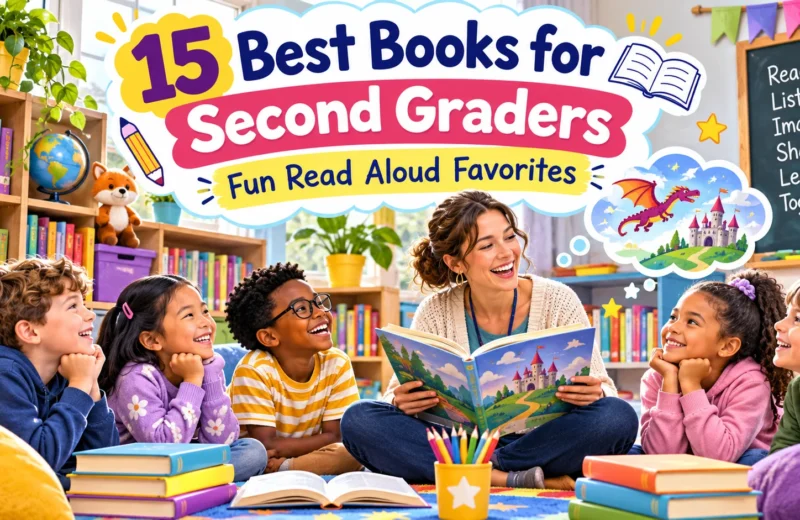
Math becomes more meaningful when children can see numbers, shapes, and patterns in familiar stories. A picture book about sharing cookies can introduce equal groups, while a story about animals can turn counting into an exciting discovery.
The best children’s books about math combine engaging illustrations, memorable characters, and mathematical ideas that children can explore through conversation and play.
For teachers looking for children’s literature books for math, the challenge is choosing stories that do more than mention numbers. A useful book should encourage children to count, compare, predict, explain, or solve problems.
This guide features 15 carefully selected math picture books for preschoolers, kindergarteners, and elementary students. Each recommendation includes its learning focus, suggested grade range, and an easy activity for classroom or home use.
Quick Answer: Some excellent math books for young children include Ten Black Dots for counting, Quack and Count for addition, Mouse Shapes for geometry, Pattern Fish for repeating patterns, and The Doorbell Rang for equal sharing. Choose a book that matches the child’s current mathematical skills, then reinforce the story with simple questions and hands-on activities.
Why Use Children’s Literature to Teach Math?
Picture books can make mathematical concepts easier to discuss because they place them within situations children understand. Instead of seeing addition only as numbers on paper, children might watch characters join a group, share objects, or solve a practical problem.
Stanford University’s Development and Research in Early Mathematics Education (DREME) initiative highlights how picture books provide opportunities for conversations about counting, shapes, patterns, and measurement.
These learning opportunities become particularly useful when adults ask thoughtful questions and encourage children to explain their reasoning.
Math picture books can support several learning goals:
- Number sense: Recognizing quantities, counting objects, and comparing numbers.
- Mathematical vocabulary: Understanding words such as more, fewer, equal, longer, and shorter.
- Problem-solving: Considering different ways to solve a question.
- Spatial reasoning: Identifying shapes, positions, and relationships.
- Early operations: Exploring addition, subtraction, grouping, and sharing.
The goal is not to turn every story into a formal lesson. A few meaningful questions and a short activity can help children connect the mathematical ideas to everyday experiences.
15 Best Math Books for Kids, Organized by Learning Skill
Best Books for Counting and Number Recognition
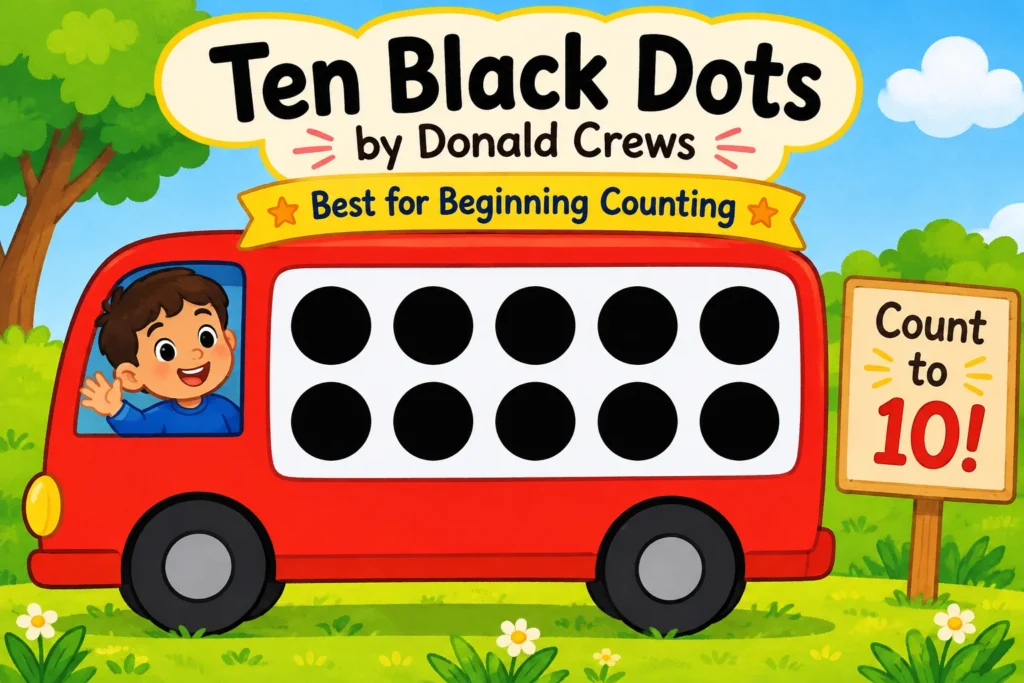
1. Ten Black Dots by Donald Crews — Best for Beginning Counting
Suggested level: Preschool–Kindergarten
Math focus: Counting, number recognition, and visual representation
Ten Black Dots transforms simple black dots into imaginative illustrations. Children discover how the same circular shapes can become different pictures while representing quantities.
Its uncomplicated illustrations make it particularly useful for young learners who are beginning to associate spoken number words with groups of objects.
Why this book works: Children can focus on one-to-one counting without being distracted by overly complicated pictures.
Try this activity: Give children ten paper circles. Ask them to make a picture using five dots, count the dots, and explain what they created.
Discussion question: Can you arrange the same number of dots in a different way?
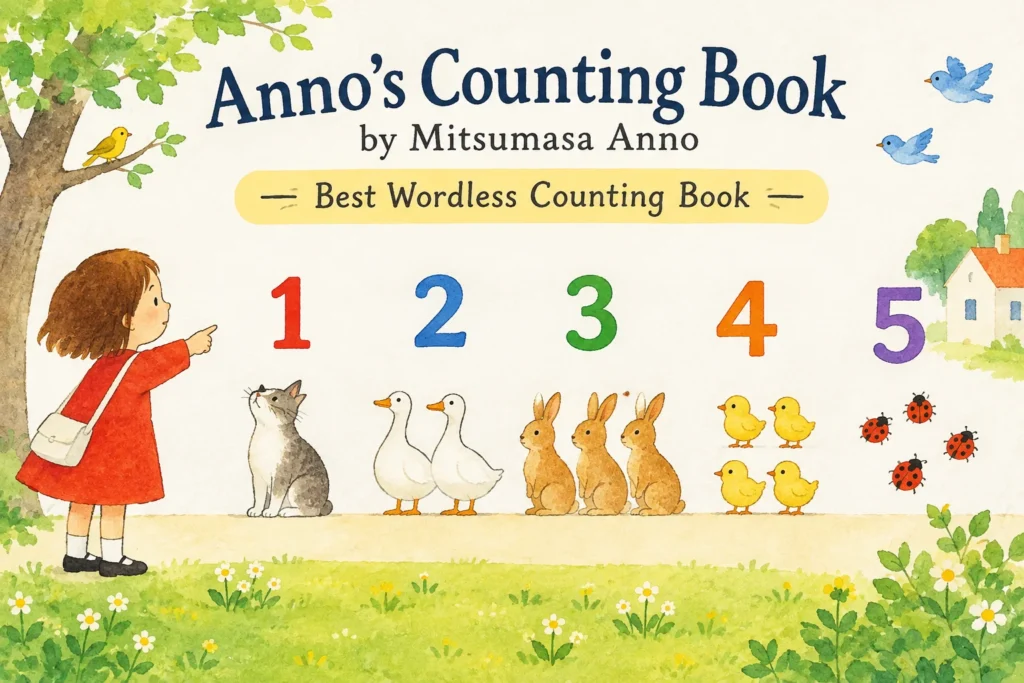
2. Anno’s Counting Book by Mitsumasa Anno — Best Wordless Counting Book
Suggested level: Preschool–Kindergarten
Math focus: Counting, sequencing, and number patterns
This beautifully illustrated counting book uses changing landscapes and everyday objects to introduce quantities.
Because the story is communicated primarily through pictures, adults can adapt their questions to each child’s mathematical understanding.
Beginning learners can count visible objects, while more confident children can explore how quantities change across the pages.
Why this book works: It encourages careful observation instead of relying entirely on written instructions.
Try this activity: Ask children to create a counting picture showing four trees, four birds, or four flowers.
Discussion question: What changes when you turn to the next page?
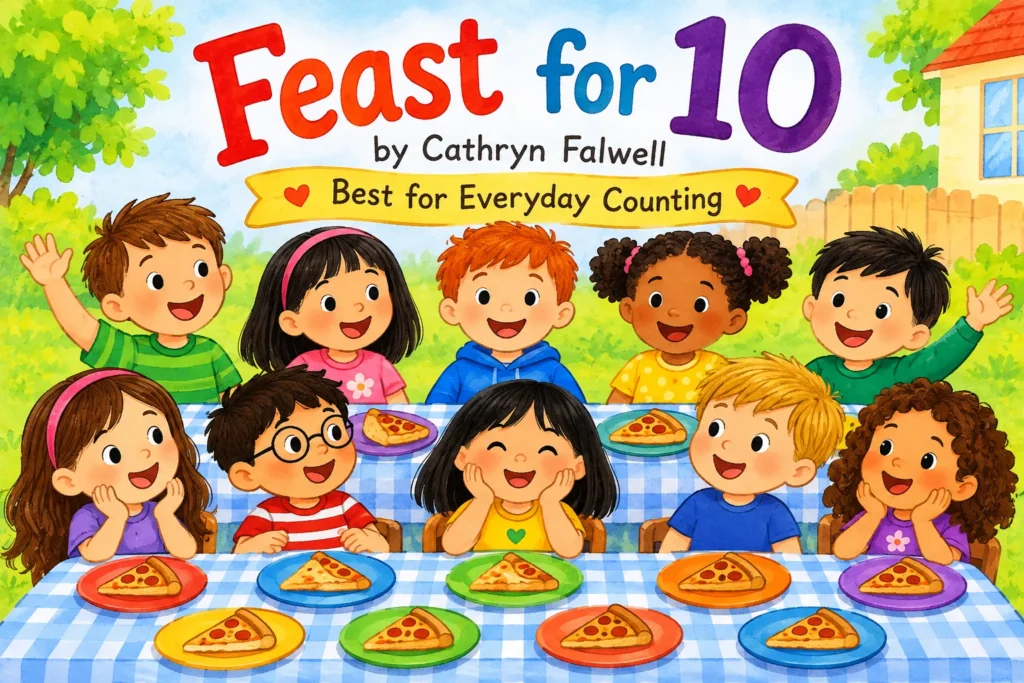
3. Feast for 10 by Cathryn Falwell — Best for Everyday Counting
Suggested level: Preschool–Grade 1
Math focus: Counting, number recognition, and real-world mathematics
In Feast for 10, a family shops for groceries and prepares a meal together. The story naturally introduces counting through familiar objects and routines.
Children can connect mathematical ideas to shopping, cooking, setting the table, and family activities.
Why this book works: It shows that counting is a practical skill used outside the classroom.
Try this activity: Create a pretend grocery store with classroom objects. Give children simple shopping lists containing quantities such as three apples and five carrots.
Discussion question: How could we check that we collected the correct number of items?
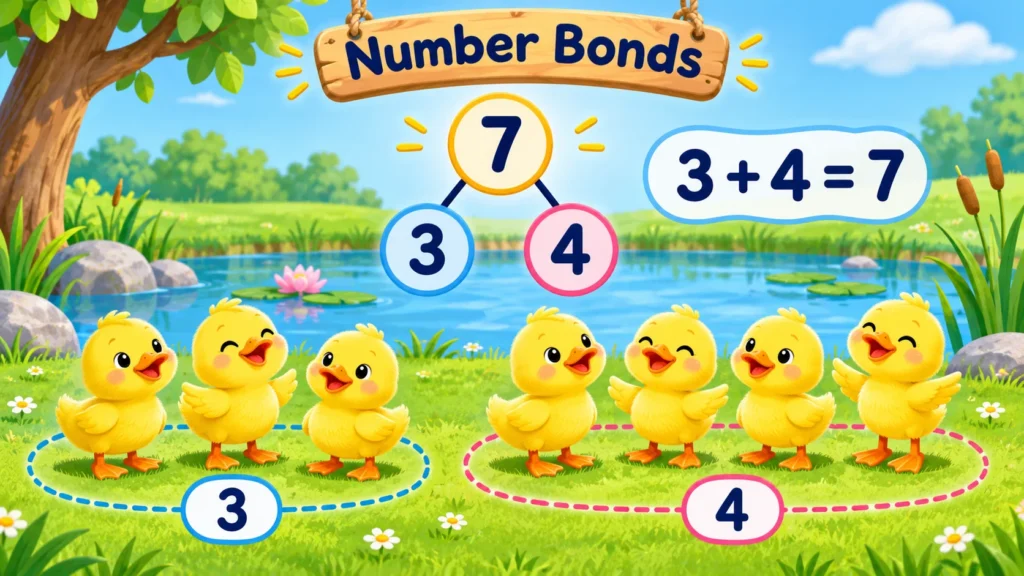
4. Quack and Count by Keith Baker — Best for Making Number Bonds
Suggested level: Kindergarten–Grade 1
Math focus: Addition, combinations, and number relationships
Seven playful ducklings move through different arrangements throughout this rhyming picture book.
Children can observe that the same total can be represented by different groups.
For example, three ducks and four ducks still make seven.
Why this book works: It introduces the idea that numbers can be broken into smaller parts and combined again.
Try this activity: Provide seven toy ducks or counters. Ask children to separate them into two groups and record the combinations they discover.
Discussion question: Can we make seven using a different pair of numbers?
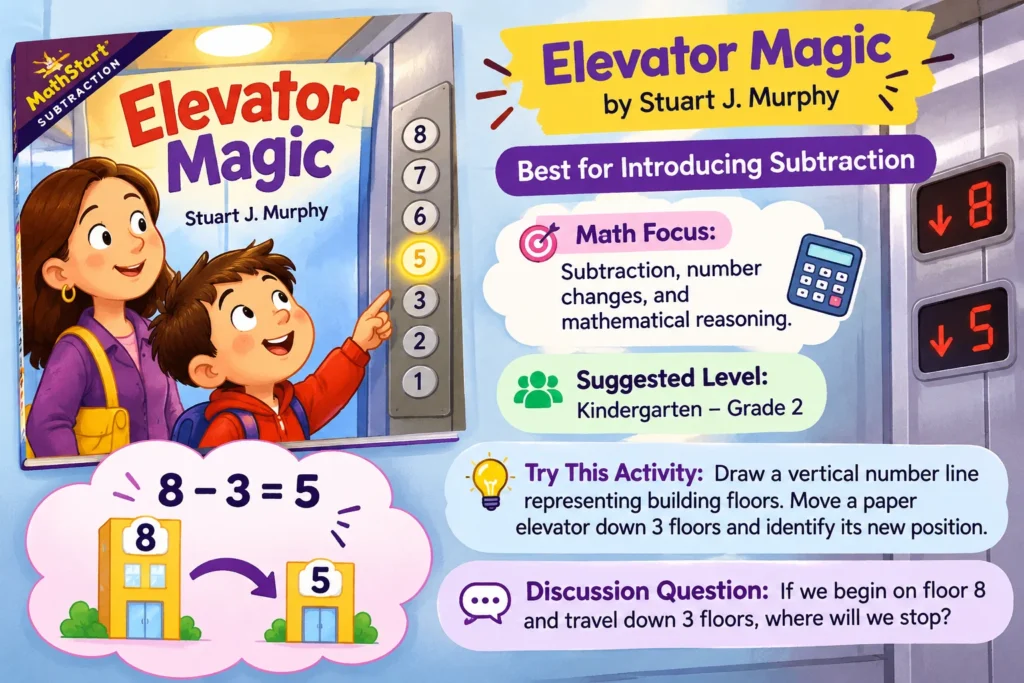
5. Elevator Magic by Stuart J. Murphy — Best for Introducing Subtraction
Suggested level: Kindergarten–Grade 2
Math focus: Subtraction, number changes, and mathematical reasoning
A boy and his mother travel through a building using an elevator. Each journey creates an opportunity to think about moving down a certain number of floors.
The unusual experiences behind the elevator doors make the mathematical problems part of an imaginative adventure.
Why this book works: Elevator movement provides a concrete model for subtracting numbers.
Try this activity: Draw a vertical number line representing building floors. Move a paper elevator down three floors and ask children to identify its new position.
Discussion question: If we begin on floor eight and travel down three floors, where will we stop?
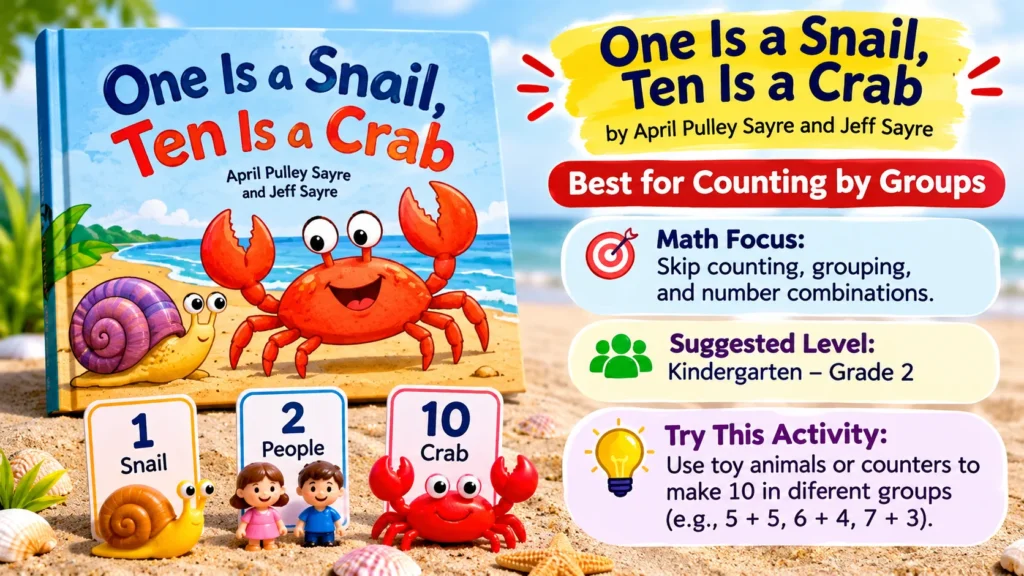
6. One Is a Snail, Ten Is a Crab by April Pulley Sayre and Jeff Sayre — Best for Counting by Groups
Suggested level: Kindergarten–Grade 2
Math focus: Addition, skip counting, and number combinations
This entertaining picture book counts the feet of different animals and people.
A snail represents one foot, a person two feet, and a crab ten feet. As different creatures appear, children explore multiple ways to represent the same number.
Why this book works: It provides a memorable introduction to grouping and flexible number thinking.
Try this activity: Draw pictures of animals with different numbers of feet. Challenge students to make a total of ten feet using different combinations.
Discussion question: How many different ways can we make ten feet?
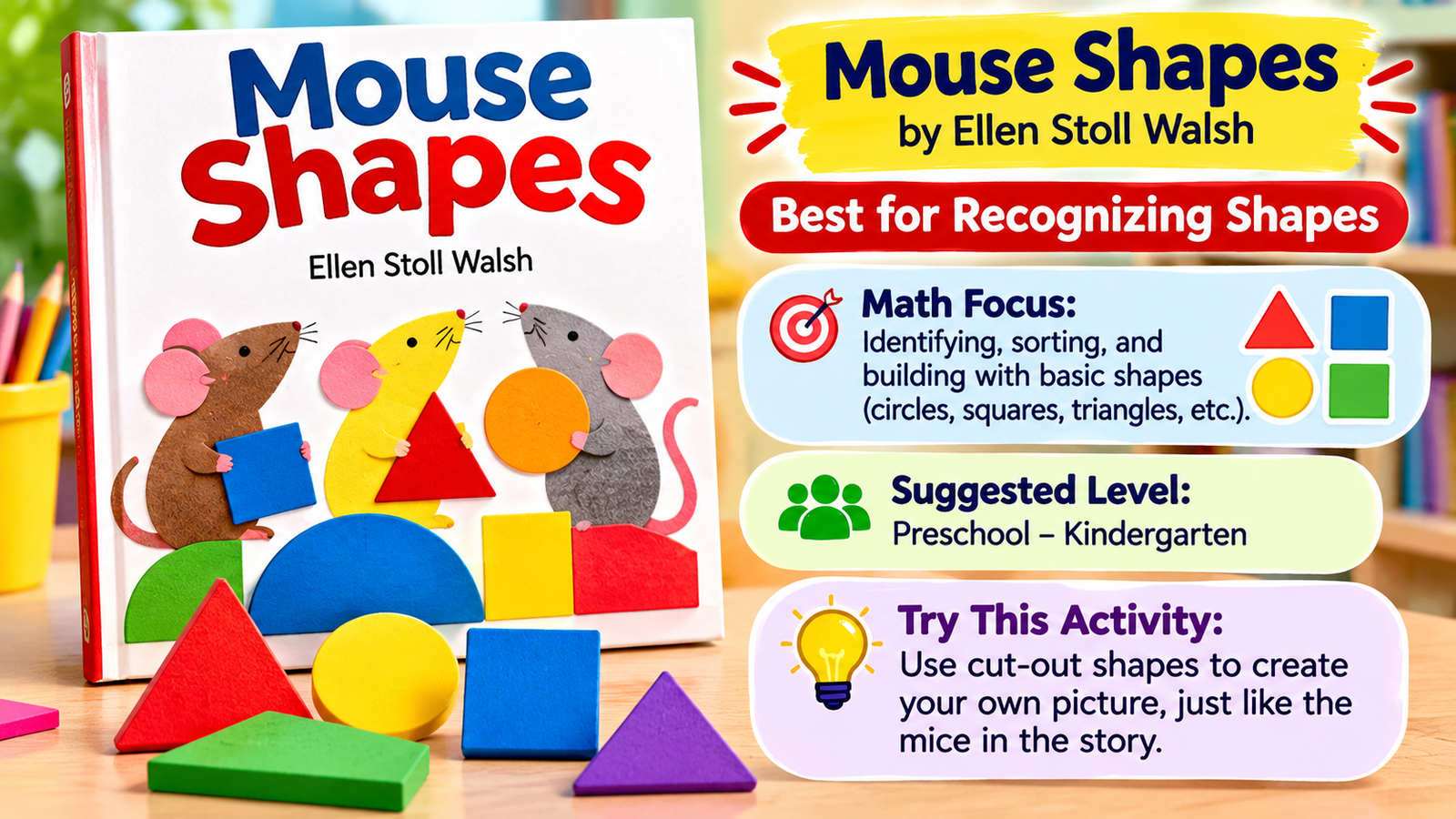
7. Mouse Shapes by Ellen Stoll Walsh — Best for Recognizing Shapes
Suggested level: Preschool–Kindergarten
Math focus: Two-dimensional shapes, sorting, and spatial reasoning
Three mice discover colorful shapes and use them to create different objects.
The story introduces circles, squares, triangles, and other familiar geometric forms through playful visual examples.
Young children can recognize individual shapes and investigate how several shapes combine to make something new.
Why this book works: Children learn to connect geometric vocabulary with objects they can build and manipulate.
Try this activity: Cut circles, triangles, and rectangles from colored paper. Let children assemble houses, animals, or vehicles.
Discussion question: Which shapes did you combine to make your picture?
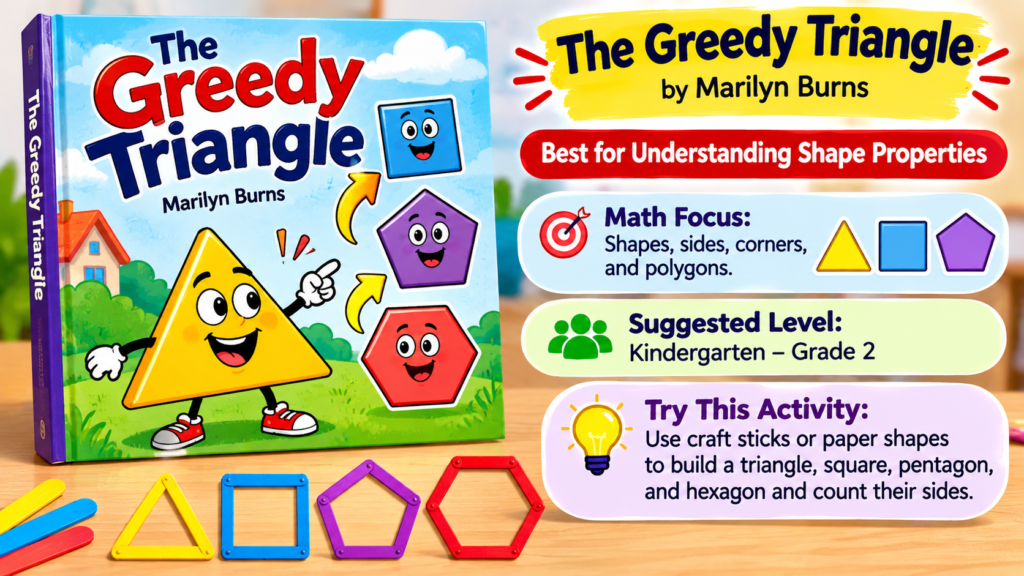
8. The Greedy Triangle by Marilyn Burns — Best for Understanding Shape Properties
Suggested level: Kindergarten–Grade 2
Math focus: Polygons, sides, corners, and geometric reasoning
A triangle becomes dissatisfied with its shape and asks a shapeshifter to give it additional sides.
As the character changes, children encounter polygons with different numbers of sides and corners.
The storyline makes geometry more engaging by turning mathematical properties into part of a character’s adventure.
Why this book works: It helps children notice how shapes are classified by their defining characteristics.
Try this activity: Give students craft sticks and ask them to build triangles, quadrilaterals, and pentagons.
Discussion question: What happens to a triangle when we add another side and corner?
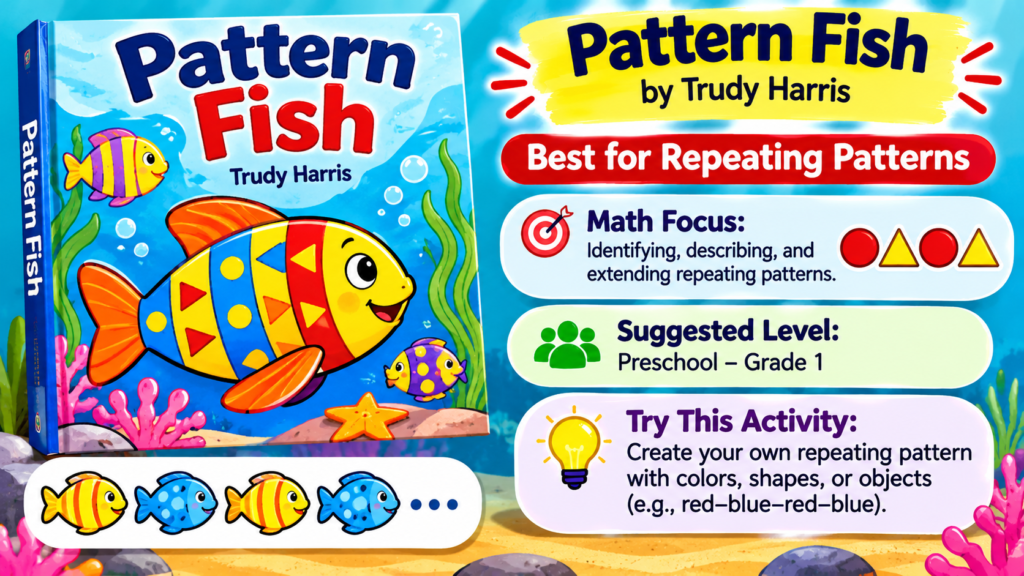
9. Pattern Fish by Trudy Harris — Best for Repeating Patterns
Suggested level: Preschool–Grade 1
Math focus: Pattern recognition, prediction, and sequencing
Colorful underwater creatures introduce repeating patterns through illustrations, movements, and rhythmic language.
Children can identify patterns in colors, sounds, and actions while predicting what should happen next.
Why this book works: It allows learners to encounter patterns through both visual and auditory experiences.
Try this activity: Give children colored blocks and ask them to create an AB pattern, such as red-blue-red-blue. Extend the challenge with an AAB pattern.
Discussion question: How do you know which color should come next?
Best Books for Measurement
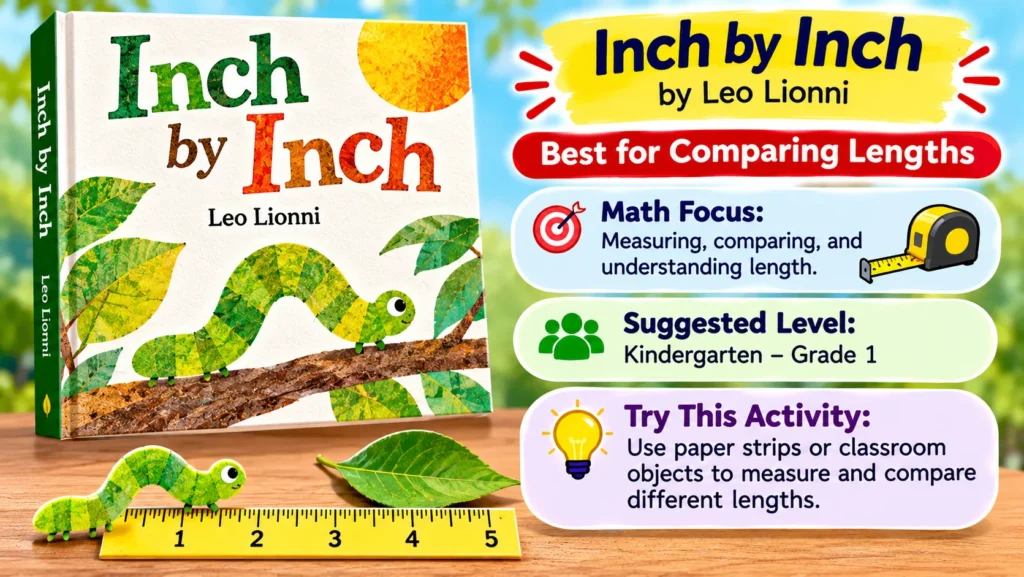
10. Inch by Inch by Leo Lionni — Best for Comparing Lengths
Suggested level: Kindergarten–Grade 1
Math focus: Length, comparison, and measurement
A small inchworm discovers that its ability to measure things can help it navigate challenges involving larger birds.
As the story unfolds, children explore the meaning of length and the process of measuring different objects.
Why this book works: It gives measurement a clear purpose within a memorable story.
Try this activity: Use paper strips of equal length to measure classroom objects. Ask children to compare their measurements.
Discussion question: Why should we use equal-sized units when measuring?
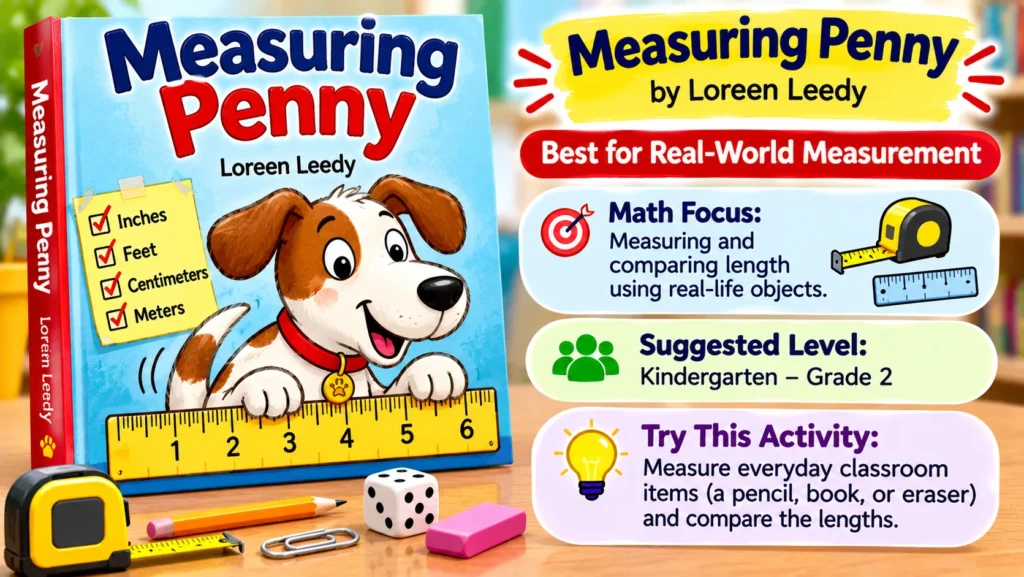
11. Measuring Penny by Loreen Leedy — Best for Real-World Measurement
Suggested level: Grades 1–2
Math focus: Measurement units, comparison, and recording results
Lisa receives a school assignment to measure something and chooses her dog, Penny.
She investigates different ways to measure and compare her pet with other dogs.
The story introduces both standard and nonstandard measurement while showing children how to organize observations.
Why this book works: It connects measurement to real objects and encourages children to record their findings.
Try this activity: Ask students to measure a pencil using paper clips and then a ruler. Discuss how the measurements differ.
Discussion question: What information do we need to include when we record a measurement?
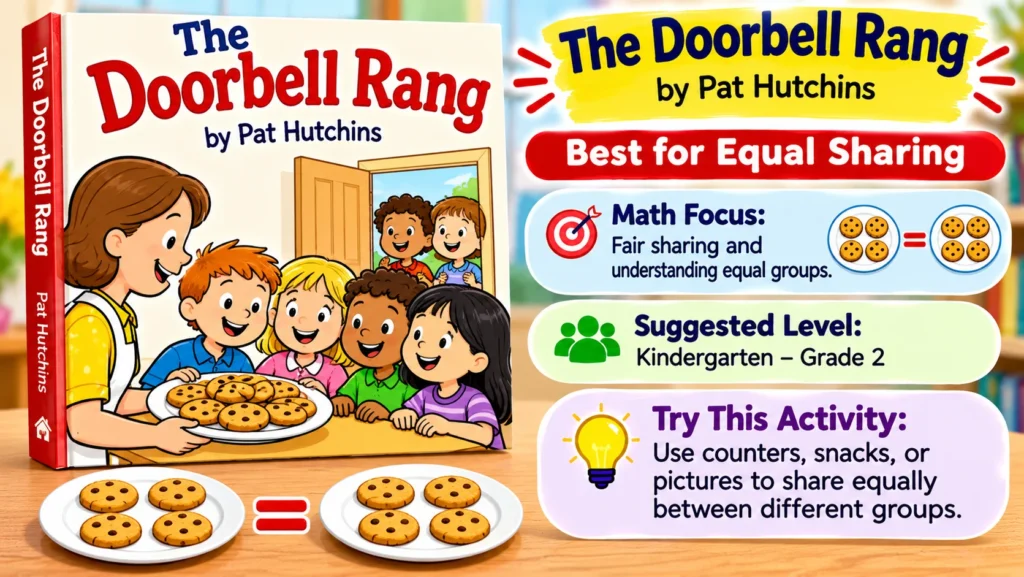
12. The Doorbell Rang by Pat Hutchins — Best for Equal Sharing
Suggested level: Kindergarten–Grade 2
Math focus: Equal groups, sharing, and introductory division
Two children prepare to enjoy twelve cookies. However, more visitors keep arriving, and the cookies must be shared among an increasing number of people.
As the group grows, each person’s share becomes smaller.
The story creates an approachable introduction to fair sharing without requiring young readers to master formal division symbols.
Why this book works: Children can act out the mathematical situations using everyday objects.
Try this activity: Give students twelve paper cookies and ask them to distribute the cookies equally between two, four, and six people.
Discussion question: What happens to each person’s share when more people join?
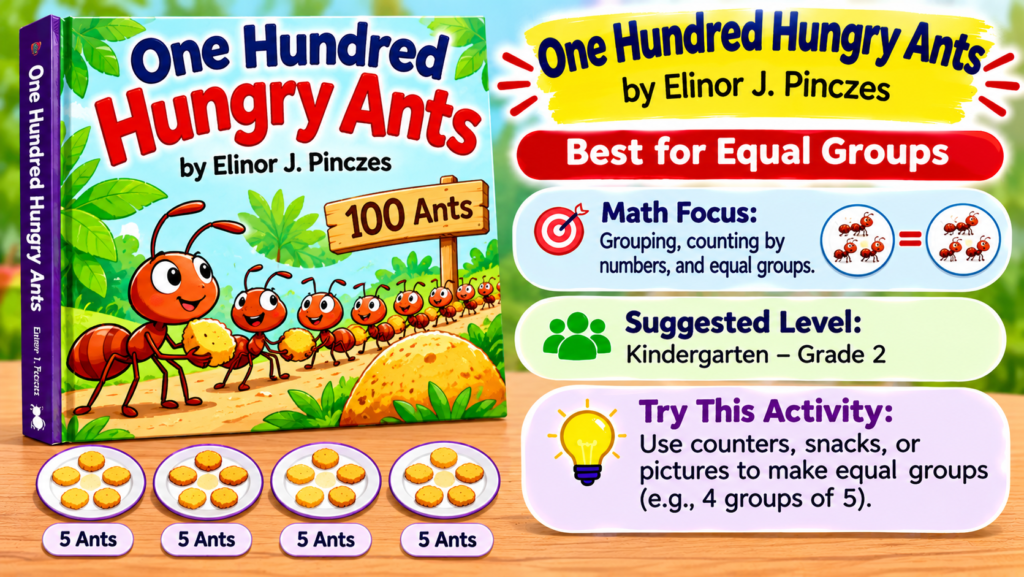
13. One Hundred Hungry Ants by Elinor J. Pinczes — Best for Equal Groups
Suggested level: Grades 1–2
Math focus: Grouping, arrays, and early multiplication
One hundred hungry ants are heading toward a picnic. Along the way, they repeatedly reorganize themselves into different rows.
Children can observe that the total number of ants stays the same even when their arrangement changes.
Why this book works: It provides a visual introduction to equal groups and rectangular arrays.
Try this activity: Use twelve counters to create arrangements of two rows of six, three rows of four, and four rows of three.
Discussion question: Does changing the arrangement change the total number of counters?
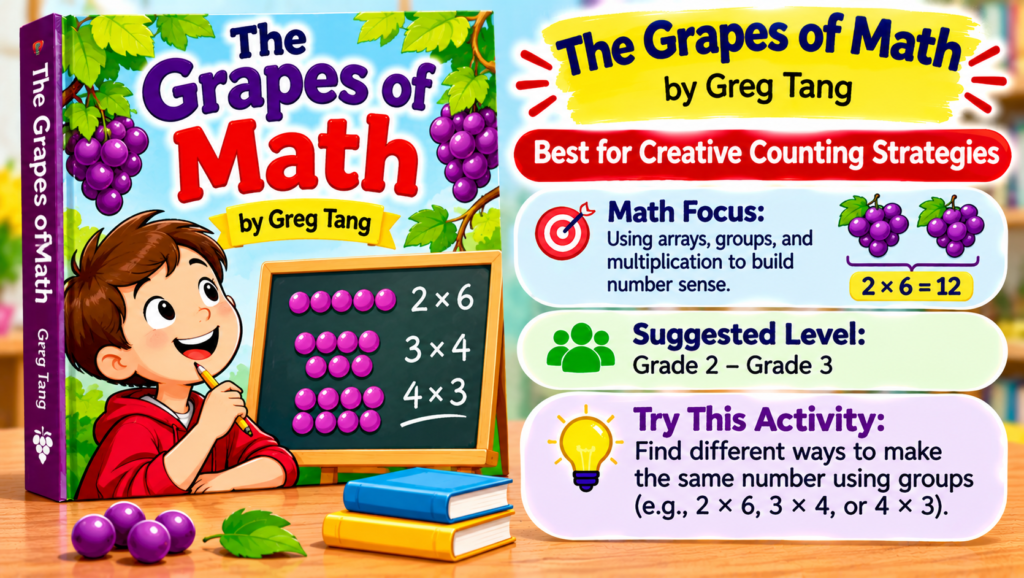
14. The Grapes of Math by Greg Tang — Best for Creative Counting Strategies
Suggested level: Grades 1–2
Math focus: Grouping, mental math, and visual problem-solving
This collection of illustrated mathematical riddles encourages children to look for efficient ways to count groups of objects.
Rather than counting every object individually, readers are encouraged to notice arrangements and number relationships.
Why this book works: It demonstrates that mathematical questions can have more than one useful solution strategy.
Try this activity: Arrange fifteen counters in three groups of five. Ask students to calculate the total without counting each counter separately.
Discussion question: Can you find a faster way to count these objects?
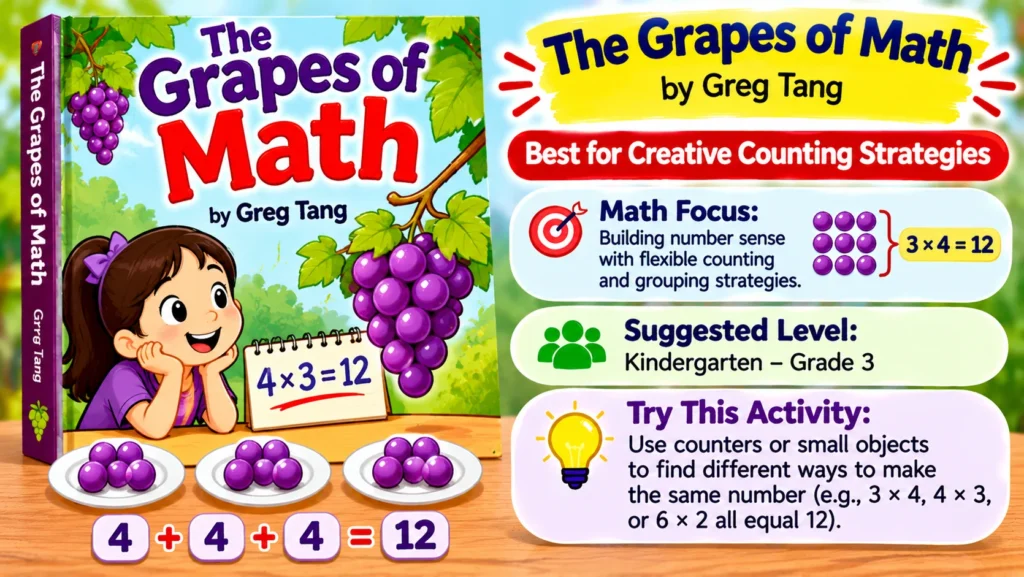
15. The Grapes of Math by Greg Tang — Best for Creative Counting Strategies
Suggested level: Grade 2 and above, with adult guidance
Math focus: Large numbers, estimation, and place-value awareness
Many children can say the word million without understanding how large that quantity really is.
This imaginative book uses exaggerated but memorable comparisons to help readers visualize enormous numbers.
Why this book works: It encourages curiosity about quantities that are too large to count individually.
Try this activity: Show children a container holding one hundred small counters. Ask them to estimate what ten similar containers would contain.
Discussion question: Why is estimating useful when a number is too large to count easily?
Quick Comparison: Which Math Book Should You Choose?
The following chart can help teachers and parents match books to children’s learning needs.
| Mathematical skill | Recommended book | Suggested grade |
|---|---|---|
| Beginning counting | Ten Black Dots | PreK–K |
| Visual number sense | Anno’s Counting Book | PreK–K |
| Everyday counting | Feast for 10 | PreK–1 |
| Addition | Quack and Count | K–1 |
| Subtraction | Elevator Magic | K–2 |
| Skip counting | One Is a Snail, Ten Is a Crab | K–2 |
| Shape recognition | Mouse Shapes | PreK–K |
| Polygon properties | The Greedy Triangle | K–2 |
| Repeating patterns | Pattern Fish | PreK–1 |
| Length | Inch by Inch | K–1 |
| Measurement units | Measuring Penny | 1–2 |
| Equal sharing | The Doorbell Rang | K–2 |
| Arrays and grouping | One Hundred Hungry Ants | 1–2 |
| Mental math | The Grapes of Math | 1–2 |
| Large numbers | How Much Is a Million? | 2+ |
Note: Grade ranges are suggested teaching levels rather than official publisher age ratings. Children may benefit from different books depending on their experience, interests, and reading support.
How to Choose Math Books by Age and Learning Level
A child’s current understanding matters more than choosing books based only on age.
Preschool: Ages 3–5
Choose books featuring recognizable objects, clear illustrations, short sentences, and simple mathematical ideas.
Prioritize counting small groups, comparing quantities, identifying basic shapes, and noticing patterns.
Good starting choices: Ten Black Dots, Anno’s Counting Book, and Mouse Shapes.
Kindergarten: Ages 5–6
Look for stories that encourage children to compare quantities, combine small numbers, identify shapes, and explain patterns.
Books with repeated structures or opportunities to predict what happens next work particularly well for interactive read-alouds.
Good starting choices: Quack and Count, Pattern Fish, and The Greedy Triangle.
First Grade: Ages 6–7
Introduce stories involving addition, subtraction, measurement, number relationships, and equal groups.
Children can begin recording the mathematical ideas they notice through pictures, counters, and number sentences.
Good starting choices: Elevator Magic, Inch by Inch, and The Doorbell Rang.
Second Grade: Ages 7–8
Select books that encourage flexible strategies, skip counting, arrays, measurement, estimation, and more detailed explanations.
Encourage students to compare different solutions and explain why their strategies work.
Good starting choices: One Hundred Hungry Ants, Measuring Penny, and The Grapes of Math.
How to Teach Math Through Picture Books: A 5-Minute Routine
You do not need to create an elaborate lesson every time you introduce a math story.
Use this four-stage routine after reading a book. It is a practical teaching framework, not a formally validated instructional program.
| Stage | Time | What to do |
|---|---|---|
| Read | Before the routine | Enjoy the story and introduce the mathematical situation |
| Notice | 1 minute | Ask children to identify numbers, shapes, patterns, or quantities |
| Discuss | 2 minutes | Encourage predictions and explanations |
| Practice | 2 minutes | Reinforce the concept using objects, drawings, or movement |
For example, after reading Quack and Count, ask children to describe two groups of ducklings. Then give them seven counters and invite them to show different ways to make seven.
Encourage children to explain their thinking rather than immediately correcting an incorrect answer. Questions such as “How did you work that out?” can reveal useful information about their understanding.
3 Simple Math Activities Inspired by Children’s Books
1. Story Counting Mats
Best for: Preschool and kindergarten
Materials: Paper, crayons, and counting cubes
Draw several circles on a sheet of paper and assign a number to each circle.
After reading a counting book, children place the correct number of cubes inside each circle.
Ask learners to count each group aloud and check whether the quantity matches the written number.
Learning focus: One-to-one correspondence and recognizing quantities.
2. Shape Detective Challenge
Best for: Kindergarten and first grade
Materials: Paper, pencils, and classroom objects
After reading Mouse Shapes, invite children to search for circles, rectangles, triangles, and other shapes around the classroom.
Students can draw or record the shapes they discover.
Extend the activity by asking how they identified each shape instead of relying only on its appearance.
Learning focus: Shape properties and spatial reasoning.
3. Cookie Sharing Investigation
Best for: Kindergarten through second grade
Materials: Twelve paper circles and small paper plates
After reading The Doorbell Rang, tell students that twelve cookies must be shared equally.
Begin with two plates, then repeat with four and six plates.
Have students explain how many cookies belong on each plate and why.
Learning focus: Equal sharing, number relationships, and early division.
A Simple Checklist for Choosing Quality Math Picture Books
Before purchasing a book or adding it to a classroom lesson, consider the following questions.
- Mathematical accuracy: Do the illustrations and explanations correctly represent the concepts?
- Age appropriateness: Can the child understand the story with reasonable support?
- Learning objective: Does the book connect clearly to a useful mathematical skill?
- Engagement: Does the story invite curiosity, prediction, or conversation?
- Practical application: Can children explore the ideas using familiar materials?
- Representation: Do the illustrations and characters offer children varied, relatable experiences?
A beautifully illustrated book is not automatically an effective math resource. The strongest choices combine a worthwhile story with opportunities for children to investigate mathematical ideas.
Frequently Asked Questions
What are the best children’s books about math for kindergarten?
Ten Black Dots, Quack and Count, Mouse Shapes, and Pattern Fish are useful kindergarten choices. They introduce counting, number combinations, shapes, and patterns through visual storytelling.
Can children’s literature help students who struggle with math?
Stories can provide a less formal setting for discussing difficult concepts. Picture books allow students to use illustrations and physical objects before moving to abstract symbols. However, children who need additional support may also require explicit instruction and targeted practice.
What math books are best for preschoolers?
Preschoolers often benefit from picture books with clear illustrations, repetition, and opportunities to count or compare objects. Anno’s Counting Book, Ten Black Dots, and Mouse Shapes are suitable starting points.
How can parents teach math through storybooks at home?
Parents can ask children to count objects in illustrations, compare quantities, recognize shapes, or predict what happens next. Short follow-up activities using toys, blocks, or household objects can reinforce the ideas.
Are math picture books better than worksheets?
They serve different purposes. Picture books introduce mathematical concepts through meaningful situations and discussion, while well-designed worksheets can provide additional practice. Combining stories, physical materials, conversation, and appropriate practice often provides a richer learning experience.
How often should teachers use math read-alouds?
There is no single required frequency. Teachers can incorporate short read-alouds when they support current learning objectives. A single book can also be revisited to explore different mathematical ideas over several lessons.
Final Thoughts
Math learning does not have to begin with complicated equations or repetitive exercises. A story about ducklings, mice, or cookies can give children meaningful opportunities to think about numbers and relationships.
Choose books that match the child’s current learning needs, read them for enjoyment, and encourage curiosity through questions and activities.
Whether you are an elementary teacher planning a lesson or a parent building a home reading collection, the right picture books can make mathematics a more engaging part of everyday learning.
Start with one book, explore one mathematical idea, and give children time to discover what the numbers mean.