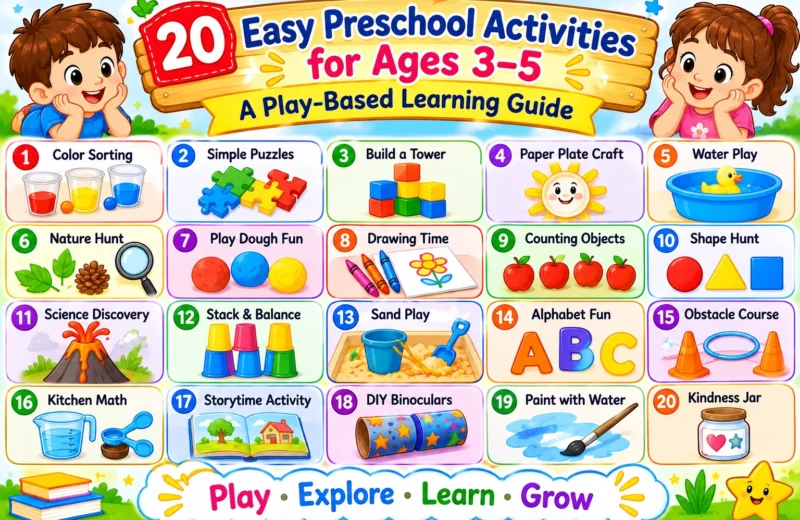
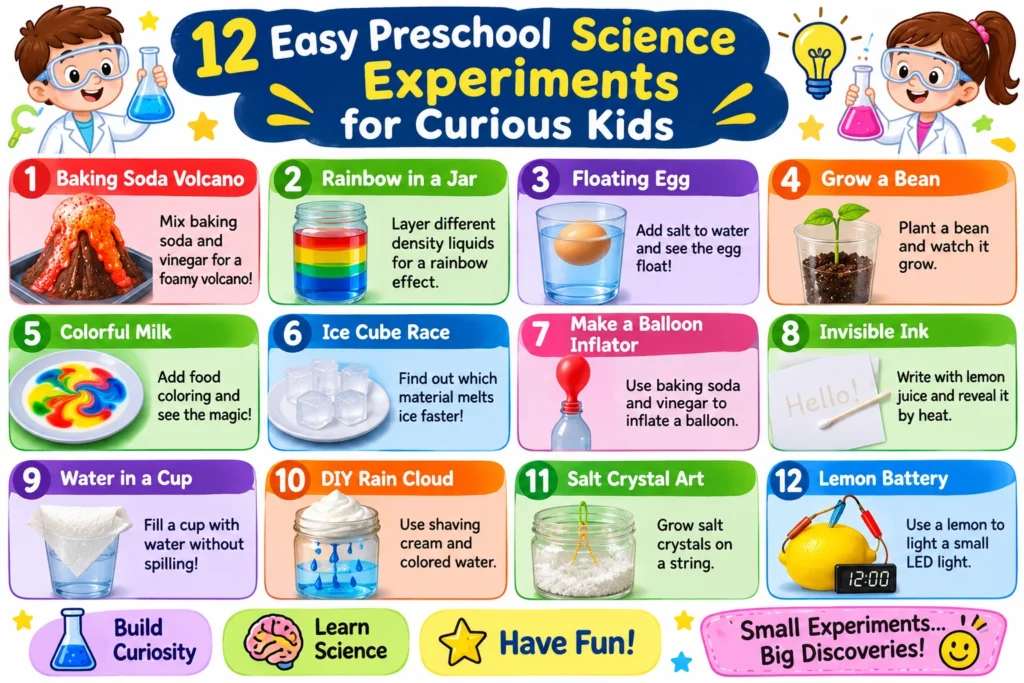
Preschool activities science experiments help young children discover how the world works through observation, exploration, and play. From colorful water experiments to fizzing chemical reactions, simple activities can turn everyday household materials into exciting learning opportunities.
Children ages 3–5 don’t need complicated scientific explanations. They learn by asking questions, making predictions, testing ideas, and describing what happens.
The National Association for the Education of Young Children (NAEYC) emphasizes that everyday objects and open-ended exploration can support children’s early scientific thinking.
This guide includes 12 hands-on experiments, a practical science-skills comparison, and a simple observation framework for teachers and parents.
Easy Science Experiments Using Everyday Materials
These beginner-friendly investigations introduce cause and effect, color changes, floating, and chemical reactions.
Baking Soda and Vinegar Volcano
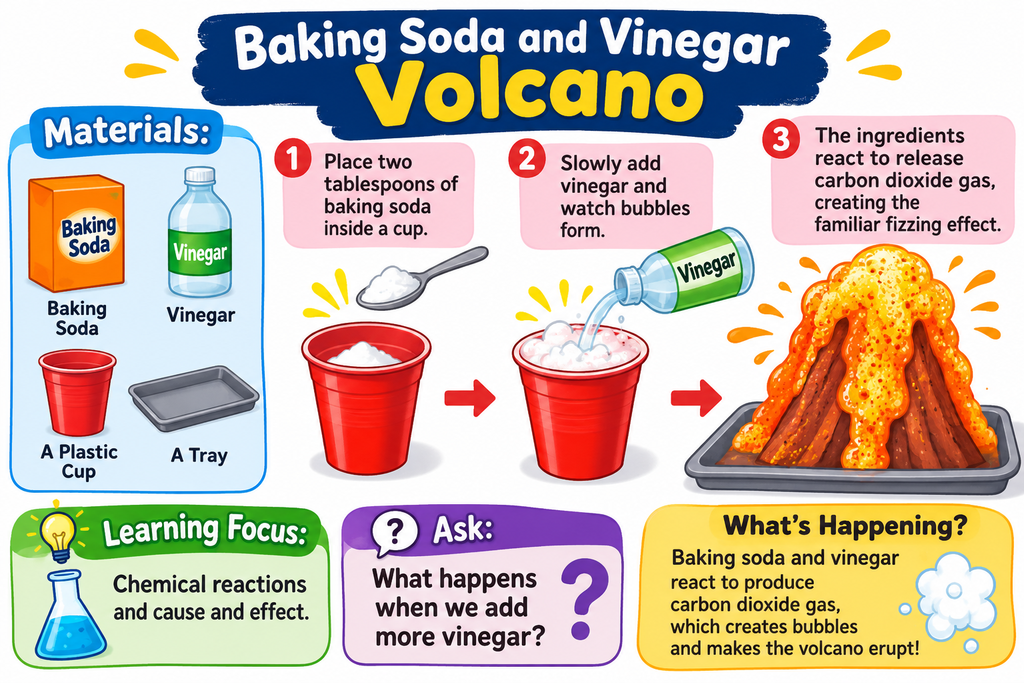
Materials: Baking soda, vinegar, a plastic cup, and a tray.
Place two tablespoons of baking soda inside a cup. Slowly add vinegar and watch bubbles form.
The ingredients react to release carbon dioxide gas, creating the familiar fizzing effect.
Learning focus: Chemical reactions and cause and effect.
Sink or Float Experiment
Materials: Water, a plastic tub, a wooden spoon, a sponge, and a large plastic toy.
Fill the tub with water and invite children to predict whether each object will sink or float.
Test the objects individually and compare the results.
Learning focus: Prediction, observation, and buoyancy.
Rainbow Color Mixing
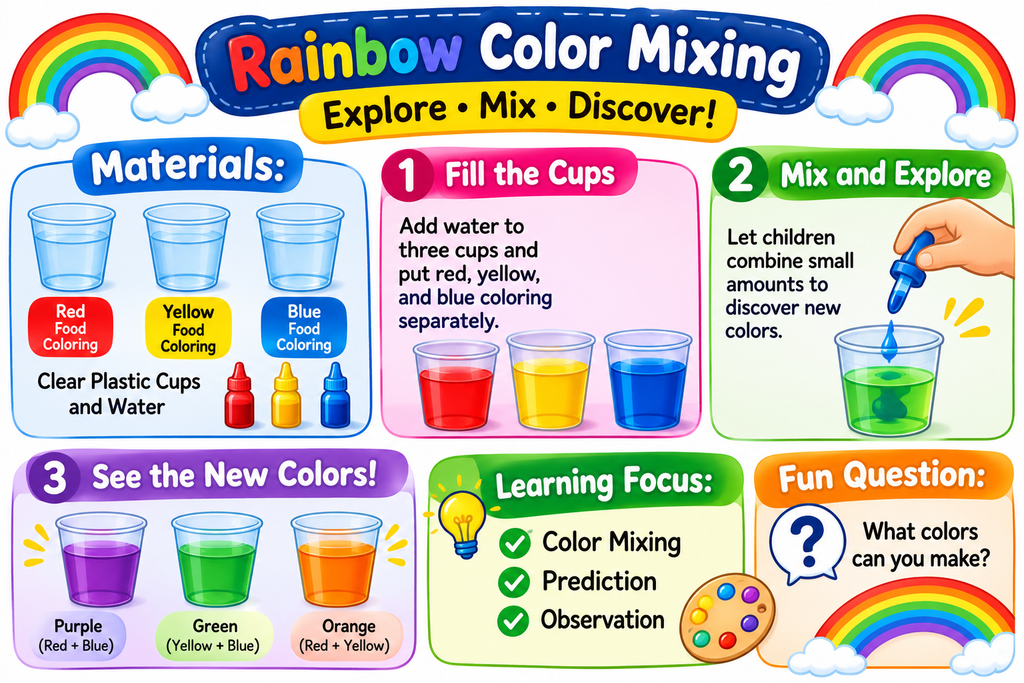
Materials: Clear plastic cups, water, and food coloring.
Fill three cups with water and add red, yellow, and blue coloring separately.
Let children combine small amounts to discover new colors.
Learning focus: Color mixing, prediction, and observation.
Dancing Raisins Experiment
Materials: Clear cup, water, vinegar, baking soda, and raisins.
Mix water and vinegar in a tall container. Add a little baking soda, followed by several raisins.
Carbon dioxide bubbles may attach to the raisins, helping them rise before sinking again.
Learning focus: Gas formation and movement.
This activity demonstrates the same principle described by the DuPage Children’s Museum in its early chemistry resources.
Nature and Outdoor Science Activities for Preschoolers
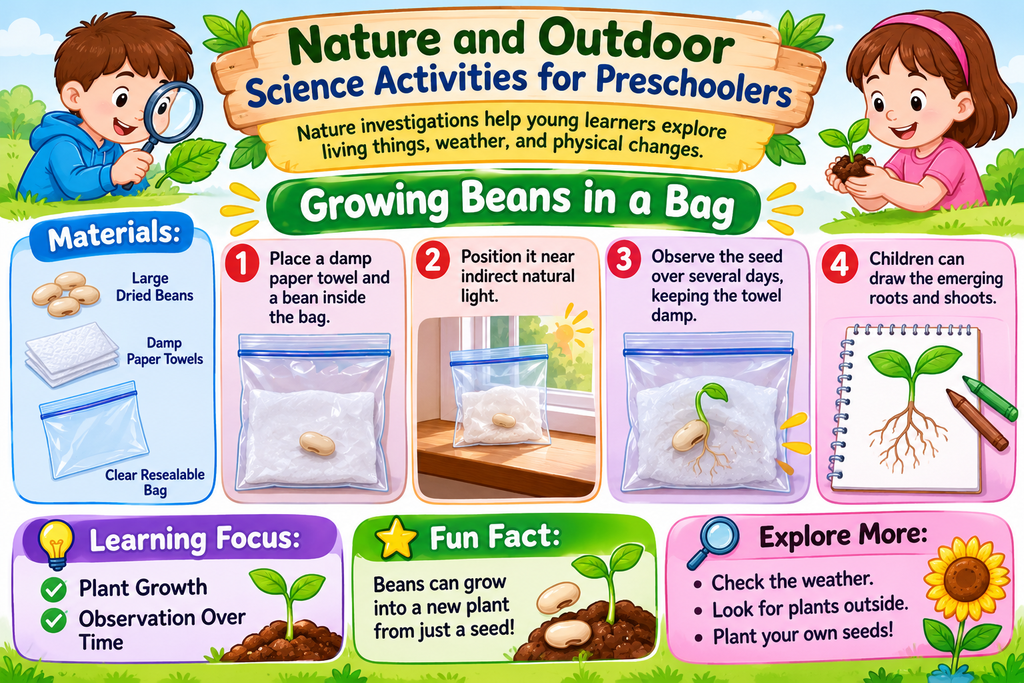
Nature investigations help young learners explore living things, weather, and physical changes.
Growing Beans in a Bag
Materials: Large dried beans, damp paper towels, and a clear resealable bag.
Place a damp paper towel and a bean inside the bag. Position it near indirect natural light.
Observe the seed over several days, keeping the towel damp.
Children can draw the emerging roots and shoots.
Learning focus: Plant growth and observation over time.
Melting Ice Investigation
Materials: Ice cubes, two shallow trays, and room-temperature water.
Place ice cubes in separate trays. Add a little water to one tray and leave the other unchanged.
Compare how quickly the ice melts.
Learning focus: Temperature, melting, and comparison.
Exploring Shadows
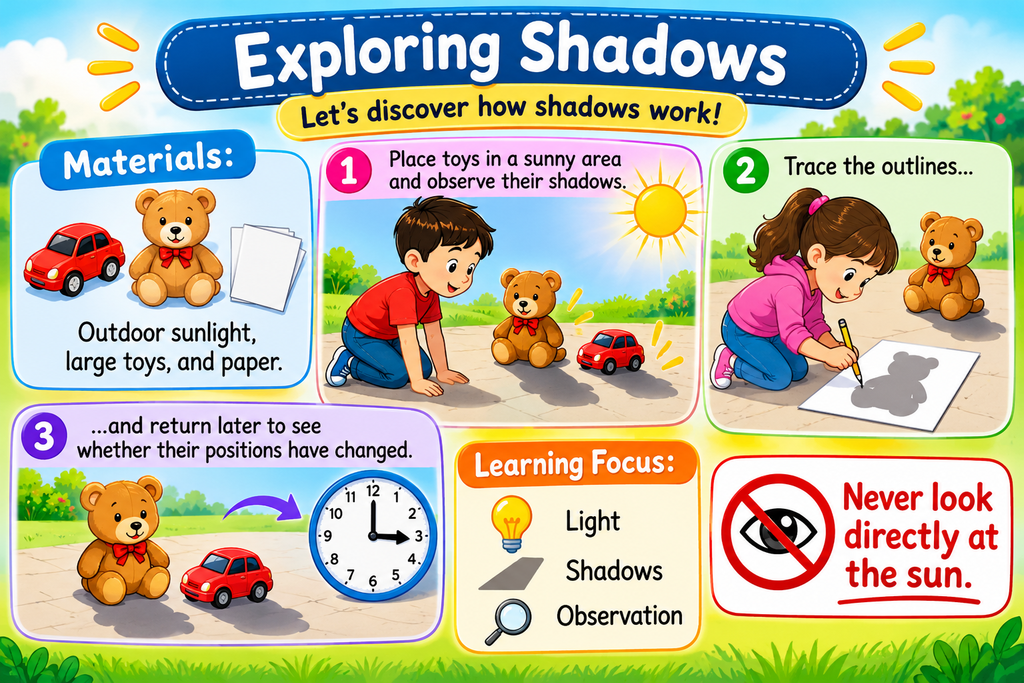
Materials: Outdoor sunlight, large toys, and paper.
Place toys in a sunny area and observe their shadows.
Trace the outlines and return later to see whether their positions have changed.
Learning focus: Light, shadows, and observation.
Never look directly at the sun.
Leaf Investigation
Materials: Fallen leaves, magnifying glasses, and paper.
Collect leaves of different sizes and shapes.
Examine their veins, edges, and colors, then sort them into groups.
Learning focus: Classification, patterns, and natural variation.
Creative STEM Experiments for Preschool Classrooms
These preschool activities science experiments connect science with movement, construction, and hands-on problem-solving.
Walking Water Rainbow
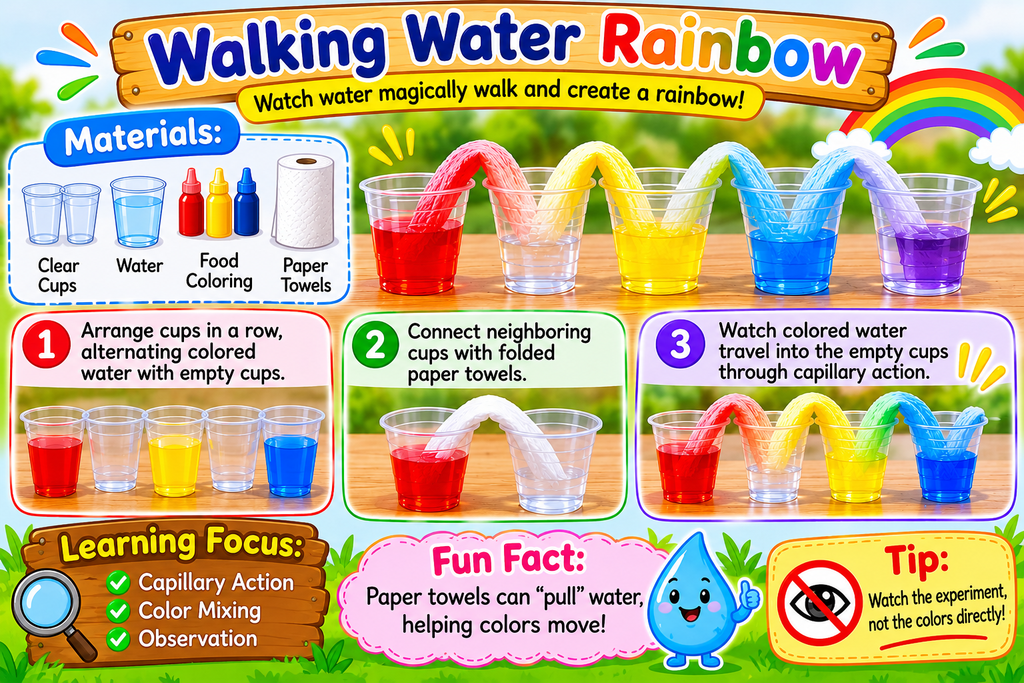
Materials: Clear cups, water, food coloring, and paper towels.
Arrange cups in a row, alternating colored water with empty cups.
Connect neighboring cups using folded paper towels.
Watch colored water gradually travel into the empty cups through capillary action.
Learning focus: Water movement and color mixing.
Magnetic or Nonmagnetic?
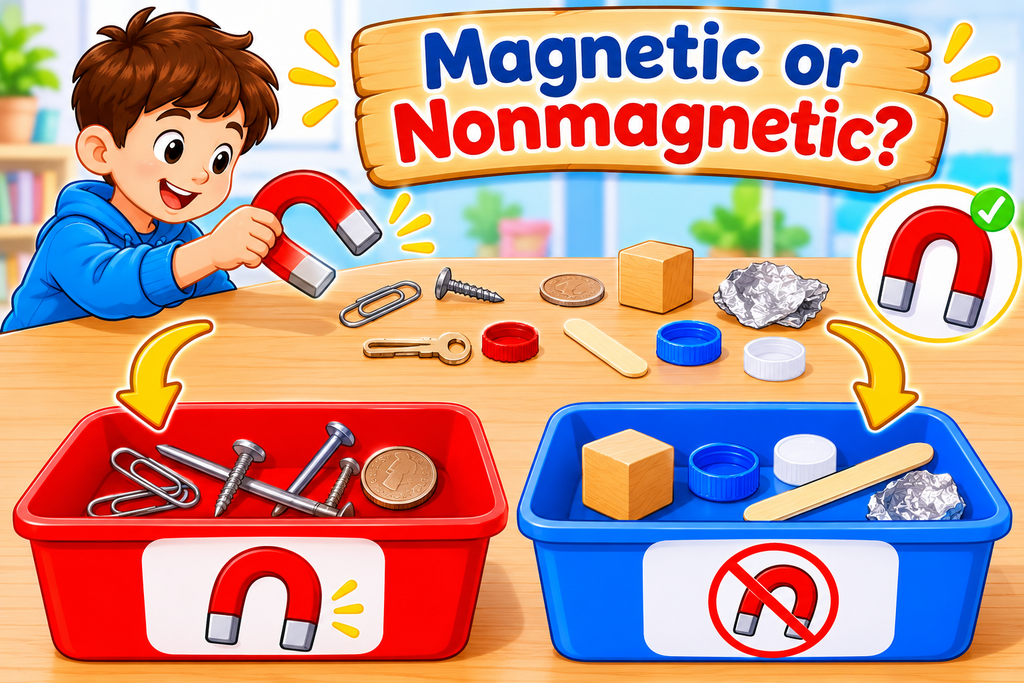
Materials: A large enclosed magnet and assorted household objects.
Ask children to predict which objects will attract the magnet.
Test each item and sort the results.
Learning focus: Magnetism and classification.
Use only intact, age-appropriate magnets; loose or small powerful magnets are dangerous if swallowed.
Build a Foil Boat
Materials: Aluminum foil, a shallow water tub, and large identical blocks.
Shape foil into a boat and carefully place it on water.
Add blocks one at a time until the boat sinks. Redesign and test again.
Learning focus: Buoyancy, design, and problem-solving.
Absorption Experiment
Materials: Sponge, paper towel, fabric, plastic sheet, and water.
Place a few drops of water on each material.
Observe which materials absorb water and which allow droplets to remain on the surface.
Learning focus: Material properties and comparison.
How to Choose Science Activities by Learning Goal
This Preschool Science Discovery Matrix helps match investigations to specific learning outcomes.
| Learning goal | Recommended experiment | Key question |
|---|---|---|
| Cause and effect | Baking soda volcano | What creates bubbles? |
| Prediction | Sink or float | What will happen? |
| Observation | Growing beans | What has changed? |
| Problem-solving | Foil boat | How can we improve it? |
| Classification | Leaf investigation | Which objects are similar? |
| Physical changes | Melting ice | Why does ice melt? |
The matrix is a practical teaching guide, not a standardized developmental assessment.
The WONDER Framework for Preschool Science Learning
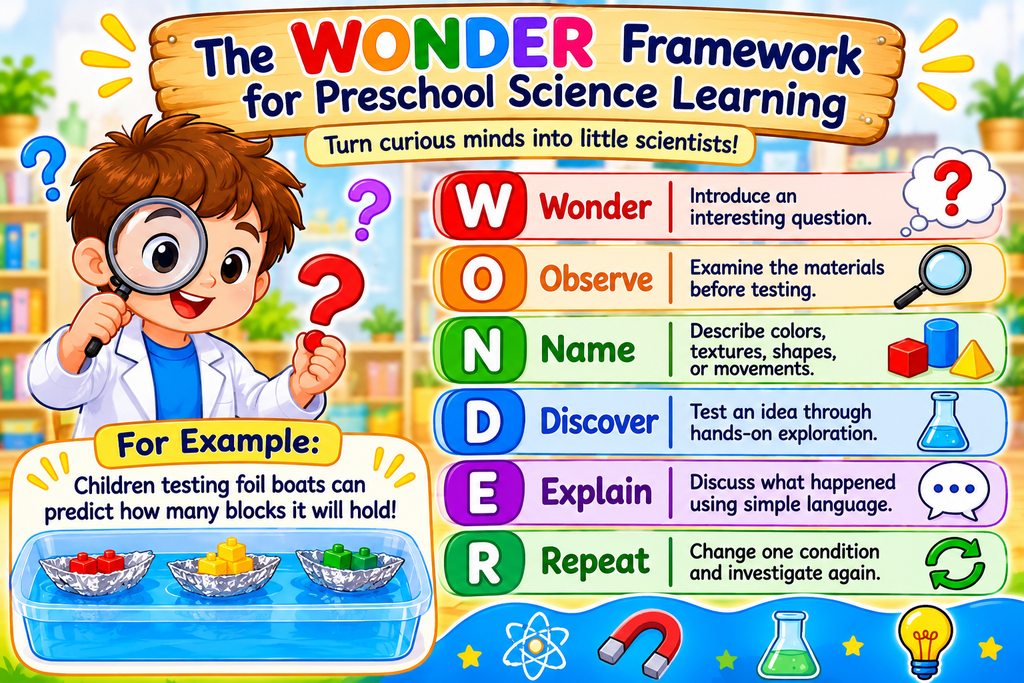
Teachers can use the WONDER Framework to make preschool activities science experiments rather than simple demonstrations.
- W — Wonder: Introduce an interesting question.
- O — Observe: Examine the materials before testing.
- N — Name: Describe colors, textures, shapes, or movements.
- D — Discover: Test an idea through hands-on exploration.
- E — Explain: Discuss what happened using simple language.
- R — Repeat: Change one condition and investigate again.
For example, children testing foil boats can predict how many blocks a boat will hold, observe the result, and improve their design.
This approach supports curiosity without requiring children to memorize complicated scientific terms.
Safety Tips for Preschool Science Activities
Always supervise young children, especially around water, small objects, magnets, and household ingredients.
Use shallow water containers, age-appropriate materials, and child-safe tools. Never mix cleaning chemicals or allow children to taste experimental materials.
For classroom investigations, prepare supplies beforehand and encourage children to wash their hands after activities.
Frequently Asked Questions
What Are the Easiest Science Experiments for 3-Year-Olds?
Color mixing, supervised sink-or-float investigations, leaf sorting, and ice melting are simple starting activities.
How Do Science Activities Help Preschoolers Learn?
Hands-on investigations encourage observation, prediction, classification, problem-solving, and communication.
What Materials Are Useful for Preschool Science?
Water, clear plastic cups, paper towels, foil, large toys, leaves, food coloring, and baking soda can support many investigations.
Can Preschoolers Learn Science Without Worksheets?
Yes. Children can demonstrate their understanding through drawings, conversations, sorting activities, and repeated exploration.
Conclusion
Preschool activities science experiments make early learning engaging by transforming ordinary materials into opportunities for discovery.
Start with simple activities such as color mixing and floating objects, then introduce plant growth, water movement, and construction challenges.
The goal isn’t to produce perfect results. It’s to help children ask questions, explore possibilities, and develop confidence through hands-on discovery.