
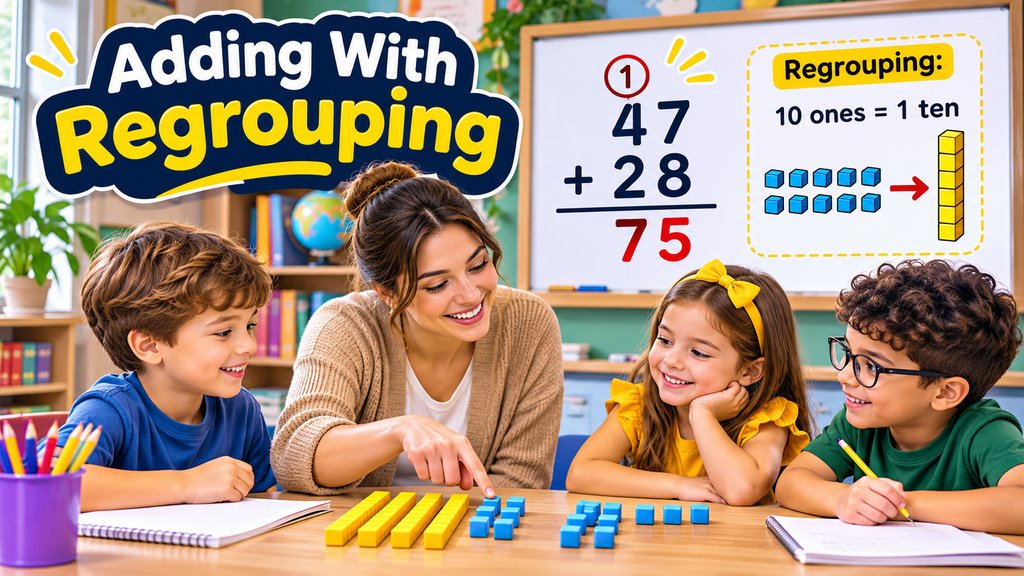
Adding with regrouping can be tricky when students first learn to work with two-digit and three-digit numbers. A child might know that 8 + 7 = 15 but still wonder why a small 1 appears above the next column.
The key is understanding place value. When we add ten or more ones, we can exchange ten ones for one ten without changing the total value.
For example:
47 + 28 = 75
The ones digits add to 15. That means we have one new ten and five ones. We regroup that ten into the tens column and continue adding.
This guide explains adding with regrouping step by step using place-value models, worked examples, teaching activities, and practice problems with answers. It is designed for second- and third-grade students, teachers, and parents helping with math homework.
What Is Regrouping in Addition?
Regrouping in addition means combining smaller place-value units into a larger unit when their total reaches ten or more.
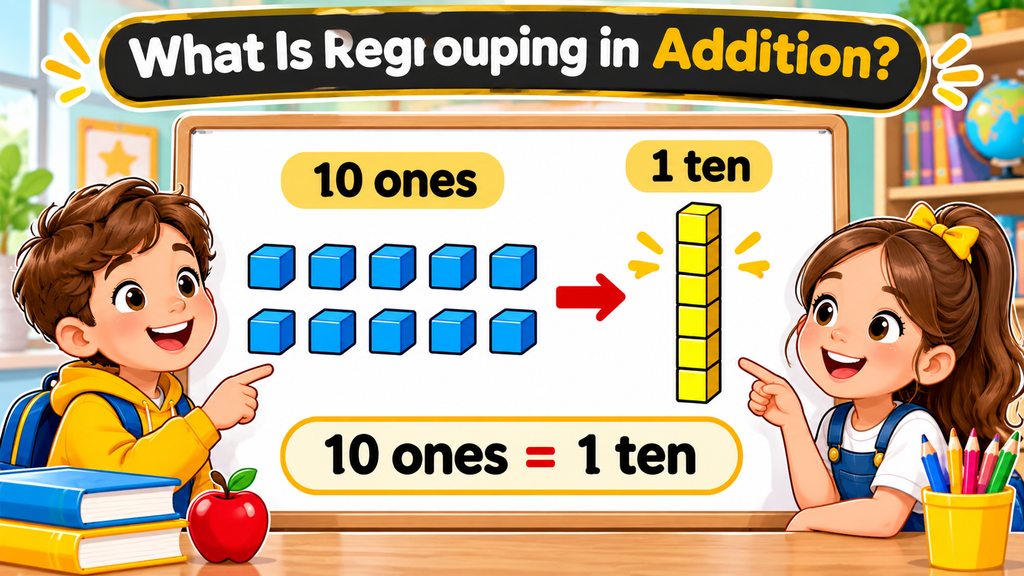
In our base-ten number system:
- 10 ones = 1 ten
- 10 tens = 1 hundred
- 10 hundreds = 1 thousand
Students often hear this process called carrying. However, explaining the exchange helps children understand why the written method works.
Understanding Tens and Ones
Consider the number 34.
It contains:
- 3 tens, worth 30
- 4 ones, worth 4
Together:
30 + 4 = 34
Now consider adding 38 and 17.
We have:
| Place value | From 38 | From 17 | Combined |
|---|---|---|---|
| Tens | 3 | 1 | 4 tens |
| Ones | 8 | 7 | 15 ones |
Fifteen ones can be regrouped as 1 ten and 5 ones.
The four original tens become five tens.
So:
38 + 17 = 55
Notice that we have not added an extra number. We have simply changed how the same total is organized.
When Do You Need to Regroup?
Compare these two examples.
Without regrouping:
24 + 13 = 37
The ones digits add to 7, so no new ten needs to be made.
With regrouping:
26 + 17 = 43
The ones digits add to:
6 + 7 = 13
Thirteen ones contain one complete ten and three remaining ones.
We regroup one ten, then add it to the other tens:
2 tens + 1 ten + 1 regrouped ten = 4 tens.
Answer: 43
An important lesson for students is that not every addition problem requires regrouping. They should check the place-value totals before deciding whether to regroup.
How to Add With Regrouping Step by Step
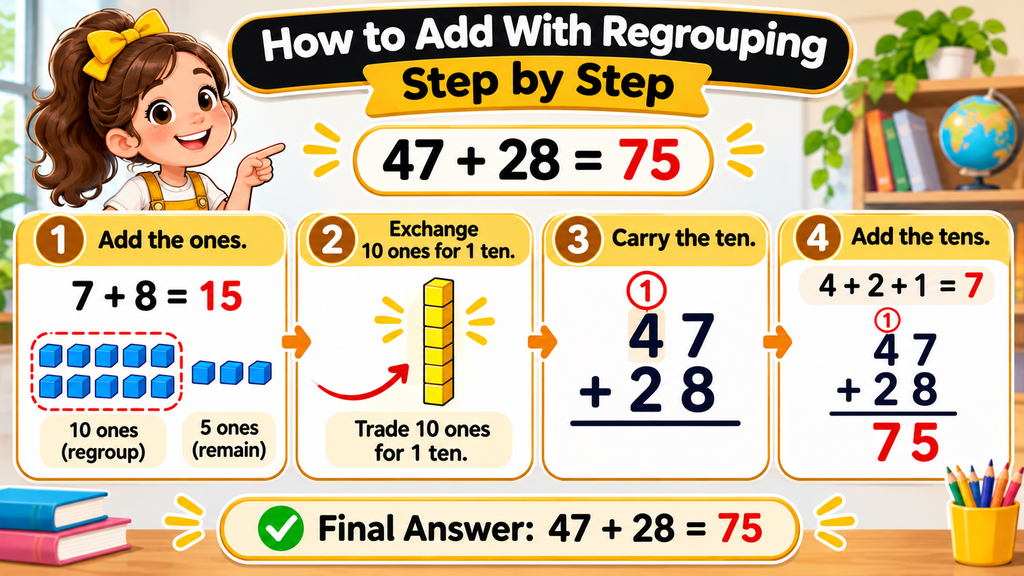
Let’s solve 47 + 28 using a place-value chart and the written addition method.
Step 1: Line Up the Place Values
Write the numbers so the ones digits are under the ones digits and the tens digits are under the tens digits.
| Tens | Ones | |
|---|---|---|
| First number | 4 | 7 |
| Second number | 2 | 8 |
The number 47 contains four tens and seven ones.
The number 28 contains two tens and eight ones.
Lining up the columns is important because we must combine units with the same place value.
Step 2: Add the Ones
Start with the ones column.
7 + 8 = 15
We cannot represent 15 ones with a single digit in the ones place.
Instead, split 15 into:
15 ones = 1 ten + 5 ones
Write 5 in the ones place of the answer.
Record the new ten above the tens column.
Step 3: Regroup the New Ten
The small 1 written above the tens column means one group of ten, not one single unit.
Now add all the tens:
4 tens + 2 tens + 1 ten = 7 tens
So:
4 + 2 + 1 = 7
Write 7 in the tens place.
Step 4: Read the Answer
The answer has seven tens and five ones.
47 + 28 = 75
We can confirm this using expanded form:
47 = 40 + 7
28 = 20 + 8
Combine the values:
40 + 20 + 7 + 8 = 60 + 15
Regroup:
60 + 15 = 70 + 5
Final answer: 75
Step 5: Check the Answer
One useful way to check is subtraction.
75 − 28 = 47
Since subtracting one addend gives us the other, the calculation checks out.
Students can also estimate first:
47 is close to 50, and 28 is close to 30.
50 + 30 = 80
Our exact answer, 75, is reasonably close to that estimate.
Estimation does not replace an exact answer, but it helps children notice answers that are clearly too large or too small.
Two-Digit and Three-Digit Addition With Regrouping
After learning the basic method, students should practice problems with different regrouping situations.
Example 1: Two-Digit Addition With One Regrouping
Solve: 36 + 27
Add the ones:
6 + 7 = 13
Regroup 13 ones as one ten and three ones.
Write 3 in the ones place.
Add the tens:
3 + 2 + 1 = 6
Answer: 63
Check:
63 − 27 = 36
Example 2: Two-Digit Addition With a Three-Digit Answer
Solve: 58 + 67
Add the ones:
8 + 7 = 15
Write 5 in the ones place and regroup one ten.
Now add the tens:
5 + 6 + 1 = 12 tens
Twelve tens equal 120, or one hundred and two tens.
Write 2 in the tens place and 1 in the hundreds place.
58 + 67 = 125
This example shows that adding two two-digit numbers can sometimes produce a three-digit answer.
Example 3: Three-Digit Addition With Regrouping Twice
Solve: 268 + 157
First, arrange the digits in the correct columns.
| Hundreds | Tens | Ones | |
|---|---|---|---|
| First number | 2 | 6 | 8 |
| Second number | 1 | 5 | 7 |
Add the ones:
8 + 7 = 15
Write 5 ones and regroup one ten.
Add the tens:
6 + 5 + 1 = 12 tens
Regroup ten of those tens into one hundred, leaving two tens.
Add the hundreds:
2 + 1 + 1 = 4 hundreds
Now read the answer:
4 hundreds + 2 tens + 5 ones = 425
268 + 157 = 425
This is an important example because students must regroup from ones to tens and then from tens to hundreds.
Example 4: Adding Numbers With a Zero
Solve: 395 + 208
Start with the ones:
5 + 8 = 13
Write 3 ones and regroup one ten.
Add the tens:
9 + 0 + 1 = 10 tens
Ten tens become one hundred, so the tens digit of the answer is 0.
Add the hundreds:
3 + 2 + 1 = 6
395 + 208 = 603
Remind students that a zero in the answer may be necessary to show an empty place-value position.
The answer is 603, not 63.
Example 5: A Real-Life Addition Word Problem
A teacher has 38 craft sticks. Another teacher gives the class 27 more.
How many craft sticks does the class have now?
Write:
38 + 27
Add the ones:
8 + 7 = 15
Regroup one ten and keep five ones.
Add the tens:
3 + 2 + 1 = 6
Answer: 65 craft sticks
Ask students to explain why this word problem uses addition.
The class is combining two groups of craft sticks to find how many there are altogether.
Easy Ways to Teach Regrouping Addition
Children learn regrouping more confidently when they can connect physical objects, drawings, and written numbers.
Here are practical ways teachers and parents can make the concept easier to understand.
1. Use Base-Ten Blocks
Best for: Students learning what regrouping means
Base-ten blocks include single cubes for ones and rods for tens.
To demonstrate 47 + 28:
- Build 47 using four ten rods and seven single cubes.
- Build 28 using two ten rods and eight single cubes.
- Combine the blocks. You now have six ten rods and fifteen single cubes.
- Exchange ten single cubes for one ten rod.
- Count the result: seven ten rods and five single cubes.
Total: 75
Ask students what changed during the exchange.
The blocks were arranged differently, but the total value stayed the same.
2. Draw a Place-Value Model
Best for: Classrooms without manipulatives
Use long lines to represent tens and dots to represent ones.
For 26 + 17, draw:
- Two long lines and six dots
- One long line and seven dots
Combine the drawings.
You have three tens and thirteen ones.
Circle ten dots and replace them with another line representing one ten.
The result is four tens and three ones.
26 + 17 = 43
This method helps students connect the drawing to the written calculation.
3. Use Expanded Form
Best for: Students familiar with tens and ones
Expanded form shows the value of each digit.
For example:
46 + 27
Break the numbers apart:
46 = 40 + 6
27 = 20 + 7
Combine the tens and ones:
40 + 20 = 60
6 + 7 = 13
Then:
60 + 13 = 73
Answer: 73
Students can see how the extra ten is included in the total without memorizing a carrying rule.
4. Practice Making the Next Ten
Best for: Building mental addition strategies
Consider:
48 + 25
Start with 48.
Take 2 from 25 to make 50:
48 + 2 = 50
There are 23 left from the original 25.
50 + 23 = 73
Answer: 73
This strategy strengthens number sense and shows students that written column addition is not the only valid way to solve regrouping problems.
If students still struggle with basic addition combinations, revisit familiar number relationships through our math fact fluency activities.
5. Try a Regrouping Exchange Game
Best for: Partner work or a short math center
Materials: Ten small counters, paper tens cards, and number cards.
Give students two number cards and have them build both numbers using tens and ones.
When their combined ones reach ten, they trade ten individual counters for a tens card.
Students record the exchange and write the final addition equation.
For example:
28 + 16 = 44
The eight ones and six ones make fourteen ones.
Trade ten ones for one ten, leaving four ones.
The original three tens become four tens.
This simple exchange game reinforces why regrouping is necessary.
Common Mistakes When Adding With Regrouping
| Common mistake | Why it happens | How to fix it |
|---|---|---|
| Forgets the regrouped ten | Student treats the ones and tens as unrelated calculations | Mark the new ten above the tens column and explain its value |
| Writes 15 in the ones place | Student does not separate tens and ones | Show 15 as one ten and five ones |
| Misaligns digits | Place values are not matched | Use lined paper or a place-value chart |
| Regroups when it is not needed | Student assumes every problem requires carrying | Compare problems with and without regrouping |
| Forgets to regroup ten tens | Student knows the ones exchange but not the hundreds exchange | Use ten rods to form one hundred block |
| Cannot explain an answer | Student follows memorized steps without understanding | Return to blocks, drawings, or expanded form |
A helpful teaching question is: “What did you trade, and did the total value change?”
A student who can explain the exchange is showing more understanding than one who only remembers where to write the small 1.
The same place-value relationships also support subtraction, although the exchange works in the opposite direction. Our subtracting with regrouping guide explains that process with worked examples.
Adding With Regrouping Practice Problems and Answers
The following problems move from simpler two-digit addition to three-digit regrouping.
Students should line up the place values, show each exchange, and check their answers using estimation or subtraction.
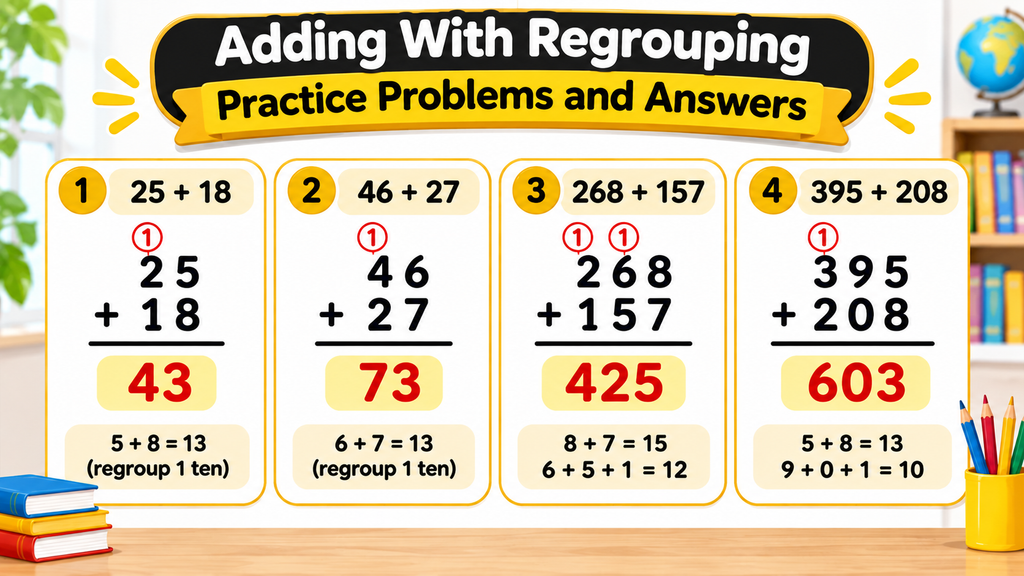
Addition Practice Questions
| # | Problem | Your answer |
|---|---|---|
| 1 | 25 + 18 | ______ |
| 2 | 46 + 27 | ______ |
| 3 | 67 + 15 | ______ |
| 4 | 38 + 46 | ______ |
| 5 | 59 + 26 | ______ |
| 6 | 76 + 48 | ______ |
| 7 | 89 + 57 | ______ |
| 8 | 105 + 27 | ______ |
| 9 | 136 + 258 | ______ |
| 10 | 268 + 157 | ______ |
| 11 | 395 + 208 | ______ |
| 12 | 487 + 369 | ______ |
Encourage students to use a place-value drawing if the written method feels confusing.
Answer Key
| # | Correct answer | Check |
|---|---|---|
| 1 | 43 | 43 − 18 = 25 |
| 2 | 73 | 73 − 27 = 46 |
| 3 | 82 | 82 − 15 = 67 |
| 4 | 84 | 84 − 46 = 38 |
| 5 | 85 | 85 − 26 = 59 |
| 6 | 124 | 124 − 48 = 76 |
| 7 | 146 | 146 − 57 = 89 |
| 8 | 132 | 132 − 27 = 105 |
| 9 | 394 | 394 − 258 = 136 |
| 10 | 425 | 425 − 157 = 268 |
| 11 | 603 | 603 − 208 = 395 |
| 12 | 856 | 856 − 369 = 487 |
Challenge: Find the Regrouping Mistake
A student solves:
47 + 28
The student writes 65.
Their explanation is:
“I added 7 + 8 and wrote 5 in the ones place. Then I added 4 + 2 to get 6 tens.”
What did the student forget?
The student forgot to add the new ten created when the ones totaled fifteen.
The correct steps are:
7 + 8 = 15
Write 5 ones and regroup 1 ten.
4 + 2 + 1 = 7 tens.
Correct answer: 75
Ask children to explain why the regrouped ten must be included.
Quick Exit Ticket for Teachers
To finish the lesson, give students this problem:
56 + 27 = ?
Ask them to:
- Solve the problem.
- Show the regrouped ten.
- Explain why regrouping was necessary.
Correct answer: 83
The ones digits make thirteen, so ten ones become one additional ten.
A student who can represent the exchange with a drawing, number sentence, or clear verbal explanation is showing an understanding of the underlying place value.
Final Teaching Reminder
Adding with regrouping becomes easier when children understand that ten ones can be exchanged for one ten and ten tens can be exchanged for one hundred.
Begin with physical models, move to drawings, and connect those representations to the written method. Introduce harder examples only after students understand the earlier steps.
The goal is not simply to carry numbers correctly. It is to help students understand place value, choose useful strategies, and solve addition problems with confidence.

Written by johan
Jonas is an Educational Content Writer and STEM Learning Contributor at Haute Vibes (hautevibes.com), focusing on elementary education, early mathematics, science exploration, and hands-on learning activities. His writing breaks down educational concepts into simple, engaging lessons that help children develop curiosity, logical thinking, and problem-solving skills. Jonas emphasizes age-appropriate teaching methods, practical classroom resources, and interactive learning experiences that support both teachers and parents. Through his articles, he aims to make STEM education accessible, enjoyable, and meaningful while encouraging young learners to explore, experiment, and build confidence in their abilities.
View all articles →
Join the conversation