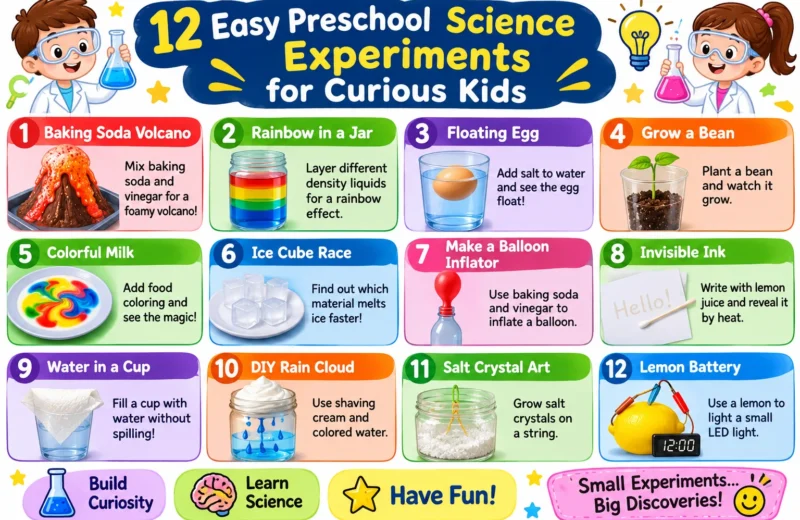
Preschool activities help children build early learning skills through play, movement, creativity, and everyday discovery. Whether you’re a teacher preparing classroom learning centers or a parent looking for educational ideas at home, meaningful learning doesn’t require expensive toys or complicated worksheets.
Children between ages 3 and 5 learn by exploring materials, asking questions, experimenting, and interacting with others. The National Association for the Education of Young Children (NAEYC) recommends developmentally appropriate, hands-on experiences that balance child-led exploration with intentional teaching. NAEYC
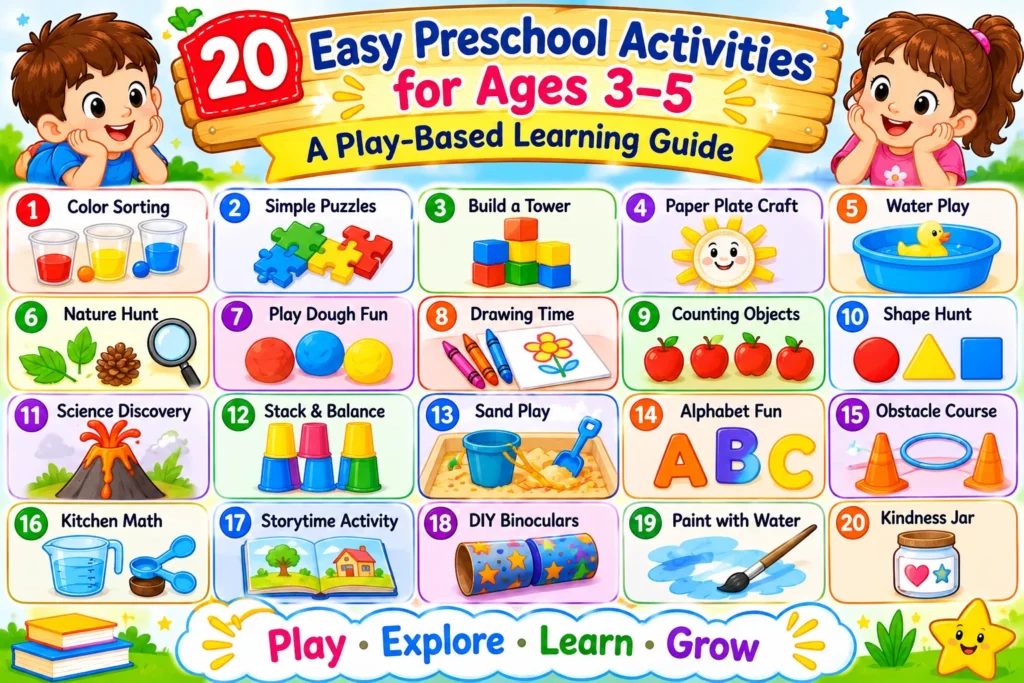
This guide features 20 practical ideas organized by learning goals, plus a unique activity-selection framework and a weekly planning template.
Hands-On Literacy and Early Math Activities
Early literacy and numeracy develop through conversations, games, sorting, and playful discovery rather than memorization alone.
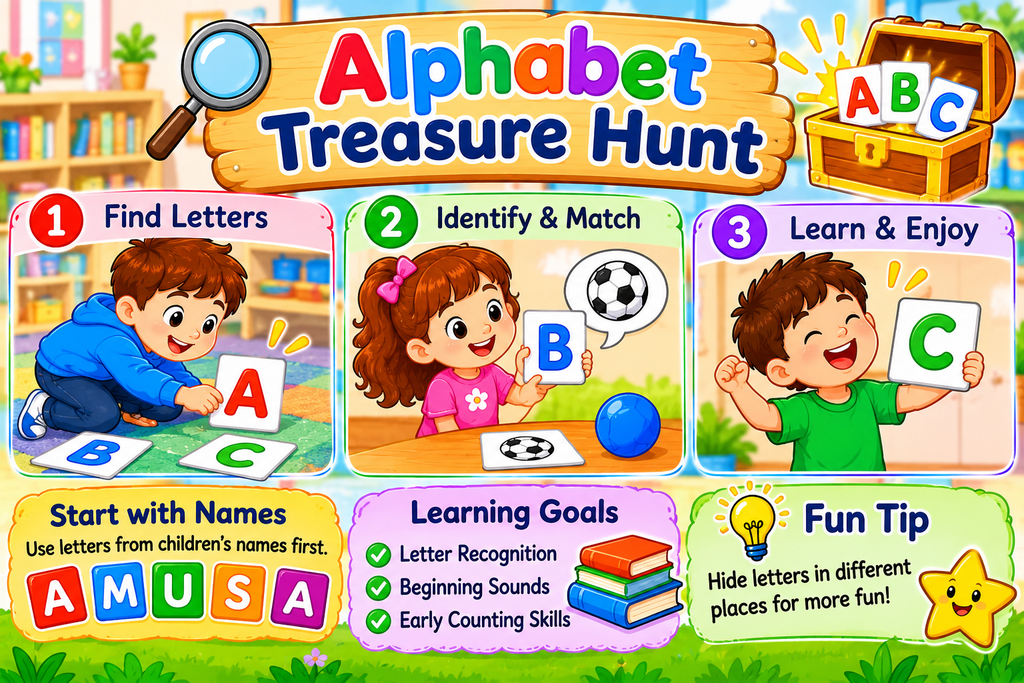
Alphabet Treasure Hunt
Hide large letter cards around the classroom. Invite children to find them, identify familiar letters, and match them with objects beginning with the same sound.
Start with letters in children’s names before introducing less familiar ones.
Name Building With Letter Cards
Write each child’s name on a strip of paper. Provide matching letter cards and encourage children to arrange them in order.
For additional challenge, remove the name model and ask children to reconstruct it independently.
Story Basket Adventures
Place familiar story props inside a basket. After reading a picture book, children use the objects to retell important events.
Ask open-ended questions about what happened first, next, and last.
Counting Toy Collections
Provide large toy animals, blocks, or cars. Children count each object while touching it once.
Rearrange the collection and count again to practice one-to-one correspondence.
Shape Hunt Challenge
Invite children to search for circles, triangles, rectangles, and squares around the room.
They can photograph, draw, or describe the objects they discover.
Color Pattern Trains
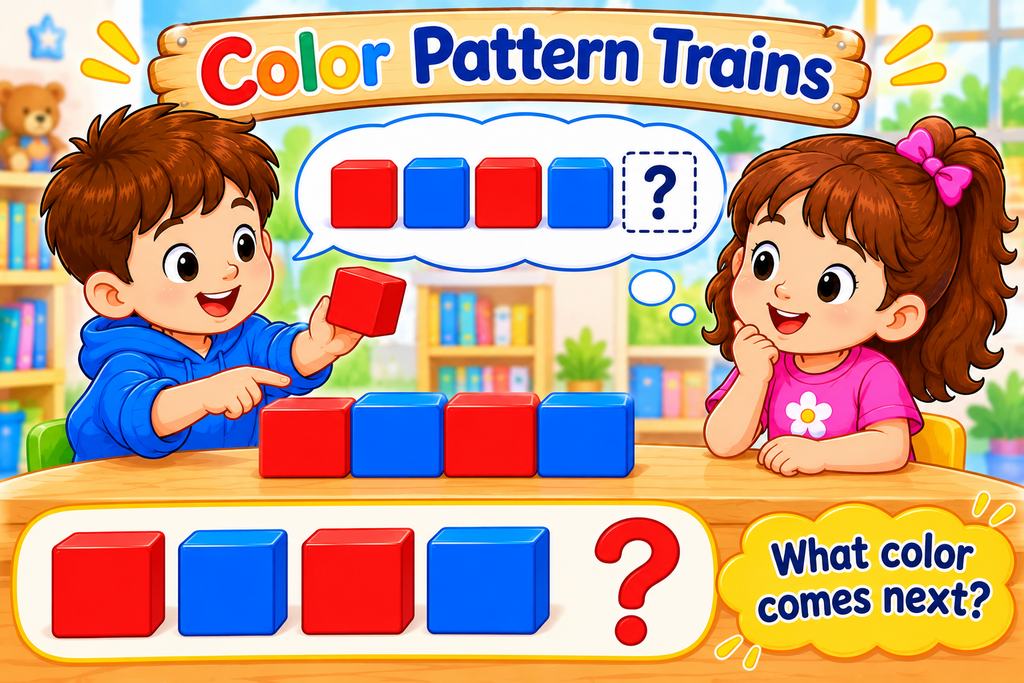
Use large colored blocks to build repeating sequences such as red-blue-red-blue.
Encourage children to predict which color comes next and explain their reasoning.
Creative Art and Sensory Learning Ideas
Open-ended activities allow children to make choices, explore textures, and develop confidence without copying a single finished example.
Nature Texture Rubbings
Place leaves beneath paper and gently rub crayons across the surface.
Compare the resulting shapes and textures.
Playdough Shape Workshop
Provide playdough, child-friendly rollers, and large shape cutters.
Children can roll, flatten, squeeze, and combine shapes to create imaginative objects.
Recycled Materials Sculpture
Offer clean cardboard boxes, paper tubes, and construction-paper scraps.
Challenge children to build imaginary houses, vehicles, or animals.
Water Pouring Station
Arrange shallow containers, cups, scoops, and funnels inside a water tray.
Invite children to experiment with filling, emptying, and comparing container capacities.
Supervise water play continuously.
Collaborative Classroom Mural
Tape a large sheet of paper to a table and provide washable crayons or paint.
Children contribute individual drawings to one shared scene.
Encourage discussions about colors, cooperation, and creative choices.
These experiences reflect NAEYC’s emphasis on art, construction, and water play as opportunities for developing language, mathematical thinking, and coordination. NAEYC
Movement, Nature, and Social-Emotional Activities
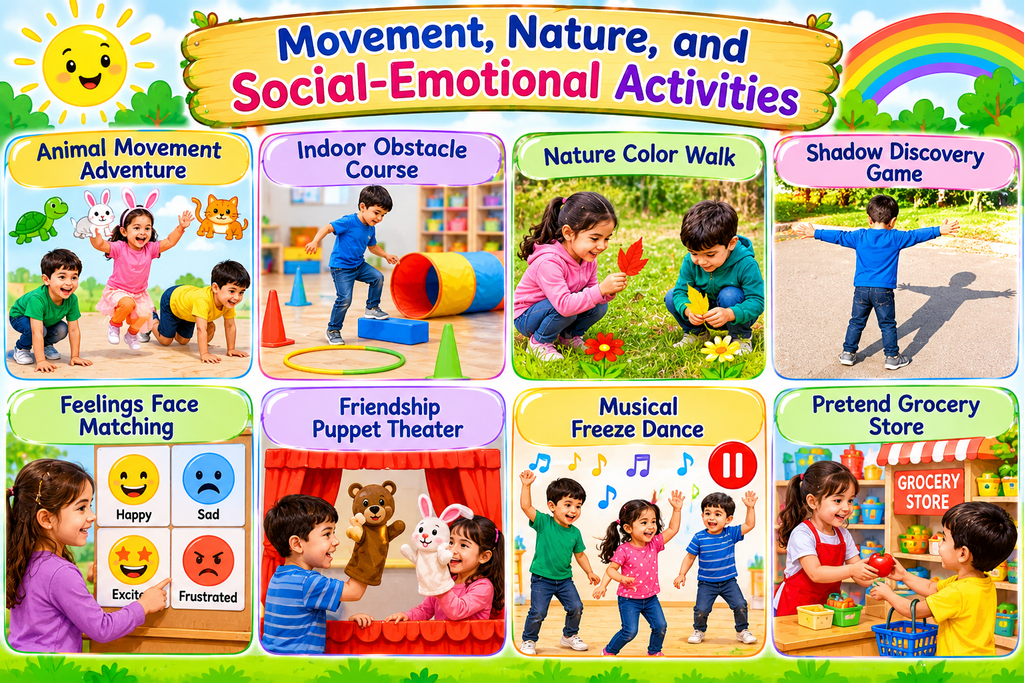
Physical movement and cooperative games encourage children to explore their surroundings while practicing communication and self-regulation.
Animal Movement Adventure
Invite children to hop like rabbits, stretch like cats, or walk slowly like turtles.
Change movements when you call out a new animal.
Indoor Obstacle Course
Arrange cushions, floor markers, and safe tunnels.
Children crawl, balance, step, and move through the course.
Adapt the layout for different mobility needs.
Nature Color Walk
Explore an outdoor area and search for natural objects in different colors.
Discuss leaves, flowers, rocks, and changes in the environment without collecting or touching unfamiliar plants.
Shadow Discovery Game
On a sunny day, children observe their shadows and experiment with different body positions.
Ask how a shadow changes when they move.
Feelings Face Matching
Draw faces representing happiness, sadness, excitement, and frustration.
Children match facial expressions with emotion words and discuss situations associated with each feeling.
Friendship Puppet Theater
Use handmade puppets to act out sharing, cooperation, or asking for help.
Encourage children to suggest different solutions to everyday disagreements.
NAEYC specifically recommends puppet play as one approach to helping young children discuss emotions and social situations. NAEYC
Musical Freeze Dance
Play age-appropriate music and invite children to dance.
Pause the music and ask everyone to freeze.
This supports listening, movement control, and group participation.
Pretend Grocery Store
Create a small shop with empty food containers, baskets, and pretend money.
Children take turns being customers and shopkeepers while practicing counting and conversation.
Build-a-Bridge Challenge
Provide large blocks or sturdy cardboard pieces.
Invite children to design a bridge that supports a lightweight toy.
Encourage them to modify their structure after testing it.
How to Choose Activities by Age and Learning Goal
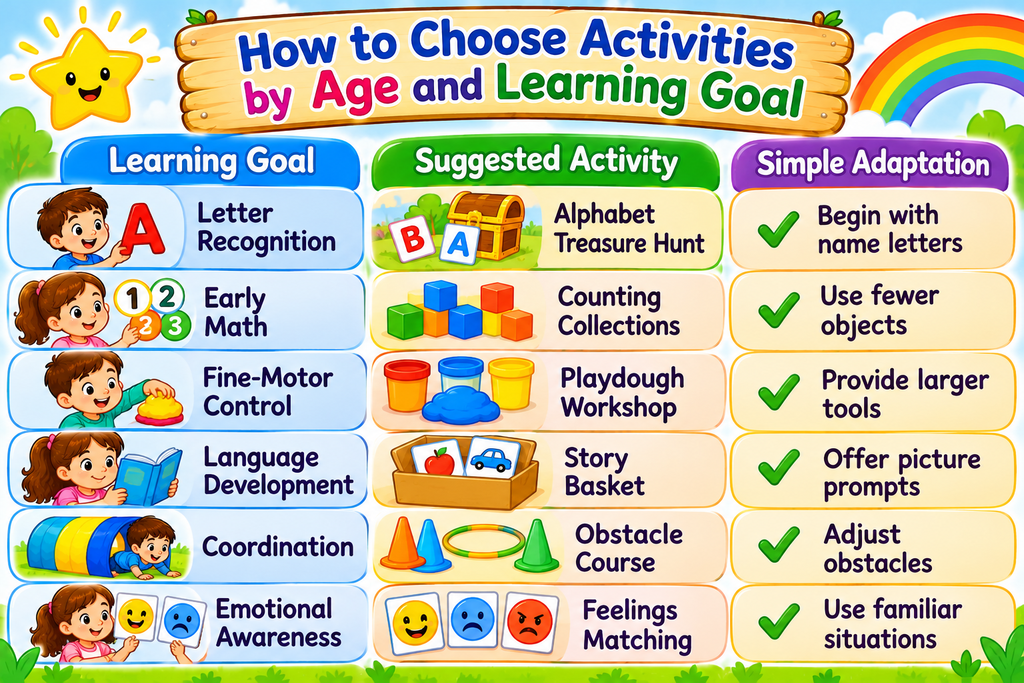
The following Play–Skill Matching Matrix is an original planning guide for selecting activities based on children’s interests and developing abilities.
| Learning goal | Suggested activity | Simple adaptation |
|---|---|---|
| Letter recognition | Alphabet treasure hunt | Begin with name letters |
| Early math | Counting collections | Use fewer objects |
| Fine-motor control | Playdough workshop | Provide larger tools |
| Language development | Story basket | Offer picture prompts |
| Coordination | Obstacle course | Adjust obstacles |
| Emotional awareness | Feelings matching | Use familiar situations |
Age is only one consideration. Teachers should also account for individual abilities, interests, communication needs, and access requirements.
The PLAY Framework for Preschool Learning
The PLAY Framework is a simple activity-planning model developed for this guide.
- P — Purpose: Choose one meaningful learning goal.
- L — Let children explore: Provide materials and encourage independent discovery.
- A — Ask questions: Invite predictions, observations, and explanations.
- Y — Yield to interests: Adapt the activity when children discover something unexpected.
For example, a block-building session might begin with counting but naturally lead to questions about balance, height, and cooperation.
The framework prioritizes flexible learning experiences over rigid instructions.
Sample Weekly Learning Plan
| Day | Activity focus | Example |
|---|---|---|
| Monday | Literacy | Name-building game |
| Tuesday | Math | Pattern trains |
| Wednesday | Art | Nature rubbings |
| Thursday | Movement | Animal adventure |
| Friday | Social skills | Puppet theater |
This is a flexible planning example, not a required curriculum. Children also need ample opportunities for free play, rest, outdoor exploration, and everyday interaction.
Frequently Asked Questions
What Are the Best Preschool Activities for 3-Year-Olds?
Simple sorting games, large-block building, playdough exploration, movement games, and picture-book storytelling are accessible starting points.
How Can I Teach Preschoolers Without Worksheets?
Use hands-on experiences such as counting toys, retelling stories, exploring nature, constructing models, and engaging in pretend play.
What Activities Help Prepare Children for Kindergarten?
Playful opportunities to practice communication, independence, early literacy, counting, cooperation, and motor coordination can support kindergarten readiness.
How Long Should a Preschool Learning Activity Last?
There is no universal ideal duration. Follow children’s engagement, attention, interests, and individual needs rather than enforcing a fixed time.
Conclusion
Effective preschool activities combine curiosity, movement, communication, and meaningful play. Simple materials can support literacy, mathematics, creativity, problem-solving, and social development.
Start with activities that match children’s interests, adapt the level of challenge, and use conversations to extend their discoveries. The goal is not to complete more projects but to create opportunities for children to explore, participate, and enjoy learning.