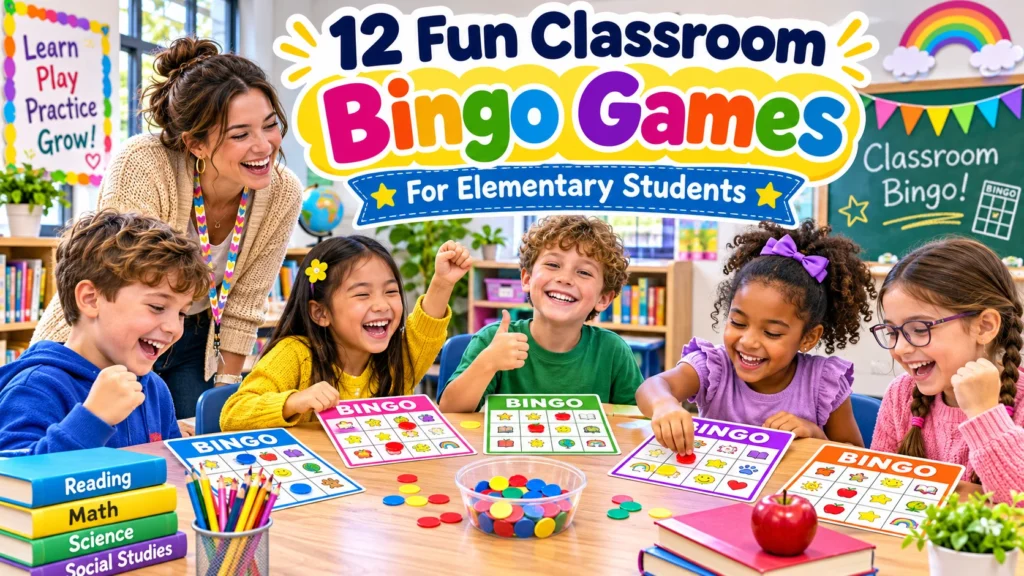
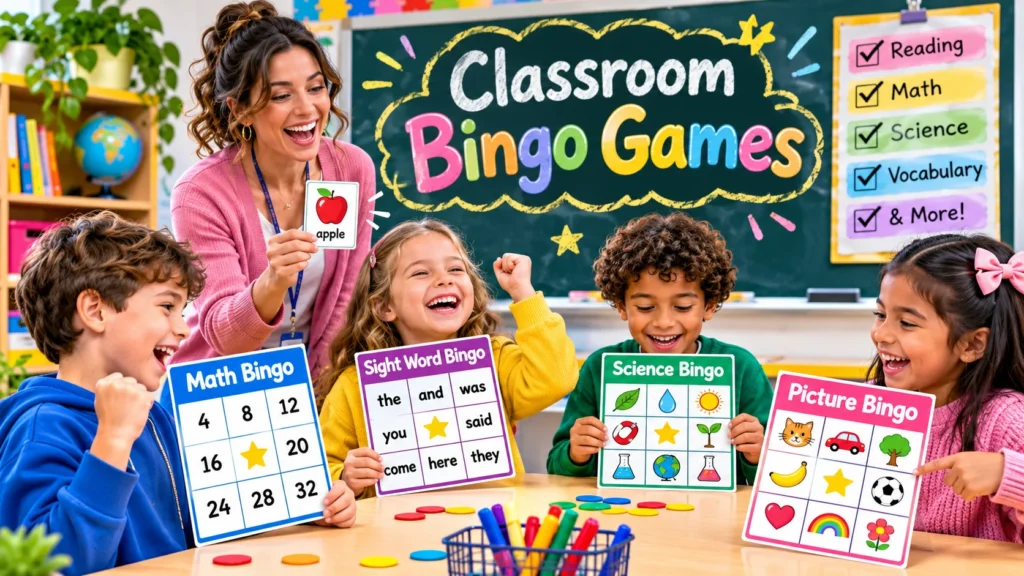
Looking for a fun way to keep students excited about learning? Classroom bingo games can turn everyday lessons into interactive activities that encourage participation, listening, and problem-solving.
Whether you’re teaching kindergarten students to recognize letters or helping fifth graders review fractions, bingo offers a flexible way to practice important classroom skills.
The best part? You don’t need expensive supplies or hours of preparation. With a few bingo cards, simple clues, and reusable markers, you can create engaging activities for almost any subject.
If you’ve been searching for a bingo game for classroom learning, this guide includes 12 creative ideas for reading, math, science, vocabulary, and classroom community building. You’ll also learn how to organize the games, prepare cards, and adjust activities for different grade levels.
What Is a Classroom Bingo Game?
A classroom bingo game is an educational version of traditional bingo in which students identify words, numbers, pictures, or answers on a grid.
Instead of calling random numbers, teachers can present questions, vocabulary clues, math problems, or visual prompts. Students mark the correct squares and try to complete a winning pattern.
For example, in a math bingo game, a teacher might say, “What is 6 plus 4?” Students find the number 10 on their cards and mark it.
In sight word bingo, the teacher calls out the word “because,” and students look for it on their boards.
Classroom bingo can be used for:
- Letter and word recognition
- Phonics and spelling practice
- Addition, subtraction, and multiplication
- Science and social studies review
- Reading comprehension
- Classroom routines and social interaction
Teachers can make the game easier or more challenging by changing the card size, questions, and number of possible answers.
How to Play Bingo in the Classroom
Before choosing a classroom bingo activity, make sure students understand the basic rules.
Step 1: Choose a Learning Topic
Select something students are already learning, such as sight words, multiplication facts, animal habitats, or vocabulary.
Step 2: Prepare the Bingo Cards
Create cards using words, numbers, pictures, or possible answers.
Use different arrangements so students don’t all win at the same moment.
A 3×3 card works well for short games and younger learners. A 4×4 or 5×5 card offers more variety for older students.
Step 3: Distribute Cards and Markers
Give each student a bingo card and a set of reusable counters, paper squares, or washable markers.
Students can also use pencils if the cards are intended for one-time use.
Step 4: Call Out Clues or Questions
Read a word, show a picture, or ask a question related to the lesson.
Allow enough thinking time before moving to the next clue.
Step 5: Mark the Matching Answers
Students identify the correct squares and mark them.
If a student doesn’t have the answer on their card, they simply wait for the next clue.
Step 6: Check the Winning Pattern
The first student to complete the agreed pattern calls out “Bingo!”
Common winning patterns include a horizontal row, vertical column, diagonal line, or entire card.
Check the marked answers against the clues before confirming a win.
Teacher Tip: Play one practice round before starting. Younger students may need a visual demonstration to understand how to mark their cards.
12 Best Classroom Bingo Games for Kids
These classroom bingo games are organized around different learning goals. Each activity includes the suggested age group, materials, instructions, and an easy variation.
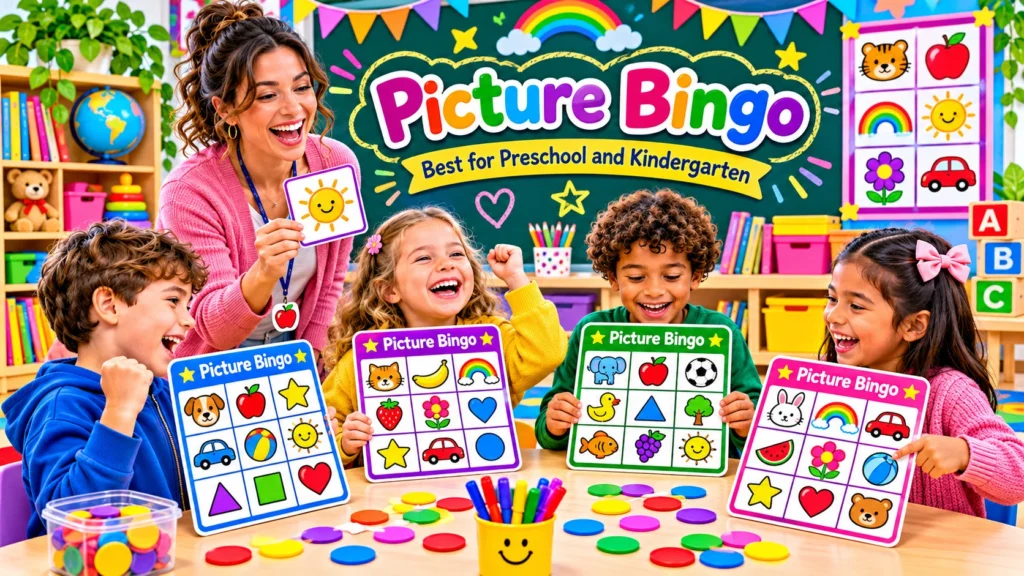
1. Picture Bingo — Best for Preschool and Kindergarten
Recommended Grades: Pre-K–Kindergarten
Preparation Time: 5–10 minutes
Skills Practiced: Visual recognition, vocabulary, and listening
Picture Bingo is an easy introduction to bingo for young children who are still developing reading skills.
Instead of using written words or numbers, fill the squares with familiar pictures such as animals, fruits, colors, vehicles, or classroom objects.
Materials Needed:
- Picture bingo cards
- Matching picture cards or a calling list
- Reusable counters
How to Play:
- Prepare 3×3 bingo cards featuring nine familiar pictures.
- Give each student a card and counters.
- Call out an object, such as “apple,” or describe it using a simple clue.
- Students find the correct picture and cover it.
- Continue until someone completes a row.
Example: Say, “Find the animal that says moo.” Students locate the cow picture and mark it.
Classroom Variation: Use shape pictures instead of animals to create a shape-recognition bingo game.
Why Use It? Picture Bingo lets younger students participate without needing advanced reading skills.
2. Sight Word Bingo — Best for Early Reading Practice
Recommended Grades: Kindergarten–Grade 2
Preparation Time: 10 minutes
Skills Practiced: Sight word recognition, reading fluency practice, and attention
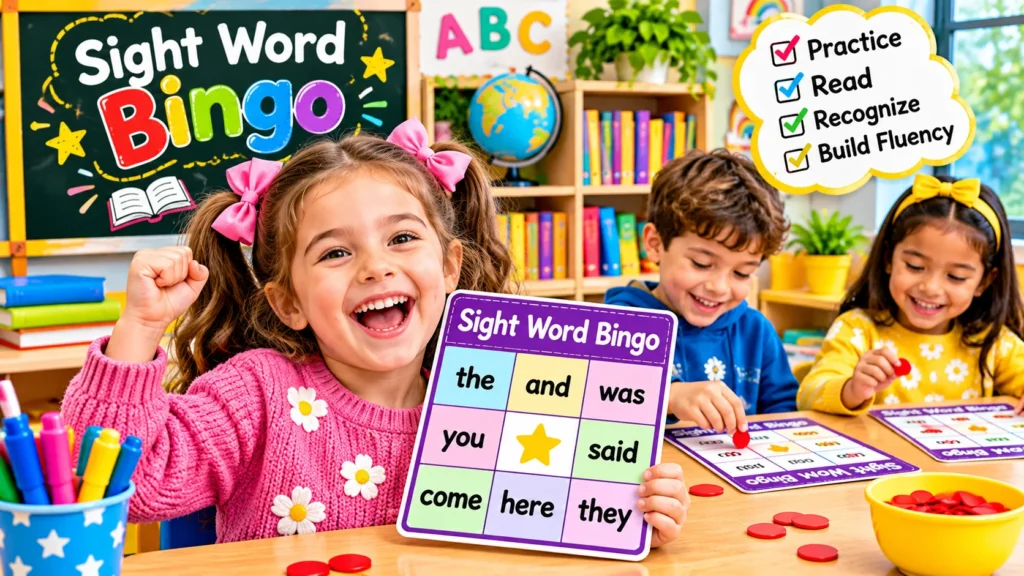
Sight Word Bingo helps students become familiar with common words they frequently encounter in early reading materials.
Words such as the, said, come, here, and they can be placed in different squares.
Materials Needed:
- Bingo cards with familiar sight words
- A word calling list
- Pencils or counters
How to Play:
- Select 12–20 words students have already practiced.
- Arrange a selection of the words on each bingo card.
- Read one word aloud.
- Ask students to locate and mark it.
- Continue until a student completes the winning pattern.
Example 3×3 Sight Word Bingo Card:
| the | and | said |
|---|---|---|
| you | FREE | they |
| was | come | here |
Students may cover the free center square before the game begins.
Classroom Variation: Instead of calling a word by itself, use it in a short sentence. Students listen for the target word and mark it.
Teacher Tip: Display or spell the word after each round when students need additional support.
.
3. Phonics Bingo — Best for Letter Sounds
Recommended Grades: Kindergarten–Grade 2
Preparation Time: 10 minutes
Skills Practiced: Phonemic awareness, phonics, and sound-letter matching
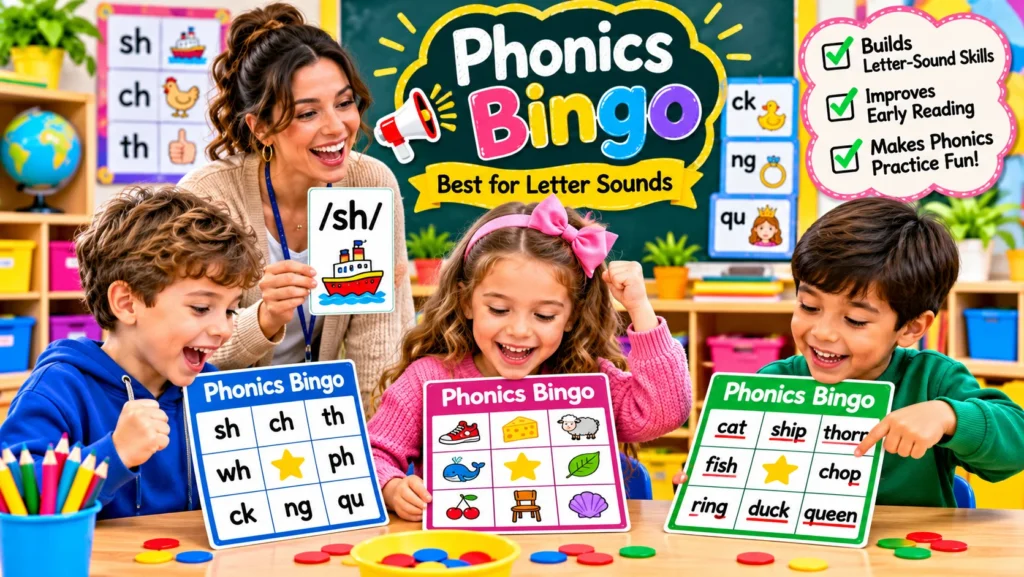
Phonics Bingo turns letter-sound practice into a listening game.
Students match sounds or spoken clues to letters, letter combinations, or spelling patterns.
Materials Needed:
- Letter or phonics bingo cards
- A prepared sound and word list
- Counters
How to Play:
- Choose the phonics patterns students are learning.
- Place letters or spelling patterns on the bingo cards.
- Pronounce a target sound or say a word containing it.
- Students identify the matching letter or pattern.
- Mark the correct square and continue playing.
Example Clues:
- “Which letter makes the first sound in sun?” — S
- “Which two letters make the beginning sound in ship?” — SH
- “Find the spelling pattern that makes the final sound in duck.” — CK
Classroom Variation: Create rhyming-word bingo. Say “cat” and ask students to identify a matching rhyme, such as “hat.”
Teacher Tip: Use a consistent sound and pronunciation model. For words with multiple possible spellings, make the intended answer clear.
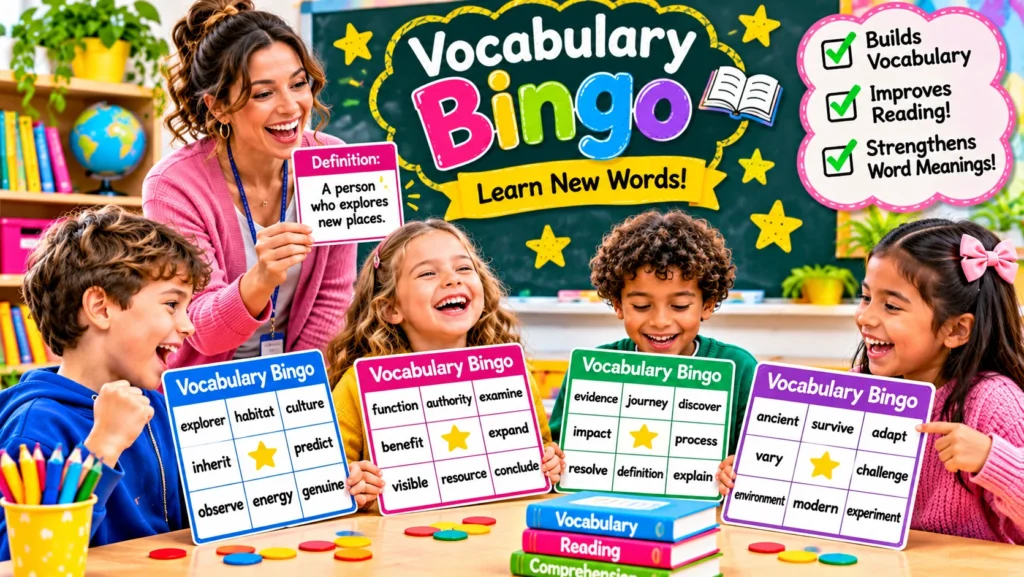
4. Vocabulary Bingo — Best for Learning New Words
Recommended Grades: Grades 2–5
Preparation Time: 10–15 minutes
Skills Practiced: Word meanings, listening comprehension, and vocabulary recall
Vocabulary Bingo is useful for reviewing words from reading lessons, science units, and social studies topics.
Instead of calling a word directly, teachers read its meaning and students identify the matching word.
Materials Needed:
- Vocabulary bingo cards
- Word definitions
- Counters or pencils
How to Play:
- Choose vocabulary terms from a recent lesson.
- Write the terms in different positions on student bingo cards.
- Read a definition aloud without saying the answer.
- Students identify the correct word.
- Continue until a winning pattern is completed.
Example Clues:
| Teacher’s Clue | Bingo Answer |
|---|---|
| A person who studies the past | Historian |
| The process by which plants make food using light | Photosynthesis |
| A word with the opposite meaning | Antonym |
| An animal that eats plants | Herbivore |
Classroom Variation: Ask students to write their own clues and take turns acting as the bingo caller.
Why Use It? Students practice connecting definitions to words rather than simply memorizing a list.
5. Addition and Subtraction Bingo — Best for Math Practice
Recommended Grades: Grades 1–3
Preparation Time: 10 minutes
Skills Practiced: Number sense, addition, subtraction, and mental math
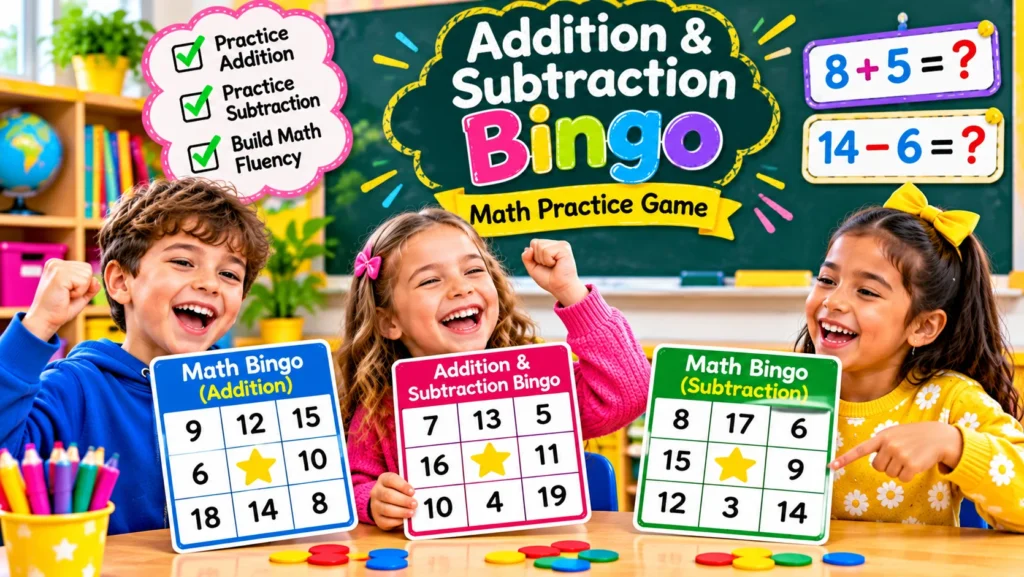
Addition and Subtraction Bingo is a simple way to review math facts while keeping the lesson interactive.
Students solve math problems and find the answers on their bingo cards.
Materials Needed:
- Number bingo cards
- Addition and subtraction questions
- Counters
- Optional scratch paper
How to Play:
- Place numbers such as 5, 8, 10, 12, 15, and 20 on the cards.
- Prepare math questions with answers matching those numbers.
- Read a problem aloud.
- Give students time to solve it.
- Students mark the answer if it appears on their cards.
Example Questions:
- 7 + 5 = 12
- 15 − 6 = 9
- 8 + 8 = 16
- 20 − 7 = 13
Classroom Variation: Create two difficulty levels. Younger students can solve problems within 10, while older students work within 100.
Teacher Tip: Give children enough processing time. The goal is accurate practice, not simply answering faster than classmates.
6. Multiplication Bingo — Best for Practicing Times Tables
Recommended Grades: Grades 3–5
Preparation Time: 10–15 minutes
Skills Practiced: Multiplication facts, number relationships, and calculation fluency
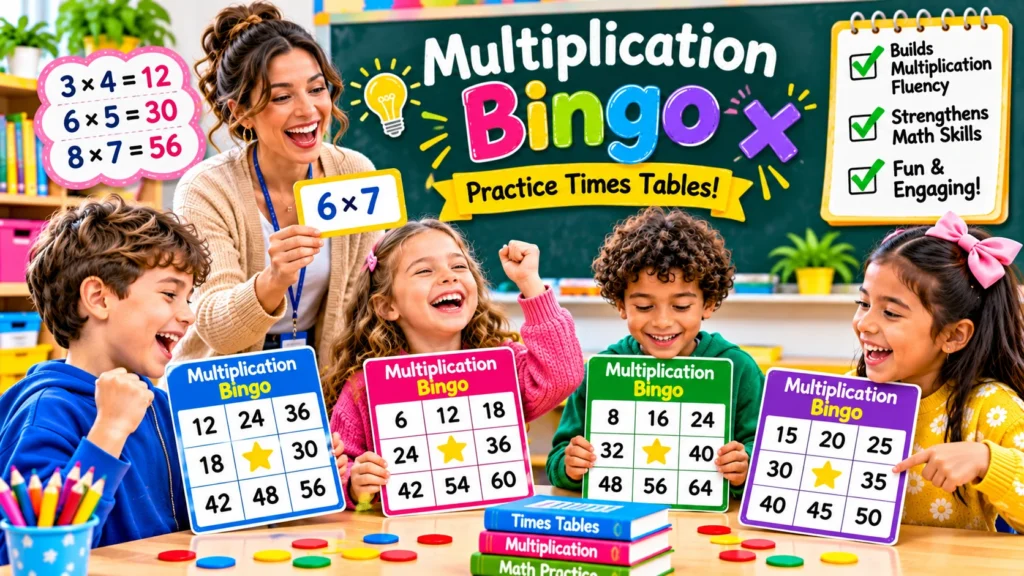
Multiplication Bingo helps students practice times tables through repeated, engaging questions.
Instead of having students recite facts in order, teachers present multiplication problems in mixed sequences.
Materials Needed:
- Bingo cards containing multiplication products
- Multiplication question cards
- Pencils or counters
How to Play:
- Select multiplication facts students are reviewing.
- Put products such as 12, 18, 24, 32, and 42 on the cards.
- Call out multiplication questions.
- Students calculate the answers.
- They locate and mark the correct products.
Example Questions:
- 3 × 4 = 12
- 6 × 7 = 42
- 8 × 4 = 32
- 9 × 2 = 18
Classroom Variation: Let students use multiplication charts during the first round. Remove the charts in later rounds when appropriate.
Teacher Tip: Some multiplication problems share the same product. Plan the calling list to prevent accidentally treating a repeated answer as a new square.
7. Fraction Bingo -Best for Understanding Fractions
Recommended Grades: Grades 3–5
Preparation Time: 15 minutes
Skills Practiced: Fraction recognition, visual models, and equivalent fractions
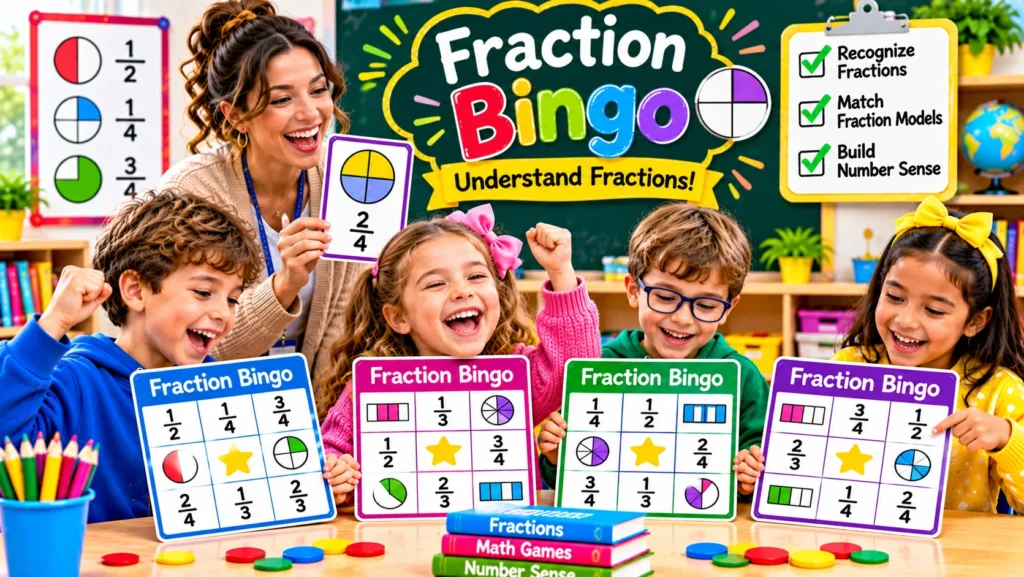
Fraction Bingo gives students an opportunity to connect numerical fractions with pictures and representations.
Instead of writing only numbers on their cards, teachers can use circles, fraction bars, or shaded shapes.
Materials Needed:
- Fraction bingo cards
- Fraction diagrams or calling cards
- Counters
How to Play:
- Create cards containing fractions such as 1/2, 1/3, 1/4, 2/3, and 3/4.
- Display fraction models or read fraction clues.
- Students identify the matching representation.
- They mark the appropriate square.
- Continue until a student completes a winning pattern.
Example: Show a rectangle divided into four equal parts with three parts shaded. Students mark 3/4.
Classroom Variation: Use equivalent fractions. Ask students to match 2/4 with 1/2 or 3/6 with 1/2.
Teacher Tip: Decide before the game whether students are matching exact written fractions or equivalent values. Make the answer rules clear to avoid confusion.
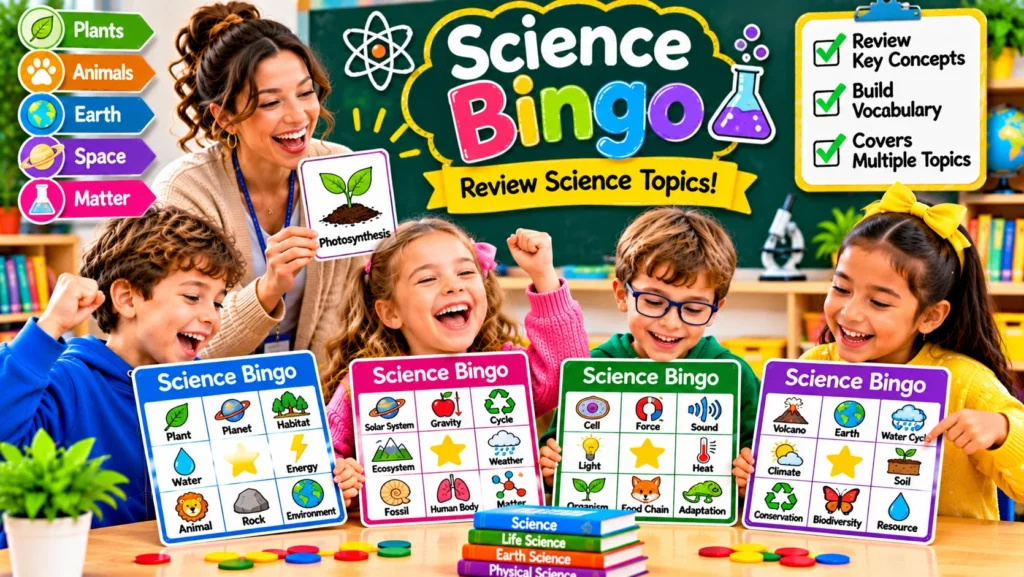
8. Science Bingo – Best for Reviewing Science Topics
Recommended Grades: Grades 2–5
Preparation Time: 10–15 minutes
Skills Practiced: Scientific vocabulary, concept recognition, and recall
Science Bingo can reinforce what students have learned about plants, animals, weather, space, and the human body.
It’s particularly useful as a review activity after completing a science unit.
Materials Needed:
- Science-themed bingo cards
- Vocabulary questions or picture clues
- Counters
How to Play:
- Choose a science topic students have studied.
- Add related words or images to the bingo cards.
- Read questions or descriptions aloud.
- Students find the correct answers.
- Continue until someone completes a row or other agreed pattern.
Example Questions:
| Teacher’s Question | Bingo Answer |
|---|---|
| What do plants absorb from the soil through their roots? | Water |
| Which planet is known as the Red Planet? | Mars |
| What is water called when it freezes? | Ice |
| What force pulls objects toward Earth? | Gravity |
Classroom Variation: Use pictures of animal habitats and ask students to match animals with the correct environments.
Why Use It? Science Bingo encourages students to recall scientific terms while connecting them to familiar questions and examples.
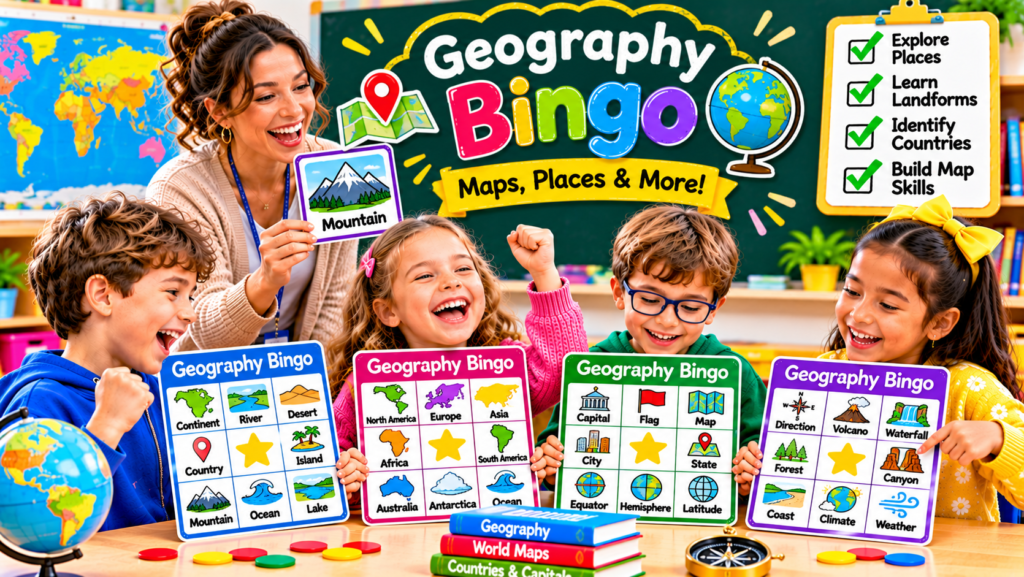
9. Geography Bingo — Best for Maps and Places
Recommended Grades: Grades 3–5
Preparation Time: 10–15 minutes
Skills Practiced: Geography vocabulary, map knowledge, and location recognition
Geography Bingo can make map skills and location-based learning more engaging.
Teachers can focus on continents, oceans, US states, landforms, or important geographical features.
Materials Needed:
- Geography bingo cards
- Maps or question cards
- Counters
How to Play:
- Choose geography topics appropriate for your class.
- Write place names or geographical terms on the cards.
- Read a clue or show a location on a map.
- Students identify the correct answer.
- They mark the matching square.
Example Clues:
- “Which continent is Brazil located in?” – South America
- “Which ocean lies along the eastern coast of the United States?” — Atlantic Ocean
- “Which US state has Austin as its capital?” — Texas
- “What do we call a large body of land surrounded by water?” — Island
Classroom Variation: Show unlabeled maps and let students identify locations before marking their cards.
Teacher Tip: Use maps that match students’ current lessons rather than introducing too many unfamiliar locations at once.
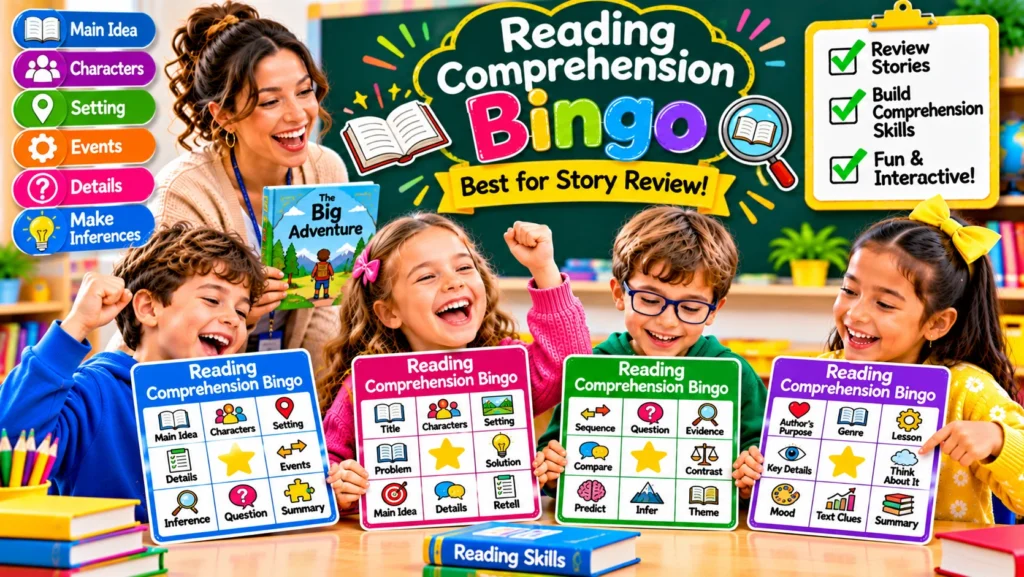
10. Reading Comprehension Bingo – Best for Story Review
Recommended Grades: Grades 2–5
Preparation Time: 15 minutes
Skills Practiced: Reading comprehension, story elements, and recall
Reading Comprehension Bingo transforms story review into an interactive activity.
Students use information from a story they have read or listened to in order to match answers on their bingo cards.
Materials Needed:
- A familiar story or classroom reading passage
- Bingo cards featuring story elements
- Prepared comprehension questions
- Counters
How to Play:
- Read a story together or use a passage students have already completed.
- Create cards containing character names, settings, events, and important story details.
- Ask questions about the reading.
- Students locate the correct answers.
- Continue until a student completes the required pattern.
Example Questions:
- Who is the main character?
- Where does the story begin?
- What problem does the character face?
- Which event happens after the character finds the missing object?
- How is the main problem resolved?
Classroom Variation: Make inference bingo. Students match simple clues to character feelings, motivations, or conclusions supported by the text.
Teacher Tip: Use questions with clearly identifiable answers. Discuss ambiguous responses before students mark their cards.
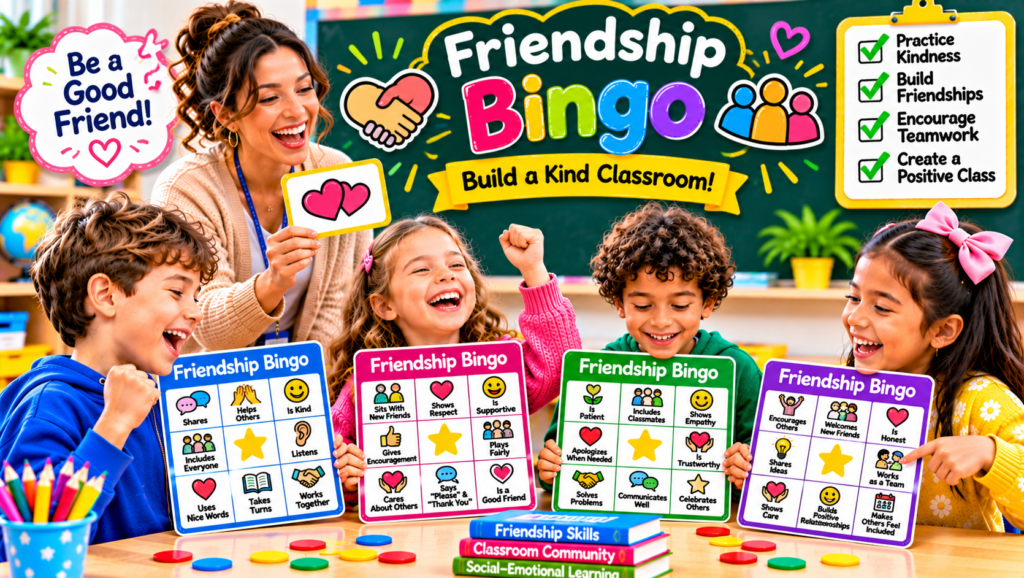
11. Friendship Bingo – Best for Classroom Community Building
Recommended Grades: Kindergarten–Grade 5
Preparation Time: 10 minutes
Skills Practiced: Communication, social interaction, and listening
Friendship Bingo is a fun classroom icebreaker, especially during the first week of school.
Instead of marking academic answers, students talk with classmates to discover shared interests and experiences.
Materials Needed:
- Friendship bingo cards
- Pencils
- A list of age-appropriate prompts
How to Play:
- Create bingo cards containing statements about familiar interests.
- Give each student a card.
- Allow students to move around the classroom and ask classmates questions.
- When a classmate matches a statement, students write that person’s name in the square.
- Continue until students complete a row or the allotted time ends.
Example Friendship Bingo Prompts:
- Likes drawing pictures
- Enjoys reading books
- Has a favorite animal
- Likes playing soccer
- Enjoys music
- Likes science activities
- Enjoys building with blocks
- Likes visiting parks
Classroom Variation: Play seated partner bingo for students who prefer not to move around the room.
Teacher Tip: Avoid prompts involving family circumstances, finances, health, or other personal information. Give students permission to skip any question and offer alternative participation options.
Why Use It? Friendship Bingo gives students structured opportunities to start conversations and discover common interests.
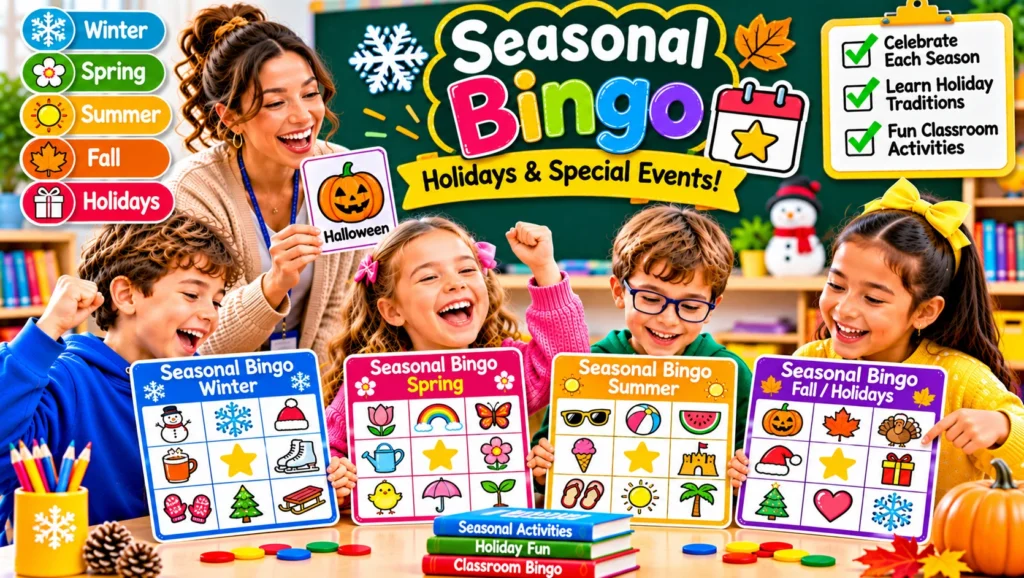
12. Seasonal Bingo — Best for Holidays and Special Events
Recommended Grades: Pre-K–Grade 5
Preparation Time: 10–15 minutes
Skills Practiced: Seasonal vocabulary, observation, listening, and thematic learning
Seasonal Bingo is an easy way to adapt classroom activities throughout the school year.
Teachers can create different bingo cards for fall, winter, spring, summer, and classroom celebrations.
Materials Needed:
- Seasonal bingo cards
- Themed pictures or vocabulary words
- Counters
How to Play:
- Choose a seasonal theme related to your classroom activities.
- Prepare cards with appropriate words or pictures.
- Call out a word or describe an item.
- Students identify and mark matching squares.
- Continue until a winning pattern is completed.
Seasonal Bingo Themes:
| Theme | Example Bingo Words |
|---|---|
| Fall Bingo | Pumpkin, leaf, apple, sweater |
| Winter Bingo | Snowflake, scarf, mittens, snowman |
| Spring Bingo | Flower, butterfly, rain, seed |
| Summer Bingo | Sunshine, beach, sunglasses, watermelon |
| Back-to-School Bingo | Pencil, backpack, notebook, classroom |
Classroom Variation: Use seasonal vocabulary during writing lessons. After playing bingo, ask students to write sentences using three words from their cards.
Teacher Tip: Choose themes that are welcoming and relevant to your students. Seasonal nature topics can be useful alternatives to holiday-specific activities.
Quick Comparison: Best Classroom Bingo Games by Grade
Not sure which bingo activity to choose? Use this guide to select a game that fits your students’ needs.
| Classroom Bingo Game | Recommended Grades | Main Learning Focus |
|---|---|---|
| Picture Bingo | Pre-K–K | Visual recognition |
| Sight Word Bingo | K–2 | Early reading |
| Phonics Bingo | K–2 | Letter sounds |
| Vocabulary Bingo | 2–5 | Word meanings |
| Addition and Subtraction Bingo | 1–3 | Basic math facts |
| Multiplication Bingo | 3–5 | Times tables |
| Fraction Bingo | 3–5 | Fraction concepts |
| Science Bingo | 2–5 | Science review |
| Geography Bingo | 3–5 | Maps and places |
| Reading Comprehension Bingo | 2–5 | Story understanding |
| Friendship Bingo | K–5 | Social communication |
| Seasonal Bingo | Pre-K–5 | Thematic vocabulary |
These are suggested grade levels, not strict limits. Teachers can simplify or increase difficulty based on the skills students have already learned.
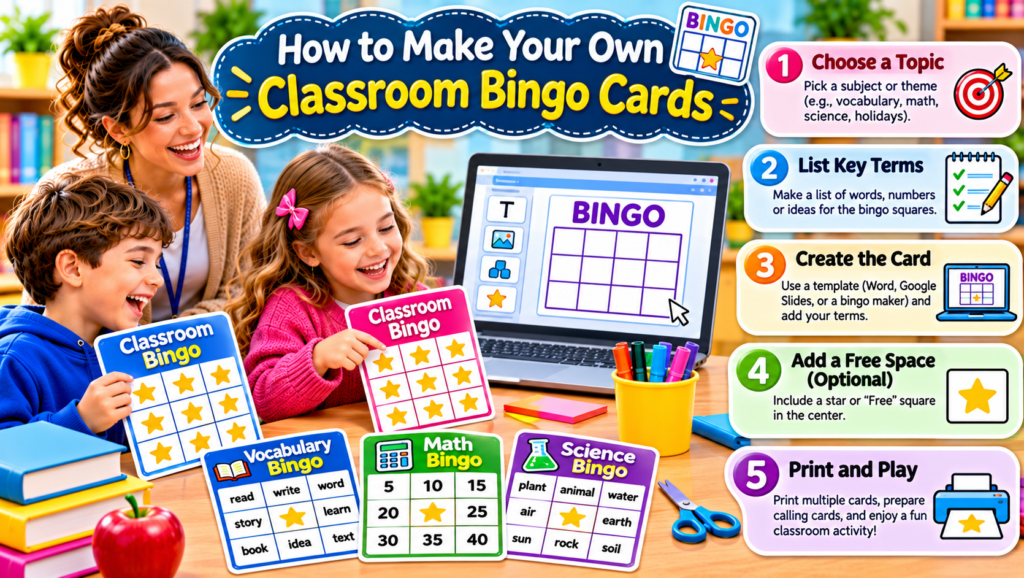
How to Make Your Own Classroom Bingo Cards
Creating a bingo classroom game doesn’t require expensive software or professional design skills.
You can make bingo cards using paper, classroom presentation software, or a simple digital table.
1. Select a Topic
Start with a clear learning objective.
For example, if students are reviewing multiplication facts, use multiplication products as the answers on the cards.
2. Choose a Bingo Grid
Select a card size based on the students’ age and the amount of content.
| Grid Size | Number of Squares | Suggested Use |
|---|---|---|
| 3×3 | 9 | Quick games and younger learners |
| 4×4 | 16 | Standard classroom review |
| 5×5 | 25 | Longer games and larger vocabulary sets |
A center free space is optional. If you use one, adjust the number of answer squares accordingly.
3. Add Words, Pictures, or Numbers
Fill the squares with possible answers from your chosen topic.
Use clear, readable text. For early learners, choose familiar images and avoid overcrowded designs.
4. Create Different Card Arrangements
Shuffle the placement of answers so students receive varied cards.
For large classes, use a common answer bank to generate several different arrangements. Make sure the calling list covers every possible answer.
5. Prepare Your Calling List
Create a teacher answer key containing every clue and its correct answer.
For academic bingo, verify all questions before the lesson.
6. Print and Reuse
Print the cards on regular paper or cardstock.
For reusable games, laminate the cards or place them in dry-erase sleeves.
Store the cards by subject or grade level so they can be used again.
How to Make Classroom Bingo More Engaging
Even a simple game can become repetitive if students always play in exactly the same way.
These variations can help keep classroom bingo activities interesting.
Try Different Winning Patterns
Instead of always requiring a straight line, try:
- Four corners
- An X pattern
- Two completed lines
- Full-card bingo
- A teacher-selected shape
Explain the winning pattern before starting and make sure it works with your chosen grid.
Let Students Become the Bingo Caller
Invite students to read clues, display pictures, or present questions.
For academic bingo, provide a verified answer key so the caller can check responses.
Add Partner Discussions
Before marking an answer, students can briefly discuss the question with a partner.
This approach is especially helpful for vocabulary, fractions, and reading comprehension.
Combine Bingo With Movement
Place calling clues around the classroom and let students visit stations to find answers.
Keep movement organized and provide an accessible seated option.
Play Cooperative Bingo
Instead of focusing only on the first student to win, encourage the entire class to work toward a shared goal.
For example, the class might aim to correctly identify 20 vocabulary clues together.
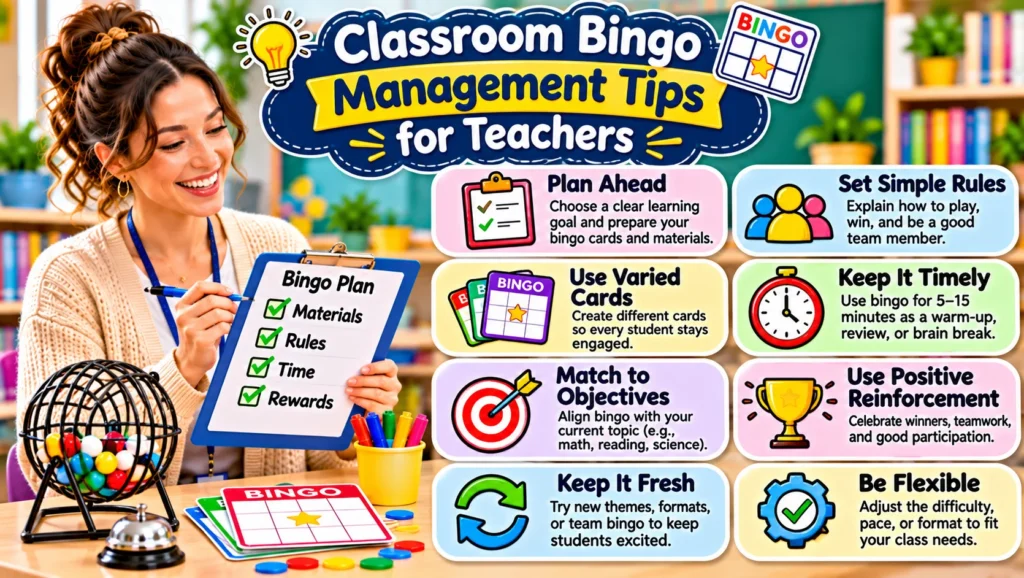
Classroom Bingo Management Tips for Teachers
Successful classroom bingo activities depend on clear expectations and appropriate pacing.
Set the rules before playing. Explain how to mark squares, when to call “Bingo,” and what students should do when they finish.
Practice first. Demonstrate one or two clues before the game begins.
Allow thinking time. Avoid turning every activity into a speed competition. Give students a chance to process information.
Use clear visual materials. Large fonts, uncluttered layouts, and recognizable pictures help students identify answers.
Differentiate when necessary. Offer smaller grids, picture supports, word banks, or more challenging questions.
Check answers fairly. Verify winning cards using the calling list rather than accepting every claim automatically.
Celebrate participation. Praise careful listening, teamwork, and effort rather than focusing only on winning.
Keep games manageable. A short round may work well as a lesson warm-up, while a longer session can serve as a review activity.
Common Classroom Bingo Problems and Easy Solutions
| Challenge | Practical Solution |
|---|---|
| Students become too noisy | Establish a classroom voice level before playing |
| Younger children lose their markers | Use crayons, washable markers, or dry-erase sleeves |
| Some students finish too quickly | Try longer patterns or additional rounds |
| Students struggle with clues | Offer picture supports or read clues twice |
| Children become upset about losing | Use cooperative bingo or recognize multiple types of participation |
| Different cards cause confusion | Explain that students have the same answer bank in different arrangements |
| Preparation takes too long | Reuse card templates and maintain organized calling lists |
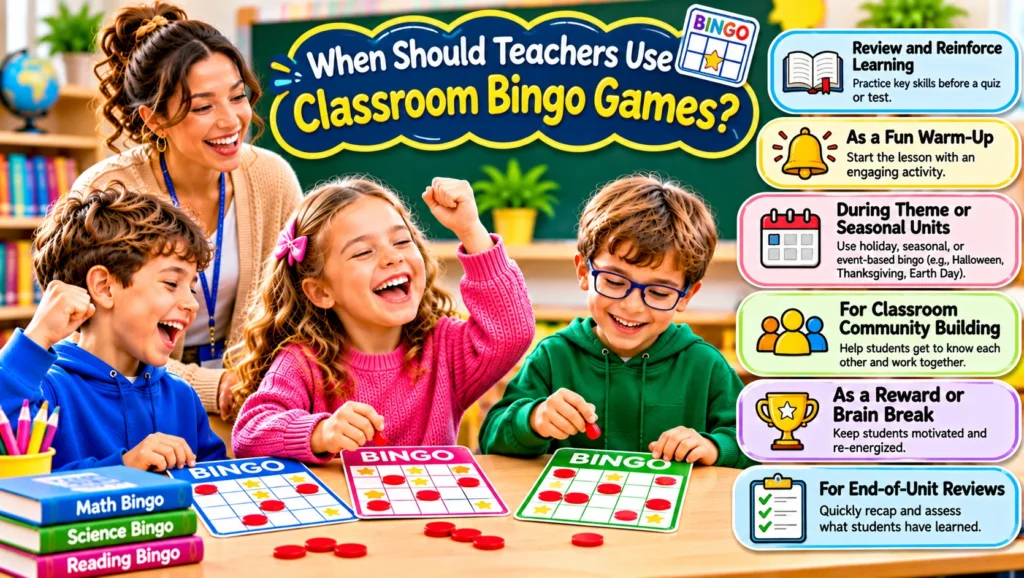
When Should Teachers Use Classroom Bingo Games?
Classroom bingo is especially useful when students need a change of pace without leaving the lesson’s learning objective behind.
Morning Warm-Ups: Use a short sight word or number bingo game to review familiar material.
Lesson Review: Reinforce key vocabulary, formulas, or concepts after teaching a topic.
Small-Group Instruction: Use targeted bingo cards to practice skills with a smaller group of students.
Friday Review Activities: Revisit important material from the week through an interactive game.
Indoor Recess or Flexible Activity Time: Choose picture bingo, seasonal bingo, or another enjoyable activity that doesn’t require extensive preparation.
Substitute Teacher Activities: Keep a reusable bingo kit with complete instructions and an answer key for a substitute teacher.
The most effective choice depends on the purpose of the activity. When bingo is used for academic learning, connect the questions to what students have already been taught.
Frequently Asked Questions About Classroom Bingo Games
What is the best bingo game for a classroom?
The best bingo game depends on the age and learning goals of the students. Picture Bingo is suitable for young learners, Sight Word Bingo is useful for early reading practice, and Math Bingo works well for reviewing number skills.
How do you play bingo with elementary students?
Give every student a bingo card and markers. Read questions or clues aloud, and ask students to identify the matching answers. Students mark their squares and call out “Bingo!” when they complete the agreed winning pattern. Check their answers before confirming a win.
How do I make bingo fun for students?
Use colorful cards, familiar themes, varied winning patterns, student callers, and partner activities. Changing the subject and gameplay format can also help maintain interest.
What can I use instead of bingo chips?
Students can use paper squares, crayons, pencils, washable markers, or dry-erase markers on laminated cards. Choose materials appropriate for their age and classroom needs.
Can classroom bingo help students practice reading?
Yes. Teachers can use bingo for sight word recognition, phonics patterns, vocabulary meanings, and reading comprehension questions. The game provides structured opportunities to practice skills already introduced during instruction.
How many squares should a classroom bingo card have?
A 3×3 grid has nine squares and works well for short activities. A 4×4 grid provides 16 squares, while a traditional 5×5 grid contains 25 squares. Teachers can adjust the size based on students’ abilities and the desired game length.
Can students play bingo without printed cards?
Yes. Students can draw their own grids on paper, use mini whiteboards, or complete a digital bingo activity when classroom technology is available.
How long should a classroom bingo game last?
A short bingo round may take around 5–10 minutes, depending on the number of clues and students’ familiarity with the game. Longer review activities may take 15–20 minutes or more. Plan enough time to explain the rules and check answers.
How can I adapt bingo for different learning abilities?
Try larger print, picture clues, smaller grids, additional response time, partner support, or pre-taught vocabulary. Students who need more challenge can work with multi-step questions or more complex clues.
What subjects can teachers teach using bingo?
Bingo can be adapted for reading, phonics, spelling, math, science, geography, social studies, and classroom community activities. The key is to match the content and questions to a clear learning objective.
Final Thoughts: Make Classroom Learning Fun With Bingo
Classroom bingo games are a flexible way to bring variety into everyday lessons. Whether students are identifying sight words, solving multiplication problems, reviewing science vocabulary, or getting to know their classmates, bingo can make practice more interactive.
You don’t need complicated supplies or a perfect classroom setup to get started. Choose one learning goal, prepare a simple set of cards, and introduce the rules with a short practice round.
Start with one of these 12 classroom bingo ideas, then adapt the game to your students’ interests and abilities.