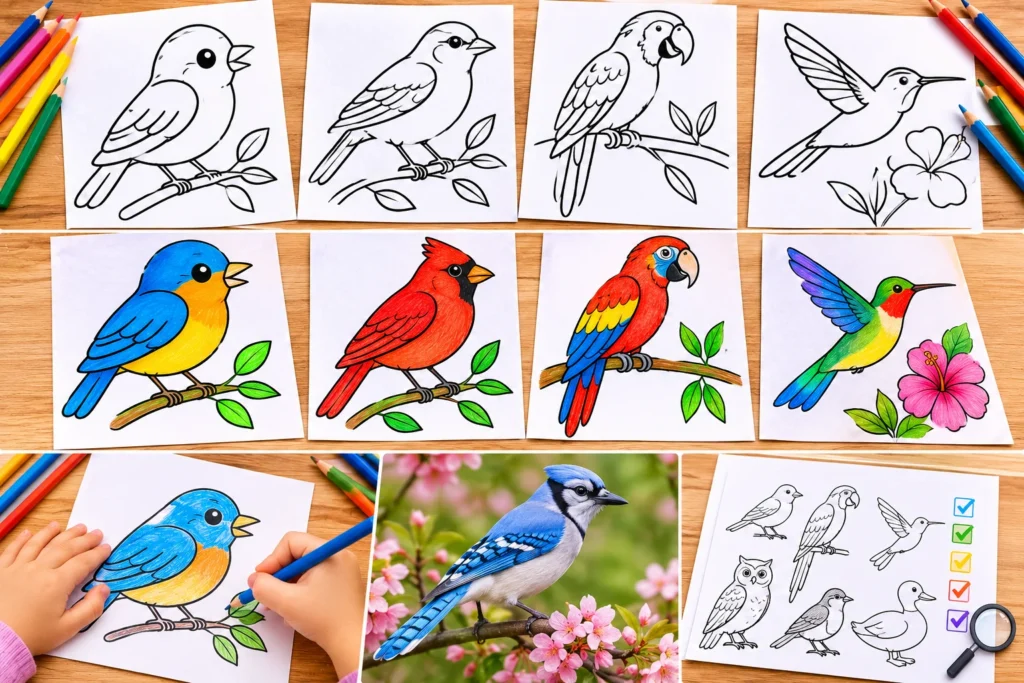
Most bird coloring pages are sold as downloads, but the page itself is only half of what makes coloring work. The other half is matching the design to the colorist and coloring the bird in a way that looks right. A hummingbird outline given to a four-year-old ends in frustration. A cartoon chick given to an adult hobbyist ends in boredom. This guide on choosing a bird coloring page gives you a framework for avoiding both, plus a species color reference most printable pages leave out.
What Makes a Good Bird Coloring Page?
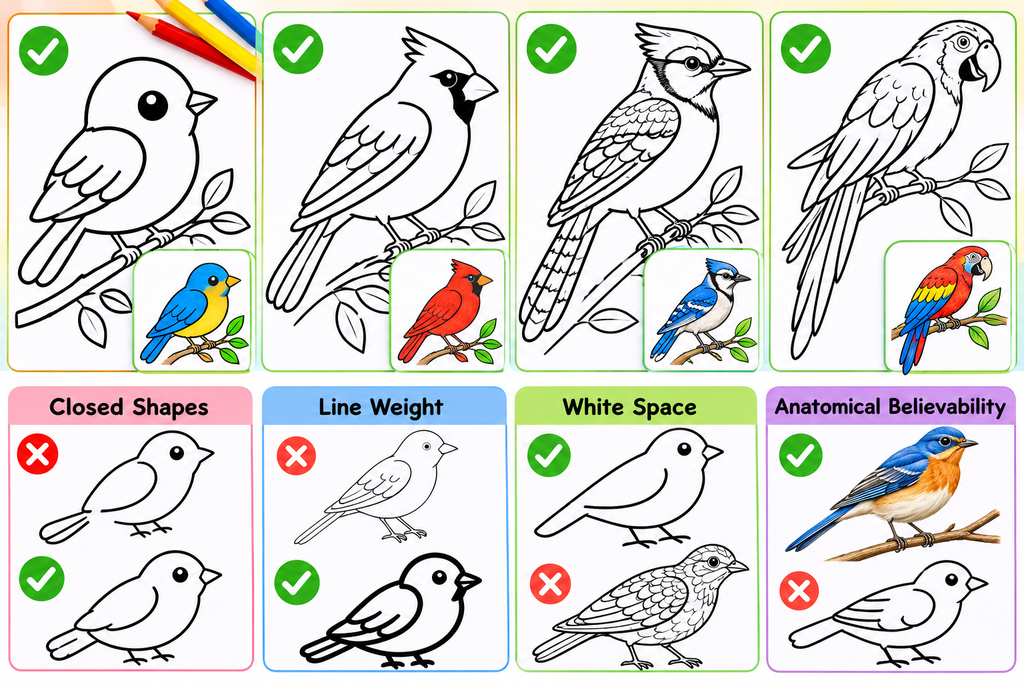
A good bird coloring page has clean, closed outlines, a clear focal bird, and line detail that suits the colorist’s skill level. Everything else, such as theme, background, and cuteness, is secondary.
Check four things before you print:
- Closed shapes: Gaps in outlines make color bleed and frustrate beginners.
- Line weight: Thick lines suit crayons and markers. Fine lines suit pencils and gel pens.
- White space: Large open areas (wings, bodies) suit young children. Small repeating sections (feather patterns) suit older colorists.
- Anatomical believability: If you want a bird you can color realistically, beak, leg, and wing proportions should look like a real species.
The Haute Vibes Bird Page Matching Framework
This is an original selection framework: three levels, each tied to a colorist’s motor control and attention span. Use the table to choose your bird coloring page, then scale up as confidence grows.
| Level | Best for | Design features | Best tools | Example subjects |
| 1. Bold Shapes | Ages 2-5 | Thick outlines, 1-3 large areas, no background | Chunky crayons, washable markers | Round chick, simple duck, cartoon owl |
| 2. Guided Detail | Ages 6-10 | Medium lines, defined wings and tail, simple branch or nest | Crayons, colored pencils, markers | Robin, blue jay, parrot on a perch |
| 3. Feather Fidelity | Ages 11+ and adults | Fine lines, individual feather groups, realistic posture | Colored pencils, gel pens, fine liners | Hummingbird, eagle, kingfisher, mandala birds |
How to Use the Framework
Print one page from the level you think fits. If the colorist finishes in under five minutes and loses interest, move up a level. If they abandon it halfway, move down. The right page should hold attention for roughly 15-30 minutes without frustration.
How to Color Birds Accurately: The Species Color Guide
Real birds follow color rules. Knowing them helps children learn species identification and gives adults more convincing results.
Quick Reference for Popular Subjects
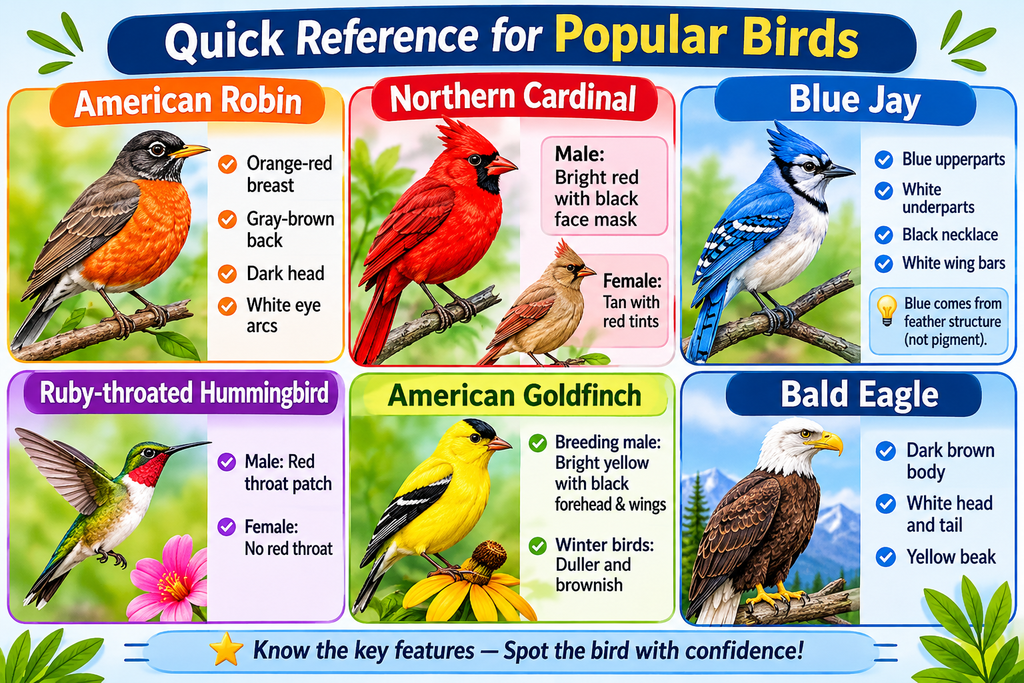
- American robin: Orange-red breast, gray-brown back, dark head, white eye arcs.
- Northern cardinal: The male is bright red with a black face mask. The female is warm tan with red tints on wings, tail, and crest.
- Blue jay: Blue upperparts with white underparts, a black necklace, and white wing bars. The blue comes from feather structure that scatters light rather than from blue pigment, so use layered blues rather than a flat fill.
- Ruby-throated hummingbird: The male has a red throat patch and a metallic green back. The female lacks the red throat.
- American goldfinch: The breeding male is bright yellow with a black forehead and wings. Winter birds are duller and brownish.
- Bald eagle: Dark brown body with a white head and tail and a yellow beak.
Three Techniques That Improve Any Bird Page
- Color the lightest areas first. Yellow and white next to dark colors will smear if you do darks first.
- Layer, don’t press. Build color with several light passes to create depth, especially on iridescent feathers.
- Shade underneath. Add a slightly darker tone beneath the belly, under wings, and under the tail to make the bird look three-dimensional.
Choosing the Right Tools for Bird Pages
Tool choice changes the result more than most people expect:
- Colored pencils give the best control for feather texture and gradual blending, making them ideal for Level 3 pages.
- Washable markers give saturated color quickly but can bleed through thin paper, so place a sheet underneath.
- Crayons are best for Level 1, since they forgive imprecision.
- Gel pens are good for highlights and fine detail on dark feathers.
Paper Matters
Standard printer paper handles crayons and pencils well. For markers or any light watercolor wash, use heavier paper (about 160 gsm / 90 lb or more) to prevent warping.
Make It Educational: Turn One Page into a Bird Study Session
Coloring is a natural entry point for observation. Try this three-step routine, useful for classrooms, homeschooling, and family activity time:
- Observe first. Look at a photo or, better, watch a real bird outside for a few minutes. Note the main colors and beak shape.
- Color from observation. Ask the colorist to pick colors based on what they saw, not from a guess.
- Label the page. Add the species name and one fact about habitat or diet.
This turns a passive activity into a short field-study exercise, and it works for children and adults alike.
Printing and Setup Checklist
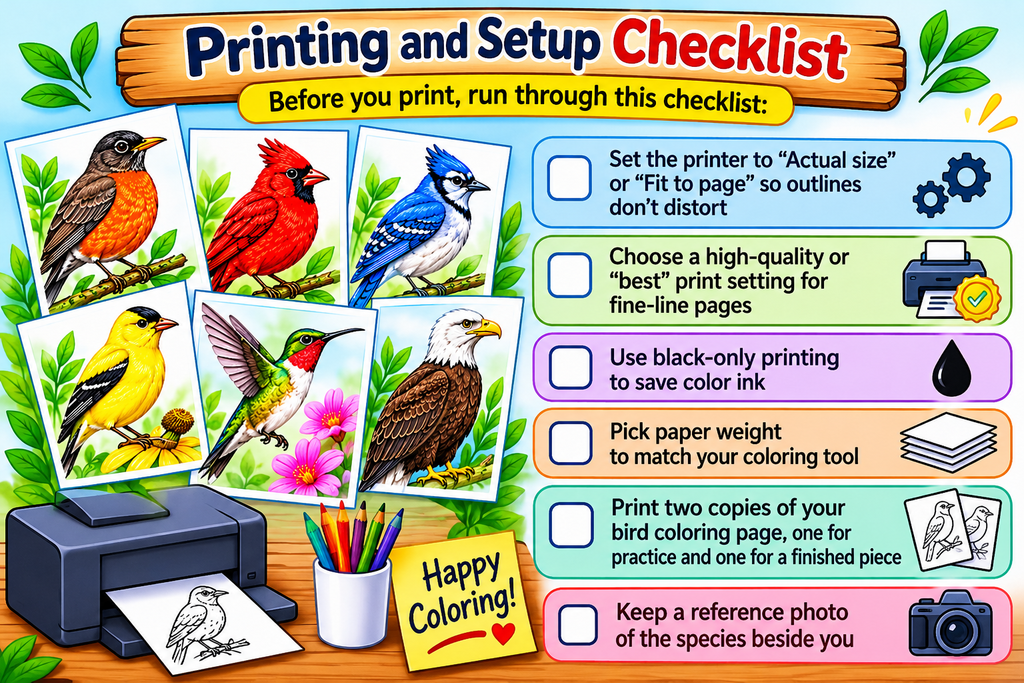
Before you print, run through this linkable checklist:
- ☐ Set the printer to “Actual size” or “Fit to page” so outlines don’t distort
- ☐ Choose a high-quality or “best” print setting for fine-line pages
- ☐ Use black-only printing to save color ink
- ☐ Pick paper weight to match your coloring tool
- ☐ Print two copies of your bird coloring page, one for practice and one for a finished piece
- ☐ Keep a reference photo of the species beside you
Frequently Asked Questions
What age are bird coloring pages suitable for?
Any age. Choose bold, simple designs for toddlers and preschoolers, and detailed, realistic or mandala-style designs for older children and adults.
What are the best coloring tools for bird pages?
Colored pencils work best for realistic feather detail. Crayons and washable markers suit younger children.
Can I use bird coloring pages in a classroom?
Yes. Pair them with the observation routine above for a short science and art activity.
Contribute to This Series
Haute Vibes accepts expert contributions on birdwatching, art education, printable design, and classroom activities. We’re especially interested in species-specific color guides, accessibility-adapted coloring methods, and educator-tested lesson plans. Pitch us with your credentials and a one-paragraph outline.
The Takeaway
The best bird coloring page is one matched to the person holding the pencil. Use the three-level framework to choose, the species color guide to color accurately, and the printing checklist to avoid common problems. Start with one bird coloring page, observe how the colorist responds, and adjust.
Related reading on Haute Vibes (add as these publish): Coloring Pages for Kids by Age · Colored Pencil Techniques for Beginners · Backyard Bird Identification for Beginners · Printable Nature Activities for Classrooms