Penguins are a hit with children because they look funny, waddle, and wear what seems like a tuxedo. That makes them a perfect subject for a quiet art session. Penguin coloring pages give young children a friendly way to practice grip, color choice, and focus, while also sparking questions about animals and the places they live. This guide shows how to match a page to each age, a short routine that adds learning, and a species comparison you can use for science talk.
Quick answer: Pick a penguin page that fits the child’s age, offer a small set of colors, and add one simple goal, such as coloring a real species or finishing a snowy scene.
Why Penguins Work So Well for Young Artists
A penguin is built from simple shapes: an oval body, a round head, two flippers, and a small beak. Children can see those shapes easily, so the page feels doable even for beginners.
The black and white pattern also helps. Children get a clear starting point, then add color to the beak, feet, and background. That mix of structure and freedom keeps hesitant children comfortable and gives confident ones room to experiment.
Match the Page to the Child
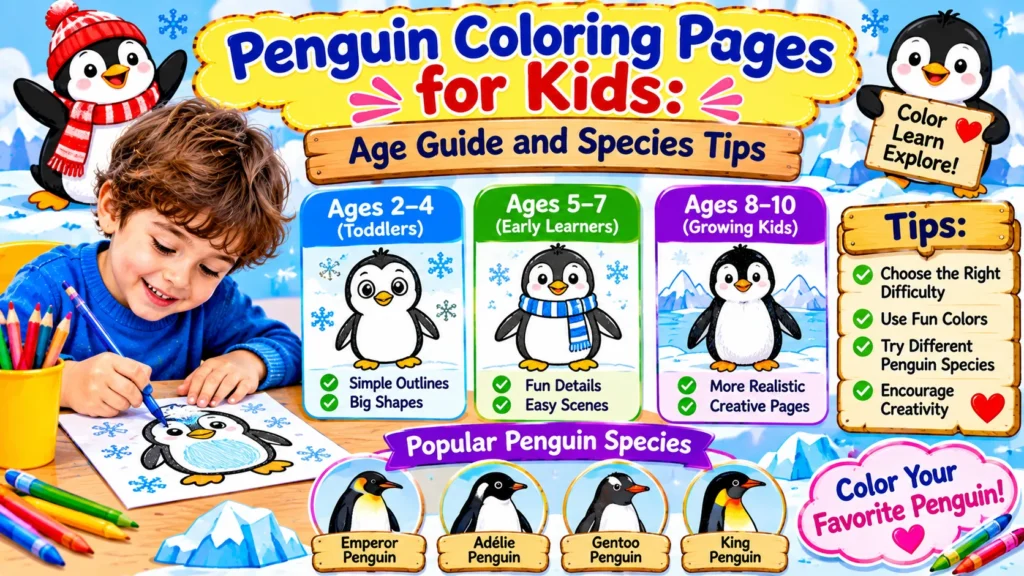
A page that is too detailed frustrates beginners, and one that is too plain bores older kids. Use this table as a starting point.
| Age range | Best page style | What it builds |
| 2 to 3 | One big penguin, thick outlines | Grip, scribbling, color names |
| 4 to 5 | Penguin with a simple background like ice or snow | Staying inside lines, color choice |
| 6 to 7 | Penguin family or scene with several parts | Planning, patterns, fine motor control |
| 8 and up | Detailed penguin with patterns and habitat | Patience, shading, creative design |
If a page feels too hard, move one level down. If a child finishes in two minutes, move one level up. The goal is a challenge that feels possible.
The Look, Color, Tell Routine
Free coloring is fun, but a small structure keeps attention longer. This routine takes about fifteen minutes and works for one child or a group.
Look
Show a real photo or picture book page of a penguin before coloring. Ask children what they notice, such as the beak color, the shape of the flippers, or how the penguin stands.
Color
Offer only four or five crayons. Fewer choices speed up decisions and often lead to bolder results. Encourage children to color the penguin first, then the background.
Tell
When the page is done, ask each child to tell one fact or story about their penguin. It might be real, such as “penguins swim,” or imaginary, such as the penguin’s name. Both build speaking skills.
Penguin Species Comparison for Coloring
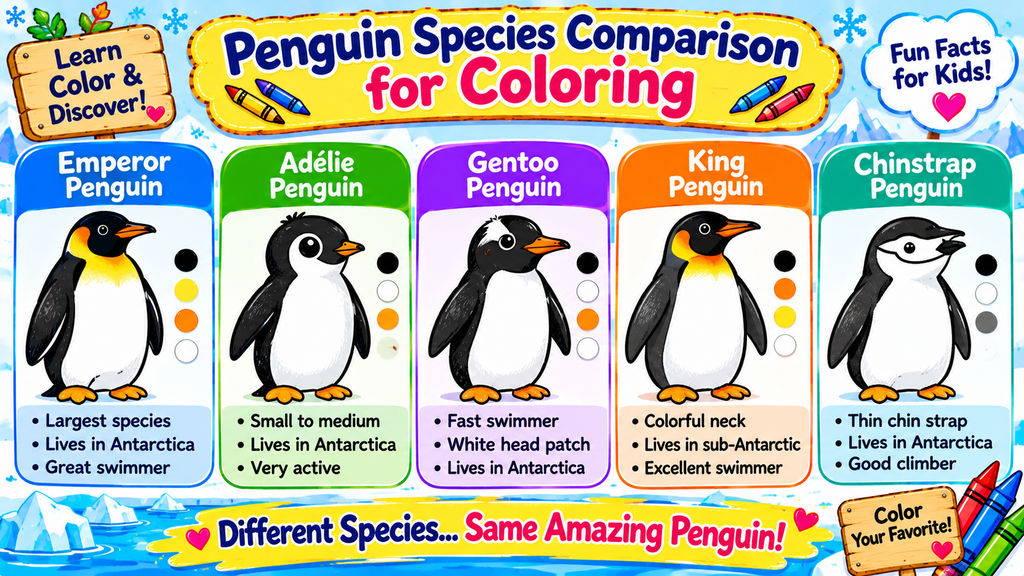
Real penguins come in many styles, and each one offers a fun coloring challenge. Use this table to turn a simple page into a mini science lesson.
| Penguin | Easy way to spot it | Coloring tip |
| Emperor | Largest penguin, yellow patches near the neck | Add soft yellow and orange near the head |
| Adélie | Black head with a white ring around the eye | Leave the eye ring white |
| Chinstrap | A thin black line under the chin | Draw or color the line like a helmet strap |
| Gentoo | Bright orange beak and white patch above the eye | Use bright orange for the beak and feet |
| Macaroni | Yellow feathers on the forehead | Add yellow sprays above the eyes |
Ask children to pick one species and look at a picture while they color. This turns an art activity into a small observation task.
Learning Hidden Inside the Page
Coloring looks simple, but it supports many early skills at once.
- Fine motor control: Staying inside lines strengthens small hand muscles.
- Observation: Looking at a real penguin builds attention to detail.
- Vocabulary: Words like flipper, beak, colony, and chick come up naturally.
- Science thinking: Children learn that many penguins live in cold places, while some live in milder coastal areas.
- Storytelling: Naming a penguin and telling a short tale builds language.
Because it feels like play, children rarely notice that they are learning.
Easy Ways to Make It Special
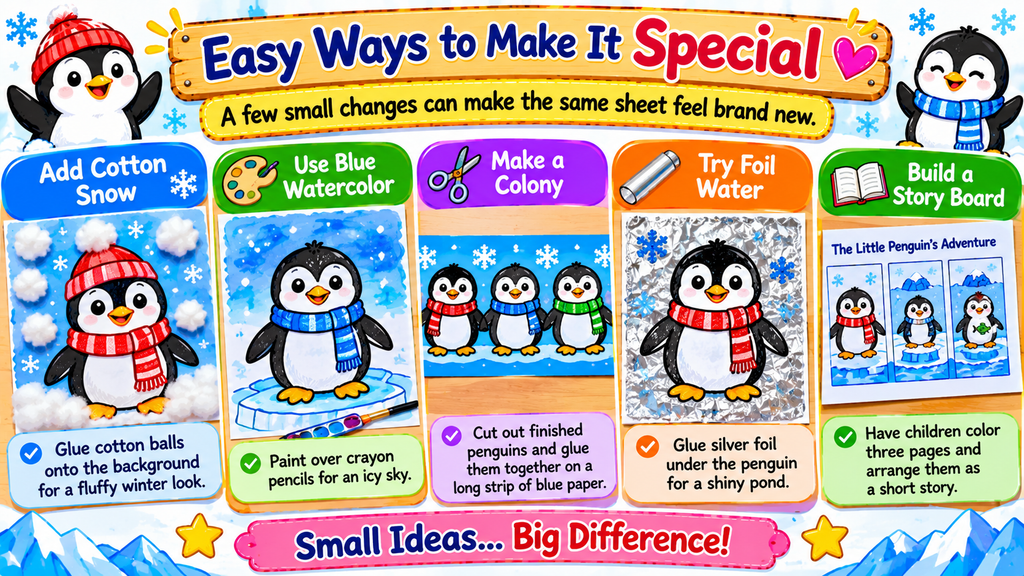
A few small changes can make the same sheet feel brand new.
- Add cotton snow: Glue cotton balls onto the background for a fluffy winter look.
- Use blue watercolor: Paint over crayon pencils for an icy sky.
- Make a colony: Cut out finished penguins and glue them together on a long strip of blue paper.
- Try foil water: Glue silver foil under the penguin for a shiny pond.
- Build a story board: Have children color three pages and arrange them as a short story.
Setup Checklist Before You Print
Run through this list so the activity goes smoothly.
- The page size and detail match the child’s age
- Crayons or markers are sorted and ready
- A real penguin photo or book is nearby
- Each child has a clear workspace
- Extra sheets are available for restarts
- A place is ready to display finished work
Waddle Over to the Crayons
Penguins make coloring feel like an adventure. A few well-chosen pages, a small set of colors, and a simple purpose are enough to turn an ordinary afternoon into a creative lesson. Let children choose their own colors, celebrate effort over neatness, and ask them what their penguin is up to today. A purple penguin is still a great penguin.
This week, print one penguin coloring page, set out four crayons, and see what story your child tells.