
What Are Teen Numbers in Kindergarten Math?
Teen numbers in kindergarten lessons are the numbers 11–19: ten ones and one to nine additional ones. To teach them, have children build ten, add the extra ones, name the total, and match it to the written numeral.
For example, sixteen is ten ones and six more ones: 16 = 10 + 6. The aim is to help children understand the quantity, rather than only recite the counting sequence.
This guide provides a teaching sequence, a reference chart, six activities, a short lesson plan, and an assessment checklist for teachers and families.
Terminology: Strictly, thirteen through nineteen have names ending in “teen.” Kindergarten resources commonly include eleven and twelve in the same instructional group because all numbers from 11–19 share the ten-and-some-more structure.
Why Are Numbers in the Teens Difficult?
A child may count aloud to nineteen but struggle to make a collection of fourteen objects. Saying number words in order, recognizing numerals, and understanding quantities are connected but distinct skills.
- Number names: Eleven and twelve do not make their relationship to ten obvious.
- Spoken and written order: “Fourteen” starts with the sound “four,” while 14 begins with the digit 1.
- Grouping: Children must learn that ten separate ones can be considered together.
- Digit position: 12 and 21 contain the same digits, but represent different amounts.
Let children handle and rearrange objects. Ask them to explain their model before correcting the written answer.
What Should Children Practice First?
Give the child ten large counters. Ask them to count each object once and tell you the total. Then invite them to fill a ten frame: two rows of five spaces, with one counter in each space.
If objects are skipped or counted twice, practice moving each one into a space. Continue this support alongside teen-number work; children do not need perfect numeral writing before they can explore quantities.
Materials to Prepare
- Two ten frames per learner
- 19 counters or linking cubes per learner
- Number cards from 11–19
- Paper or a small whiteboard
- Pencils, crayons, or dry-erase markers
How to Teach Teen Numbers Step by Step
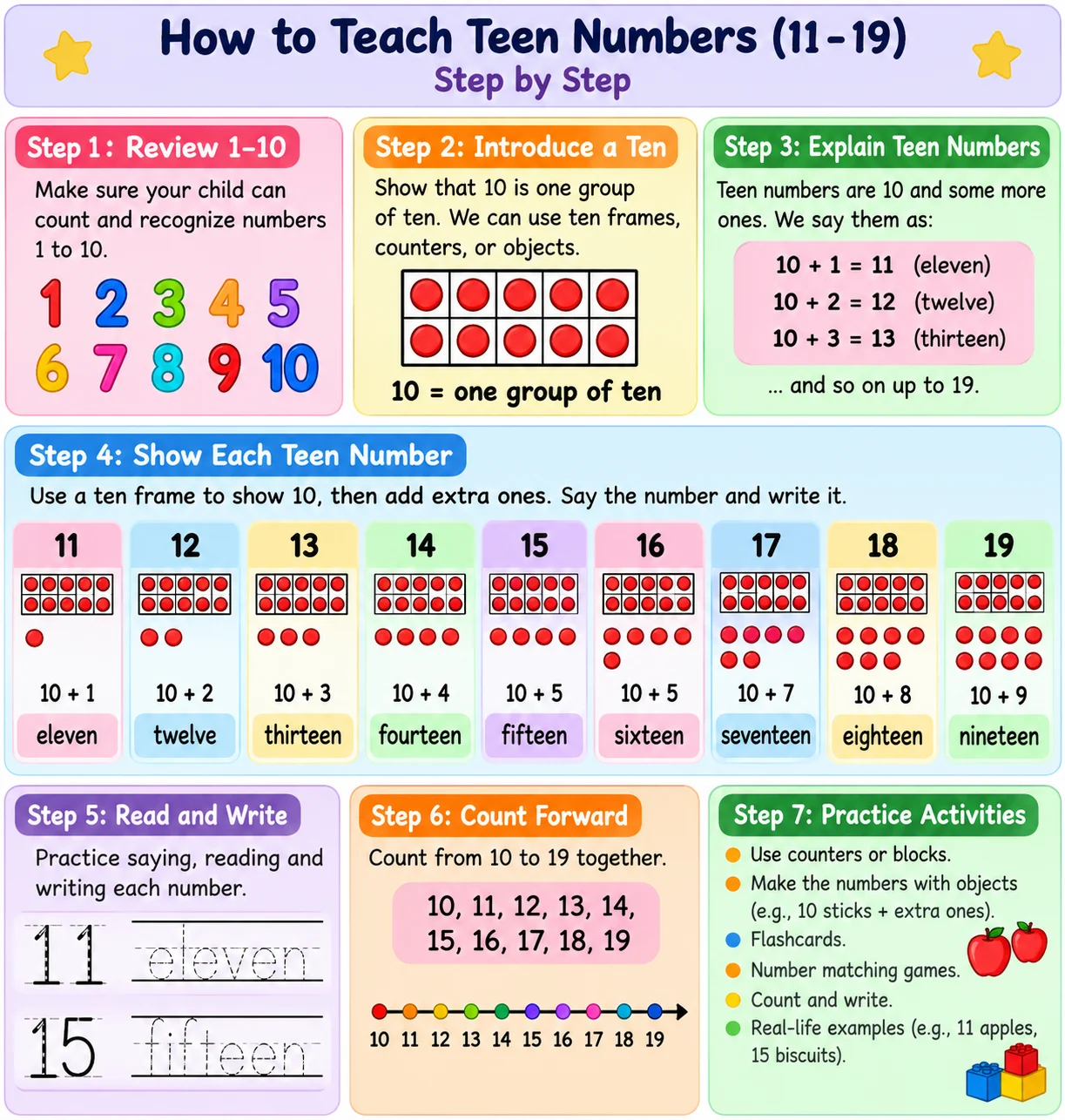
1. Make Ten Visible
Count ten individual cubes into a row, then connect them. Alternatively, fill a ten frame.
“These are ten ones. We can keep them together as a group of ten.”
2. Add the Extra Ones
Place three loose cubes beside the ten. Keep the parts visually separate. Have the child check the total.
“Ten ones and three more ones make thirteen.”
3. Connect the Model to 13
Place the numeral card beside the completed model. Explain that in 13, the 1 represents the group of ten and the 3 represents the three extra ones.
Keep the objects visible while discussing the digits. Invite children to point to the ten and the extra ones as they explain.
4. Compose and Decompose
Invite the child to build thirteen independently. Then ask them to separate the collection into ten ones and the remaining ones.
- Compose: “What do these parts make?”
- Decompose: “How can you split thirteen into ten and some more?”
Both directions matter: children should combine the parts and recognize the parts within the total.
5. Draw or Record the Parts
Ask the child to draw ten circles inside a box and three outside. If ready, help them write the matching equation.
A drawing is a useful record when writing an equation is still difficult.
Teacher prompt: “Show me the ten. Show me the extra ones. How many altogether?” Allow children to recount when needed; model counting on without requiring it before they understand the collection.
Teen Numbers Chart: 11–19
Introduce a few numbers at a time. Use the chart as a reference while children build matching quantities.
| Numeral | Name | Parts | Equation |
|---|---|---|---|
| 11 | Eleven | 10 ones and 1 more | 11 = 10 + 1 |
| 12 | Twelve | 10 ones and 2 more | 12 = 10 + 2 |
| 13 | Thirteen | 10 ones and 3 more | 13 = 10 + 3 |
| 14 | Fourteen | 10 ones and 4 more | 14 = 10 + 4 |
| 15 | Fifteen | 10 ones and 5 more | 15 = 10 + 5 |
| 16 | Sixteen | 10 ones and 6 more | 16 = 10 + 6 |
| 17 | Seventeen | 10 ones and 7 more | 17 = 10 + 7 |
| 18 | Eighteen | 10 ones and 8 more | 18 = 10 + 8 |
| 19 | Nineteen | 10 ones and 9 more | 19 = 10 + 9 |
Ask: “What stays the same?” Each number has ten ones. “What changes?” The number of additional ones changes.
A Ten-Frame Example: 16 = 10 + 6
Fill one frame with ten counters. Place six counters in the second frame, filling its top row first and then one space in its bottom row.
Ask children to explain how they know there are sixteen counters. Some will count all sixteen; others will recognize the full ten and count six more. Listen to their reasoning.
Curriculum connection: Common Core kindergarten standard K.NBT.A.1 focuses on composing and decomposing 11–19 into ten ones and further ones, with a drawing or equation. Formal place-value vocabulary can support the lesson, but should remain connected to objects and quantities.
Six Hands-On Teen Number Activities
Choose one activity for a short session. Reuse familiar materials so children can focus on the number relationships.
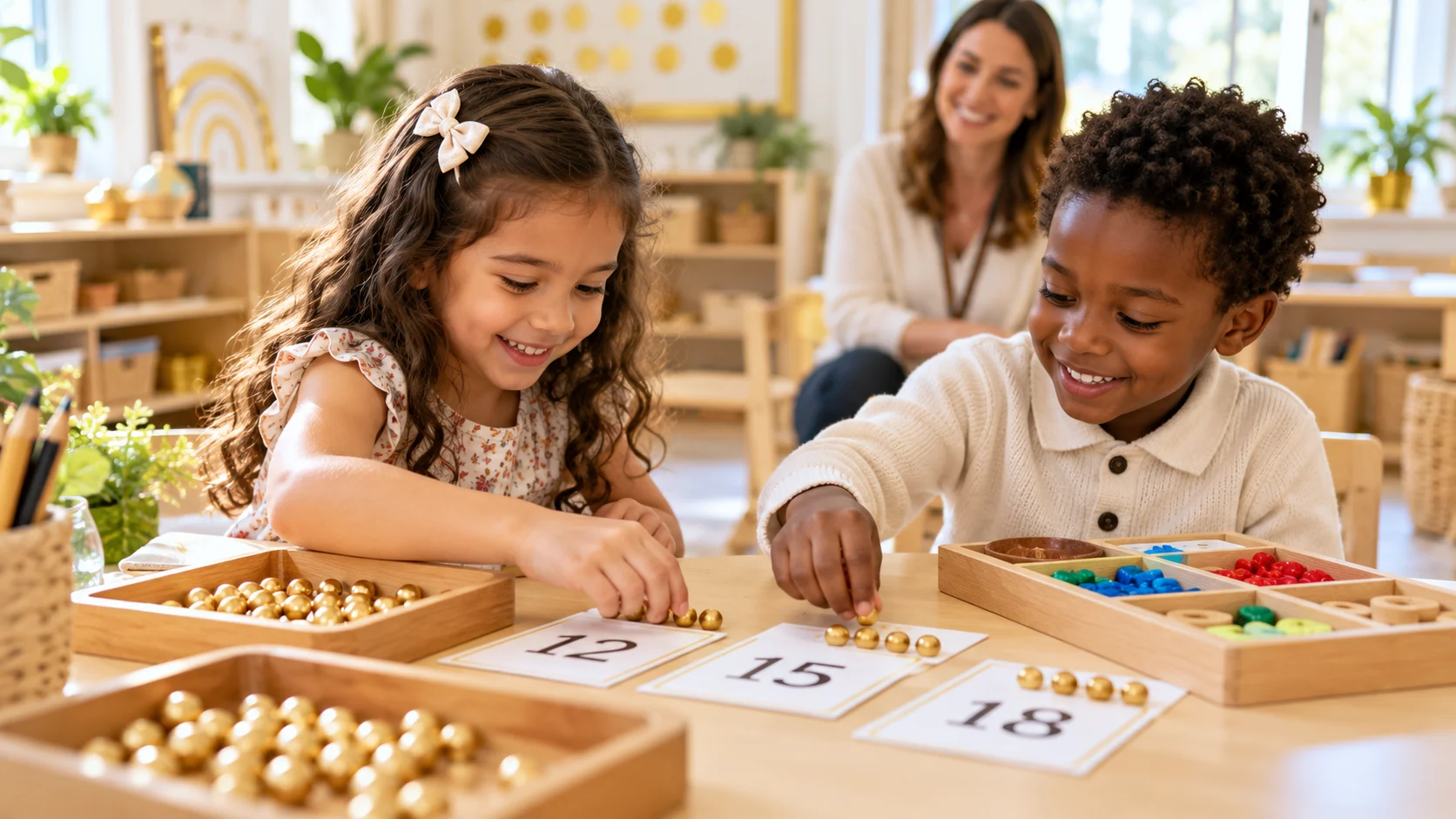
1. Build a Teen Number
Use: Cubes and number cards.
A child selects 17, makes ten connected cubes, and adds seven loose ones. Ask them to identify both parts and name the total.
Ask: “Where are the ten ones? How many more ones did you add?”
2. Fill Ten, Add More
Use: Two ten frames and counters.
Show 12, then ask the child to fill one frame and add two more counters. Change to 15 and ask how the model must change.
Ask: “Can you change twelve into fifteen without emptying your full ten frame?”
3. Match the Model
Use: Three numeral cards and three accurately drawn ten-frame pictures.
Children match each numeral to its quantity and explain one pair. Matching a numeral to an identical numeral is a separate recognition task.
Ask: “How does this picture show fourteen?”
4. Guess My Number
Use: Spoken clues and counters.
Say: “I have ten ones and five more ones.” The child names fifteen and builds a model to check. Partners can take turns giving clues.
Ask: “Can you give me a clue for a different teen number?”
5. Change It by One
Use: A model of 15.
Add one counter to make 16, return to 15, then remove one to make 14. Ask children to describe how the extra ones change while the first ten remains full.
Ask: “What changed? What stayed the same?”
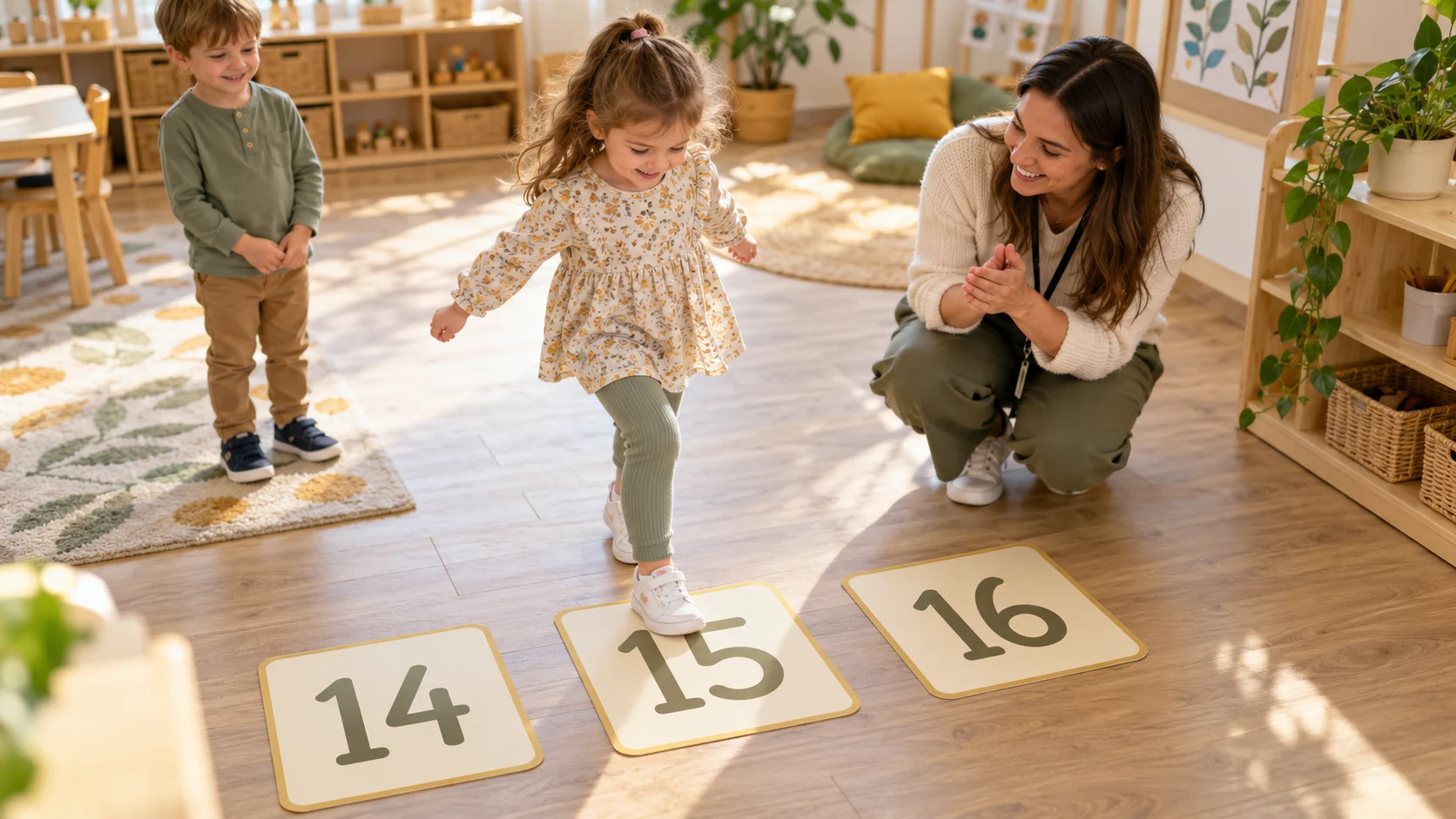
6. Step Along a Number Path
Use: Large cards 14, 15, and 16 arranged in order.
Ask a child to point or step toward the number one more than 15. Secure cards so they cannot slide; offer a seated pointing option.
Finish by building the chosen number with counters.
Common Mistakes and What to Teach Next
| Observation | Teaching Response |
|---|---|
| Confuses 12 and 21 | Build one group of ten and two ones, then two groups of ten and one one. Compare the quantities; keep 21 as an optional contrast, not a new lesson requirement. |
| Counts an object twice | Move each counted object into a ten-frame space. |
| Can name 14 but cannot build it | Model ten and four more, then ask the child to rebuild it. |
| Builds the correct amount but reverses a digit | Check the quantity separately, then model numeral formation. |
| Recounts the full ten | Allow checking. Highlight the completed frame and model counting on. |
| Matches numerals but cannot explain the quantity | Follow recognition with a building or picture-matching task. |
Give a concrete prompt such as “Check the extra ones” rather than repeating “Try again.”
Support Different Learning Needs
For extra support, begin with 11–13, offer fewer number cards, use larger objects, and repeat the sentence: “Ten ones and ___ more ones make ___.”
Demonstrate once, build together, then invite an independent attempt.
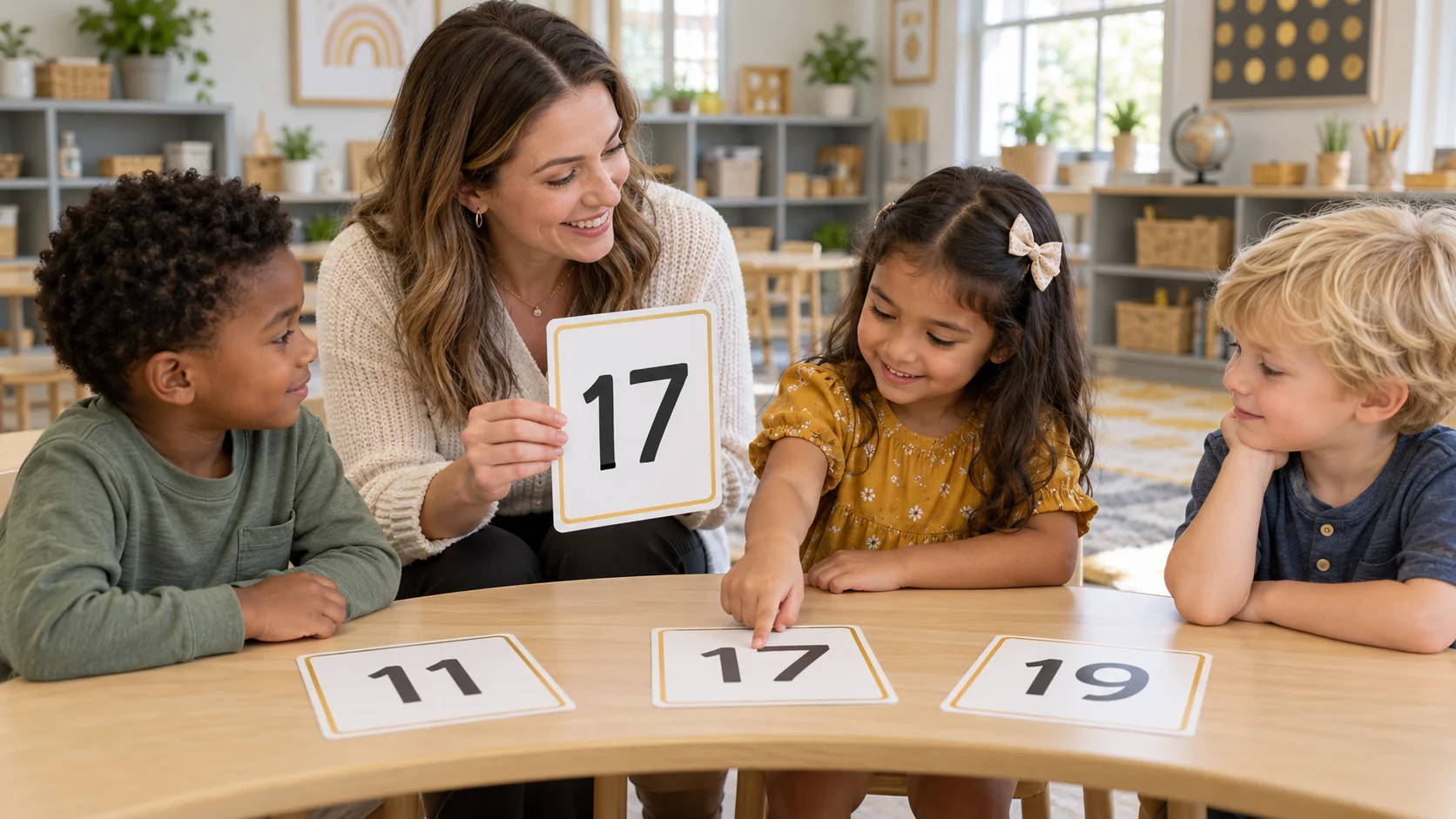
For children learning English, pair spoken number words with numerals and objects. Accept a point, a model, or an explanation in a familiar language as evidence of mathematical thinking.
Offer a Challenge When Children Are Ready
Ask: “I have ten counters. How many more do I need to make eighteen?” Let the child solve it using a frame before recording an equation.
A 15-Minute Kindergarten Lesson Plan
| Time | Stage | Action |
|---|---|---|
| 2 minutes | Warm-up | Count ten objects into a full ten frame. |
| 3 minutes | Model | Build 14, identify ten and four more, and match the numeral. |
| 4 minutes | Guided practice | Build 12 and 16 together; compare the extra ones. |
| 4 minutes | Independent practice | Give each child one numeral to build and draw. |
| 2 minutes | Exit check | Scan the models and ask selected children to explain. Schedule individual follow-up for others. |
Repeat with different numbers across several sessions. Slow down if children need more time counting objects accurately.
An Assessment Checklist You Can Use Today
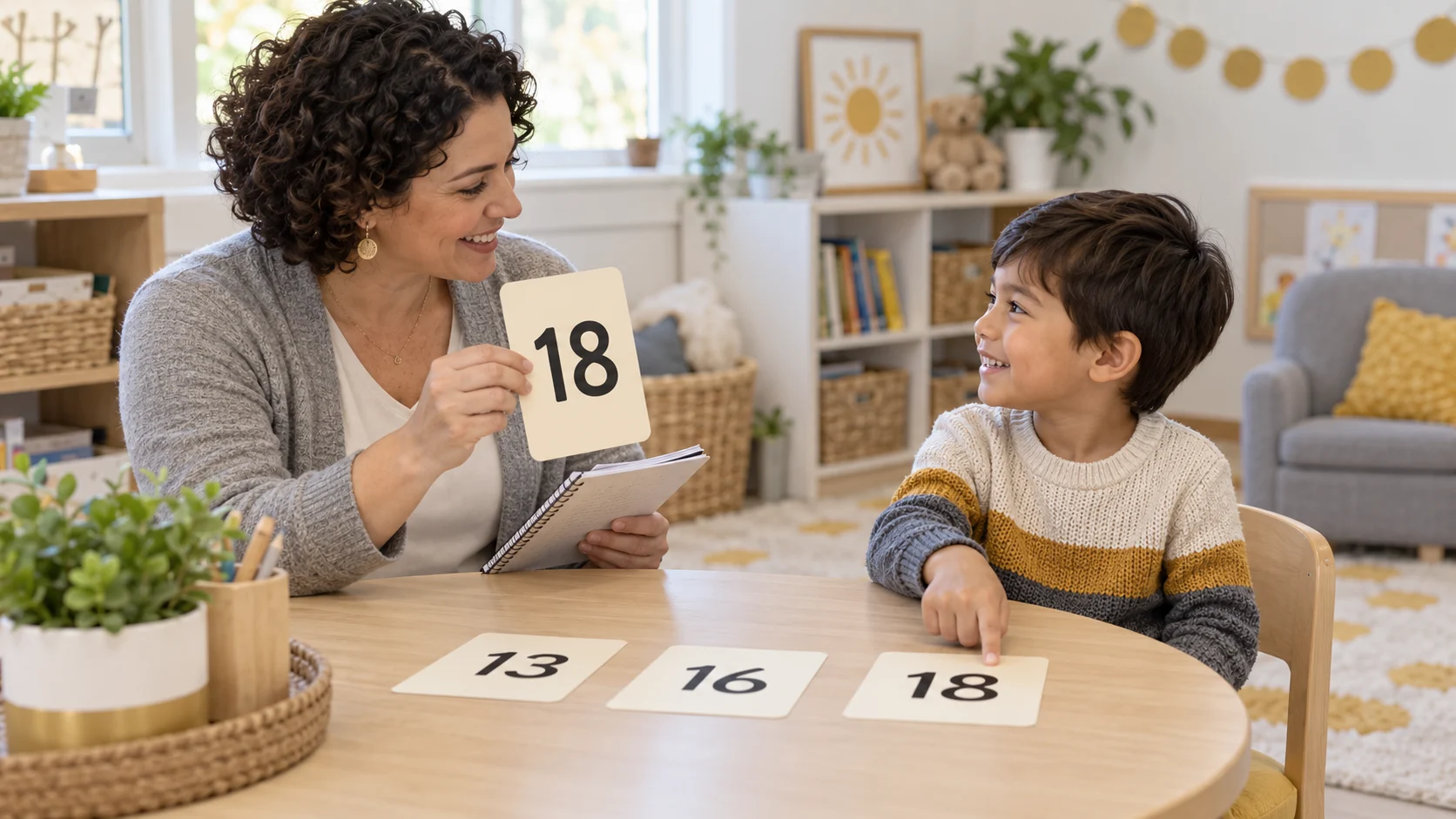
Give the child a 17 card, counters, and two ten frames. Ask them to build it and record its parts. On a different day, show a model of 14 and ask them to select its numeral.
| Check | Independent | With Support | Next Teaching Step |
|---|---|---|---|
| Names or selects the numeral | □ | □ | Practice a smaller set of cards. |
| Builds the correct total | □ | □ | Support one-to-one counting. |
| Separates ten ones from extra ones | □ | □ | Fill one ten frame before adding more. |
| Explains both parts | □ | □ | Use a sentence frame and pointing. |
| Records with a drawing or equation | □ | □ | Draw the model together first. |
This is a classroom planning aid, not a standardized diagnostic test. Look for understanding across several numbers and occasions. A correct memorized answer alone does not show that the child understands the structure.
Practice Teen Numbers at Home
Use building blocks or crayons to make ten and some more. Ask the child to choose a number card, build its quantity, and explain the extra ones.
For a brief practice session, build twelve, change it to thirteen, then invite the child to make a number of their choice. Stop while the activity is still enjoyable rather than insisting on completing all nine numbers.
Frequently Asked Questions
Are teen numbers 11–19 or 13–19?
The names thirteen through nineteen end in “teen.” In kindergarten math, 11–19 are commonly taught together because each is ten ones and additional ones.
How do I explain teen numbers simply?
Say “Make ten first, then add some more.” Show the objects, identify the extra ones, and match the completed model to a numeral.
What is the difference between counting and understanding teen numbers?
Counting names the total. Understanding the structure includes recognizing that, for example, seventeen can be separated into ten ones and seven more ones.
Should children write equations straight away?
Start with objects and drawings. Introduce equations with support when they help record a model the child understands.
Why does a child confuse 12 and 21?
The digits look familiar, but their positions change their values. Compare physical models rather than relying only on a rule about digit order.
Is twenty a teen number?
No. Twenty is two complete groups of ten. Adding one to nineteen can demonstrate how the second group becomes full.
Image note: Classroom scenes are AI-generated illustrations. The ten-frame model above is the counting reference.