Subtraction can become confusing when students need to take away more ones than they have in a number’s ones place. For example, how can you solve 52 − 28 when there are only two ones in 52?
The answer is regrouping. Instead of changing the value of the number, students exchange one ten for ten ones so they can complete the subtraction.
Subtracting with regrouping becomes much easier when children understand this exchange rather than simply memorizing a borrowing rule.
This guide explains how regrouping works, shows step-by-step two-digit examples, and provides simple teaching strategies and practice questions for elementary students.
What Is Subtraction With Regrouping?
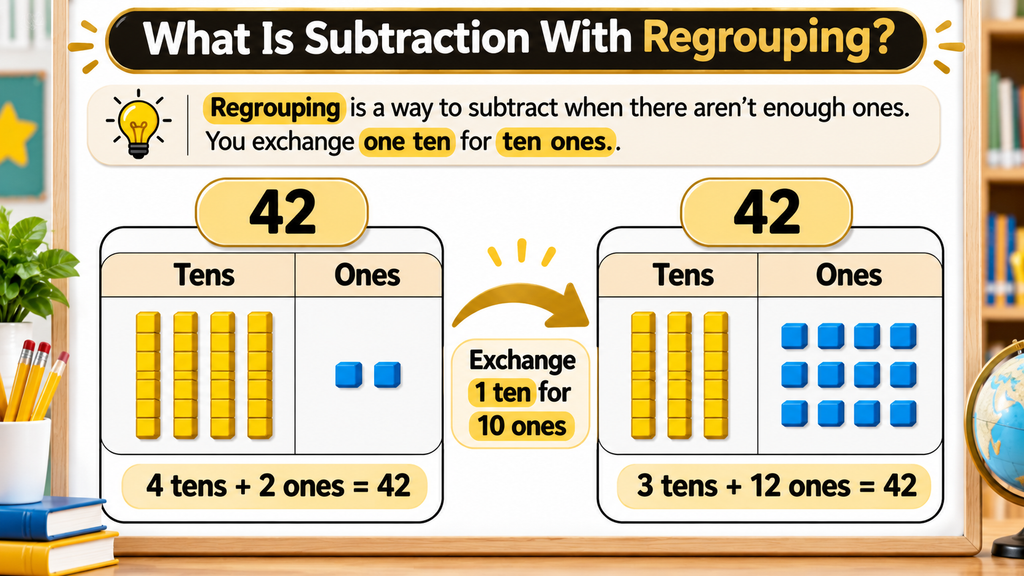
Subtraction with regrouping is a method of subtracting numbers by exchanging units from one place-value column for equivalent units in another.
In two-digit subtraction, students may exchange one ten for ten ones.
For example, the number 42 contains:
- 4 tens
- 2 ones
We can also represent 42 as:
- 3 tens
- 12 ones
Both representations equal 42 because 30 + 12 = 42.
This exchange is called regrouping. It is sometimes called borrowing, although nothing is actually borrowed or returned. The number is simply represented in a different way.
When Do You Need to Regroup?
Consider two subtraction problems.
48 − 23 = 25
The ones calculation is 8 − 3. Since eight ones are enough to take away three ones, no regrouping is needed.
Now look at:
42 − 17
There are only two ones in 42, but we need to subtract seven ones.
We regroup one ten into ten ones, giving us 3 tens and 12 ones.
Then:
12 − 7 = 5 ones
3 − 1 = 2 tens
The answer is 25.
Understanding this exchange is the foundation of regrouping subtraction.
How to Subtract Two-Digit Numbers With Regrouping
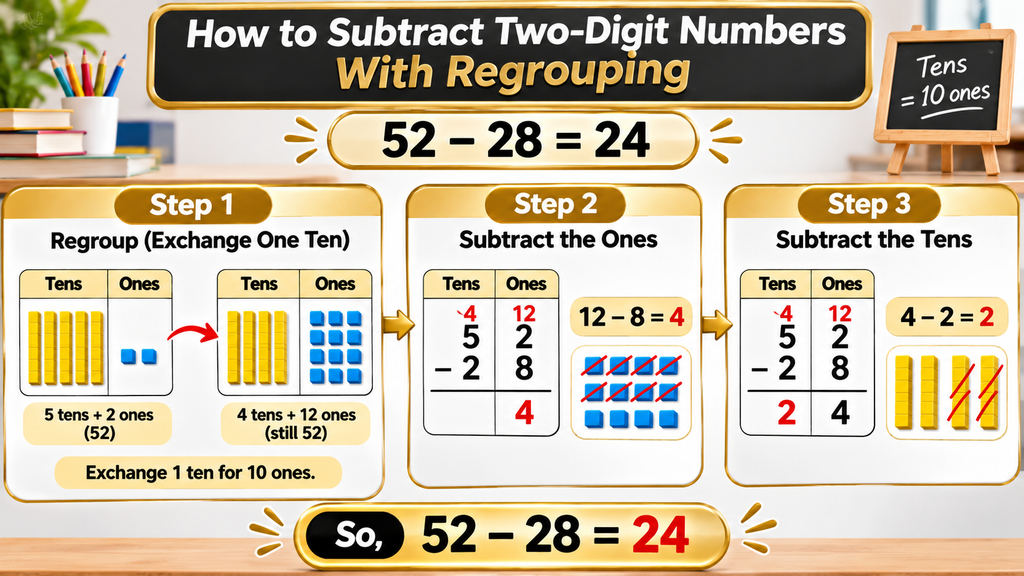
Let’s solve 52 − 28 using place value.
Step 1: Identify the Tens and Ones
Write the numbers with their tens and ones aligned.
| Tens | Ones | |
|---|---|---|
| Starting number | 5 | 2 |
| Number to subtract | 2 | 8 |
We need to subtract eight ones from two ones. There are not enough ones in the starting number, so we must regroup.
Step 2: Exchange One Ten for Ten Ones
Take one ten from the five tens.
Five tens become four tens, and the two ones become twelve ones.
| Representation | Tens | Ones | Total |
|---|---|---|---|
| Before regrouping | 5 | 2 | 52 |
| After regrouping | 4 | 12 | 52 |
Notice that the total stays the same.
Step 3: Subtract the Ones
Now subtract eight ones from twelve ones.
12 − 8 = 4
Write 4 in the ones place.
Step 4: Subtract the Tens
There are four tens remaining after regrouping.
4 − 2 = 2
Write 2 in the tens place.
Therefore:
52 − 28 = 24
Check the Answer
Use addition to check the result:
28 + 24 = 52
Since the addition returns the starting number, the subtraction answer is correct.
Important reminder: Regrouping changes how the number is divided into tens and ones. It does not change the number’s value.
More Subtracting With Regrouping Examples
Once students understand the basic exchange, give them problems that use the same idea in slightly different situations.
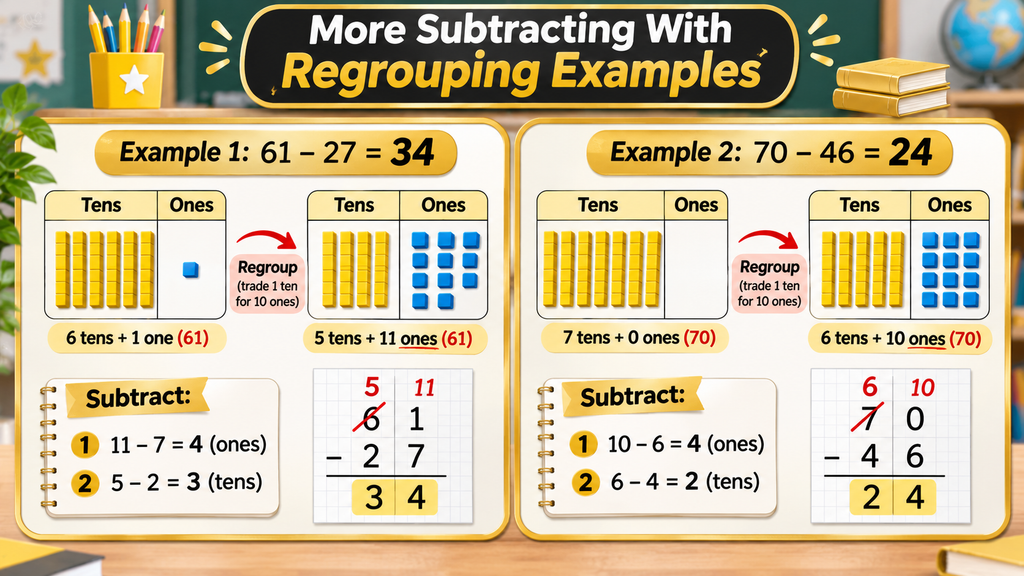
Example 1: Solve 61 − 27
Start with six tens and one one.
Since one one is not enough to subtract seven ones, exchange one ten for ten ones.
61 becomes five tens and eleven ones.
Now subtract:
11 − 7 = 4
5 − 2 = 3
The answer is 34.
Check: 27 + 34 = 61.
Example 2: Solve 70 − 46
This example is important because the ones digit of the starting number is zero.
The number 70 contains seven tens and zero ones.
Exchange one ten for ten ones.
70 becomes six tens and ten ones.
Now subtract:
10 − 6 = 4
6 − 4 = 2
Therefore:
70 − 46 = 24
Students sometimes believe they cannot regroup when there is a zero in the ones place. This example shows that one ten can still be exchanged for ten ones.
Example 3: Solve a Word Problem
A teacher has 54 crayons. Students use 27 crayons during an art activity.
How many crayons remain?
Write the equation:
54 − 27
Exchange one ten so that 54 becomes four tens and fourteen ones.
Subtract the ones:
14 − 7 = 7
Subtract the tens:
4 − 2 = 2
Answer: 27 crayons remain.
Ask students to explain why fourteen ones and four tens still represent 54 before solving the problem.
This helps connect the written calculation to the meaning of regrouping.
How to Teach Regrouping Subtraction to Elementary Students
Children often understand subtraction better when they can see and touch the quantities they are working with.
Before introducing written shortcuts, show students how tens and ones can be exchanged.
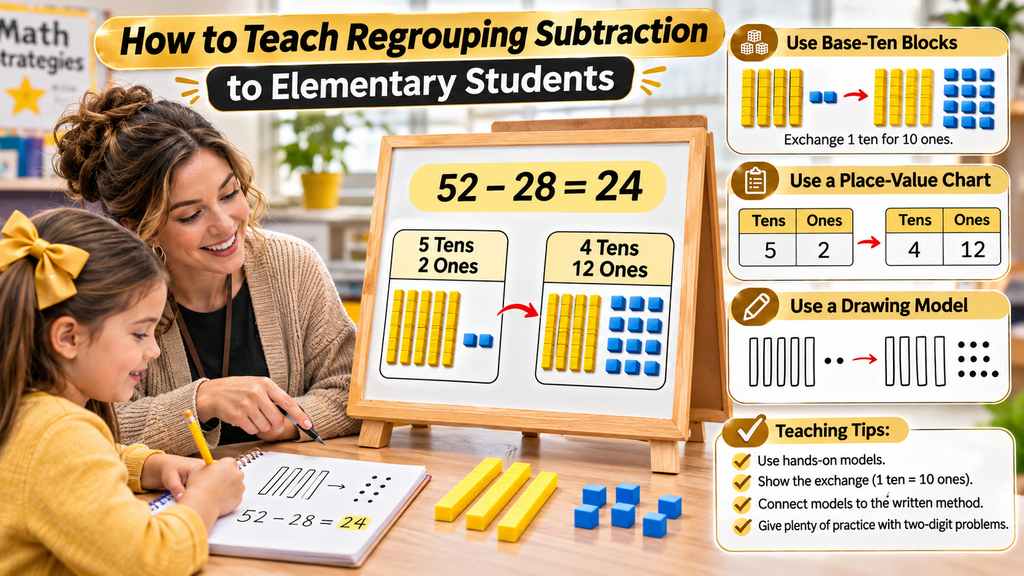
Use Base-Ten Blocks
Base-ten blocks are useful because students can physically represent numbers.
A ten rod represents ten ones, while a single cube represents one.
For 52 − 28:
- Build 52 using five ten rods and two single cubes.
- Exchange one ten rod for ten single cubes.
- Show four ten rods and twelve single cubes.
- Remove eight single cubes and two ten rods.
- Count what remains: two tens and four ones.
The answer is 24.
Try a Place-Value Drawing
If blocks are unavailable, draw long lines for tens and small dots for ones.
For 43 − 18, draw four tens and three ones.
Cross out one ten, then replace it with ten extra ones.
Students now have three tens and thirteen ones. They can cross out eight ones and one more ten to find 25.
This makes the exchange visible without requiring special classroom materials.
Teach Students to Explain Each Step
Ask questions such as:
- How many tens and ones do we have?
- Why do we need to regroup?
- What happens when we exchange one ten?
- Does the starting number change?
- How can we check the answer?
These questions help teachers identify whether students understand place value or are only following memorized instructions.
Common Subtraction Mistakes
| Student mistake | How to correct it |
|---|---|
| Subtracts 2 from 8 when solving 52 − 28 | Show why eight ones cannot be removed from two ones without regrouping |
| Forgets to reduce the tens after exchanging | Use base-ten blocks to show that one ten has been exchanged |
| Changes the ones but not the tens | Record both parts of the exchange in a place-value chart |
| Struggles with a zero in the ones place | Model 70 as seven tens and then exchange one ten |
| Gets the answer but cannot explain it | Ask the student to show the regrouping with objects or drawings |
Practical teaching tip: Start with physical objects, move to drawings, and then connect those representations to written calculations. Give students opportunities to explain what each step means.
Subtraction With Regrouping Practice Problems
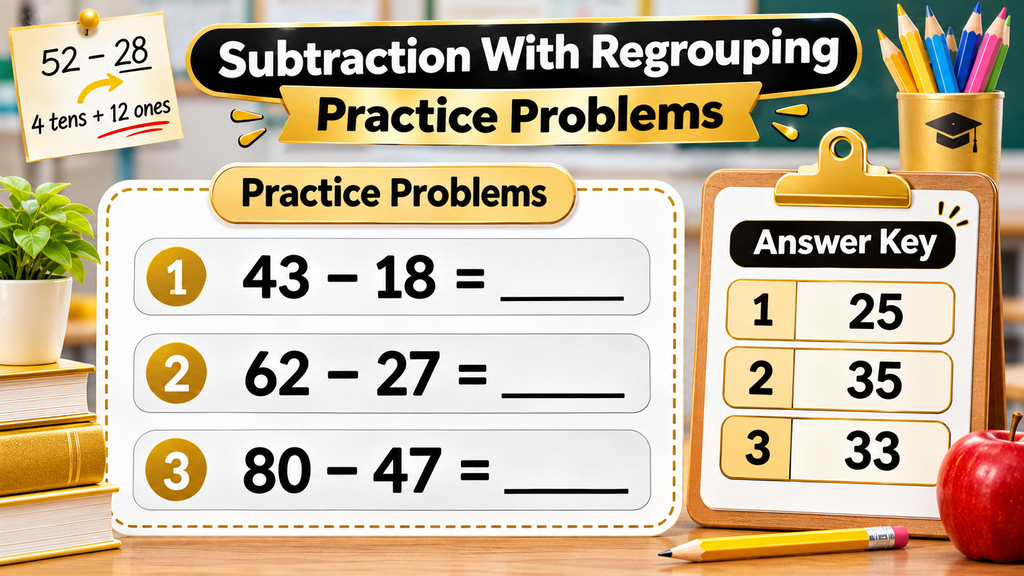
Use these questions for independent work, partner practice, or a short classroom review.
Ask students to show their regrouping steps rather than writing only the final answer.
| Question | Problem | Student answer |
|---|---|---|
| 1 | 43 − 18 | ______ |
| 2 | 62 − 27 | ______ |
| 3 | 74 − 38 | ______ |
| 4 | 80 − 47 | ______ |
| 5 | 91 − 56 | ______ |
| 6 | 50 − 16 | ______ |
| 7 | 63 − 19 | ______ |
| 8 | 85 − 48 | ______ |
| 9 | 32 − 15 | ______ |
| 10 | 72 − 46 | ______ |
Answer Key
| Question | Correct answer |
|---|---|
| 1 | 25 |
| 2 | 35 |
| 3 | 36 |
| 4 | 33 |
| 5 | 35 |
| 6 | 34 |
| 7 | 44 |
| 8 | 37 |
| 9 | 17 |
| 10 | 26 |
Challenge: Find the Mistake
A student solves 52 − 28 and writes the answer as 36.
The student says:
“I changed the 2 to 12, but I still had five tens, so I subtracted two tens and got three tens.”
What went wrong?
The student forgot that exchanging one ten leaves only four tens.
The correct calculation is:
12 − 8 = 4 ones
4 − 2 = 2 tens
Correct answer: 24
Ask students to show the exchange using a place-value drawing.
Regrouping subtraction becomes more understandable when students see that one ten is equal to ten ones.
Start with simple two-digit problems, explain each exchange, and gradually introduce examples involving zeros and word problems.
With clear place-value models and regular practice, students can learn to subtract accurately while understanding why the method works.