Imagine asking your students a question and seeing the same three hands go up every time. Some children are eager to answer, while others stay quiet, even when they have great ideas.
That’s where the turn and talk strategy can make a difference.
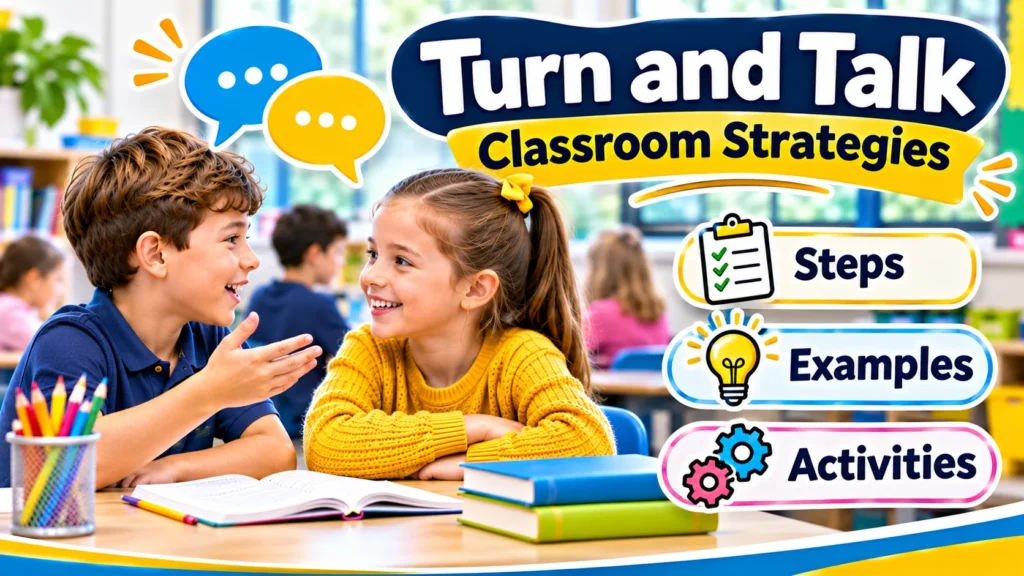
Instead of waiting for students to volunteer in front of the whole class, turn and talk gives children a chance to share their thinking with a partner. It’s simple, requires very little preparation, and can fit into reading, math, science, or almost any classroom lesson.
But successful partner conversations don’t happen automatically. Students need clear instructions, meaningful questions, and opportunities to practice speaking and listening.
This guide explains what turn and talk means, how to teach it step by step, and how to use it effectively with kindergarten and elementary students.
What Is Turn and Talk?
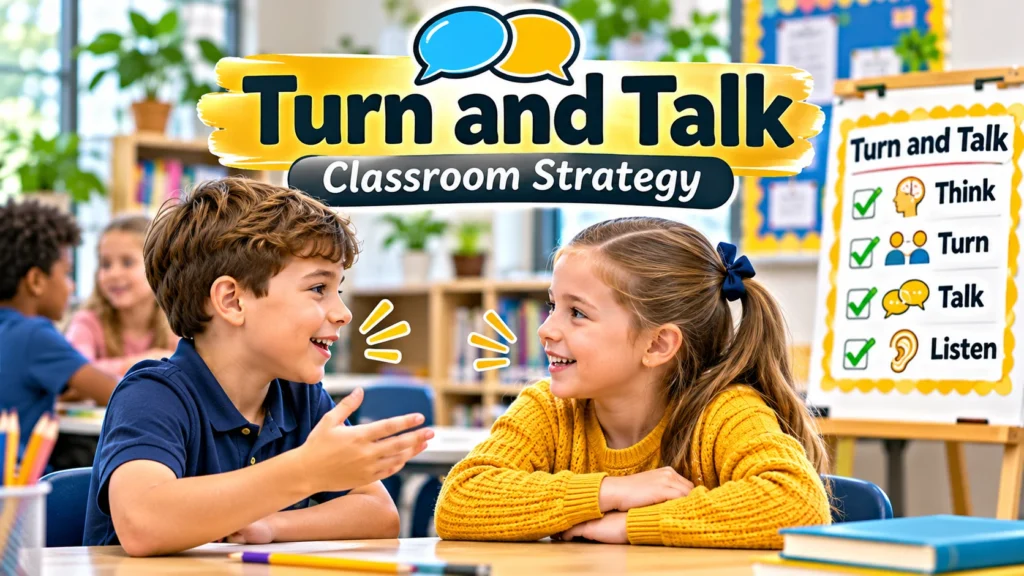
Turn and talk is a classroom discussion strategy in which students briefly turn toward a partner to share their thoughts about a question, topic, or learning activity.
The teacher introduces a discussion prompt, gives students an opportunity to think, and invites partners to explain their ideas to each other.
For example, during a reading lesson, a teacher might ask:
“Why do you think the character decided to help their friend?”
Rather than asking one student to answer, the teacher invites everyone to turn and talk with a partner.
One child shares an idea, the other listens and responds, and then they switch roles.
The conversation may last less than a minute or several minutes, depending on students’ ages and the complexity of the question.
A Simple Turn and Talk Example
Teacher: “Think about what plants need to grow. Turn and talk with your partner about two things plants need.”
Student A: “Plants need water because their roots take it in.”
Student B: “They also need light. I think sunlight helps plants make their food.”
Teacher: “What did you and your partner discuss?”
Student A: “We talked about water and sunlight.”
This short exchange allows both children to participate and gives the teacher an opportunity to check their understanding.
Why Is Turn and Talk Important in the Classroom?
Turn and talk gives students structured opportunities to practice explaining ideas, listening, and learning from one another.
1. Encourages More Students to Participate
During traditional whole-class questioning, only a few students may have an opportunity to respond.
Partner discussions allow many students to speak at the same time.
Even children who rarely raise their hands get a chance to contribute.
2. Builds Speaking and Listening Skills
Students practice expressing ideas in complete sentences, listening without interrupting, and responding respectfully.
These communication habits are useful in both academic and everyday situations.
3. Helps Students Organize Their Thinking
Explaining an answer aloud encourages students to put their thoughts into words.
Sometimes children understand a concept but struggle to explain it. Discussing with a partner can help them identify what they know and what remains confusing.
4. Supports Shy and Reluctant Speakers
Speaking to one familiar classmate may feel less intimidating than addressing an entire classroom.
Teachers can make participation more comfortable by using predictable partners, giving preparation time, and allowing visual or written responses when needed.
5. Gives Teachers Immediate Feedback
As students talk, teachers can move around the classroom and listen for understanding.
Their conversations may reveal misconceptions, missing vocabulary, or ideas worth exploring with the whole class.
6. Encourages Respect and Cooperation
Children learn that meaningful conversations involve both speaking and listening.
They practice waiting, considering another perspective, and disagreeing politely.
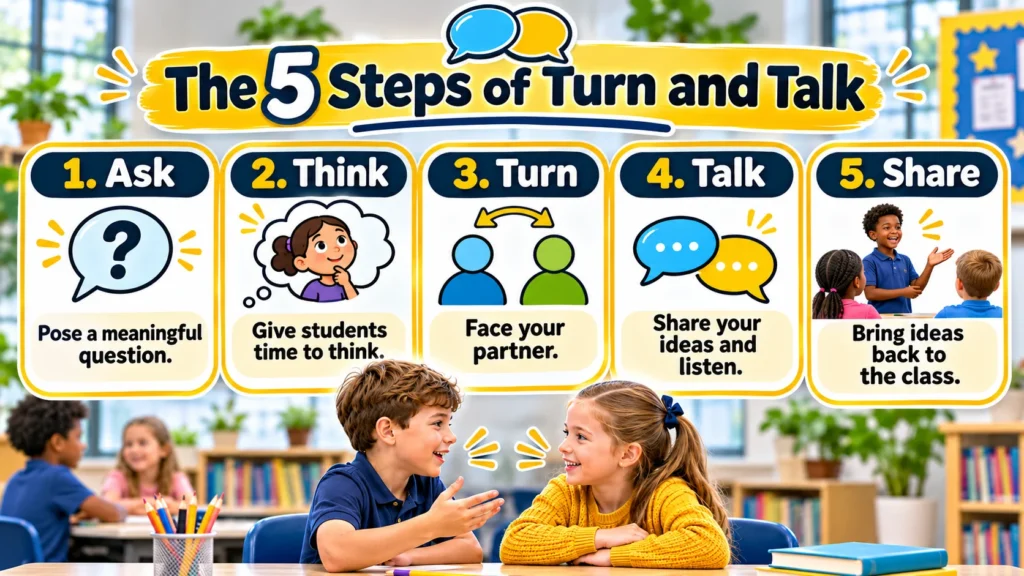
How to Use Turn and Talk in the Classroom: 5 Easy Steps
A successful turn and talk routine should be predictable enough that students can follow it without lengthy explanations.
Step 1: Ask a Meaningful Question
Start with a question connected to the lesson.
Choose prompts that encourage explanation rather than simple yes-or-no answers.
Instead of asking:
“Do plants need water?”
Ask:
“What might happen to a plant if it doesn’t get enough water? Why?”
The second question gives students more to discuss.
Step 2: Give Students Thinking Time
Before students begin talking, allow a brief moment to prepare an answer.
For younger students, try 10–20 seconds as a starting point. Adjust the time to their needs.
Older students may benefit from writing a few words or drawing a quick idea before speaking.
Thinking time can help reduce the pressure to answer immediately.
Step 3: Ask Students to Turn Toward Their Partners
Assign partners before the activity so children know whom to talk to.
Explain that students should face their partners, use comfortable speaking voices, and pay attention to the question.
You can assign roles:
- Partner A: Speaks first.
- Partner B: Listens, then responds.
After the first turn, partners switch roles.
Step 4: Let Students Talk and Listen
Begin the conversation with a consistent signal.
For example:
“Turn toward your partner. Partner A, explain your thinking first. Partner B, listen and be ready to respond.”
Walk around the classroom while students talk.
Listen to different pairs, but avoid interrupting every conversation.
Step 5: Bring Everyone Back Together
Use a familiar signal to end the discussion, such as a raised hand or quiet countdown.
Ask a few students to share something they learned from their partners.
For example:
“What is one interesting idea your partner shared?”
This helps reinforce the importance of listening.
Turn and Talk Strategies for Kindergarten
Kindergarten students are still developing conversation, attention, and turn-taking skills. Their discussions should be short, concrete, and supported by pictures or familiar experiences.
Use Picture Prompts
Show a colorful picture of a playground, farm, or classroom.
Ask students:
“What do you notice in this picture?”
Children can point to objects before explaining what they see.
Practice With Familiar Topics
Begin with topics students already understand.
Examples include:
- What is your favorite playground activity?
- What do you like about rainy days?
- Which animal would you like to learn about?
- What makes someone a good friend?
Familiar questions help children focus on learning how to have a conversation.
Model Conversations First
Demonstrate an example with another teacher or a student.
Show children how to face a partner, speak clearly, listen, and wait for their turn.
You might also demonstrate an unhelpful conversation and ask students what should change.
Keep the First Discussions Short
For beginners, start with approximately 20–30 seconds per speaker.
Increase the duration when students become comfortable taking turns and explaining their ideas.
Use Simple Visual Reminders
Create a classroom chart showing:
Look — Listen — Speak — Switch
Students can use the visual to remember the routine.
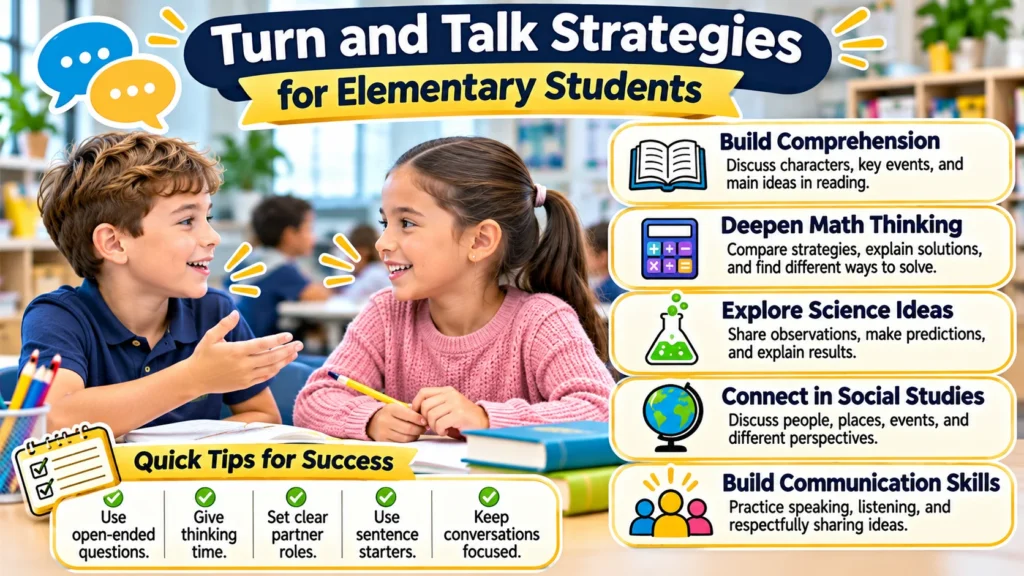
Turn and Talk Strategies for Elementary Students
As students progress through elementary school, partner discussions can become more challenging.
Grades 1–2: Explain and Describe
Ask children to describe what they notice, make predictions, and explain simple answers.
Example:
“How do you know the story takes place in winter?”
Encourage students to identify clues from illustrations and text.
Grades 3–5: Compare and Support Ideas
Older elementary students can explain their reasoning, use evidence, and respectfully consider different opinions.
Example:
“Which character made the best decision? What evidence supports your answer?”
Encourage partners to respond to each other’s reasoning rather than simply taking turns giving separate answers.
Middle and High School Adaptations
For older learners, turn and talk can support debates, text analysis, scientific explanations, and discussion of complex problems.
A middle school science prompt might be:
“Which evidence best supports our explanation of the experiment’s results?”
The main difference is the depth of thinking expected, not the basic structure.
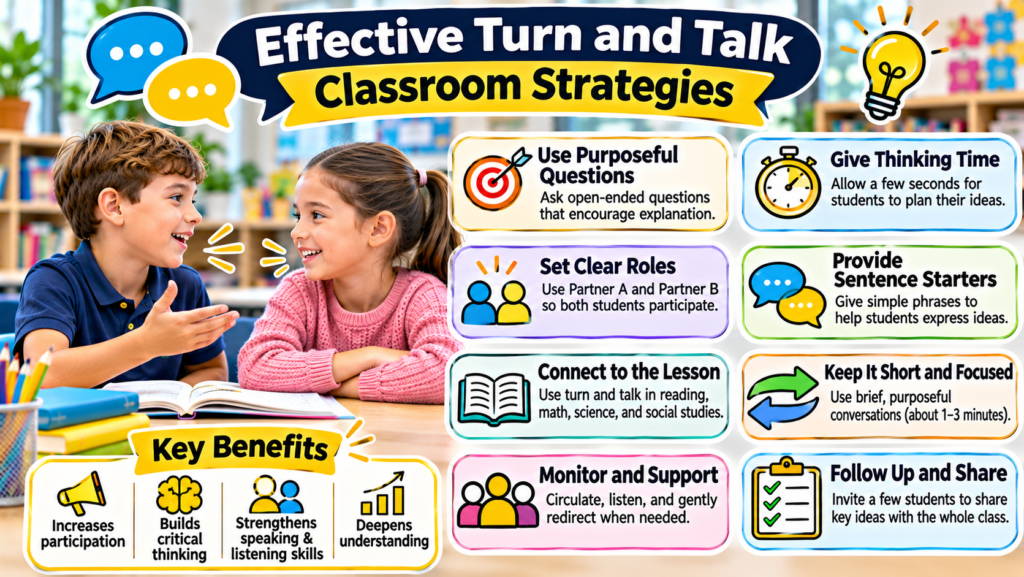
10 Effective Turn and Talk Classroom Strategies
Teachers can use different variations to make partner discussions more purposeful.
1. Think Before You Talk
Give students quiet thinking time before partner discussions.
This helps students prepare a meaningful response instead of relying entirely on their partners.
2. Partner A and Partner B
Assign speaking roles and switch them during the conversation.
This can prevent one student from doing all the talking.
3. Turn and Talk With Evidence
Ask students to support their answers with something specific.
During reading, students might identify a sentence from the story.
During science, they might refer to an observation.
4. Picture-Based Conversations
Use photographs, illustrations, graphs, or diagrams as discussion starters.
Visual prompts are especially helpful for younger students and those developing English language skills.
5. Predict and Discuss
Pause before revealing information and let students make predictions.
For example:
“What do you think will happen when we place this object in water?”
Partners can compare predictions before observing the outcome.
6. Agree, Disagree, and Explain
Present a statement with more than one possible perspective.
Students explain whether they agree or disagree and provide a reason.
Remind them to challenge ideas respectfully rather than criticize people.
7. Partner Retelling
After reading a short story, students take turns retelling important events.
One student describes the beginning, while the other continues with the middle or ending.
8. Solve and Explain
Ask students to solve a math problem independently before discussing their methods.
Partners can compare approaches and explain why their strategies work.
9. Listen and Summarize
After one student speaks, the listener summarizes the main idea.
This helps students practice careful listening instead of simply waiting to respond.
10. Reflect and Share
At the end of a lesson, ask partners:
“What is one thing you learned today, and what question do you still have?”
Use their responses to plan clarification or follow-up instruction.
Turn and Talk Sentence Starters for Students
Some children know what they want to say but have difficulty beginning a conversation.
Sentence starters provide a helpful structure without giving students the answers.
| Conversation purpose | Sentence starter |
|---|---|
| Sharing an opinion | I think ___ because ___. |
| Giving an example | One example is ___. |
| Agreeing | I agree with you because ___. |
| Disagreeing respectfully | I see it differently because ___. |
| Asking for explanation | Can you explain how you know? |
| Making a prediction | I predict ___ because ___. |
| Describing evidence | I noticed ___ in the ___. |
| Connecting ideas | That reminds me of ___. |
| Adding information | I would like to add ___. |
| Summarizing | My partner explained that ___. |
| Asking for clarification | Could you tell me more about ___? |
| Expressing uncertainty | I am not sure yet, but I think ___. |
Teacher tip: Display three or four sentence starters at a time instead of overwhelming younger learners with a long chart.
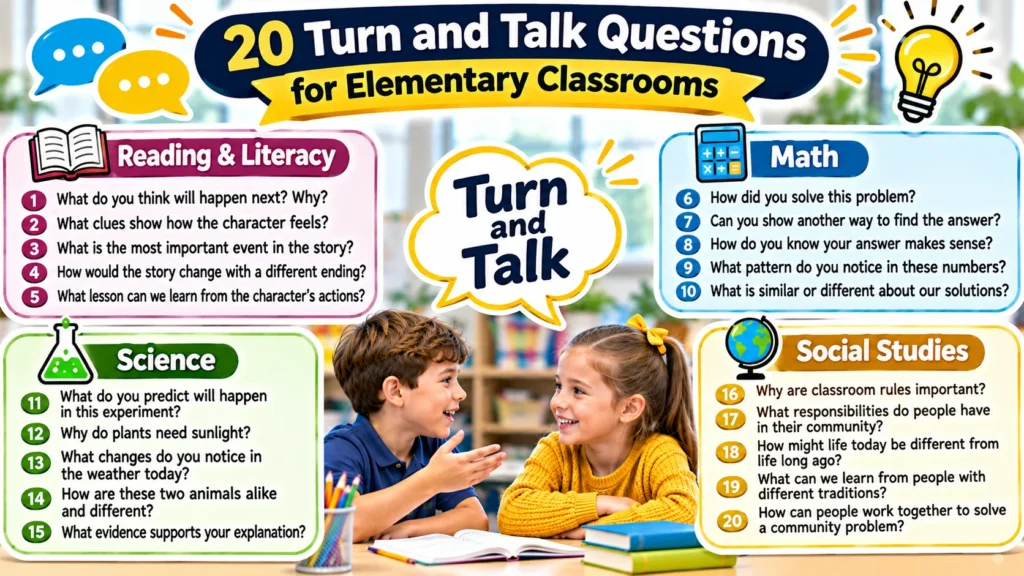
20 Turn and Talk Questions for Elementary Classrooms
The best discussion prompts connect to what students are currently learning.
Reading and Literacy
- What do you think the main character will do next? Why?
- What clues help us understand how the character feels?
- What is the most important event in this story?
- How would the story change if it had a different ending?
- What lesson can we learn from the character’s actions?
Math
- How did you solve this problem?
- Can you show another way to find the answer?
- How do you know your answer makes sense?
- What pattern do you notice in these numbers?
- What is similar or different about our solutions?
Science
- What do you predict will happen during this experiment?
- Why do plants need sunlight?
- What changes do you notice in the weather today?
- How are these two animals alike and different?
- What evidence supports your explanation?
Social Studies
- Why are classroom rules important?
- What responsibilities do people have in their community?
- How might life today be different from life long ago?
- What can we learn from people with different traditions?
- How can people work together to solve a community problem?
Turn and Talk Classroom Rules and Expectations
Clear expectations help students understand how to participate successfully.
A simple classroom anchor chart might include the following rules:
| Classroom rule | What students should do |
|---|---|
| Face your partner | Turn toward the person you are speaking with |
| Take turns | Give each person an opportunity to speak |
| Listen carefully | Pay attention to your partner’s words |
| Stay on topic | Talk about the teacher’s question |
| Use kind language | Respond respectfully, even when disagreeing |
| Explain your thinking | Give a reason or example when possible |
| Use an appropriate voice | Speak loudly enough for your partner, not the entire room |
Practice these expectations during short, low-pressure activities before moving to more complicated discussions.
How Long Should Turn and Talk Last?
The ideal discussion length depends on students’ ages, familiarity with the routine, and the difficulty of the question.
The following are suggested starting ranges, not strict rules.
| Grade level | Suggested discussion time |
|---|---|
| Kindergarten | 30–60 seconds total |
| Grades 1–2 | 1–2 minutes |
| Grades 3–5 | 2–3 minutes |
| Middle school | 2–4 minutes |
| High school | 3–5 minutes |
For particularly simple questions, a shorter conversation may be sufficient. Complex tasks may require additional thinking or discussion time.
End the activity when students have had a meaningful opportunity to respond, rather than continuing simply to fill the timer.
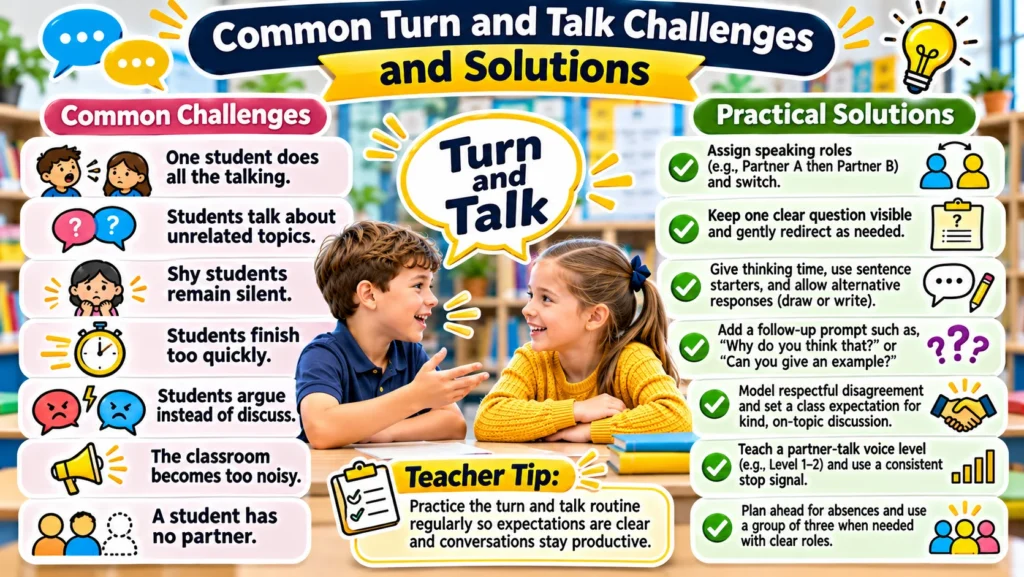
Common Turn and Talk Challenges and Solutions
Even well-planned partner conversations can become difficult to manage.
Problem 1: One Student Does All the Talking
Solution: Give each partner a speaking turn and clearly identify when to switch roles.
A visual timer can help make the structure predictable.
Problem 2: Students Talk About Unrelated Topics
Solution: Use one clear discussion question, keep the prompt visible, and gently redirect students when necessary.
Problem 3: Shy Students Remain Silent
Solution: Offer thinking time, picture cues, familiar partners, and sentence starters.
Allow students to point, draw, or write briefly as a bridge toward verbal participation.
Avoid forcing anxious students to speak publicly without support.
Problem 4: Students Finish Too Quickly
Solution: Teach a follow-up question such as:
“Why do you think that?”
Partners can ask for examples, explanations, or additional evidence.
Problem 5: Students Argue Instead of Discussing
Solution: Model respectful disagreement.
Explain that students may have different ideas while still treating each other kindly.
Problem 6: The Classroom Becomes Too Noisy
Solution: Teach an appropriate partner-talk voice level and establish a consistent stop signal.
Practice the routine before using it with the entire class.
Problem 7: A Student Has No Partner
Solution: Plan for absent students and uneven class numbers.
A group of three can work when roles are adjusted so everyone participates.
Turn and Talk vs. Think-Pair-Share
Turn and talk and think-pair-share are closely related classroom discussion strategies, but they are not always implemented in the same way.
| Feature | Turn and Talk | Think-Pair-Share |
|---|---|---|
| Main purpose | Brief partner conversation | Individual thinking followed by discussion and sharing |
| Thinking time | Recommended, but may vary | Explicit first stage |
| Partner discussion | Yes | Yes |
| Whole-class sharing | Optional | Usually included |
| Typical use | Quick learning checks and discussion | Questions requiring more deliberate reflection |
| Structure | Flexible | More clearly defined stages |
Both strategies can help students participate more actively.
In practice, teachers often combine elements of the two routines. For example, adding quiet thinking time to a turn and talk can improve participation without changing its basic purpose.
How to Assess Turn and Talk Activities
Teachers do not need to formally grade every classroom conversation.
Instead, use turn and talk as a quick opportunity to observe student understanding and communication skills.
Simple Turn and Talk Observation Checklist
| Skill | Yes | Developing |
|---|---|---|
| Student responds to the discussion prompt | ☐ | ☐ |
| Student gives their partner a speaking turn | ☐ | ☐ |
| Student listens without interrupting | ☐ | ☐ |
| Student explains an idea or gives an example | ☐ | ☐ |
| Student responds to their partner’s thinking | ☐ | ☐ |
Observe a small number of partnerships during each activity rather than trying to evaluate every student simultaneously.
Over time, these observations can help identify students who need additional speaking support, clearer instructions, or more challenging prompts.
Quick Reflection Questions
After a discussion, ask students:
- Did both partners have an opportunity to speak?
- What new idea did you hear?
- What would make your next discussion better?
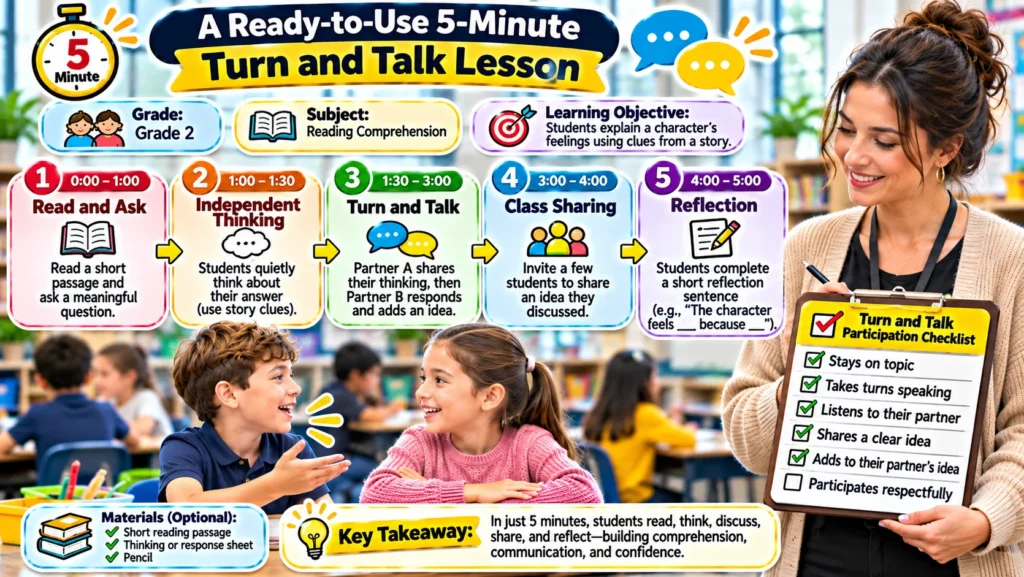
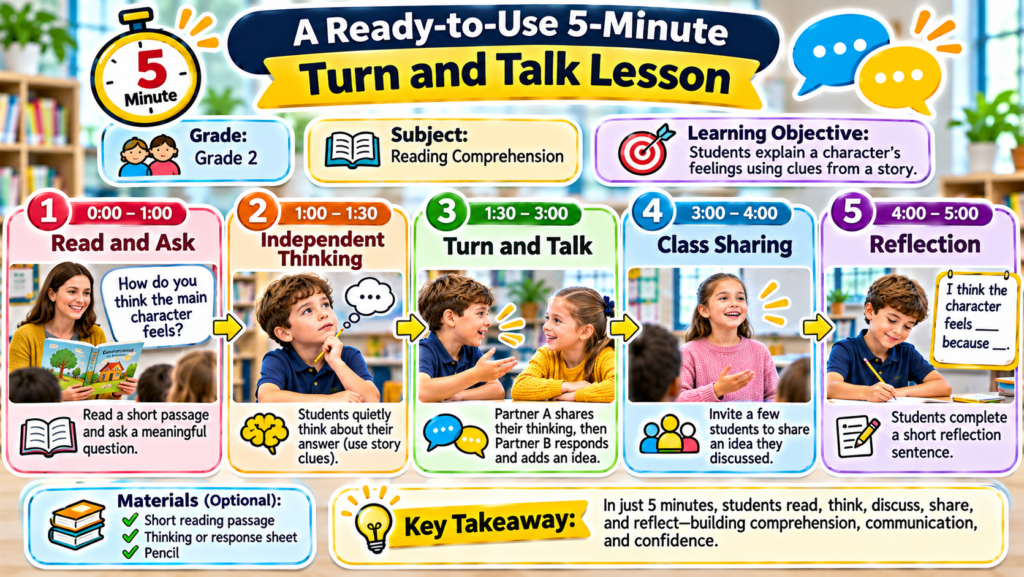
A Ready-to-Use 5-Minute Turn and Talk Lesson
Here is a simple example that teachers can adapt for a reading lesson.
Grade: 2
Subject: Reading comprehension
Learning objective: Students explain a character’s feelings using clues from a story.
0:00–1:00 — Read and Ask
Read a short passage aloud.
Ask:
“How do you think the main character feels, and what clues helped you decide?”
1:00–1:30 — Independent Thinking
Students quietly consider the question.
They may identify a word, picture, or event that supports their answer.
1:30–3:00 — Partner Conversation
Partner A explains their thinking.
Partner B listens, responds, and shares another idea.
3:00–4:00 — Class Sharing
Invite a few students to explain something they discussed.
Encourage them to mention evidence from the story.
4:00–5:00 — Reflection
Students complete this sentence:
“I think the character feels ___ because ___.”
This routine combines independent thinking, meaningful conversation, and a quick opportunity to check understanding.
How to Make Turn and Talk Inclusive for Every Learner
An effective classroom discussion routine should give students different ways to participate.
Support English Language Learners
Use images, vocabulary previews, sentence frames, and opportunities to rehearse ideas.
When helpful and appropriate, students may discuss a concept in their home language before explaining it in English.
Support Students With Communication Differences
Offer additional processing time and flexible response options.
Some students may communicate more successfully using pictures, writing, gestures, or assistive communication tools.
Support Students Who Need More Structure
Provide clear role assignments, visual timers, predictable partners, and one question at a time.
Challenge Advanced Learners
Invite students to explain evidence, compare viewpoints, or ask a follow-up question that extends the discussion.
The goal is not to make every conversation identical. It is to help every student participate meaningfully.
Frequently Asked Questions About Turn and Talk
What is the turn and talk teaching strategy?
Turn and talk is a classroom learning strategy in which students briefly discuss a teacher’s question or prompt with a partner. It provides opportunities to explain ideas, listen, and build understanding through conversation.
What is the purpose of turn and talk?
The purpose is to increase opportunities for student participation, encourage thinking, strengthen communication skills, and help teachers observe understanding during a lesson.
How do you start a turn and talk activity?
Ask a clear question, give students thinking time, identify partners, explain the speaking and listening expectations, and begin the conversation using a consistent classroom signal.
Is it called turn and talk or turn to talk?
Turn and talk is the commonly used name for the teaching strategy. The phrase turn to talk may also describe the action of turning toward a partner to begin a conversation, but it is not generally the preferred name for the routine.
How long should kindergarten students turn and talk?
For beginners, a total discussion lasting about 30–60 seconds can be a useful starting point. Teachers should adjust the time based on student development, engagement, and the task.
Can turn and talk be used in math?
Yes. Students can explain problem-solving methods, compare answers, describe patterns, and discuss different ways to represent mathematical ideas.
How is turn and talk different from think-pair-share?
Turn and talk focuses on a brief partner discussion and may include thinking time or class sharing. Think-pair-share explicitly organizes the routine into individual thinking, partner discussion, and whole-class sharing.
What if students do not want to talk?
Start with familiar questions, offer preparation time, model answers, and provide supportive communication choices. Avoid putting students under unnecessary pressure, especially when they need language or communication accommodations.
Is turn and talk suitable for older students?
Yes. Middle and high school teachers can use it for analyzing texts, explaining scientific evidence, discussing historical events, and evaluating different perspectives.
Can turn and talk be used as formative assessment?
Yes. Teachers can listen to student conversations to identify understanding, misconceptions, and areas where additional instruction may be needed.
Final Thoughts
Turn and talk is more than a quick classroom conversation. When thoughtfully planned, it gives students a regular opportunity to explain their thinking, learn from classmates, and practice respectful communication.
The most important elements are simple: ask a meaningful question, allow time to think, make expectations clear, and ensure both partners participate.
Start with a short conversation during a familiar lesson. As students become more comfortable, introduce challenging prompts, deeper explanations, and additional opportunities to respond to one another.
With consistent practice and supportive instruction, turn and talk can become a valuable part of everyday classroom learning.