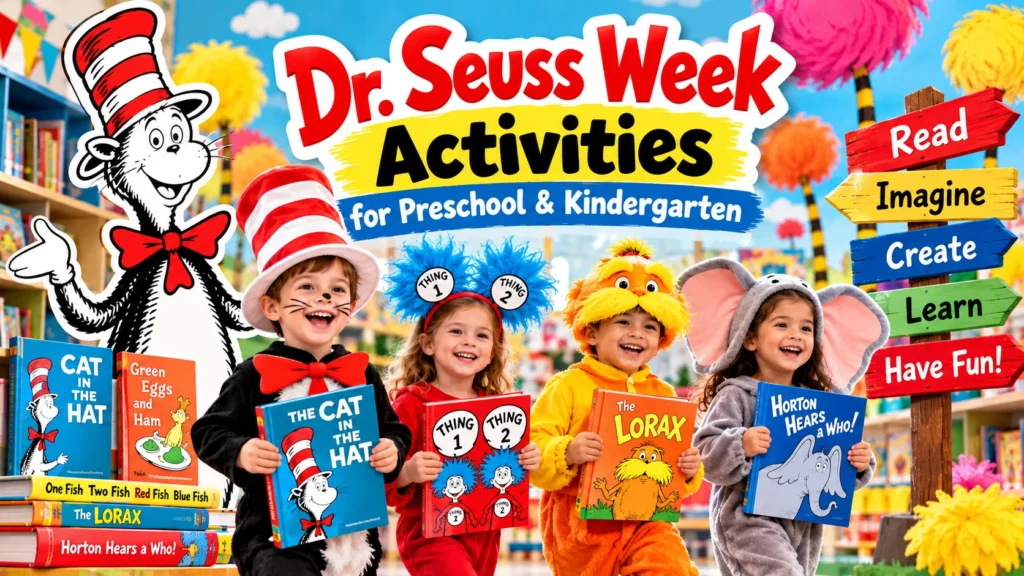
Dr. Seuss Week is a fun opportunity to bring stories, rhymes, colors, and hands-on learning into the preschool or kindergarten classroom. But planning an entire week of activities can be challenging when you have limited preparation time and a classroom full of energetic young learners.
The good news? You don’t need expensive supplies or complicated projects to make reading celebrations meaningful.
These 25 Dr. Seuss Week activities for preschool and kindergarten include easy crafts, rhyming games, counting activities, STEM challenges, and movement games. Each activity connects playful learning to an early childhood skill, making it easier to plan engaging lessons for children ages 3–6.
You’ll also find a five-day activity schedule, classroom preparation tips, and ways to adjust activities for different developmental levels.
What Is Dr. Seuss Week?
Dr. Seuss Week is a classroom celebration inspired by the children’s books of Dr. Seuss, whose birthday is March 2. Many teachers plan book-themed crafts, rhyming games, imaginative play, and reading activities around this time.
Popular books used for these celebrations include:
- The Cat in the Hat
- Green Eggs and Ham
- One Fish, Two Fish, Red Fish, Blue Fish
- Hop on Pop
- Ten Apples Up on Top!
- The Lorax
- Wacky Wednesday
These stories offer opportunities to explore rhyming, counting, colors, patterns, sequencing, and imaginative language.
Teachers can also include picture books by other authors to introduce children to different storytelling styles, cultures, and experiences.
When Is Read Across America Day in 2026?
Read Across America Day 2026 took place on Monday, March 2, 2026.
The National Education Association (NEA) organizes Read Across America to encourage children to enjoy books and develop positive reading habits.
Although Dr. Seuss’s birthday falls on the same date, Read Across America is a separate, year-round reading initiative that celebrates books by many different authors.
Schools may organize their own reading-themed celebration weeks around March 2, so dates and daily themes can vary.
Easy Dr. Seuss Activities for Pre-K
These simple Dr. Seuss activities for Pre-K are suitable for children who are still developing fine motor coordination, listening skills, color recognition, and early literacy.
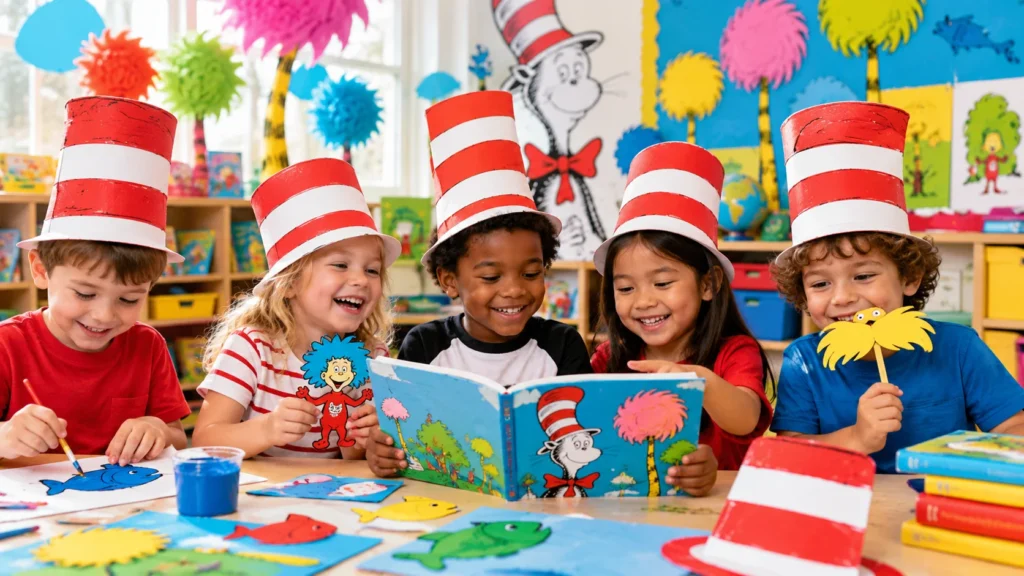
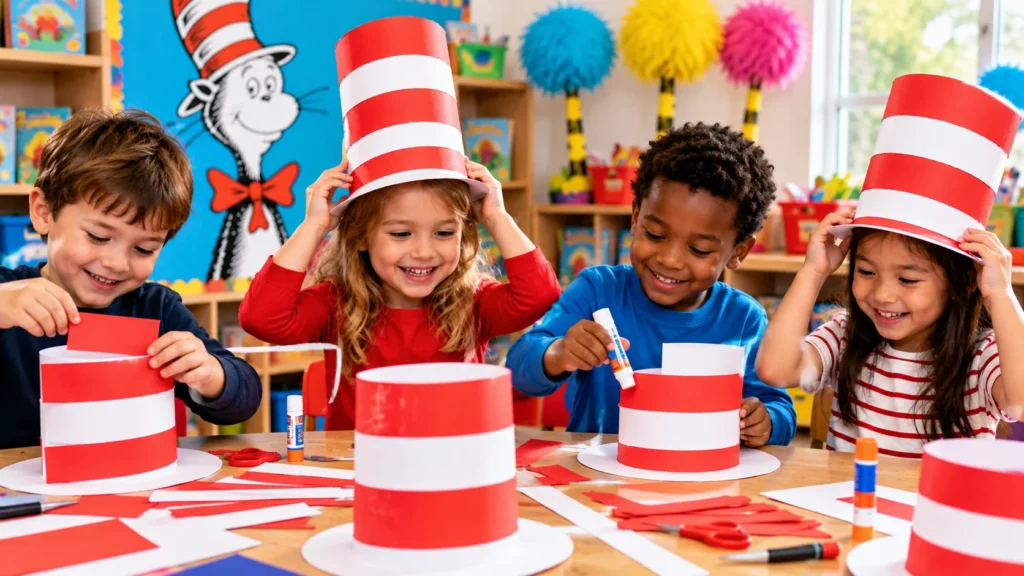
1. Red-and-White Striped Hat Craft
Inspired by: The Cat in the Hat
Recommended age: 3–6 years
Preparation time: 5 minutes
Activity time: 15–20 minutes
Learning goal: Fine motor skills, color recognition, and pattern awareness.
Materials:
- Red and white construction paper
- Glue sticks
- Safety scissors
- A paper headband or hat outline
- Crayons
How to do it:
- Prepare a large paper hat outline for each child.
- Cut red and white paper into wide strips.
- Ask children to glue the strips in an alternating pattern.
- Help students attach their completed hats to paper headbands.
- Invite everyone to show their hats during storytime.
Preschool adaptation: Provide precut paper strips and a clearly marked outline.
Kindergarten challenge: Ask students to extend an AB pattern independently or count the total stripes.
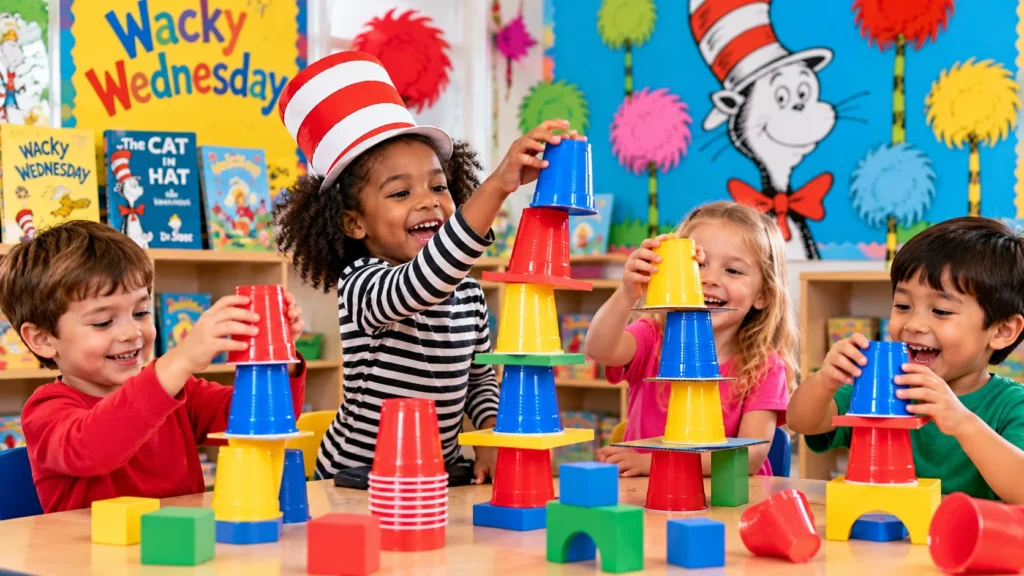
2. Wacky Wednesday Stacking Challenge
Inspired by: Wacky Wednesday
Recommended age: 4–6 years
Activity time: 15 minutes
Learning goal: Balance, problem-solving, and spatial awareness.
Materials: Plastic stacking cups, building blocks, and a flat table.
Instructions:
- Read selected pages from Wacky Wednesday.
- Invite children to build unusually shaped towers.
- Ask which towers are tall, short, wide, or narrow.
- Encourage children to change their designs when a tower falls.
- Compare the structures and discuss what makes them stable.
Teacher tip: Encourage experimentation rather than turning the activity into a competition.
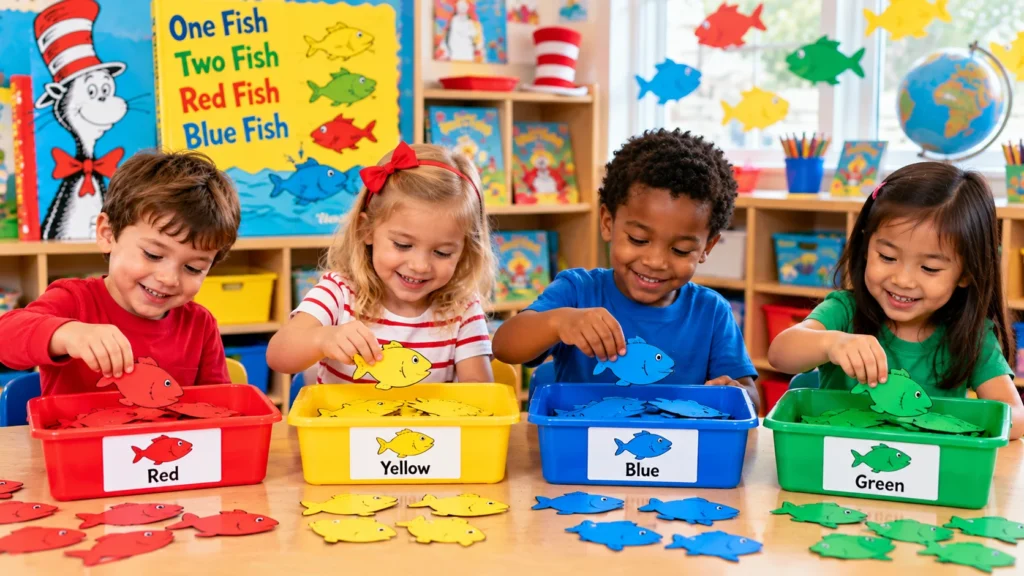
3. One Fish, Two Fish Color Sorting
Inspired by: One Fish, Two Fish, Red Fish, Blue Fish
Recommended age: 3–5 years
Activity time: 10–15 minutes
Learning goal: Color identification, sorting, and counting.
Materials: Large red, blue, yellow, and green paper fish; colored sorting mats.
Instructions:
- Spread the paper fish across a table.
- Name each color together.
- Ask children to place the fish on matching mats.
- Count how many fish belong to each group.
- Compare which group has more or fewer fish.
Kindergarten challenge: Ask students to record the number of fish in each color group.
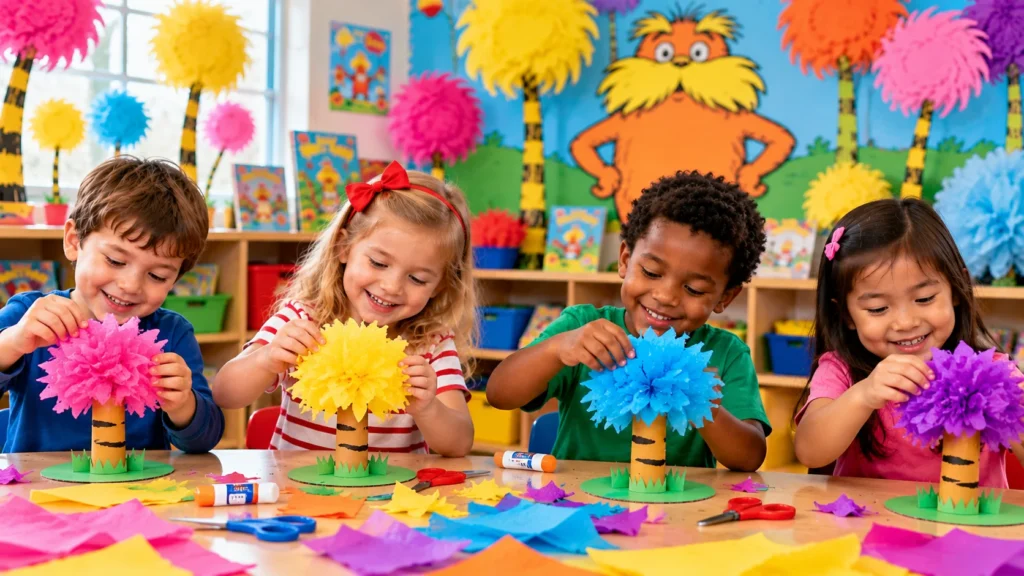
4. Truffula Tree Art
Inspired by: The Lorax
Recommended age: 3–6 years
Activity time: 20 minutes
Learning goal: Creativity, color exploration, and fine motor coordination.
Materials: Construction paper, glue, tissue paper, washable markers, and craft paper.
Instructions:
- Show children illustrations of Truffula Trees.
- Invite them to draw a tall tree trunk.
- Tear or crumple colorful tissue paper.
- Glue the tissue paper to the top of each trunk.
- Display the finished trees as a classroom forest.
Extension: Talk about why trees are important for animals and the environment.
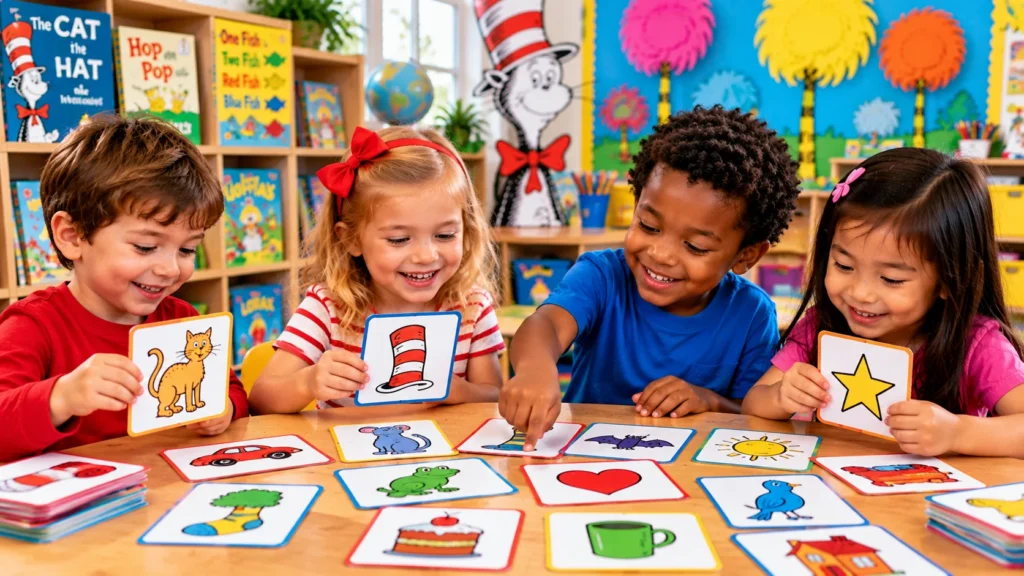
5. Silly Rhyme Matching Game
Inspired by: Dr. Seuss’s playful rhyming language
Recommended age: 4–6 years
Activity time: 10–15 minutes
Learning goal: Phonological awareness and listening.
Materials: Picture cards showing familiar rhyming words.
Instructions:
- Place picture cards on a table.
- Say two words aloud, such as cat and hat.
- Ask whether the words rhyme.
- Invite children to find the matching pictures.
- Repeat with additional word pairs.
Start with obvious rhymes such as sun–fun, cake–snake, and boat–goat.
Preschool adaptation: Offer two possible answers.
Kindergarten challenge: Ask children to suggest another word with the same ending sound.
Dr. Seuss Literacy and Rhyming Activities
Rhyming, sound awareness, storytelling, and vocabulary are important parts of early literacy instruction. These activities help children notice and play with spoken language.
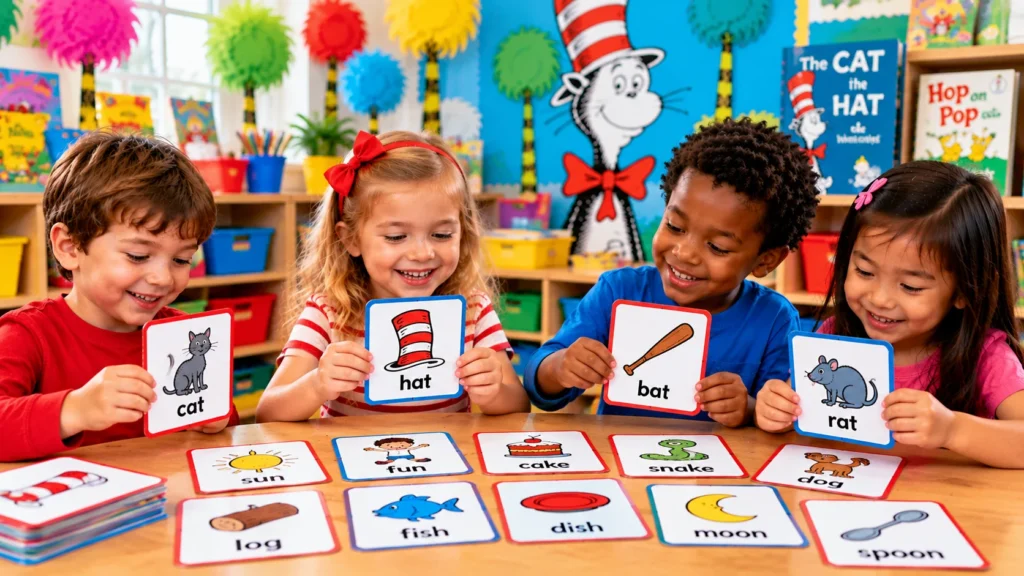
6. Cat in the Hat Rhyming Pairs
Age: 4–6 years | Time: 15 minutes
Learning goal: Recognizing rhyming word pairs.
Prepare picture cards showing familiar objects, including a cat, hat, bat, and mat.
Place the cards face up and say one word aloud.
Children choose a picture that rhymes with the spoken word.
For younger students, begin with two cards. Kindergarten students can explain how the words sound alike.
Teaching tip: Focus on listening to word endings rather than matching written letters.
7. Hop on Pop Word Family Game
Age: 5–6 years | Time: 15 minutes
Learning goal: Recognizing simple word patterns.
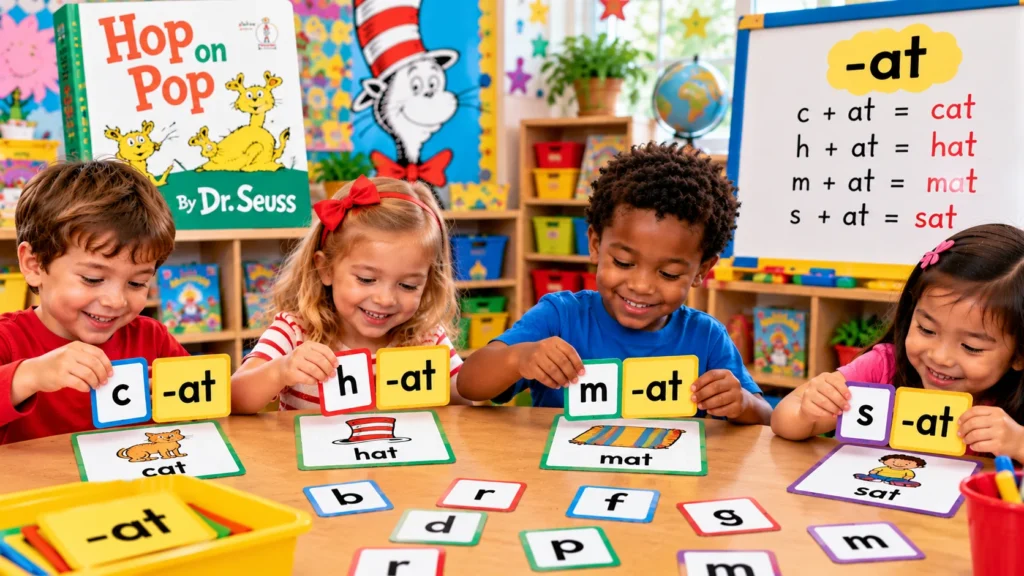
After reading Hop on Pop, introduce a short word family such as -at.
Write the ending -at on a card and provide separate beginning letters.
Help children build words such as cat, hat, mat, and sat.
Read each completed word aloud.
For preschoolers who are not ready to decode printed words, use picture-based rhyming instead.
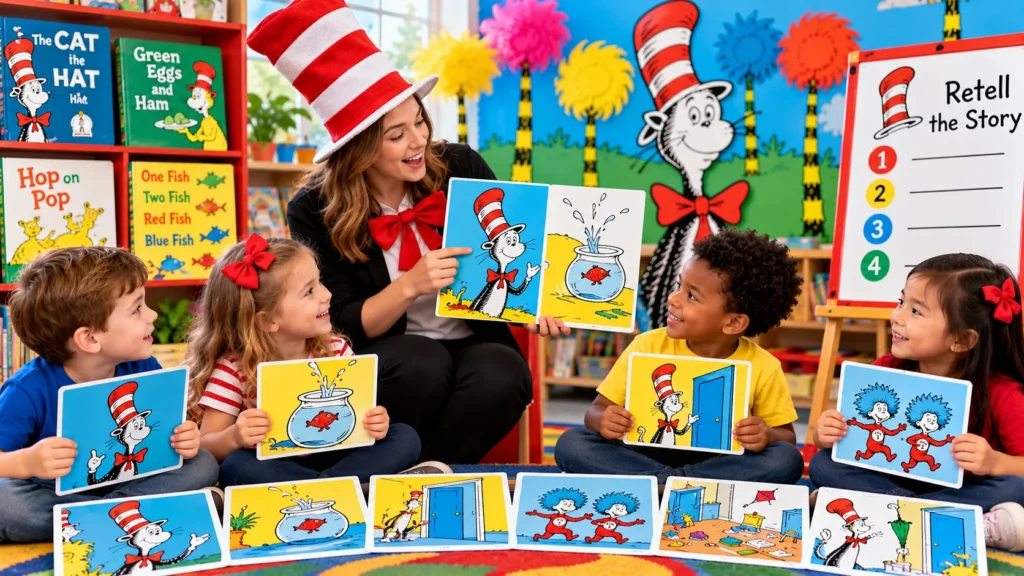
8. Green Eggs and Ham Story Sequencing
Age: 4–6 years | Time: 15–20 minutes
Learning goal: Story comprehension and sequencing.
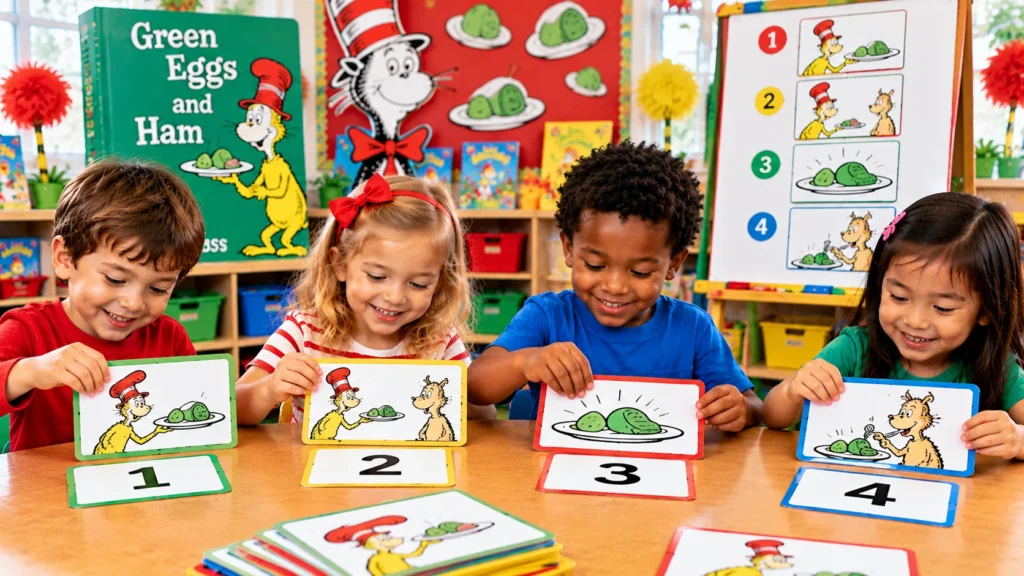
Read Green Eggs and Ham aloud.
Prepare three or four simple picture cards representing important moments from the story.
Ask children to place the cards in the correct order.
Use prompts such as:
- What happened first?
- What happened next?
- How did the character feel at the end?
Kindergarten students can describe the sequence using first, next, then, and last.
9. Dr. Seuss Picture Book Retelling
Age: 3–6 years | Time: 15 minutes
Learning goal: Oral language, memory, and comprehension.
Choose a familiar picture book and read it with the class.
Provide simple props or character pictures.
Ask children to retell what happened using the pictures as reminders.
Encourage them to identify the main character, setting, and an important event.
Preschool adaptation: Let children point to pictures or act out familiar scenes.
Kindergarten challenge: Ask students to retell the story with a beginning, middle, and end.
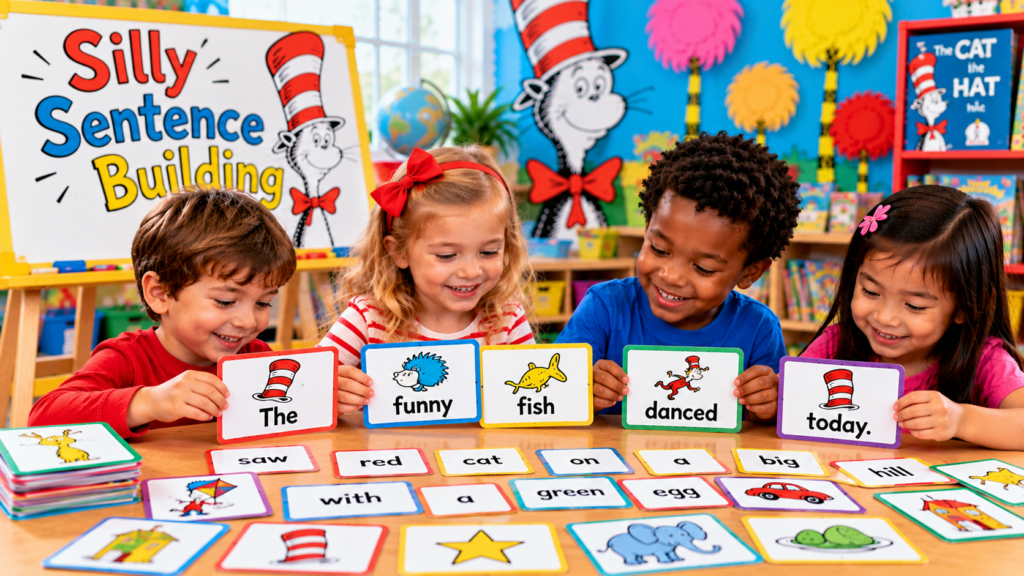
10. Silly Sentence Building
Age: 4–6 years | Time: 15 minutes
Learning goal: Sentence structure, vocabulary, and creative language.
Prepare picture cards showing animals, actions, objects, and places.
Invite students to choose three cards.
Help them build a silly sentence, such as:
“The purple dog dances on the moon.”
Read the sentences aloud and encourage children to illustrate their ideas.
Kindergarten students may attempt to write or dictate their sentences.
Dr. Seuss Arts and Crafts for Preschool and Kindergarten
Book-inspired crafts give children opportunities to express ideas creatively while practicing cutting, gluing, drawing, and hand coordination.
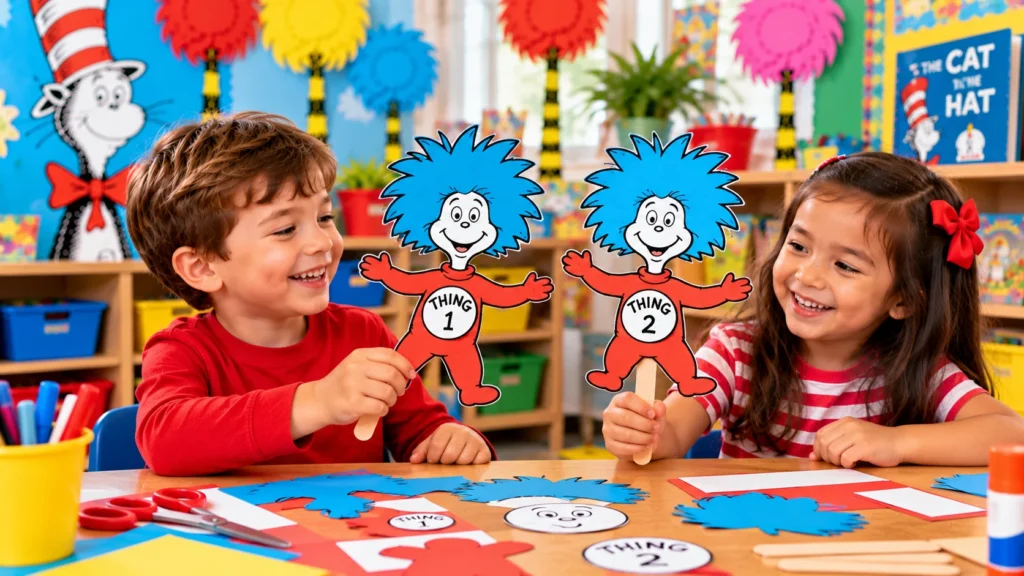
11. Thing 1 and Thing 2 Paper Puppets
Inspired by: The Cat in the Hat
Age: 4–6 years | Time: 20 minutes
Learning goal: Fine motor development and dramatic play.
Materials: Red and blue paper, craft sticks, glue, and washable markers.
Steps:
- Cut out large paper body shapes.
- Add blue paper hair and simple faces.
- Attach the shapes to craft sticks.
- Invite children to use their puppets during storytelling.
Encourage children to invent short conversations between their puppets.
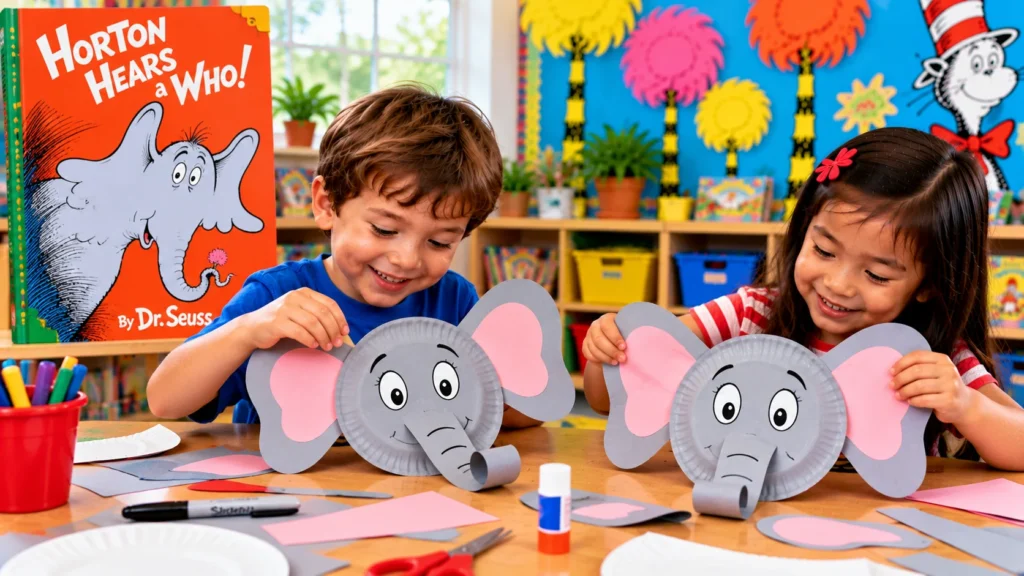
12. Horton Elephant Ear Craft
Inspired by: Horton Hears a Who!
Age: 3–6 years | Time: 15–20 minutes
Learning goal: Shape recognition and creative expression.
Give children a large elephant face outline with separate paper ears.
Ask them to identify the shapes and attach the ears.
Students can decorate their elephants with crayons or washable paint.
Finish with a short conversation about listening carefully and treating others kindly.
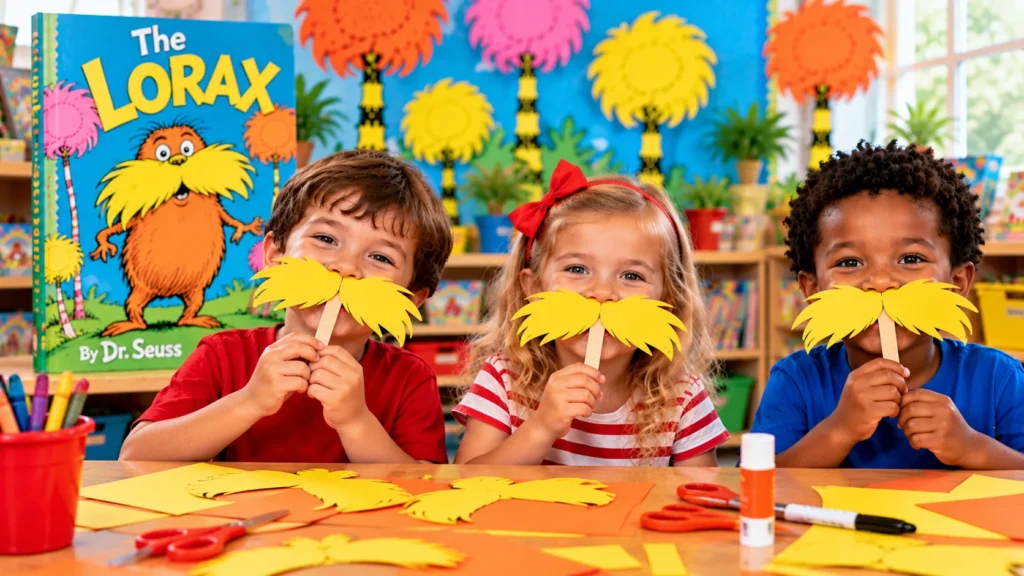
13. Lorax-Inspired Mustache Craft
Inspired by: The Lorax
Age: 4–6 years | Time: 15 minutes
Learning goal: Fine motor skills and imaginative play.
Prepare orange paper face shapes and yellow paper mustaches.
Children cut or tear strips of yellow paper and attach them to the face.
Let them add eyes, eyebrows, and other details.
Use the finished crafts to introduce a conversation about caring for trees and natural spaces.
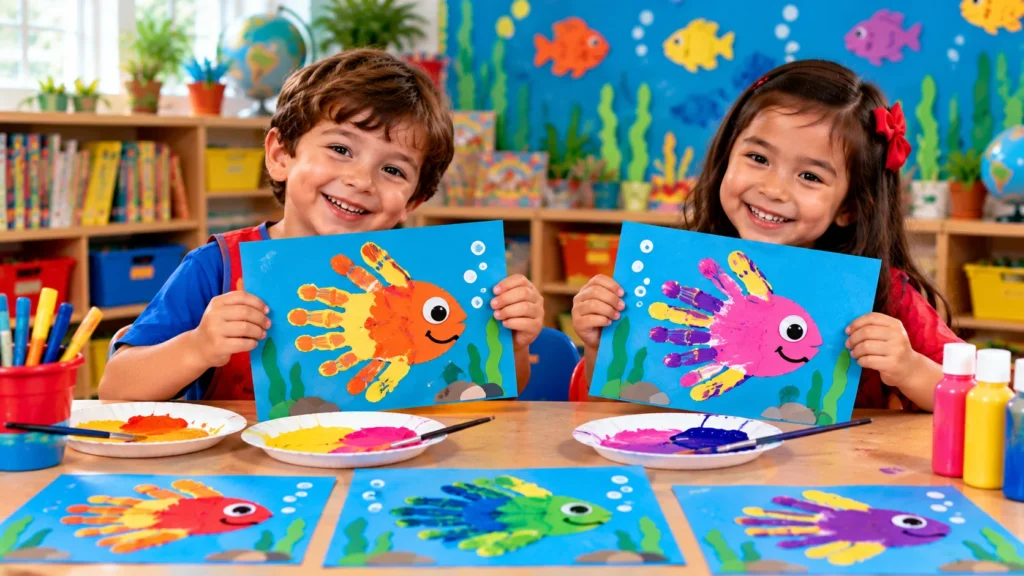
14. Colorful Handprint Fish Art
Inspired by: One Fish, Two Fish, Red Fish, Blue Fish
Age: 3–6 years | Time: 20 minutes
Learning goal: Color recognition and sensory art.
Provide washable paint in several colors.
With supervision, help children make handprints on large sheets of paper.
After the prints dry, add eyes, fins, and tails to turn them into imaginary fish.
Ask children to describe their fish using color and size words.
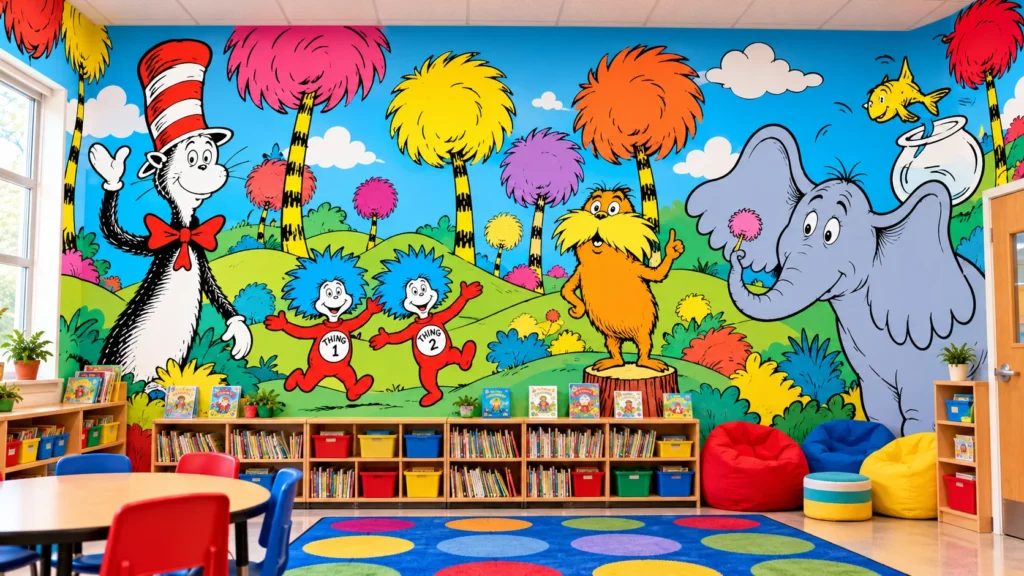
15. Dr. Seuss-Inspired Classroom Mural
Age: 3–6 years | Time: 20–30 minutes
Learning goal: Collaboration, creativity, and communication.
Attach a large sheet of paper to a classroom wall or table.
Invite students to draw imaginary animals, trees, houses, and colorful landscapes inspired by the books they have read.
Encourage children to talk about their drawings and listen to one another.
Display the completed mural in the classroom reading area.
Dr. Seuss Math and Counting Activities
Picture books can introduce early mathematical ideas through colorful objects, repeated patterns, and playful situations.
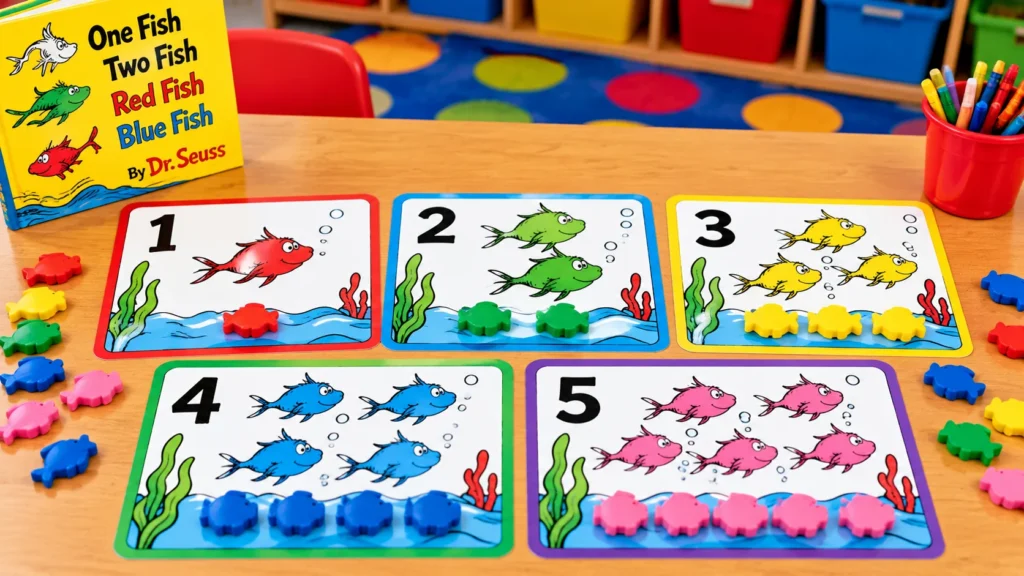
16. One Fish, Two Fish Counting Mats
Age: 3–6 years | Time: 15 minutes
Learning goal: Number recognition and one-to-one counting.
Give each child a counting mat showing numbers from 1 to 5.
Provide large paper fish counters.
Call out a number and ask children to place the matching number of fish on their mats.
Encourage them to touch each fish while counting aloud.
Kindergarten students can work with numbers up to 10 or 20, depending on readiness.
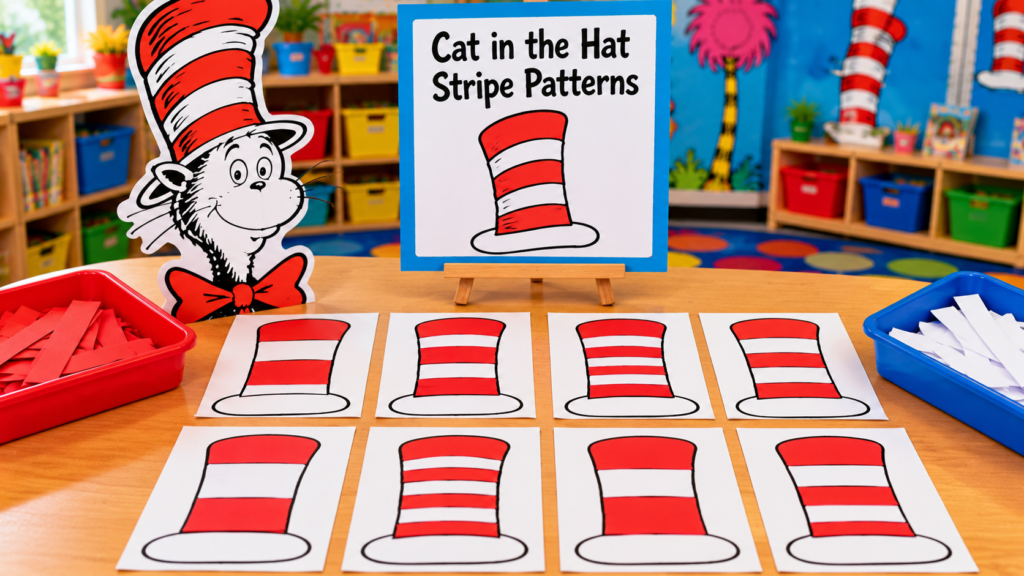
17. Cat in the Hat Stripe Patterns
Age: 3–6 years | Time: 10–15 minutes
Learning goal: Identifying and extending patterns.
Provide red and white paper strips.
Begin a simple red–white–red–white pattern.
Ask students which color comes next.
Let children continue the pattern or create a new one.
Older students can try more complex patterns such as red–red–white.
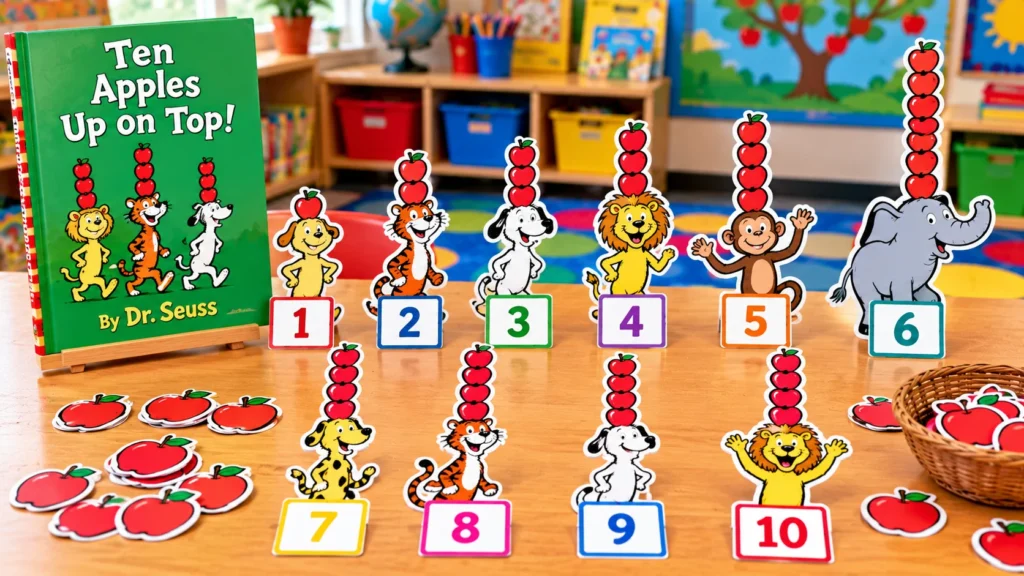
18. Ten Apples Up on Top Counting
Inspired by: Ten Apples Up on Top!
Age: 3–6 years | Time: 15–20 minutes
Learning goal: Counting and comparing quantities.
Prepare large apple-shaped paper counters and a simple character picture.
Ask students to place apples above the character’s head on a flat mat.
Count the apples together.
Challenge students to add or remove apples and explain how the quantity changes.
Safety note: Use paper counters rather than asking children to balance real apples on their heads.
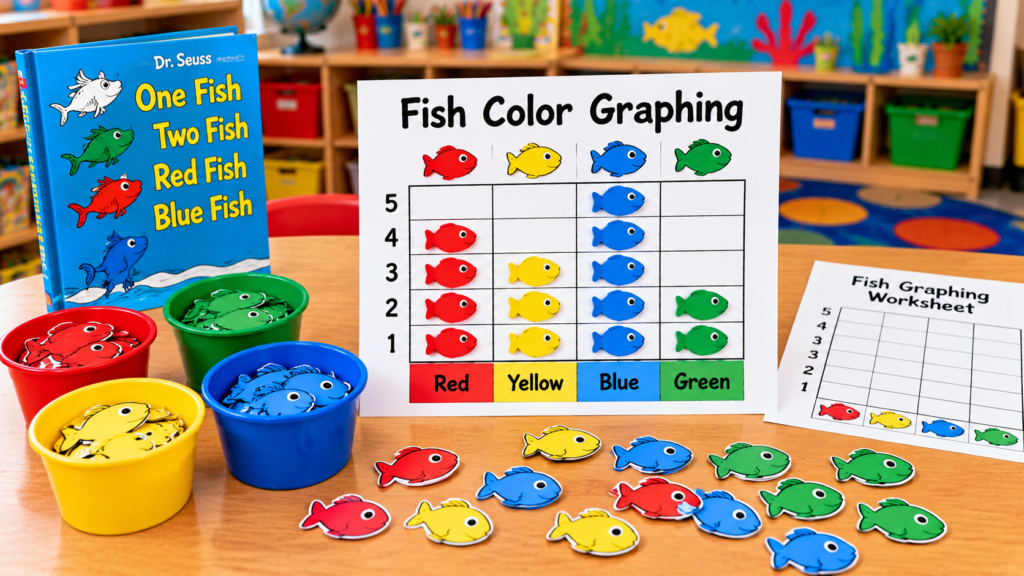
19. Fish Color Graphing Activity
Age: 4–6 years | Time: 15–20 minutes
Learning goal: Sorting, comparing, and interpreting simple data.
Provide paper fish in three or four colors.
Ask children to sort the fish into groups.
Arrange the groups into columns on a classroom chart.
Count each column and discuss:
- Which color has the most fish?
- Which has the fewest?
- Are any groups equal?
Kindergarten students can record the totals using numerals.
Dr. Seuss STEM and Sensory Activities
These activities encourage children to observe, predict, test ideas, and solve simple problems through play.
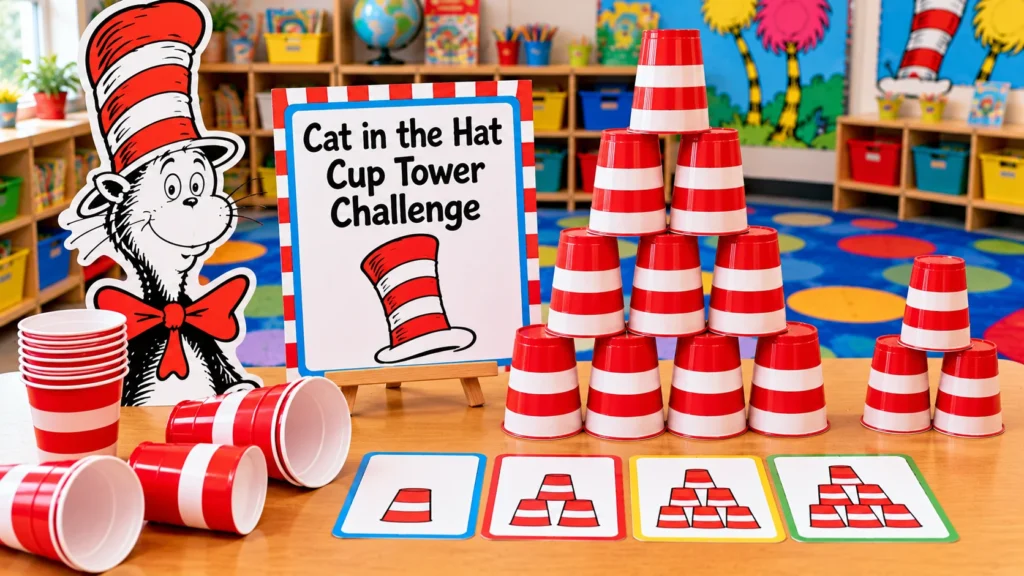
20. Cat in the Hat Cup Tower Challenge
Age: 4–6 years | Time: 15–20 minutes
Learning goal: Engineering, balance, and problem-solving.
Materials: Plastic cups, cardboard squares, and a flat surface.
Instructions:
- Give children a small set of stacking cups.
- Ask them to build the tallest tower they can.
- Observe which structures remain standing.
- Encourage students to rebuild unstable towers.
- Discuss why a wider base might help.
Students can measure tower heights using blocks or compare which structure is taller.
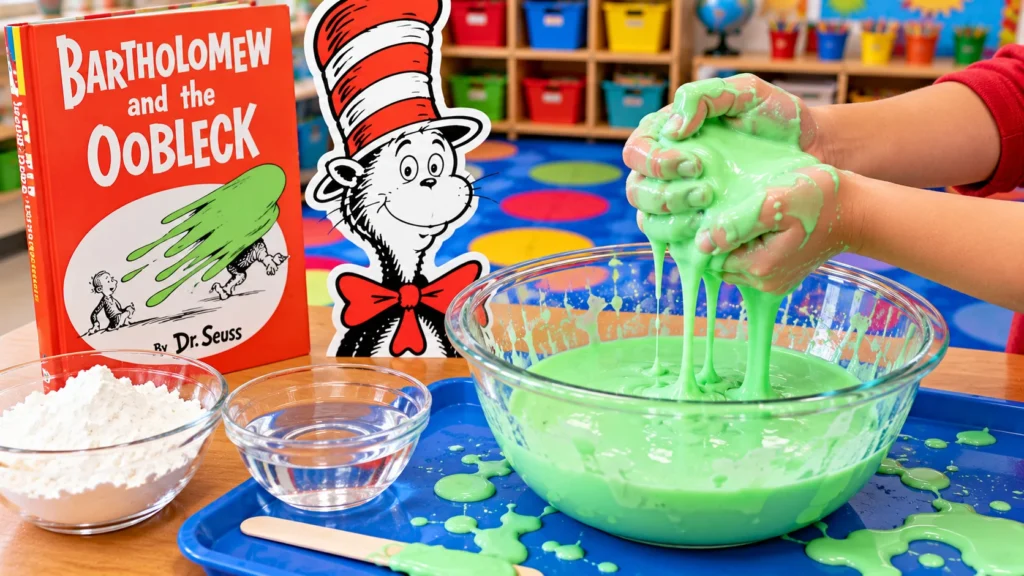
21. Oobleck Sensory Experiment
Inspired by: Bartholomew and the Oobleck
Age: 4–6 years | Time: 20 minutes
Learning goal: Scientific observation and describing materials.
Materials: Cornstarch, water, a mixing bowl, and a washable tray.
Instructions:
- Place approximately two parts cornstarch in a bowl.
- Gradually add one part water, adjusting until the mixture behaves as desired.
- Stir the mixture together.
- Invite children to gently press and release it.
- Compare how the mixture responds to different movements.
Ask children to describe what they notice when they squeeze or slowly move the mixture.
Safety: Supervise closely, do not allow tasting, check ingredient sensitivities, and keep the mixture out of drains. Offer a non-contact observation option for children with sensory sensitivities.
22. Truffula Tree Building Challenge
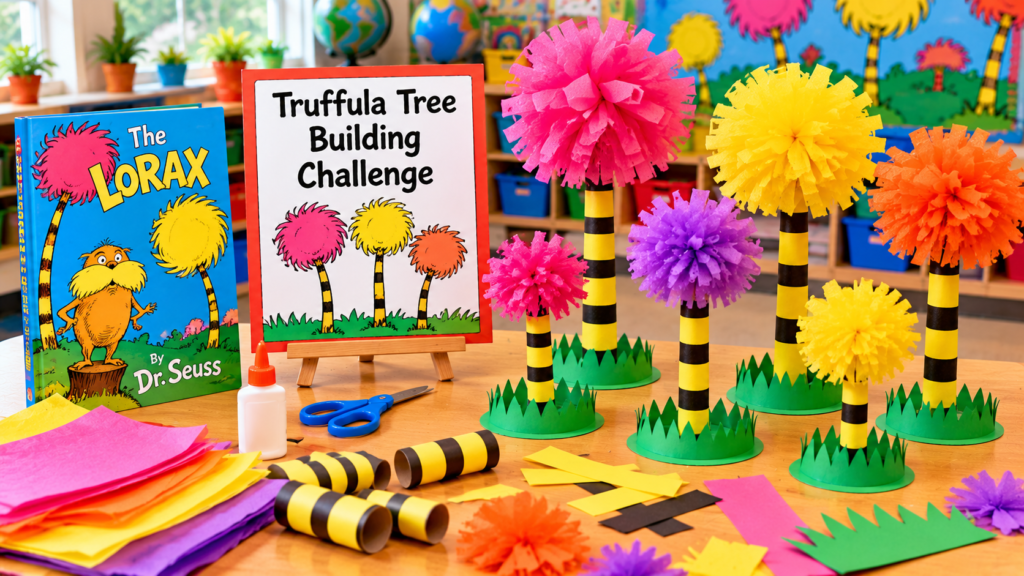
Age: 4–6 years | Time: 20 minutes
Learning goal: Engineering design, creativity, and stability.
Provide building blocks, paper tubes, or large reusable construction materials.
Challenge children to build a tall imaginary tree that stands without falling.
Let students test different base shapes and construction methods.
Encourage them to explain which design worked best and why.
23. Sink or Float Fish Experiment
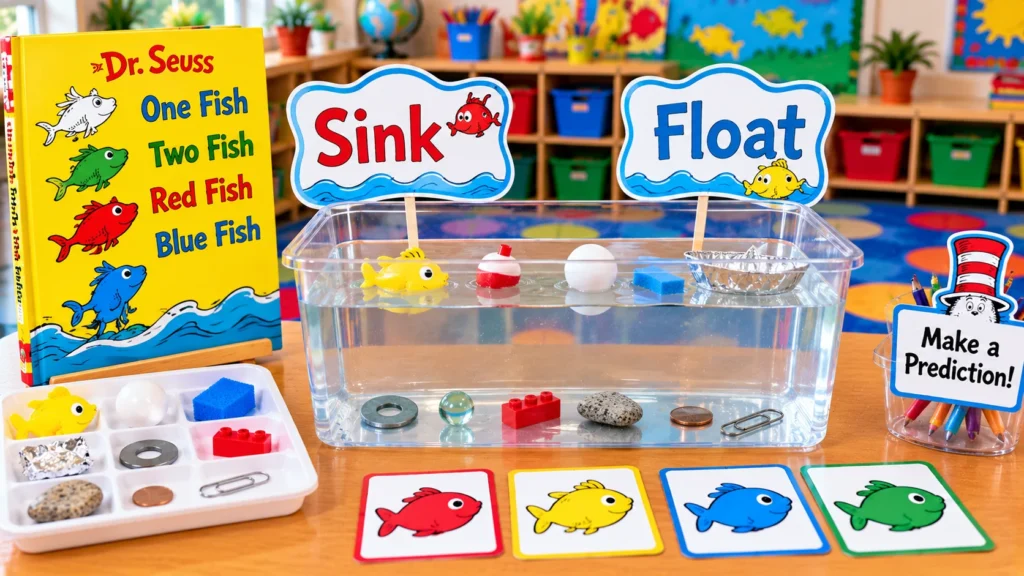
Age: 4–6 years | Time: 15–20 minutes
Learning goal: Making predictions and observing physical properties.
Fill a shallow container with water.
Provide large, child-safe objects made from different materials, such as a plastic toy fish, a cork, and a large smooth stone.
Ask students to predict whether each object will sink or float.
Place the objects in the water one at a time.
Record predictions and observations on a simple class chart.
Safety: Use close adult supervision around water, avoid small choking hazards, and empty containers immediately after use.
Dr. Seuss Week Movement and Celebration Activities
These activities combine physical movement, listening, social interaction, and enjoyment of books.
24. Dr. Seuss Character Freeze Dance
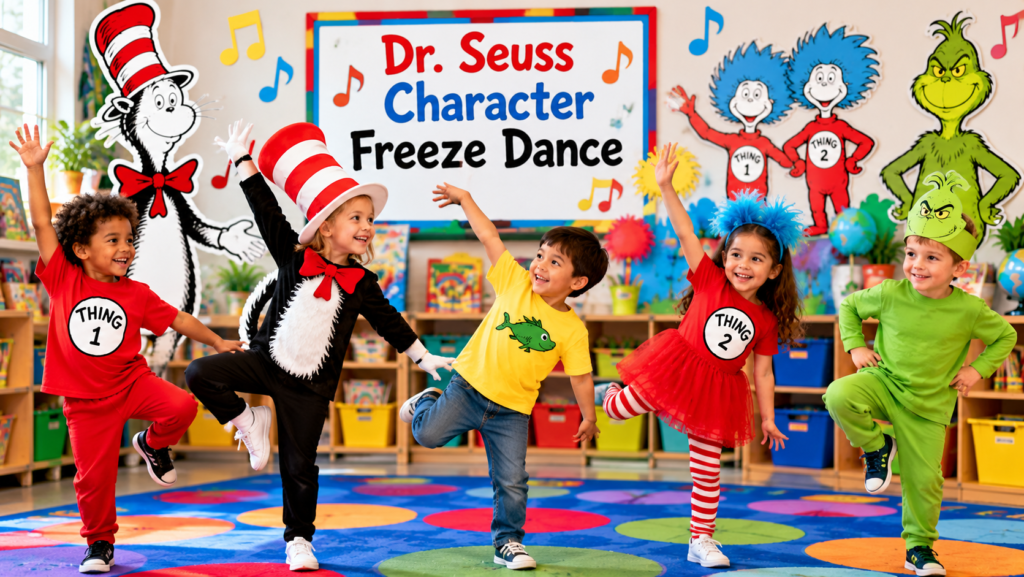
Age: 3–6 years | Time: 10–15 minutes
Learning goal: Listening, coordination, and self-regulation.
Play age-appropriate music and invite children to move like imaginary storybook characters.
Pause the music unexpectedly.
When the music stops, everyone freezes.
Try different movement prompts, such as tiptoeing, stretching, marching, or moving slowly.
Offer seated movement options so every child can participate.
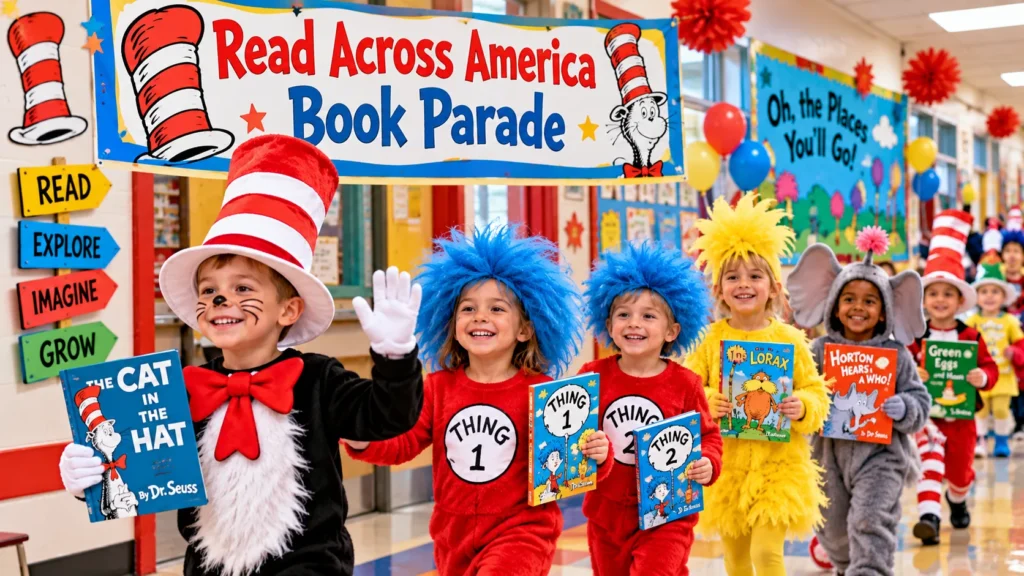
25. Read Across America Book Parade
Age: 3–6 years | Time: 20–30 minutes
Learning goal: Reading motivation, oral language, and social confidence.
Invite children to bring or choose a favorite picture book.
Children may wear simple book-inspired colors or accessories if they wish.
Organize a short classroom parade where each child displays a book.
Afterward, invite students to share the title, identify a favorite character, or describe something they like about the story.
Include books by a variety of authors and illustrators.
Five-Day Dr. Seuss Week Activity Plan
A simple weekly schedule can help teachers organize activities without overwhelming young learners.
| Day | Classroom Theme | Activities |
|---|---|---|
| Monday | Hat and Rhyme Day | Striped Hat Craft, Rhyming Pairs, Stripe Patterns |
| Tuesday | Fish and Colors Day | Fish Sorting, Fish Counting, Color Graphing |
| Wednesday | Wacky STEM Day | Cup Tower, Truffula Tree Building, Sink or Float |
| Thursday | Stories and Imagination | Story Sequencing, Paper Puppets, Silly Sentences |
| Friday | Reading Celebration Day | Book Retelling, Classroom Mural, Book Parade |
Planning tip: You do not need to complete every suggested activity. Select one main activity and one optional learning center each day according to your class schedule.
Materials Checklist for Dr. Seuss Week
Most activities can be completed using inexpensive, reusable classroom supplies.
- Red, white, blue, yellow, and green construction paper
- Washable crayons, markers, and paint
- Glue sticks and child-safe scissors
- Large paper fish and apple counters
- Picture cards for rhyming and story sequencing
- Plastic stacking cups and building blocks
- Tissue paper and craft paper
- Cornstarch and water for sensory exploration
- Picture books and reading-area materials
- Large paper sheets for group projects
Prepare activity materials in labeled trays or containers before students arrive to reduce transitions and setup time.
How to Adapt Dr. Seuss Activities for Preschool and Kindergarten
Children develop early academic and motor skills at different rates. Small adjustments help make the same activity accessible to different learners.
| Skill | Preschool (Ages 3–4) | Kindergarten (Ages 5–6) |
|---|---|---|
| Rhyming | Match picture pairs with adult support | Generate rhyming words |
| Counting | Count objects from 1 to 5 | Count and compare larger groups |
| Patterns | Copy simple AB patterns | Create ABC or AAB patterns |
| Storytelling | Retell using pictures or props | Describe beginning, middle, and end |
| Writing | Draw and dictate ideas | Write labels or short sentences |
| Crafts | Use precut materials | Practice independent cutting and assembly |
These are flexible suggestions, not rigid age-based expectations. Adjust activities according to individual development and classroom needs.
Tips for a Successful Dr. Seuss Week Celebration
Keep activities short and engaging. Many preschoolers benefit from brief, hands-on tasks with opportunities to move between activities.
Read before the activity. Introduce the related book so children understand the characters, ideas, or illustrations inspiring the project.
Make supplies easy to access. Place materials in individual trays or small-group stations.
Encourage creativity. Children’s finished crafts do not need to look identical.
Include different kinds of books. Read Across America is a great opportunity to explore stories written and illustrated by people from different backgrounds.
Offer flexible participation. Provide sensory alternatives, visual instructions, and different ways to respond or demonstrate understanding.
Focus on learning, not decorations. A simple rhyming game or counting activity can be just as valuable as an elaborate classroom display.
Frequently Asked Questions
What are the best Dr. Seuss activities for Pre-K?
Simple activities such as paper hat crafts, fish color sorting, picture-based rhyming games, and Truffula Tree art are suitable starting points for many Pre-K classrooms. Choose activities that match children’s developmental abilities and interests.
What are easy Dr. Seuss crafts for preschoolers?
Red-and-white striped paper hats, colorful tissue-paper trees, handprint fish, and paper puppets are easy options. Teachers can prepare materials in advance to make projects manageable for younger children.
How can teachers celebrate Dr. Seuss Week in kindergarten?
Teachers can combine reading aloud with rhyming games, simple word-family activities, counting challenges, story sequencing, engineering projects, and creative art.
What are some Dr. Seuss math activities?
Fish counting mats, apple counting, hat stripe patterns, and color graphing activities provide playful opportunities to practice early math skills.
What are good Dr. Seuss STEM activities?
Cup tower building, imaginary tree construction, oobleck exploration, and sink-or-float experiments encourage observation, prediction, and problem-solving.
How long should a preschool Dr. Seuss activity last?
Many hands-on activities can be planned for approximately 10–20 minutes. Teachers should adjust the duration based on the activity, group size, and children’s engagement.
Is Dr. Seuss Week the same as Read Across America Week?
No. Some schools celebrate Dr. Seuss Week around March 2, but the NEA’s Read Across America initiative is broader and promotes reading diverse books throughout the year.
When was Read Across America Day in 2026?
Read Across America Day was observed on Monday, March 2, 2026. Individual schools may have held celebrations on additional days.
Make Dr. Seuss Week Fun and Educational
Dr. Seuss Week offers many opportunities to introduce young children to rhymes, stories, numbers, colors, and imaginative play.
Whether your class is making colorful paper hats, matching rhyming pictures, counting fish, or building creative towers, the most meaningful activities are the ones that encourage children to participate, explore, and enjoy learning.
Choose a few activities that fit your classroom, prepare simple materials, and make reading the central part of your celebration.
Most importantly, continue sharing enjoyable and diverse picture books throughout the school year so children’s enthusiasm for reading extends beyond a single week.