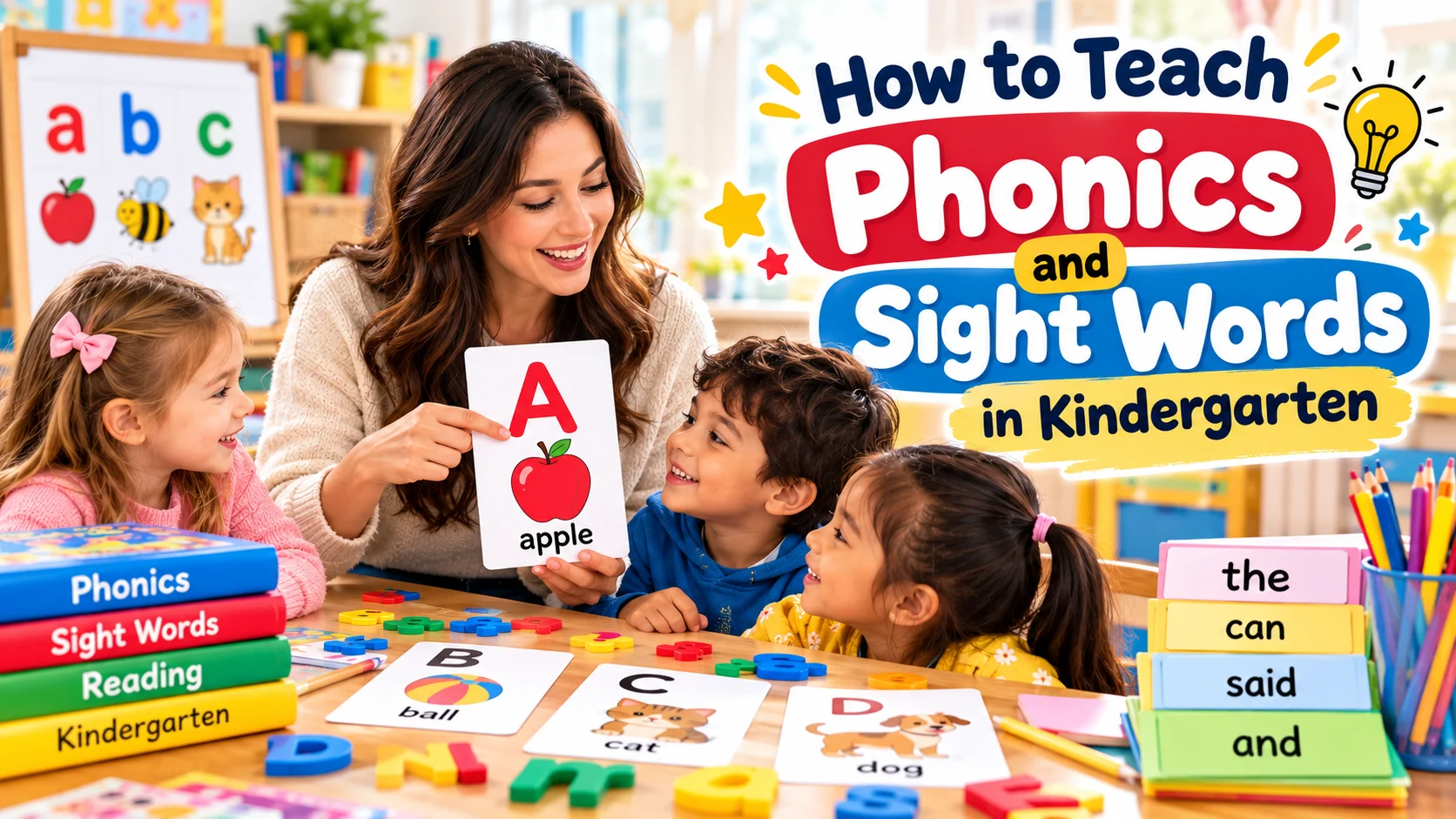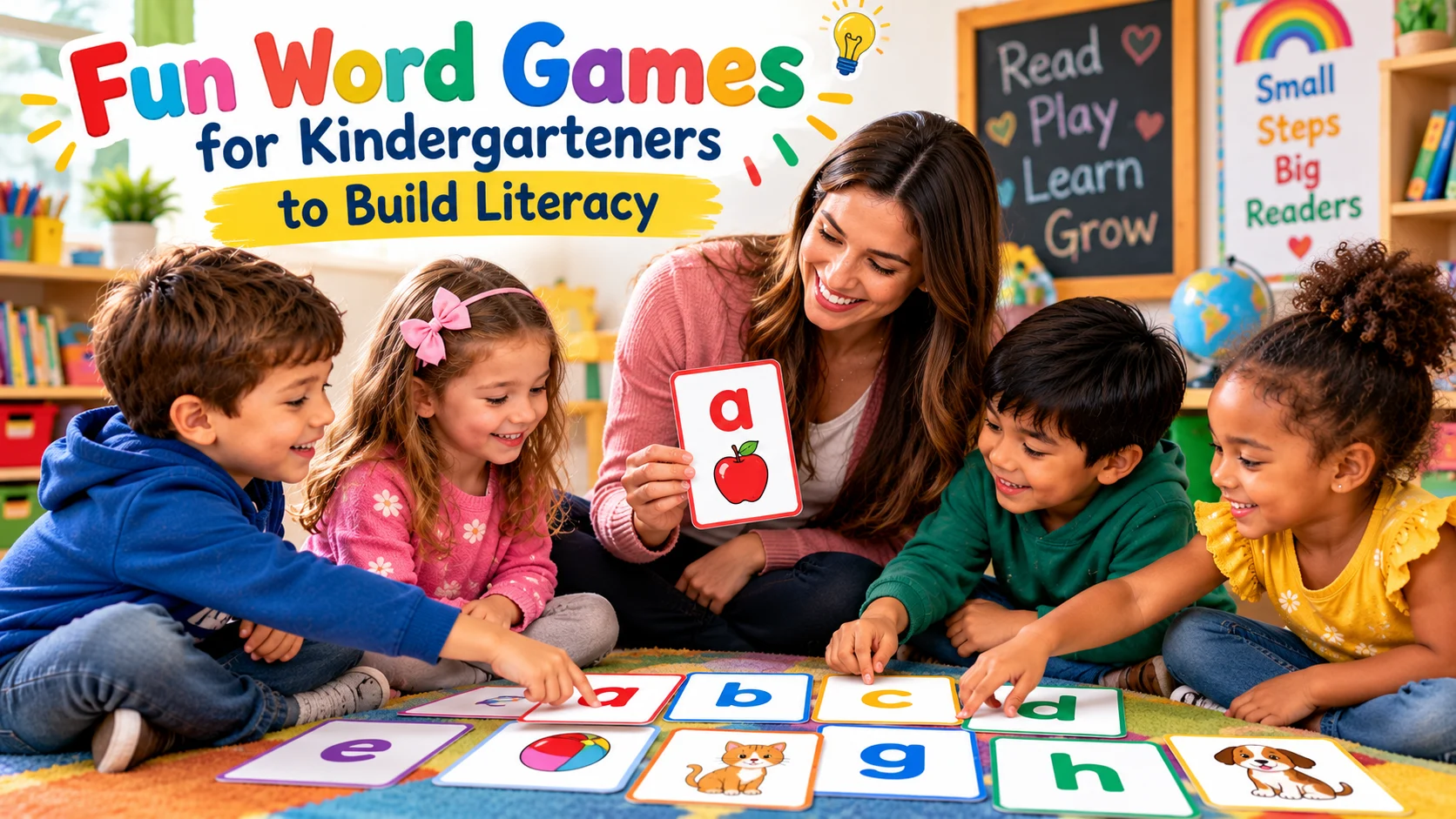

Learning to read is an exciting milestone, but practicing letters, sounds, and new words can sometimes feel difficult for young children. That’s where word games for kindergarteners can make a difference. With colorful letters, picture cards, rhyming challenges, and playful activities, children can practice important early literacy skills while having fun.
Whether you’re a kindergarten teacher planning literacy centers or a parent helping your child at home, you don’t need expensive supplies or complicated lessons. Many effective word games require only paper, letter cards, and a little imagination.
From sight word bingo and CVC word building to interactive games online for kindergarteners, this guide explores 15 engaging activities that support letter recognition, phonics, vocabulary, and beginning reading.
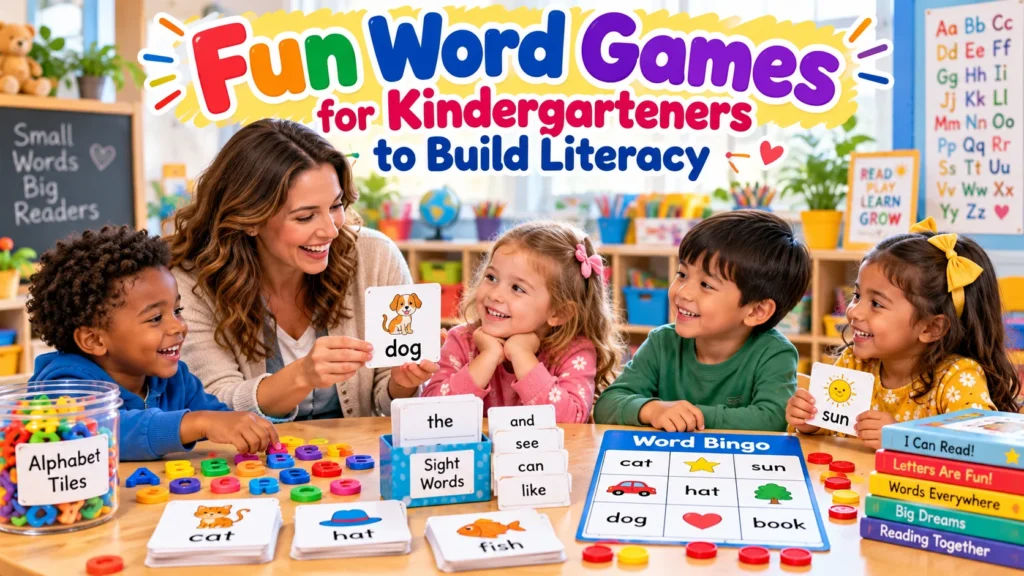
Why Are Word Games Important for Kindergarten Literacy?
Kindergarten is an important stage in developing early reading skills. Children begin connecting spoken sounds with written letters, recognizing familiar words, and understanding how sounds combine to form words.
Word games give children opportunities to practice these developing skills in an enjoyable, interactive way.
Key Benefits of Kindergarten Word Games
1. Strengthen letter recognition
Matching and sorting activities help children identify uppercase and lowercase letters and become familiar with their shapes.
2. Develop phonemic awareness
Rhyming, sound identification, and listening games help children notice and work with individual sounds in spoken words. These activities can be completed even before children recognize printed letters.
3. Reinforce phonics skills
Phonics games help children connect written letters with speech sounds, an important step toward decoding unfamiliar words.
4. Expand vocabulary
Picture matching, guessing games, and storytelling introduce useful words and encourage children to explain their meanings.
5. Encourage active participation
Hands-on games allow children to move, speak, listen, and interact with learning materials rather than relying exclusively on worksheets.
Word games work best alongside explicit reading instruction, read-aloud sessions, meaningful conversations, and regular opportunities to explore books.
10 Fun Word Games for Kindergarteners
These kindergarten literacy games are organized by learning skill, making it easier to choose an activity that matches each child’s needs.
Most can be adapted for individual practice, small groups, or classroom literacy centers.
Easy Letter Recognition and Phonics Games:
Before children can read simple words, they need opportunities to recognize letters and connect them with sounds.
The following games are particularly helpful for beginning learners.
1. Alphabet Matching Game
Best for: Letter recognition
Materials: Uppercase and lowercase alphabet cards
Time: 5–10 minutes
Alphabet Matching is a simple activity that helps kindergarteners recognize and connect different forms of the same letter.
How to play:
- Prepare two sets of cards containing uppercase and lowercase letters.
- Mix the cards and arrange them face up on a table.
- Ask children to find matching pairs, such as A and a or M and m.
- Encourage them to say each letter’s name when they find a match.
- For letters they have learned, ask them to identify the corresponding sound.
Example: A child matches B with b, names the letter, and says its common sound as in ball.
Learning benefit: Builds visual letter recognition and reinforces the connection between uppercase and lowercase forms.
Teacher tip: Start with four or five familiar letters rather than the entire alphabet. Introduce additional letters as children become confident.
2. Beginning Sound Hunt
Best for: Beginning sound identification
Materials: Common classroom or household objects
Time: 10 minutes
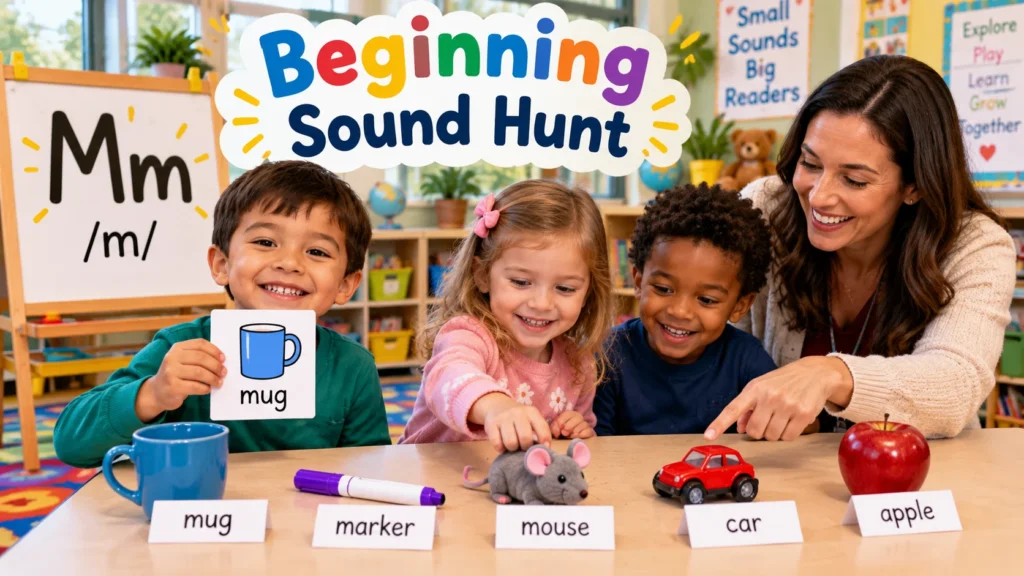
Beginning Sound Hunt turns phonemic awareness practice into an exciting search activity.
How to play:
- Choose a target sound, such as /m/.
- Say the sound clearly and ask children to repeat it.
- Encourage them to search for objects whose names begin with that sound.
- Gather their discoveries and discuss each word together.
- Repeat with another familiar sound.
Example: For /m/, children might find a marker, mug, or magnet.
Learning benefit: Helps children identify beginning sounds in spoken words and connect language with familiar objects.
Parent tip: Try this activity while preparing dinner, organizing toys, or taking a walk.
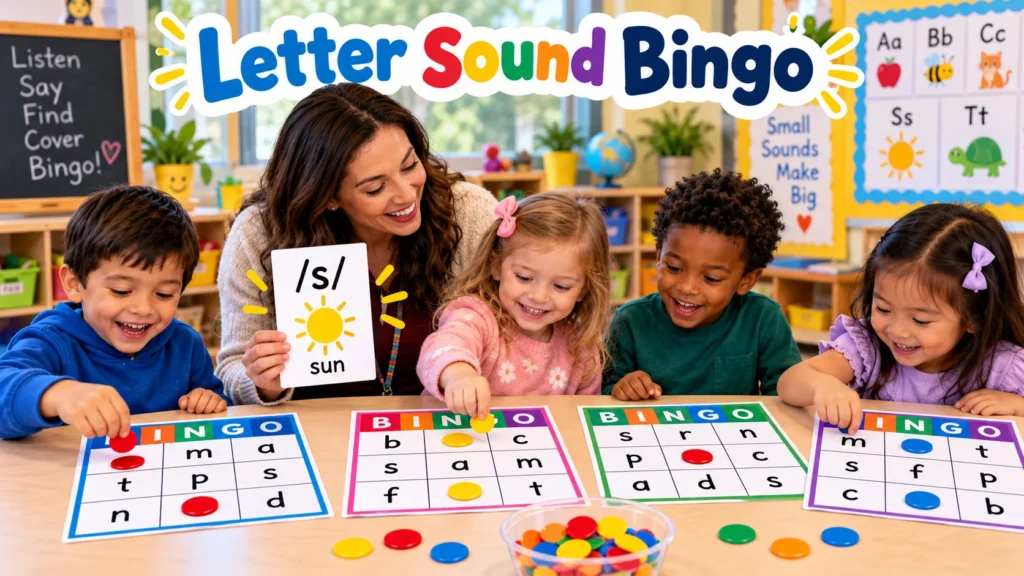
3. Letter Sound Bingo
Best for: Connecting letters with sounds
Materials: Bingo cards with letters and small counters
Time: 10–15 minutes
Letter Sound Bingo combines listening, letter recognition, and friendly competition.
How to play:
- Create a bingo card containing letters children have already learned.
- Say a letter sound without showing the printed letter.
- Ask children to identify and cover the letter representing that sound.
- Continue until a child completes a row.
- Review the covered letters and sounds together.
Example: When the teacher says /s/, a child covers the letter S.
Learning benefit: Reinforces familiar letter-sound relationships through repeated listening and recognition.
Make it easier: Use a small selection of letters and demonstrate each sound before starting.
Fun Sight Word Games for Kindergarteners:
High-frequency words appear often in children’s books and everyday writing. Some, such as in and at, are easily decoded using familiar phonics patterns. Others, such as said, contain spelling patterns that may require additional explanation.
Sight word games help children become increasingly familiar with these words through guided practice.
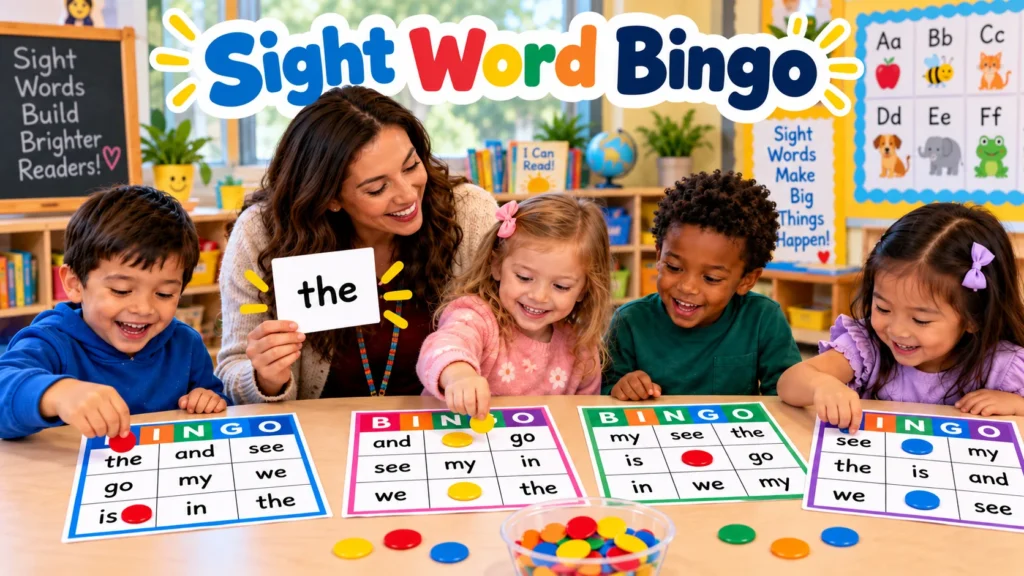
4. Sight Word Bingo
Best for: High-frequency word recognition
Materials: Sight word bingo cards and counters
Time: 10–15 minutes
Sight Word Bingo is a classroom favorite because children can practice reading while participating in a familiar game.
How to play:
- Prepare bingo cards using words students are learning.
- Give each child a card and several counters.
- Read one word aloud.
- Ask students to locate and cover the matching printed word.
- Continue until someone completes a row.
- Invite the winner to read the covered words.
Example word list: the, we, see, my, go, is, at, in, and can.
Learning benefit: Provides repeated exposure to high-frequency words and encourages accurate recognition.
Teacher tip: Model how to read the words before the game. Draw attention to their letters and sounds rather than encouraging children to guess from word shape alone.
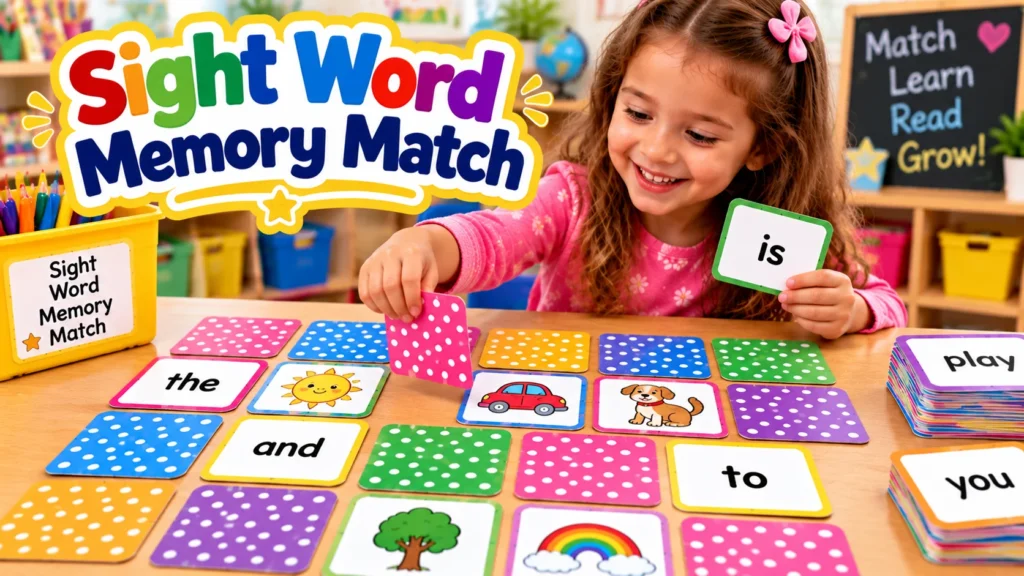
5. Sight Word Memory Match
Best for: Word recognition and concentration
Materials: Duplicate word cards
Time: 10 minutes
This activity combines a traditional memory game with reading practice.
How to play:
- Write each selected word on two separate cards.
- Shuffle the cards and place them face down.
- Ask children to turn over two cards.
- Have them read both words aloud.
- If the words match, they keep the pair.
- If they do not match, turn them face down again.
Example: A child turns over two cards displaying look and correctly identifies the matching pair.
Learning benefit: Reinforces familiar written words while encouraging attention and memory.
Make it easier: Begin with three word pairs and gradually increase the number.
6. Sight Word Treasure Hunt
Best for: Reading familiar words through movement
Materials: Word cards and removable tape
Time: 10–15 minutes
A treasure hunt makes sight word practice feel like an adventure.
How to play:
- Write five to eight familiar words on cards.
- Place the cards around the classroom or living room.
- Give children a list of words to find.
- Ask them to locate each card and read it aloud.
- Celebrate when they finish the hunt.
Example: Hide cards with go, we, see, and play around the room.
Learning benefit: Combines movement with repeated word recognition.
Parent tip: Place word cards at your child’s eye level and choose safe, easily accessible hiding places.
CVC Word Building and Blending Games
CVC stands for consonant-vowel-consonant. Common examples include cat, sun, map, and dog.
These short words allow beginning readers to practice identifying individual sounds and blending them into complete words.
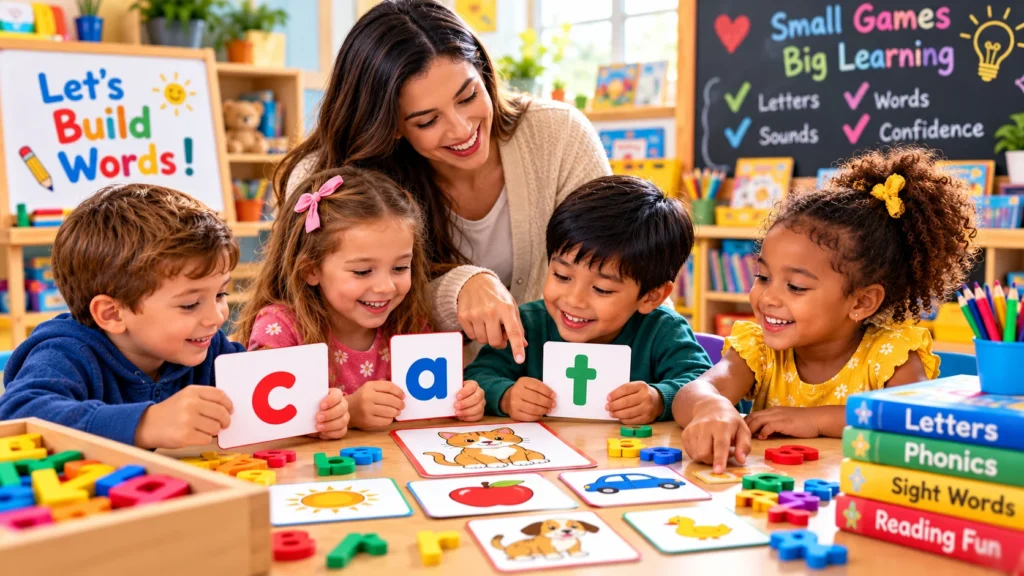
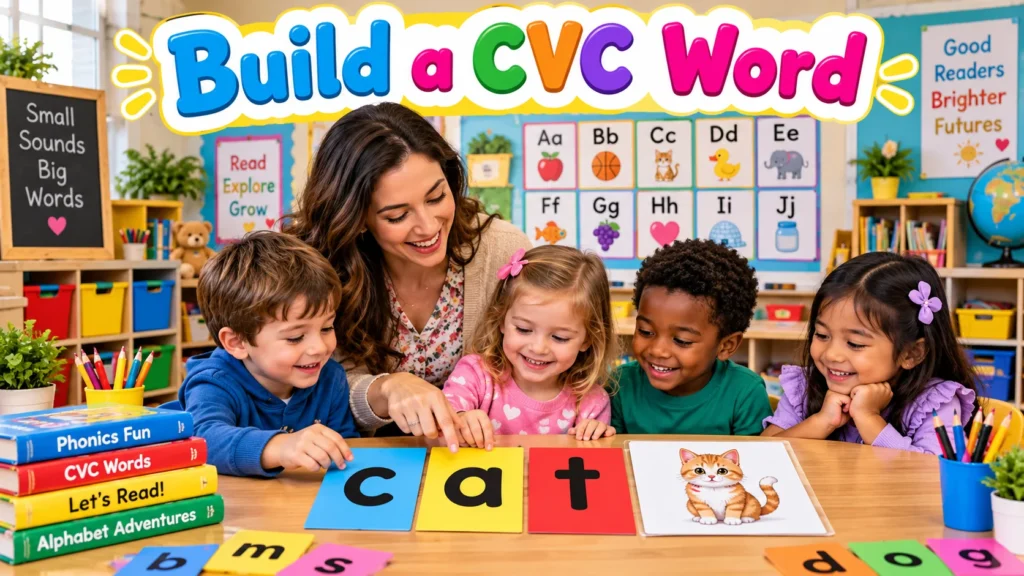
7. Build a CVC Word
Best for: Phonics and word blending
Materials: Magnetic letters, letter tiles, or paper cards
Time: 10–15 minutes
Building words with movable letters helps children see how sounds correspond to written letters.
How to play:
- Choose a familiar three-sound word, such as sun.
- Say the word slowly.
- Ask children to identify its three sounds: /s/, /u/, and /n/.
- Help them select the corresponding letters.
- Arrange the letters from left to right.
- Ask them to say each sound and blend the sounds into the word.
Practice words: cat, map, sit, sun, pig, hen, and dog.
Learning benefit: Supports sound segmentation, letter-sound knowledge, spelling, and blending.
Teacher tip: Use three sound boxes so students can move a letter into each box as they identify the sounds.
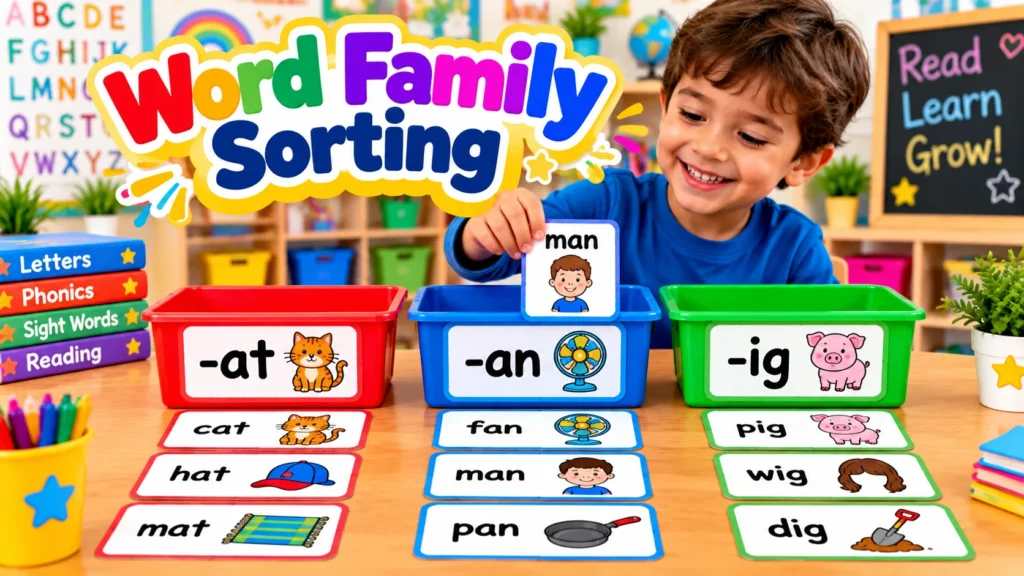
8. Word Family Sorting
Best for: Recognizing spelling patterns
Materials: Word cards and sorting mats
Time: 10 minutes
Word families contain words that share a common ending sound and spelling pattern.
Learning these patterns can help children recognize similarities between familiar words.
How to play:
- Prepare cards containing simple CVC words.
- Create sorting mats labeled -at, -an, and -ig.
- Ask children to read each word.
- Have them place the card under the correct word family.
- Read the completed groups together.
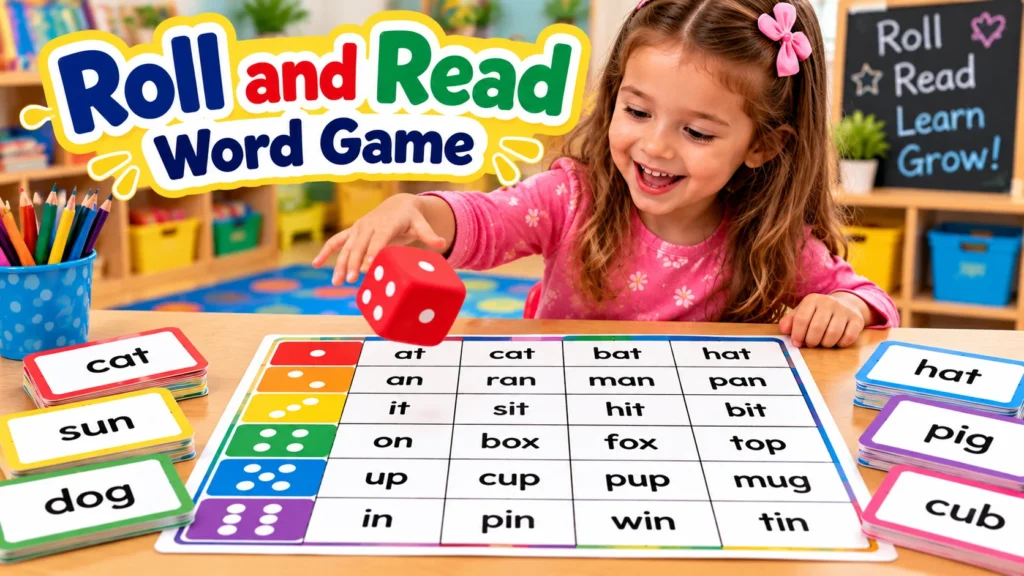
9. Roll and Read Word Game
Best for: Decoding and reading fluency practice
Materials: One die and a word chart
Time: 10 minutes
Roll and Read adds a game-like challenge to practicing decodable words.
How to play:
- Prepare a chart with six numbered rows.
- Place three or four simple words in each row.
- Ask a child to roll the die.
- The number indicates which row to read.
- Help the child blend unfamiliar words rather than guessing.
- Repeat until several rows have been practiced.
Example: Rolling a four leads to a row containing sun, run, fun, and bun.
Learning benefit: Provides repeated decoding practice in a predictable, low-pressure format.
Teacher tip: Select words containing letter-sound relationships students have already learned.
Rhyming and Vocabulary Word Games
Not every literacy activity needs written words. Listening and speaking games also play an important role in children’s language development.
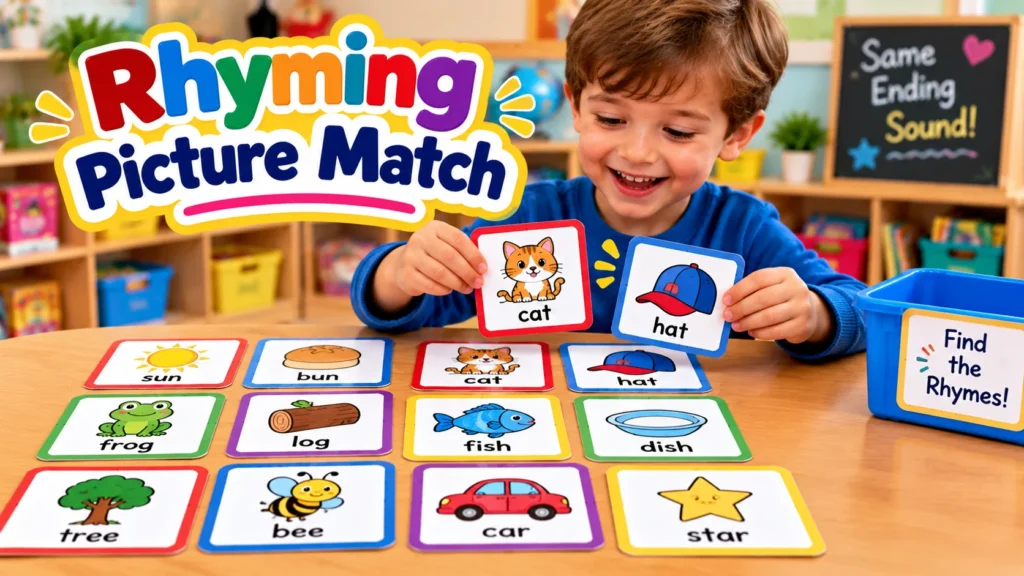
10. Rhyming Picture Match
Best for: Rhyming awareness
Materials: Picture cards
Time: 5–10 minutes
Rhyming games help children notice similar ending sounds in spoken words.
How to play:
- Prepare cards featuring familiar objects.
- Show children one picture, such as a cat.
- Say the object’s name aloud.
- Ask them to choose another picture whose name rhymes.
- Repeat the pair aloud to emphasize the rhyme.
Example pairs: cat–hat, sun–fun, log–frog, and bee–tree.
Learning benefit: Develops phonological awareness by helping children identify shared ending sounds.
Parent tip: Accept playful nonsense rhymes during oral rhyming activities. The goal is to hear matching sounds, not necessarily produce real words.
at home using food packaging, books, calendars, and toy labels.
Best Games Online for Kindergarteners to Practice Words
Digital literacy games can complement hands-on activities by providing audio, animation, and interactive practice.
When looking for games online for kindergarteners, choose activities that emphasize age-appropriate learning rather than speed, points, or entertainment alone.
Here are three educational websites worth exploring.
Starfall
Starfall offers interactive reading activities covering alphabet knowledge, phonics, short words, and beginning reading.
Its ABCs activities provide a starting point for children learning letter names and sounds, while its Learn to Read program introduces early decoding skills through games and stories.
Best for: Alphabet recognition, phonics, and beginning readers.
Cost: Core reading activities are available free; additional content is offered through memberships.
ABCya
ABCya provides grade-organized educational games, including a kindergarten category featuring letter recognition, alphabet bingo, rhyming, and spelling-related activities.
Examples include Alphabet BINGO, Monster Mansion Match, and Sight Word BINGO.
Best for: Children who enjoy colorful, interactive learning activities.
Cost: Some activities are free, while access conditions and premium options vary.
PBS KIDS
PBS KIDS provides educational games and activities inspired by children’s programming. Its literacy-related resources can support letter awareness, vocabulary, spelling, and language development.
Parents can explore games with their children and select activities that match their learning needs.
Best for: Playful educational activities and parent-supported learning.
Cost: Free educational games are available.
How to Choose Safe Online Word Games
Before introducing an online literacy game, consider the following:
- Age suitability: Choose games designed for beginning learners rather than more advanced readers.
- Educational focus: Look for clear learning goals involving sounds, letters, spelling, or vocabulary.
- Ease of navigation: Young children benefit from simple instructions and clearly labeled controls.
- Advertisements: Check whether advertising or unrelated content could distract children.
- Privacy: Review account requirements and data collection policies before entering personal information.
- Adult involvement: Play alongside children when possible and discuss the words they encounter.
Online games can be useful for practicing familiar skills, but they should complement real-world conversation, shared reading, movement, and hands-on learning.
Easy Printable Word Games for Kindergarteners
Printable activities provide a convenient option for teachers preparing literacy centers and parents looking for screen-free learning.
You can create many useful word games with paper, markers, and basic art supplies.
| Printable Activity | Materials | Target Skill |
|---|---|---|
| Alphabet Matching Cards | Printed letter cards | Letter recognition |
| Sight Word Bingo | Bingo worksheets and counters | High-frequency words |
| CVC Word Mats | Three-box word templates | Sound blending and spelling |
| Rhyming Picture Cards | Illustrated matching cards | Phonological awareness |
| Word Family Sorting | Word cards and sorting sheets | Phonics patterns |
| Letter Sound Worksheets | Letters and familiar pictures | Sound-letter connections |
To make printable word games more engaging, use large readable text, clear illustrations, and familiar vocabulary.
Laminating frequently used cards can help them withstand repeated classroom use.
How to Choose Word Games for Different Reading Levels
Kindergarten children develop literacy skills at different rates. A child who is still learning letter names may need a different activity from a child who can already blend simple words.
Choosing games according to current skills helps prevent frustration and supports meaningful progress.
| Learning Level | Skills to Practice | Recommended Games |
|---|---|---|
| Beginning | Letters and spoken sounds | Alphabet Matching, Beginning Sound Hunt |
| Developing | Letter-sound connections | Letter Sound Bingo, Word Sorting |
| Early decoding | Blending simple words | Build a CVC Word, Roll and Read |
| Growing independence | Familiar word recognition and spelling patterns | Sight Word Bingo, Word Family Sorting |
| Expanding language | Vocabulary and oral expression | Guess the Word, Mystery Word Bag |
Important: These levels are flexible descriptions, not formal reading assessments. A child may be confident in one skill while needing additional support in another.
Tips for Making Kindergarten Word Games More Effective
Word games are most helpful when adults select a clear learning goal and provide appropriate guidance.
Keep Activities Short and Engaging
Start with five to ten minutes for children who are new to an activity. Continue longer when children remain interested and comfortable.
Teach Before Asking Children to Practice
Introduce the relevant letter, sound, spelling pattern, or word before expecting independent performance.
For example, model how to blend /m/, /a/, and /p/ into map before introducing a CVC reading game.
Use an “I Do, We Do, You Do” Approach
Demonstrate the activity first, complete an example together, and then encourage the child to try independently.
This gradual approach helps children understand the task and participate with greater confidence.
Combine Different Learning Experiences
Use spoken sound games, printed words, letter tiles, picture cards, and movement throughout the week.
Different activities can reinforce the same literacy goal without requiring children to repeat an identical worksheet.
Respond Positively to Mistakes
If a child reads a word incorrectly, provide a helpful prompt or model rather than turning the activity into a test.
Praise effort, careful listening, and successful use of strategies.
Observe Progress
Notice whether children are recognizing previously taught letters, identifying sounds, and decoding familiar word patterns more accurately over time.
If a child repeatedly struggles with the same skill, provide additional modeling and consider discussing the concern with their teacher or reading specialist.
A Simple Weekly Word Game Plan for Kindergarten
Teachers and parents can use this flexible routine to provide variety while revisiting important skills.
| Day | Activity | Main Literacy Focus |
|---|---|---|
| Monday | Alphabet Matching | Letter recognition |
| Tuesday | Beginning Sound Hunt | Phonemic awareness |
| Wednesday | Build a CVC Word | Sound blending and decoding |
| Thursday | Sight Word Bingo | High-frequency word practice |
| Friday | Rhyming Picture Match | Phonological awareness |
Each activity can take approximately 5–15 minutes depending on the child’s interests and learning needs.
This schedule is only an example. Children who need additional practice with a particular skill can revisit the same game over several days.
Frequently Asked Questions About Word Games for Kindergarteners
What are the best word games for kindergarteners?
The best word games depend on each child’s current literacy abilities. Alphabet Matching and Beginning Sound Hunt are useful for children learning letters and sounds. CVC Word Building supports beginning decoding, while Sight Word Bingo provides practice with familiar high-frequency words.
Are there free games online for kindergarteners?
Yes. Educational platforms such as Starfall, ABCya, and PBS KIDS provide free learning activities. Some platforms also offer memberships or premium features, so parents and teachers should review the current access options before choosing a game.
How can I teach kindergarten sight words through games?
Begin by explicitly teaching a small number of high-frequency words. Then reinforce them through games such as Sight Word Bingo, Memory Match, and Word Treasure Hunt. Draw children’s attention to the letters and sounds within each word rather than relying only on visual memorization.
What word games help children learn phonics?
Letter Sound Bingo, CVC Word Building, Word Family Sorting, and Roll and Read can reinforce phonics knowledge. The activities should use letter-sound relationships that children have already been taught.
How long should kindergarteners play word games?
Many activities work well in short sessions of approximately 5–15 minutes. The ideal duration depends on the child’s attention, readiness, and enthusiasm. It is better to end with a positive learning experience than continue until the child becomes frustrated.
Can word games improve reading skills?
Word games can help children practice skills that contribute to reading development, including phonemic awareness, letter-sound knowledge, blending, and word recognition. However, they are most effective when combined with explicit literacy instruction, meaningful conversations, and regular reading experiences.
What word games can parents play at home without special materials?
Beginning Sound Hunt, Guess the Word, Mystery Word Bag, and Word Scavenger Hunt are easy to organize with familiar household objects. Parents can also create letter cards and simple word games using paper and markers.
Final Thoughts
Developing early literacy doesn’t have to mean endless worksheets or repetitive drills. With the right activities, children can practice sounds, letters, words, and language skills while enjoying meaningful play.
These 15 fun word games for kindergarteners provide teachers and parents with practical ways to make literacy practice more interactive, adaptable, and enjoyable.
Begin with one activity that matches your child’s current skills, explain how to play, and celebrate small improvements. Whether you’re using alphabet cards at home, organizing a classroom literacy center, or exploring educational online games, the goal is to help children build strong reading foundations while developing a positive relationship with learning.
A few playful minutes of focused practice can become a valuable part of a child’s everyday literacy journey.