The first day of school can bring a mix of excitement, curiosity, and nervousness. Some children cannot wait to meet their classmates, while others worry about making friends, finding their classroom, or being away from home.
If you are looking for a meaningful way to help students talk about these feelings, First Day Jitters by Julie Danneberg is a wonderful book to introduce during the first week of school.
With its relatable story and surprising ending, this picture book creates opportunities for reading comprehension, classroom conversations, creative writing, and social-emotional learning.
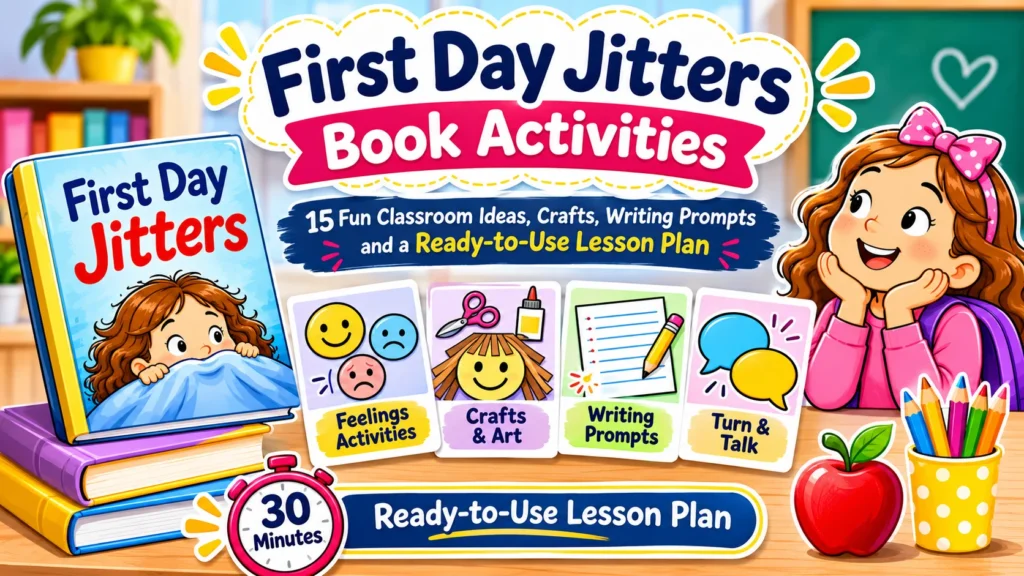
First Day Jitters activities include feelings charts, Jitter Jars, prediction games, story sequencing, writing prompts, friendship activities, and creative crafts. Teachers can use these activities with kindergarten through third-grade students to explore emotions, practice literacy skills, and build a welcoming classroom community.
Below, you will find 15 easy activities, a First Day Jitters read-aloud guide, discussion questions, worksheet ideas, and a 30-minute lesson plan.
What Is First Day Jitters About?
First Day Jitters is a children’s picture book written by Julie Danneberg and illustrated by Judy Love.
The story follows Sarah Jane Hartwell, who is extremely nervous about starting at a new school. She does not want to get out of bed, worries about meeting new people, and imagines that everything will go wrong.
Mr. Hartwell encourages Sarah to get ready and attend school despite her worries.
Throughout the book, readers may assume Sarah is a student preparing for her first day. However, the ending reveals something unexpected.
Spoiler alert: Sarah Jane Hartwell is actually the new teacher!
The humorous twist introduces an important lesson: children are not the only people who experience first-day nerves. Teachers and other adults can feel uncertain about new situations, too.
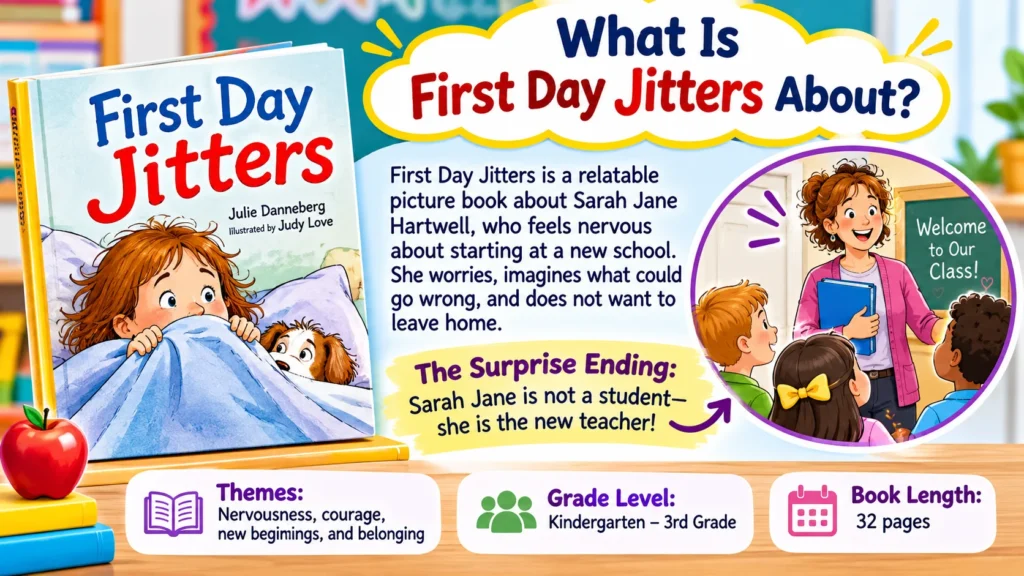
First Day Jitters Book Details
| Book Information | Details |
|---|---|
| Book Title | First Day Jitters |
| Author | Julie Danneberg |
| Illustrator | Judy Love |
| Publisher | Charlesbridge |
| Publication Year | 2000 |
| Length | 32 pages |
| Recommended Grades | Kindergarten–3rd Grade |
| Main Themes | First-day emotions, courage, empathy, change, and friendship |
The book works particularly well as a back-to-school read-aloud because students can identify with Sarah’s feelings and discuss what might help someone feel more welcome.
Why Teach First Day Jitters in the Classroom?
A picture book can give young children a comfortable starting point for conversations about unfamiliar experiences.
Instead of immediately asking children to describe their own worries, teachers can begin by discussing a fictional character.
First Day Jitters provides opportunities to explore several important skills.
1. Emotional awareness: Students learn to recognize feelings such as nervousness, excitement, uncertainty, and relief.
2. Reading comprehension: Children make predictions, identify story details, sequence events, and explain the surprise ending.
3. Empathy: Students consider how someone else might feel when entering a new environment.
4. Speaking and listening: Partner discussions help children practice expressing ideas and listening respectfully.
5. Classroom community: Shared activities encourage students to discover common interests and develop connections with classmates.
The goal is not to make every nervous feeling disappear. Instead, students learn that feelings can be discussed, understood, and supported.
How to Teach a First Day Jitters Read Aloud
A First Day Jitters read aloud works best when students have opportunities to think, predict, and respond throughout the story.
Rather than reading the entire book without stopping, organize the lesson into three stages.
Before Reading: Introduce First-Day Feelings
Suggested time: 3–5 minutes
Show students the book cover and ask them to examine the title and illustrations.
Start with simple questions:
- What do you think the word “jitters” means?
- How might someone feel on the first day of school?
- What do you notice about the book cover?
- What do you predict will happen in this story?
Explain that jitters are feelings of nervousness or uneasiness, sometimes accompanied by a fluttery sensation in the stomach.
Invite students to show a feeling with their facial expressions or point to an emotion picture.
Teacher tip: Do not require children to share personal worries. Some students may prefer to discuss the story character or listen quietly.
During Reading: Pause and Make Predictions
Suggested time: 10–12 minutes
Read the story using expressive voices and show students the illustrations.
Pause occasionally to encourage observation and critical thinking.
Ask:
- How does Sarah feel about going to school?
- What does Sarah imagine might happen?
- What does Mr. Hartwell do to encourage her?
- What clues can you find in the pictures?
- Do you think Sarah’s predictions will come true?
Avoid revealing the ending too early.
As you approach the final pages, invite students to make one last prediction about Sarah’s first day.
After Reading: Discuss the Surprise Ending
Suggested time: 5 minutes
Once students discover Sarah is the teacher, allow them to react to the surprise.
Then ask:
- Were you surprised by the ending?
- Why did you think Sarah was a student?
- Can teachers feel nervous on the first day?
- Did any details seem different after you learned Sarah was the teacher?
- What could the class do to welcome a nervous new teacher or student?
Finish by reinforcing the main message:
Everyone can experience first-day jitters, and small acts of kindness can help people feel welcome.
15 Fun First Day Jitters Activities for Kindergarten–3rd Grade
These hands-on activities combine reading comprehension, creativity, emotional expression, and classroom community building.
Most require only basic classroom supplies, making them practical for busy teachers during the first week of school.
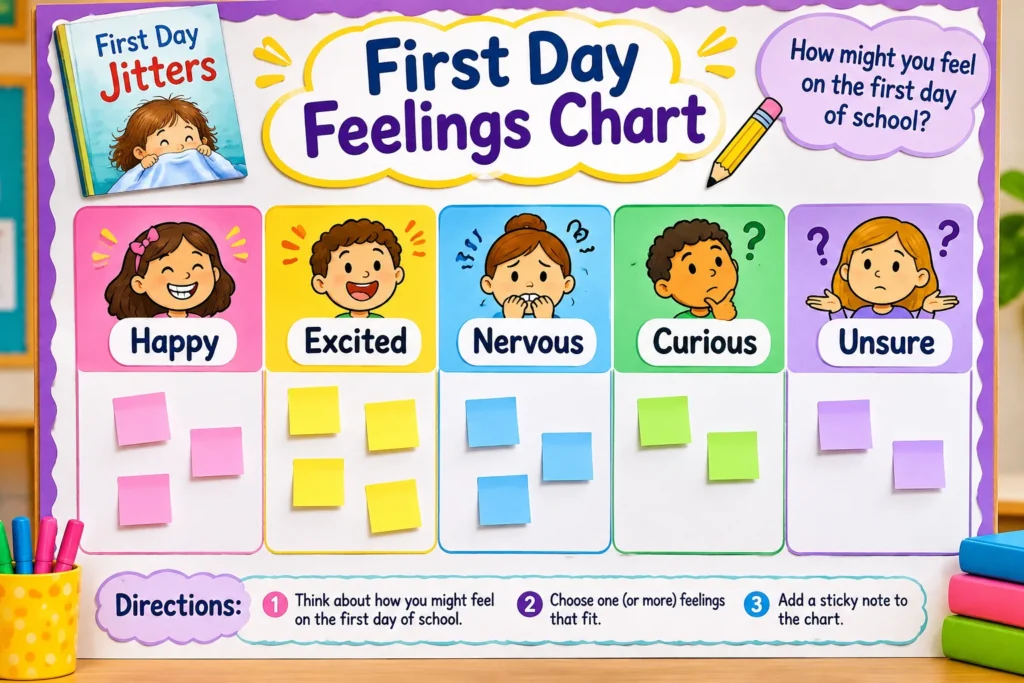
1. First Day Feelings Chart
Best for: Kindergarten–3rd Grade
Time: 10 minutes
Materials: Chart paper, markers, emotion cards, sticky notes
A feelings chart allows students to recognize that classmates may experience different emotions on the same day.
How to do it:
- Draw a large chart with emotion labels such as happy, excited, nervous, curious, and unsure.
- Add a simple illustrated face beside each emotion.
- Invite students to select an emotion that describes how someone might feel on the first day.
- Let students place a sticker or sticky note beside their choice.
- Discuss how more than one feeling can be experienced at the same time.
You can connect this activity to the story by asking which feelings Sarah experienced at different moments.
Extension: Older students can count the responses and create a bar graph.
Learning objective: Emotional vocabulary, early data skills, and empathy.
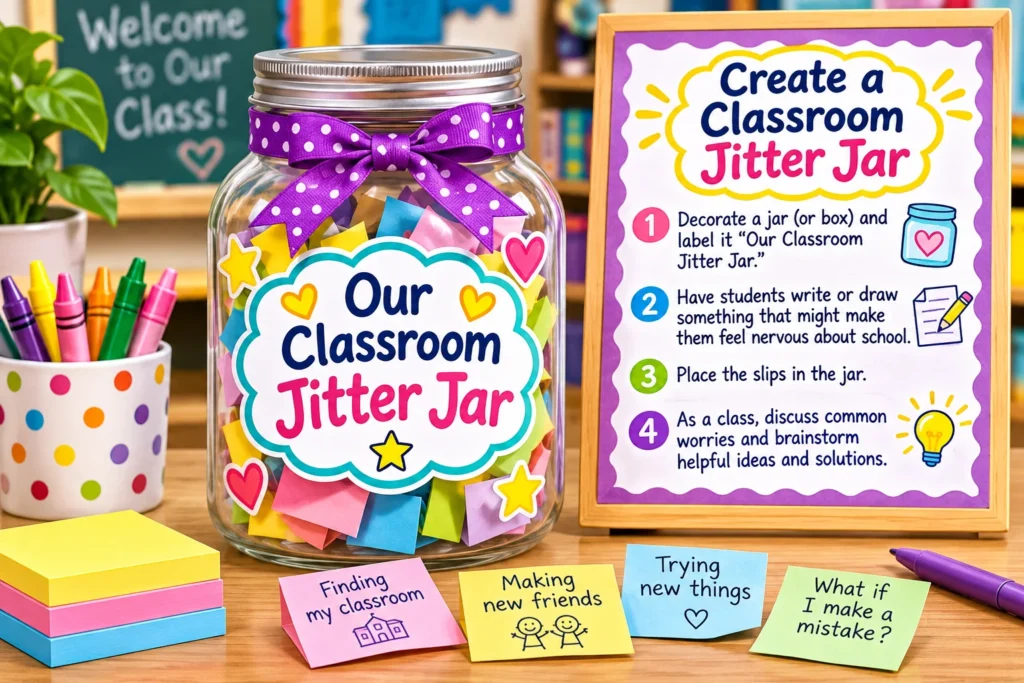
2. Create a Classroom Jitter Jar
Best for: Grades K–3
Time: 10–15 minutes
Materials: Plastic jar or decorated box, paper slips, pencils, crayons
A Jitter Jar is a simple classroom activity that gives children a private way to communicate their concerns.
How to do it:
- Decorate a container and label it “Our Jitter Jar.“
- Ask students to draw or write something that might make a child nervous about school.
- Invite them to place their paper inside the container.
- Discuss common worries in general terms, such as finding friends or learning classroom routines.
- Together, brainstorm supportive responses and helpful actions.
For kindergarten students, provide picture prompts representing common school situations.
Teacher tip: Never read a student’s personal worry aloud without permission. Review notes privately, and respond individually when a child needs additional support.
Learning objective: Emotional expression, problem-solving, and classroom trust.
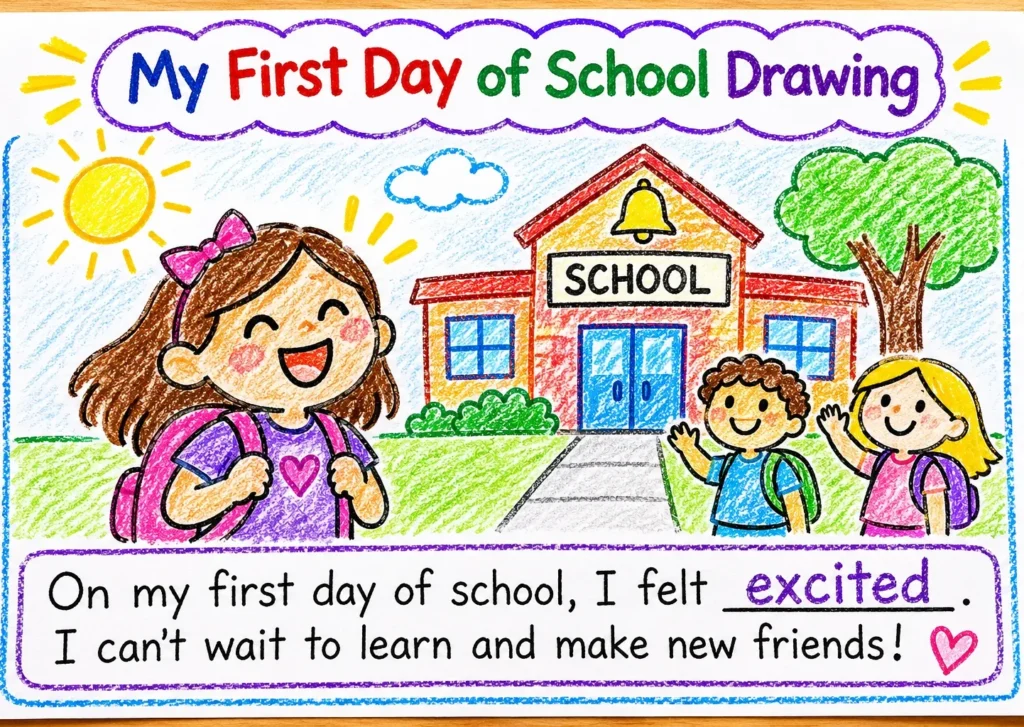
3. My First Day of School Drawing
Best for: Kindergarten–1st Grade
Time: 15 minutes
Materials: Drawing paper, crayons, colored pencils
Young children may find it easier to communicate through pictures than through complete sentences.
This activity gives them a creative way to represent their first-day experiences.
How to do it:
- Give each student a blank sheet of paper.
- Ask students to draw themselves arriving at school.
- Encourage them to include a classroom, teacher, friend, or activity.
- Invite students to add a facial expression showing how their character feels.
- Allow volunteers to explain their drawings.
Younger students can dictate a sentence for the teacher to write beneath their illustration.
Writing prompt: “On my first day of school, I felt ______ because ______.“
Learning objective: Self-expression, fine motor development, and early writing.
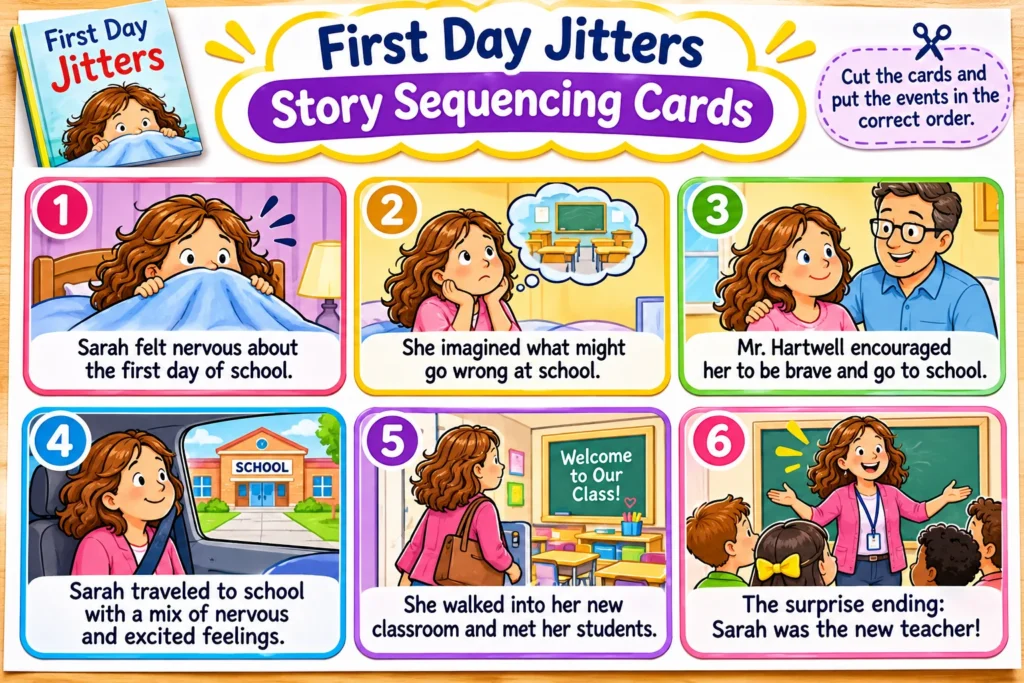
4. First Day Jitters Story Sequencing Cards
Best for: Grades K–3
Time: 10–15 minutes
Materials: Event cards, paper, scissors, glue
Story sequencing helps students understand how the events in a narrative connect.
How to do it:
- Prepare cards describing or illustrating major events from the story.
- Mix up the cards and distribute them to students.
- Ask students to arrange the events in chronological order.
- Have them compare their sequence with a partner.
- Review the order together using the book.
Suggested events include Sarah refusing to get out of bed, Mr. Hartwell encouraging her, Sarah traveling to school, and the final classroom introduction.
Kindergarten adaptation: Use three illustrated event cards.
Grades 2–3 adaptation: Ask students to write transition sentences using first, next, then, and finally.
Learning objective: Sequencing, comprehension, and narrative structure.
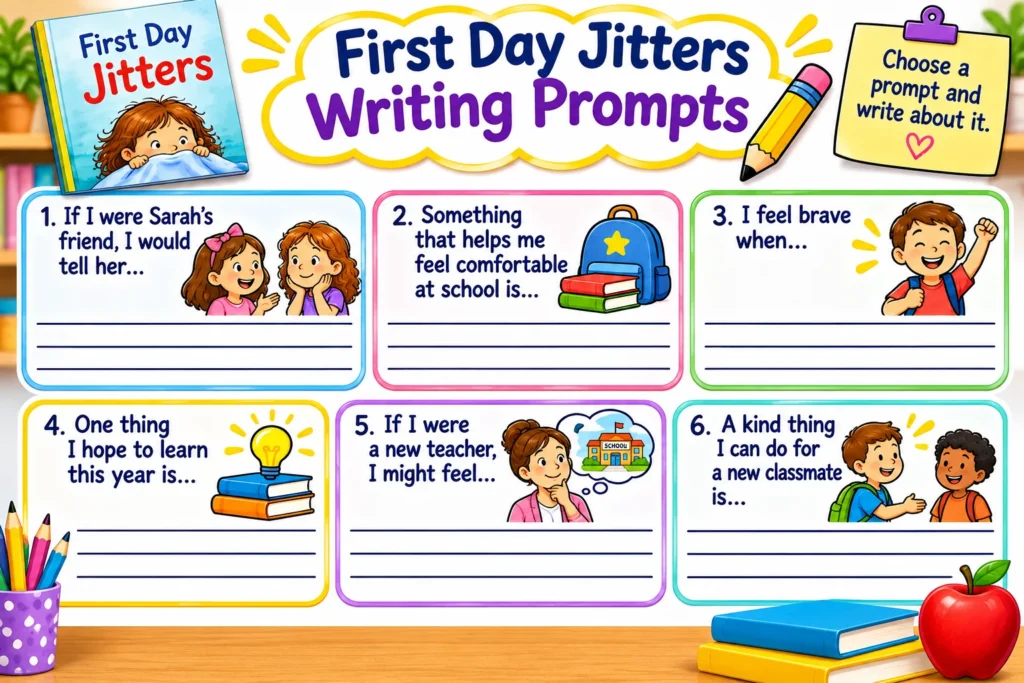
5. First Day Jitters Writing Prompts
Best for: Grades 1–3
Time: 15 minutes
Materials: Writing paper, pencils, crayons
Writing activities help students connect story themes to their own experiences.
After reading the book, give students a choice of prompts.
Suggested writing prompts:
- If I were Sarah’s friend, I would tell her…
- Something that helps me feel comfortable is…
- I feel brave when…
- One thing I hope to learn this year is…
- If I were a new teacher, I might feel…
- A kind thing I can do for a new classmate is…
Encourage children to include a picture with their response.
For beginning writers, provide sentence frames and a word bank.
Older students can develop a short paragraph explaining their response.
Learning objective: Sentence construction, personal reflection, and text-to-self connections.
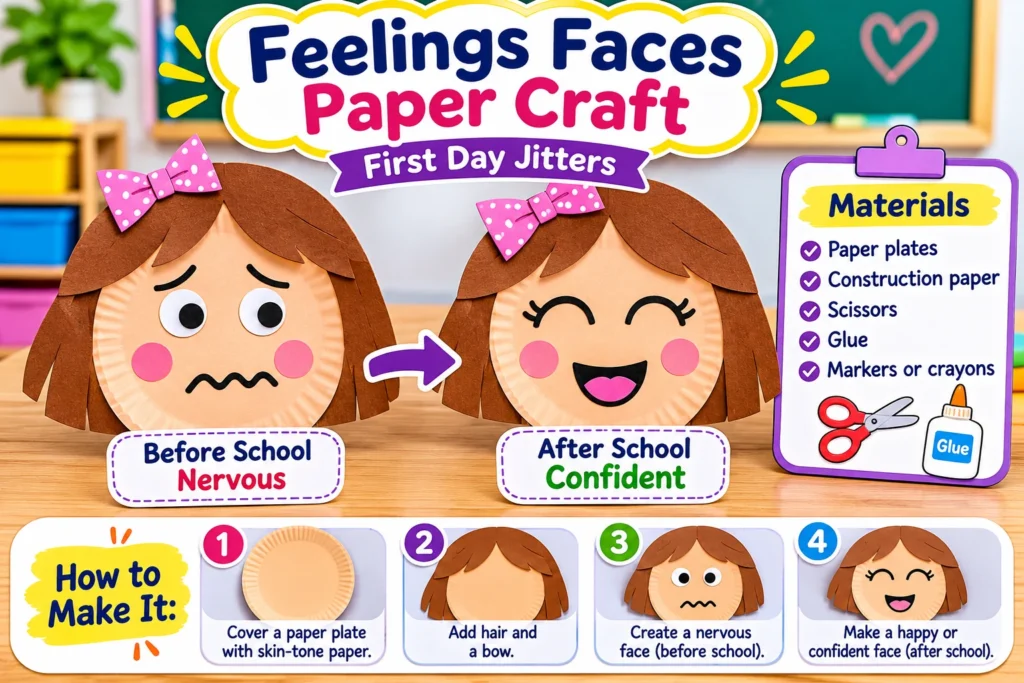
6. Feelings Faces Paper Craft
Best for: Kindergarten–2nd Grade
Time: 15–20 minutes
Materials: Construction paper, crayons, glue sticks, child-safe scissors
This activity combines creative expression with the identification of emotions.
How to do it:
- Give each student two large paper circles.
- Ask them to draw a nervous expression on the first circle.
- On the second circle, have them draw an excited, calm, or confident expression.
- Attach the circles to a folded strip of paper to create a simple flip craft.
- Ask students to explain what might help a character move from one feeling to another.
Students could create faces representing Sarah at the beginning and end of the story.
Display idea: Create a bulletin board titled “All Feelings Are Welcome Here.”
Remind students that emotions do not always change quickly, and there is no wrong feeling to experience.
Learning objective: Emotional recognition, character analysis, and creativity.
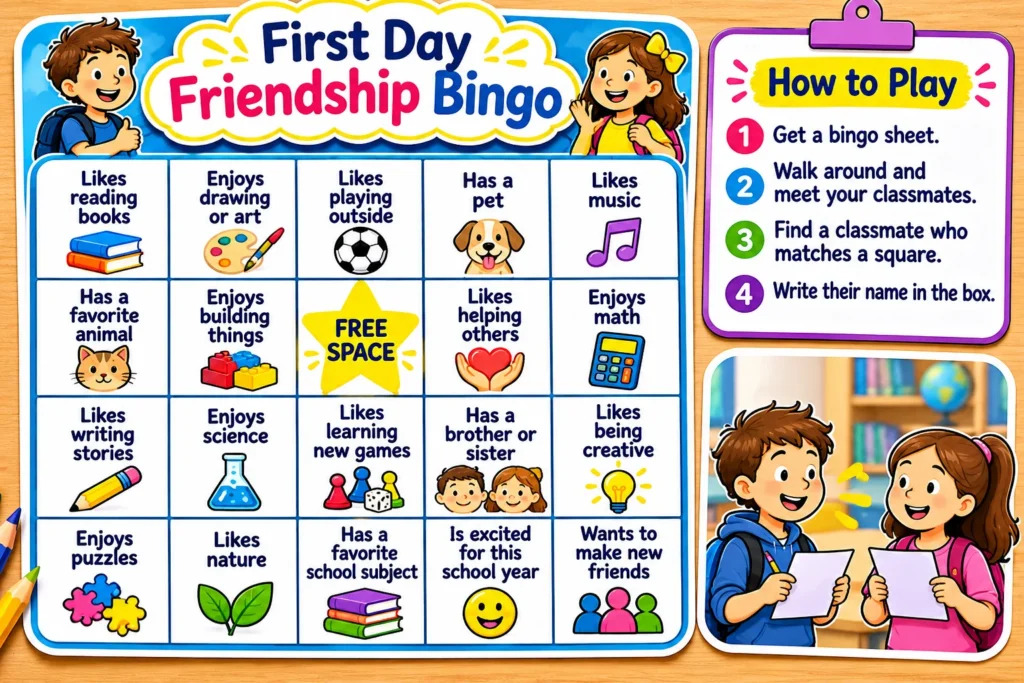
7. First Day Friendship Bingo
Best for: Grades K–3
Time: 15 minutes
Materials: Bingo sheets, pencils
Friendship Bingo encourages students to interact with classmates and discover shared interests.
How to do it:
- Create a bingo sheet containing simple statements about interests and school experiences.
- Give every student a copy.
- Ask children to move around the classroom and talk to classmates.
- When a student finds someone who matches a statement, they write that person’s name in the box.
- Gather the class afterward to discuss what they discovered.
Suggested bingo squares include:
- Likes drawing
- Enjoys reading books
- Has a favorite animal
- Likes playing outside
- Enjoys building things
- Likes music
- Has a favorite school subject
- Enjoys helping others
- Likes learning new games
For kindergarten students, use illustrated bingo squares.
Learning objective: Communication, social interaction, and classroom community.
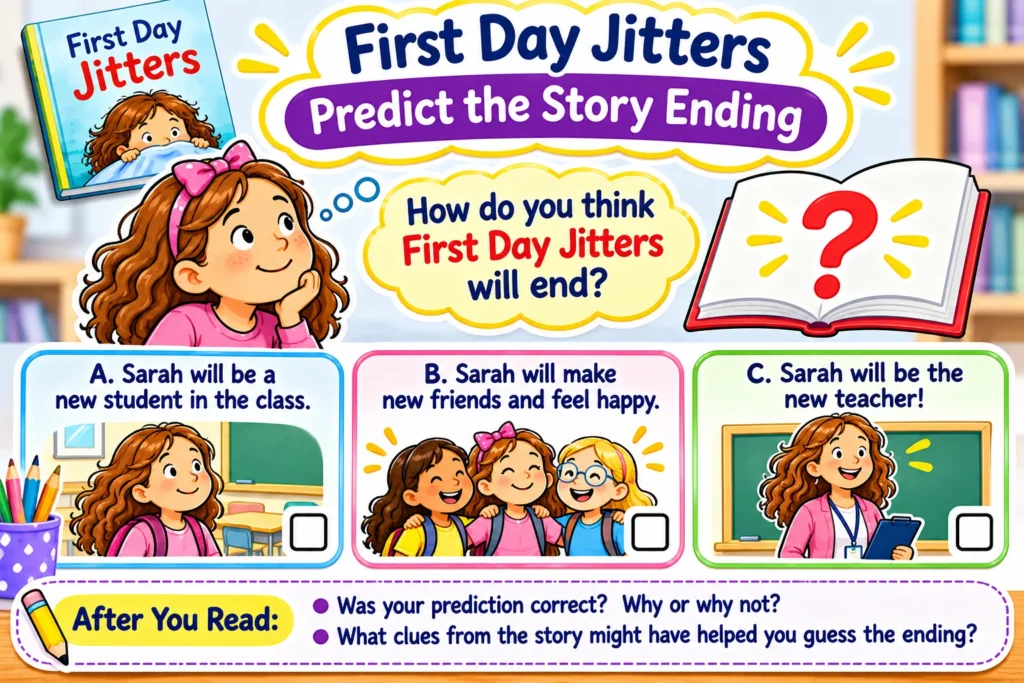
8. Predict the Story Ending
Best for: Grades 1–3
Time: 10 minutes
Materials: Prediction chart, pencils
The unexpected ending makes First Day Jitters useful for teaching predictions and inferences.
How to do it:
- Before reading, ask students what they think the story will be about.
- Record their predictions on chart paper.
- Stop during the story to discuss new clues.
- Invite students to revise their predictions if necessary.
- After the ending, compare the predictions with what happened.
Ask students to explain why they believed Sarah was a student.
Then invite them to look back at the illustrations and identify details that took on new meaning.
Learning objective: Predicting, inferencing, and using evidence.
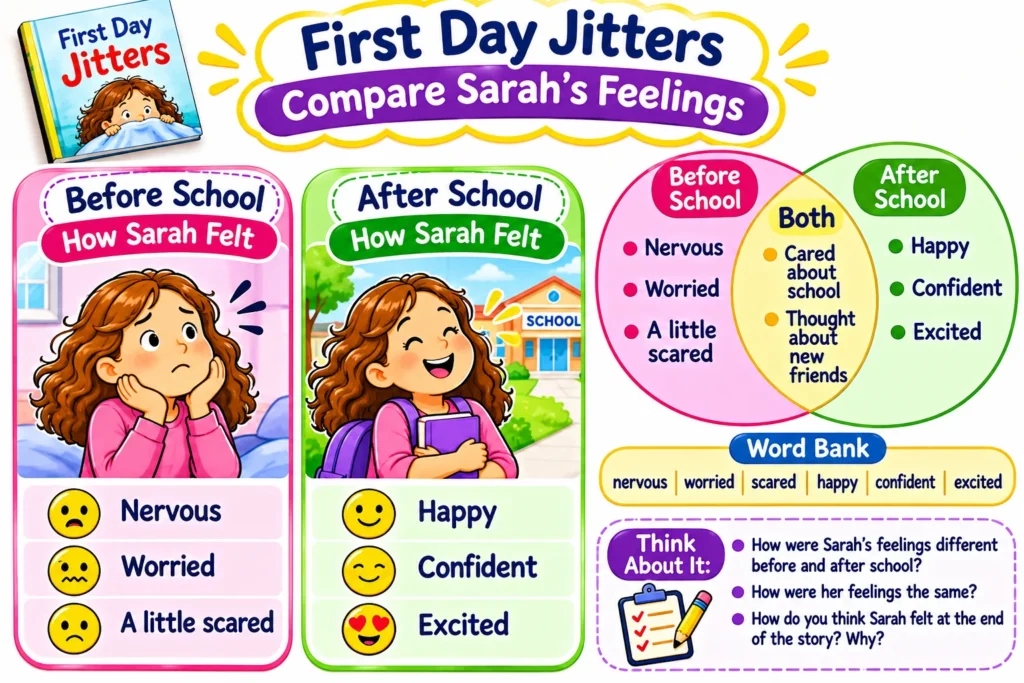
9. Compare Sarah’s Feelings
Best for: Grades 1–3
Time: 10 minutes
Materials: Character comparison worksheet, pencils
Help students examine how Sarah’s emotions develop throughout the story.
How to do it:
- Divide a sheet into two columns: “Before School” and “At School.”
- Ask students to identify Sarah’s feelings at each point.
- Encourage them to use illustrations and story events as evidence.
- Discuss what Sarah expected to happen and what actually happened.
- Ask whether students think she will feel the same way on her next school day.
Students should understand that the book does not mean all nervous feelings immediately disappear.
Learning objective: Character analysis, comprehension, and emotional awareness.
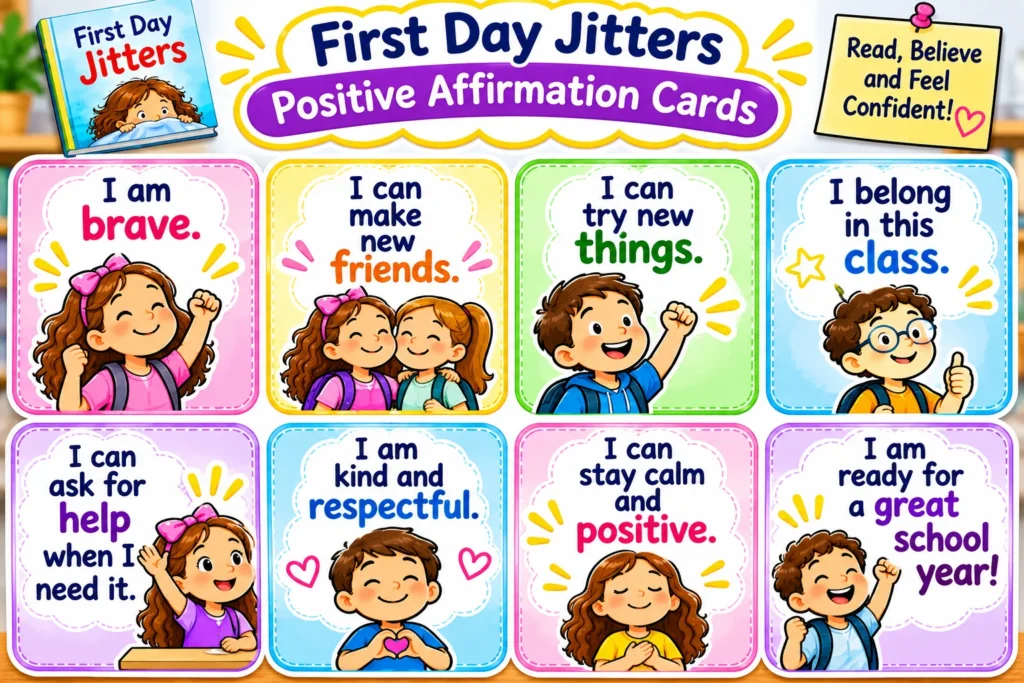
10. Positive Affirmation Cards
Best for: Grades K–3
Time: 15 minutes
Materials: Index cards, markers, crayons, stickers
Positive affirmation cards provide encouraging statements that children can read or revisit during unfamiliar situations.
How to do it:
- Give each child a blank card.
- Ask students to choose a kind, realistic statement.
- Help them write or copy the statement onto the card.
- Let students decorate their cards.
- Invite children to keep their cards in a desk, folder, or personal learning space.
Examples include:
- I can ask for help.
- I am learning something new.
- It is okay to make mistakes.
- I can try one small step.
- I belong in my classroom.
Teacher tip: Use practical statements that acknowledge difficulty rather than promising that everything will always be easy.
Learning objective: Encouraging self-talk and writing.
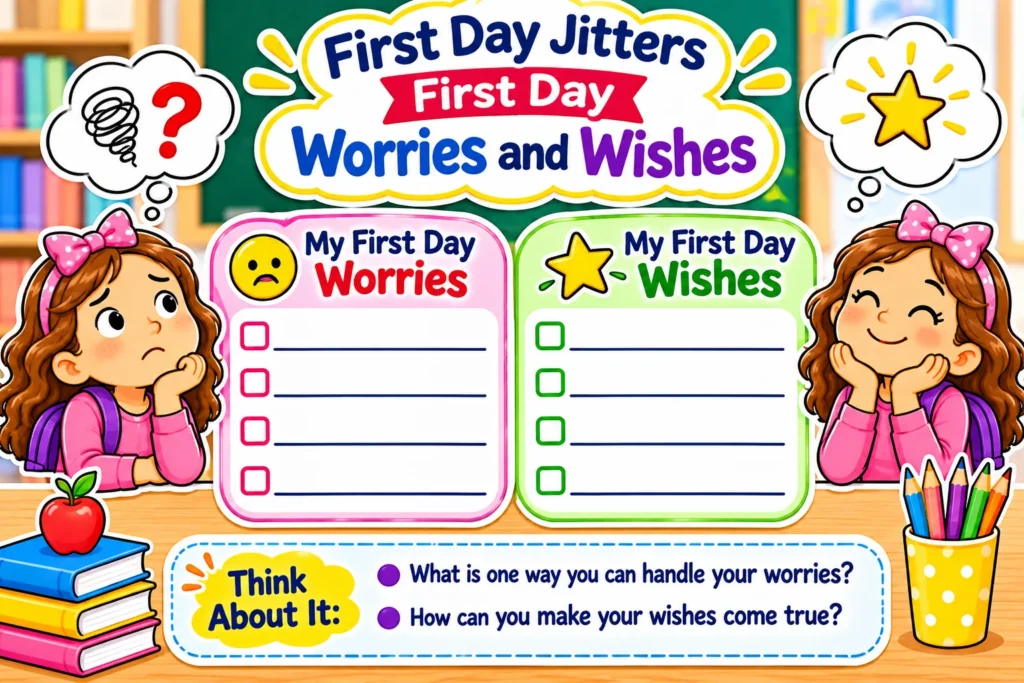
11. First Day Worries and Wishes
Best for: Grades K–3
Time: 10–15 minutes
Materials: Folded paper, pencils, crayons
This reflection activity gives students an opportunity to think about their concerns and hopes for the new school year.
How to do it:
- Ask students to fold a sheet of paper in half.
- Label one side “My Worries” and the other “My Wishes.”
- Have students draw or write a school-related concern on the first side.
- On the second side, ask them to illustrate something they hope to experience or learn.
- Encourage students to identify a person or action that might help them with a concern.
You can share a simple fictional example before students begin.
Learning objective: Reflection, emotional literacy, and goal-setting.
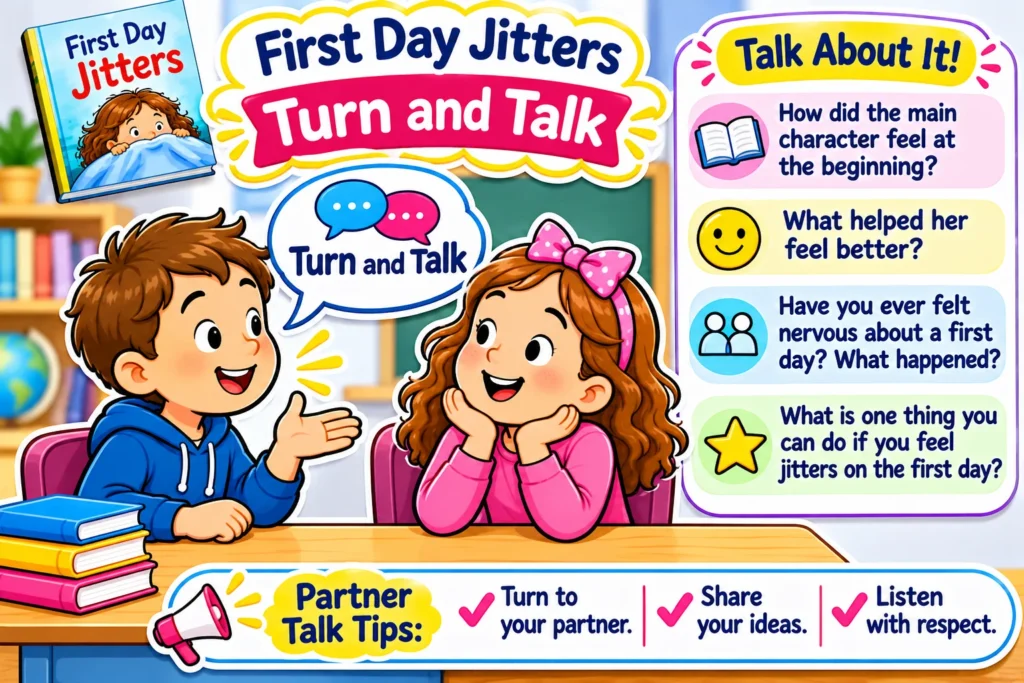
12. First Day Jitters Turn and Talk
Best for: Grades K–3
Time: 5–10 minutes
Materials: Question cards (optional)
Turn and Talk is a quick classroom discussion strategy that gives more students an opportunity to participate.
How to do it:
- Pair students with a partner.
- Ask one question about the story.
- Give children a short period to think.
- Let the first partner share an answer.
- Invite the second partner to respond before switching roles.
Possible questions include:
- Why was Sarah nervous?
- What surprised you about the ending?
- How could someone make Sarah feel welcome?
- What might you say to a new classmate?
- What is one kind action you can take today?
Offer students sentence starters such as “I think Sarah felt…” or “I would help by…”
Learning objective: Oral language, listening, and perspective-taking.
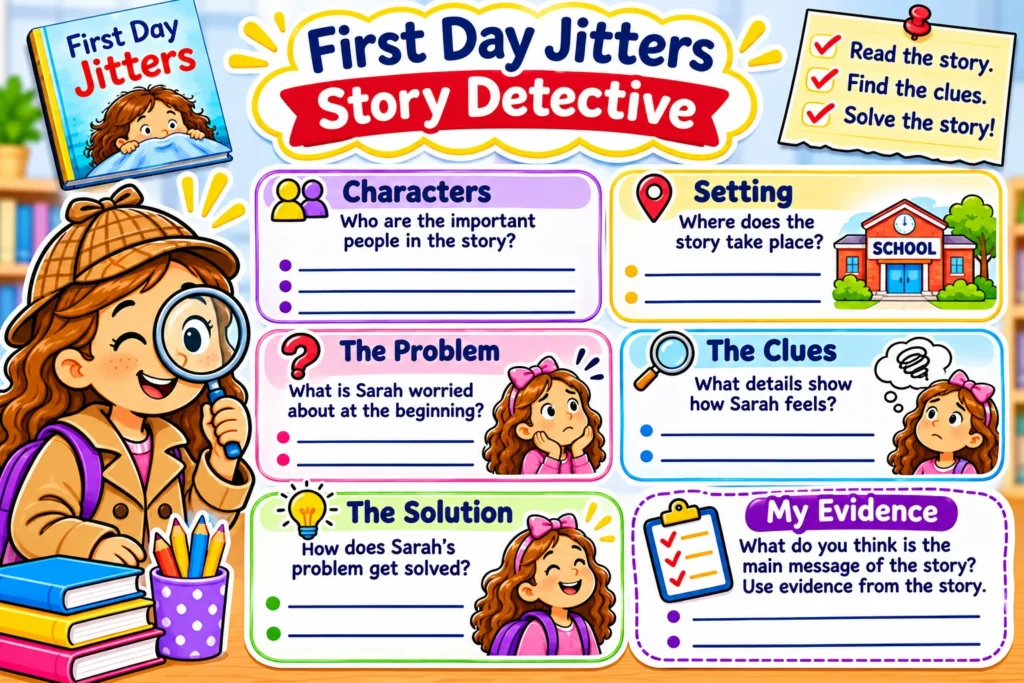
13. First Day Jitters Story Detective
Best for: Grades 2–3
Time: 10–15 minutes
Materials: Paper magnifying-glass cutouts, pencils
Turn the book’s surprise ending into a playful evidence-finding activity.
How to do it:
- After reading, tell students they are becoming story detectives.
- Ask them to look back at the text and illustrations.
- Have each student identify two details that might have hinted at Sarah’s identity.
- Ask students to explain why those clues were difficult to notice at first.
- Discuss how authors and illustrators can create surprises in stories.
Students can record their findings on a worksheet with three columns: “Clue,” “What I Thought,” and “What I Understand Now.”
Extension: Invite students to write a short story that ends with a harmless surprise.
Learning objective: Inferencing, text evidence, and understanding story structure.
14. Welcome-to-School Classroom Mural
Best for: Grades K–3
Time: 20 minutes
Materials: Large paper, markers, construction paper, glue
Creating a classroom mural encourages students to contribute to a shared project.
How to do it:
- Place a large sheet of paper on a classroom wall or table.
- Write “Everyone Belongs in Our Classroom” across the top.
- Ask students to create a drawing representing something they enjoy, value, or hope to learn.
- Have each child add their artwork to the mural.
- Discuss how all the different pictures contribute to one classroom community.
Students can also add welcoming words or messages.
Learning objective: Collaboration, belonging, and creative expression.
15. My First Day Reflection Worksheet
Best for: Grades K–3
Time: 10 minutes
Materials: Reflection worksheet, pencils, crayons
End the lesson or school day with a short reflection activity.
How to do it:
- Give students a sheet divided into “Before School” and “After School.”
- Ask them to draw or describe how they felt at each time.
- Invite them to identify one positive or meaningful experience.
- Ask students to name someone they can talk to if they need help.
- Allow children to keep their reflections private or share voluntarily.
Possible sentence starters include:
- This morning, I felt…
- One thing I enjoyed today was…
- Something new I learned is…
- Tomorrow, I hope to…
Learning objective: Reflection, emotional awareness, and communication.
First Day Jitters Activity Guide by Grade Level
Not every activity works equally well for all elementary students.
Teachers can adjust the amount of reading, writing, discussion, and independence expected from each grade.
| Grade | Recommended Activities | Suggested Adaptation |
|---|---|---|
| Kindergarten | Feelings Chart, Drawing, Paper Craft, Jitter Jar | Use pictures, oral responses, and teacher assistance |
| 1st Grade | Sequencing, Writing Prompts, Friendship Bingo, Turn and Talk | Provide sentence starters and short written responses |
| 2nd Grade | Character Feelings Comparison, Prediction Chart, Story Detective | Require explanations using story evidence |
| 3rd Grade | Story Detective, Reflective Writing, Character Analysis | Encourage detailed answers, independent writing, and inferences |
For multilingual learners, use visual emotion cards, demonstrate the activities, and welcome responses in the languages students know.
For children who find group conversations overwhelming, provide opportunities for private writing, drawing, or individual teacher check-ins.
First Day Jitters Printable Worksheet Ideas
Teachers can prepare simple worksheets using the following templates.
Worksheet 1: My First Day Feelings
Name: __________________
Today, I feel: Happy / Excited / Nervous / Curious / Unsure
Draw a picture of yourself at school.
One thing that could help me feel welcome is:
Worksheet 2: Beginning, Middle, and End
Name: __________________
Beginning: What happened when Sarah was getting ready for school?
Middle: What happened on the way to school?
End: What was surprising about the classroom introduction?
Students can draw an event inside each section and add a sentence underneath.
Worksheet 3: First Day Writing Prompts
Complete these sentences.
1. Something new I want to try this year is __________________.
2. When I feel nervous, I can __________________.
3. A kind thing I can say to a classmate is __________________.
4. If Sarah visited our classroom, I would __________________.
Worksheet 4: Story Detective
The surprising ending: __________________
Clue 1: __________________
Clue 2: __________________
How did the ending change your understanding of the story?
These templates can be copied onto paper or adapted into illustrated worksheets for younger students.
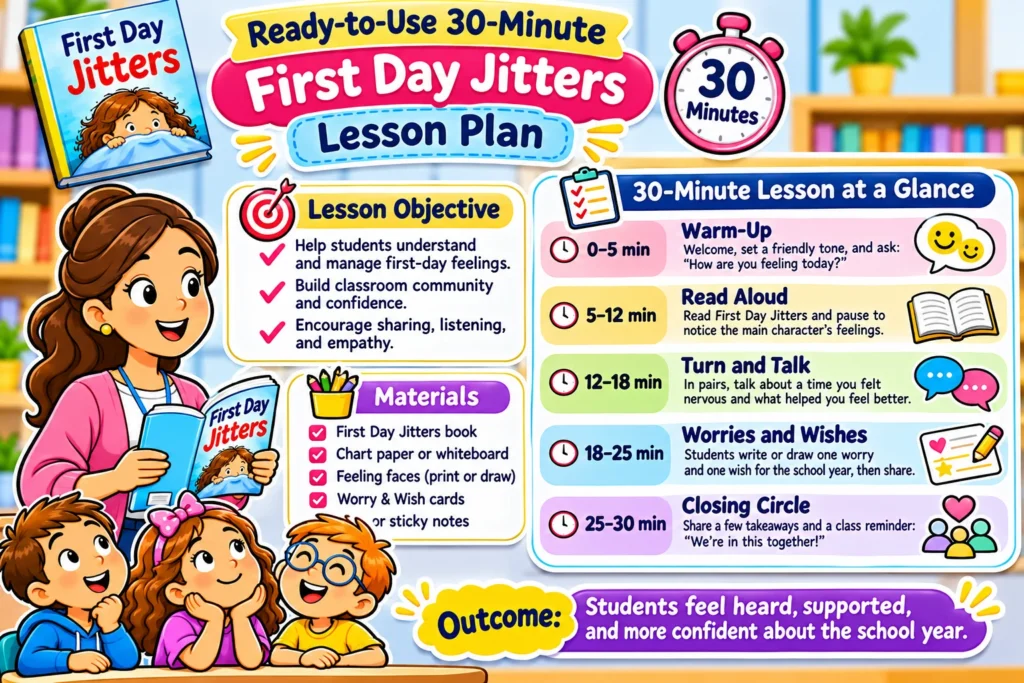
Ready-to-Use 30-Minute First Day Jitters Lesson Plan
If you have limited classroom time, combine the book with one focused activity.
Grade Level: K–3
Subject Areas: Reading, Speaking and Listening, Social-Emotional Learning
Lesson Goal: Students identify a character’s feelings, discuss the story’s central message, and recognize ways to welcome others.
| Time | Lesson Activity | Teacher Instructions |
|---|---|---|
| 4 minutes | Feelings Warm-Up | Introduce the meaning of jitters and discuss emotion cards |
| 12 minutes | Interactive Read-Aloud | Read the book, pausing briefly for predictions |
| 5 minutes | Discussion | Discuss Sarah’s feelings and the surprise ending |
| 7 minutes | Hands-On Activity | Complete a feelings chart or first-day drawing |
| 2 minutes | Exit Reflection | Ask students to name one way to help someone feel welcome |
How to Assess Student Learning
After the lesson, students should be able to:
- Identify at least one emotion Sarah experiences.
- Describe an important event from the story.
- Explain why the ending is surprising.
- Suggest one kind action that could help someone feel welcome.
For kindergarten students, oral answers and drawings can demonstrate understanding.
Older students can provide short written responses supported by examples from the story.
Tips for Helping Students With First-Day Jitters
Activities are useful, but a welcoming classroom environment also depends on how adults respond to children’s emotions.
Create Predictable Classroom Routines
Show students where to place their belongings, where to find supplies, and what will happen during the day.
A simple visual schedule can help children understand what to expect.
Use Warm, Supportive Language
If a student feels nervous, acknowledge the feeling without dismissing it.
For example, you might say, “New things can feel unfamiliar. We can figure out the next step together.”
Avoid Forcing Personal Sharing
Some children enjoy telling the class about their emotions, while others prefer to observe or communicate privately.
Give students choices about how they participate.
Offer Practical Ways to Ask for Help
Teach students how to find their teacher, request a bathroom break, join an activity, or ask a question.
Practicing these routines can help reduce uncertainty.
Support Students Who Need More Help
If a child’s worries are intense, persistent, or interfering with regular participation, communicate with caregivers and follow school procedures for additional support.
A picture-book activity is not a substitute for individualized assistance when a student needs it.
More Books to Pair With First Day Jitters
Teachers can extend their back-to-school reading lessons with other picture books that explore friendship, belonging, and unfamiliar experiences.
The Day You Begin by Jacqueline Woodson
This picture book explores how it can feel to enter a room where nobody seems quite like you.
It provides a thoughtful opportunity to discuss courage, identity, differences, and finding connections.
Companion activity: Invite children to create a drawing that represents something special about themselves, then discuss ways classmates can appreciate one another.
The Name Jar by Yangsook Choi
The Name Jar tells the story of Unhei, a child who moves from South Korea and worries about fitting in at her new school.
The story explores names, identity, friendship, and the importance of respecting others.
Companion activity: Invite students to share their names and preferred pronunciations. Discuss how learning and using one another’s names respectfully contributes to a welcoming classroom.
Students should never feel pressured to explain private family or cultural information.
Both books complement First Day Jitters by encouraging students to think about belonging and kindness from different perspectives.
Frequently Asked Questions About First Day Jitters
What is the main idea of First Day Jitters?
The main idea of First Day Jitters is that people of all ages can feel nervous about unfamiliar experiences. The story encourages readers to recognize these feelings and understand that adults, including teachers, can experience first-day worries, too.
What grade level is First Day Jitters for?
First Day Jitters is recommended for kindergarten through third grade. Younger students can participate through drawing and oral discussion, while older students can explore predictions, character development, and inferencing.
What are the best First Day Jitters activities?
Popular activities include feelings charts, Jitter Jars, story sequencing cards, writing prompts, emotion crafts, prediction games, and classroom reflection worksheets. The best choice depends on the students’ ages and the lesson objective.
How do you teach a First Day Jitters read aloud?
Begin with a discussion about nervousness and ask students to predict what the story will be about. During reading, pause to examine Sarah’s feelings and the illustrations. After revealing the surprise ending, discuss the story’s message and complete a related classroom activity.
What is the surprise ending in First Day Jitters?
The story reveals that Sarah Jane Hartwell, who appears to be a nervous new student, is actually the new teacher. This twist shows that first-day worries are not limited to children.
What is a good writing activity for First Day Jitters?
Ask students to write about a new experience, describe how they would encourage Sarah, or explain what helps someone feel welcome. Younger children can draw pictures and complete simple sentence starters.
Can kindergarten students complete First Day Jitters activities?
Yes. Kindergarten students can participate in feelings charts, classroom drawings, emotion crafts, partner discussions, and simple story-sequencing tasks. Teachers can use illustrations and oral instructions instead of lengthy writing assignments.
How much time should I allow for a First Day Jitters lesson?
A basic read-aloud lesson can fit into approximately 30 minutes, including a short introduction, reading, discussion, and one activity. Teachers can extend the lesson by adding crafts, writing, or additional reading-comprehension exercises.
Is First Day Jitters suitable for the first week of school?
Yes. The story’s themes make it a useful choice for the first week of school, when students are learning classroom routines, meeting new people, and adjusting to a different environment.
Final Thoughts
The first day of school is an important opportunity to help children feel welcomed, understood, and included.
First Day Jitters by Julie Danneberg offers a relatable starting point for these conversations, while its surprising ending reminds students that adults can experience nervousness, too.
With these 15 First Day Jitters activities, teachers can combine reading comprehension, creative expression, meaningful discussions, and classroom community building.
You do not need to complete every activity. Choose two or three that fit your students’ ages, interests, and available time.
Whether your class makes feelings charts, creates a Jitter Jar, or completes a reflection worksheet, the most important message remains the same:
Everyone deserves to feel welcome, and nobody has to face a new experience alone.