Multiplication becomes easier when students understand the rules behind the numbers. Instead of memorizing every calculation separately, they can use familiar number relationships to solve new problems.
For example, if students know that 4 × 6 = 24, they also know that 6 × 4 = 24. This works because of a multiplication property.
The properties of multiplication explain how numbers can be reordered, regrouped, or broken into smaller parts without changing the correct answer. These rules help elementary students develop mental math strategies and understand why calculations work.
This guide explains five important multiplication properties with simple examples, a comparison chart, classroom teaching ideas, and practice questions.
What Are the Properties of Multiplication?
A property of multiplication is a mathematical rule that describes how multiplication works.
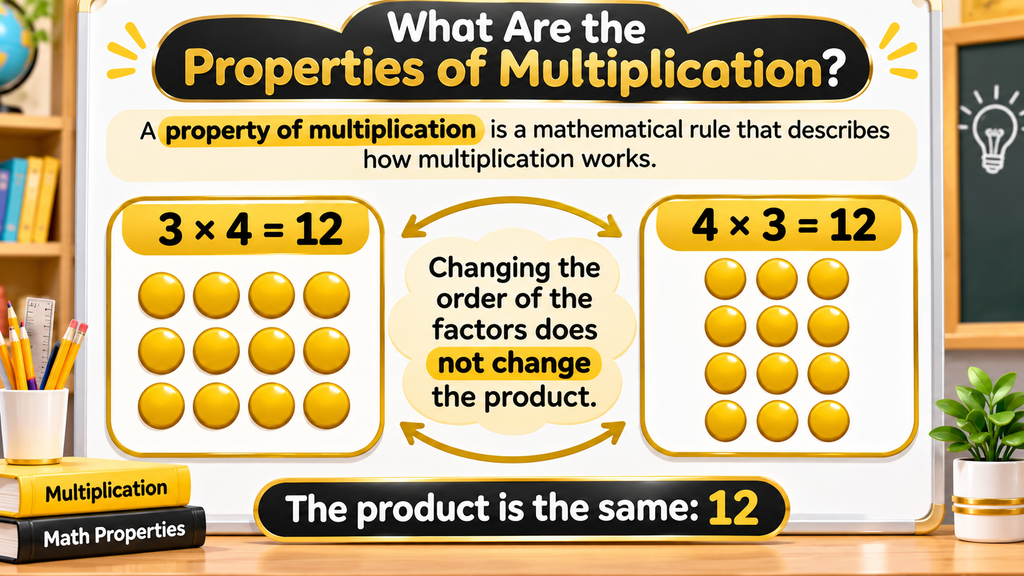
These rules help students solve problems using number relationships rather than always counting or calculating from the beginning.
For example:
5 × 8 = 40
8 × 5 = 40
Both equations have the same answer, even though the numbers appear in a different order.
Other properties explain what happens when we change the grouping of factors, multiply by one or zero, or break a number into smaller parts.
Why are multiplication properties useful?
They help students:
- Solve multiplication problems more efficiently.
- Understand relationships between numbers.
- Break difficult calculations into easier steps.
- Check whether their answers make sense.
- Build a foundation for mental math and later algebra.
Students don’t have to memorize the formal property names before they can use these strategies. Understanding what happens to the numbers is the most important starting point.
The Five Properties of Multiplication With Examples
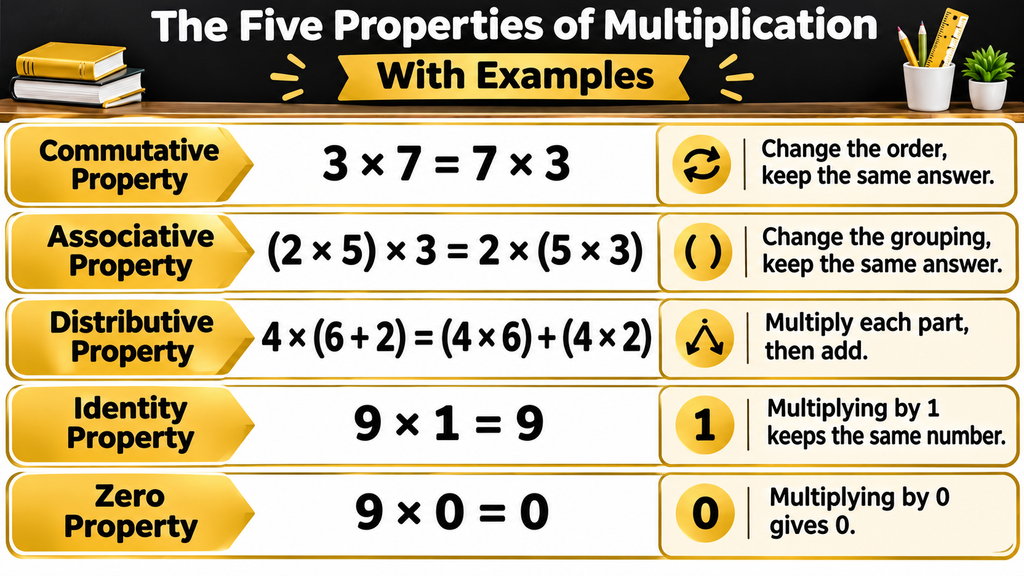
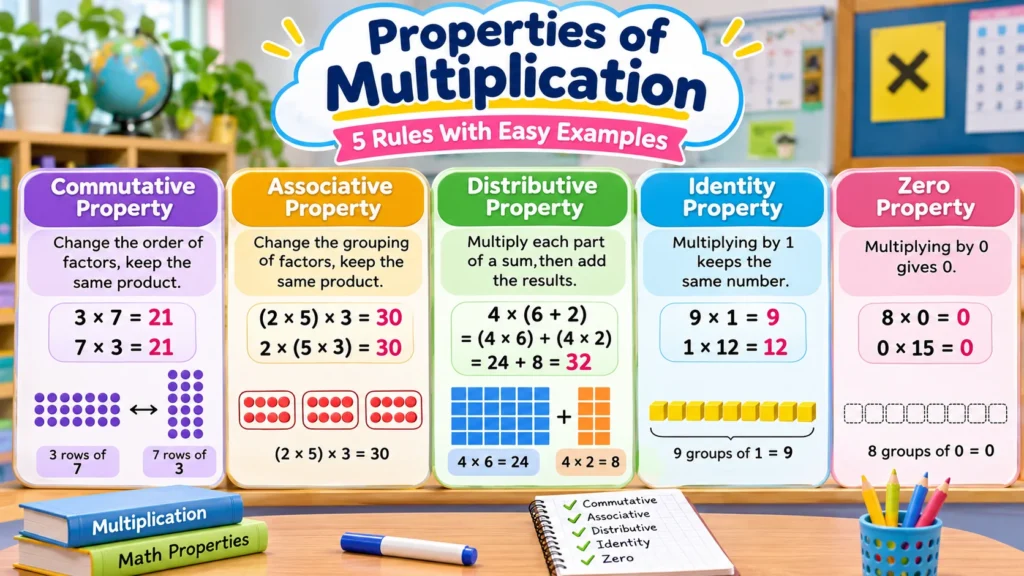
The five commonly taught multiplication properties are commutative, associative, distributive, identity, and zero.
| Property | Rule | Example |
|---|---|---|
| Commutative | Change the order of factors | 3 × 7 = 7 × 3 |
| Associative | Change how factors are grouped | (2 × 5) × 3 = 2 × (5 × 3) |
| Distributive | Multiply each part of a sum | 4 × (6 + 2) = (4 × 6) + (4 × 2) |
| Identity | Multiplying by 1 keeps the same number | 9 × 1 = 9 |
| Zero | Multiplying by 0 gives 0 | 9 × 0 = 0 |
1. Commutative Property of Multiplication
The commutative property means changing the order of two factors does not change their product.
3 × 7 = 21
7 × 3 = 21
Imagine three rows with seven counters in each row. There are 21 counters altogether.
If you rotate the arrangement, it becomes seven rows of three counters. The total remains 21.
Remember: Change the order, keep the same answer.
2. Associative Property of Multiplication
The associative property means changing the grouping of three or more factors does not change the product.
(2 × 5) × 3 = 2 × (5 × 3)
Both sides equal 30.
The parentheses tell students which numbers to multiply together first.
Remember: Change the grouping, keep the same answer.
3. Distributive Property of Multiplication
The distributive property lets students break a number into smaller parts and multiply each part separately.
For example:
4 × (6 + 2)
Break the calculation into two easier problems:
(4 × 6) + (4 × 2)
24 + 8 = 32
This is helpful when students know smaller multiplication facts but find larger ones difficult.
Remember: Multiply each part, then add the results.
4. Identity Property of Multiplication
The identity property states that any number multiplied by one remains unchanged.
7 × 1 = 7
1 × 12 = 12
For example, seven groups containing one pencil each have seven pencils altogether.
Multiplying by one does not change the number.
5. Zero Property of Multiplication
The zero property states that any number multiplied by zero equals zero.
8 × 0 = 0
0 × 15 = 0
Imagine eight empty boxes. Each box contains zero pencils.
There are no pencils altogether, so the answer is zero.
Remember: Any number multiplied by zero gives zero.
Associative Property of Multiplication: Step-by-Step Examples
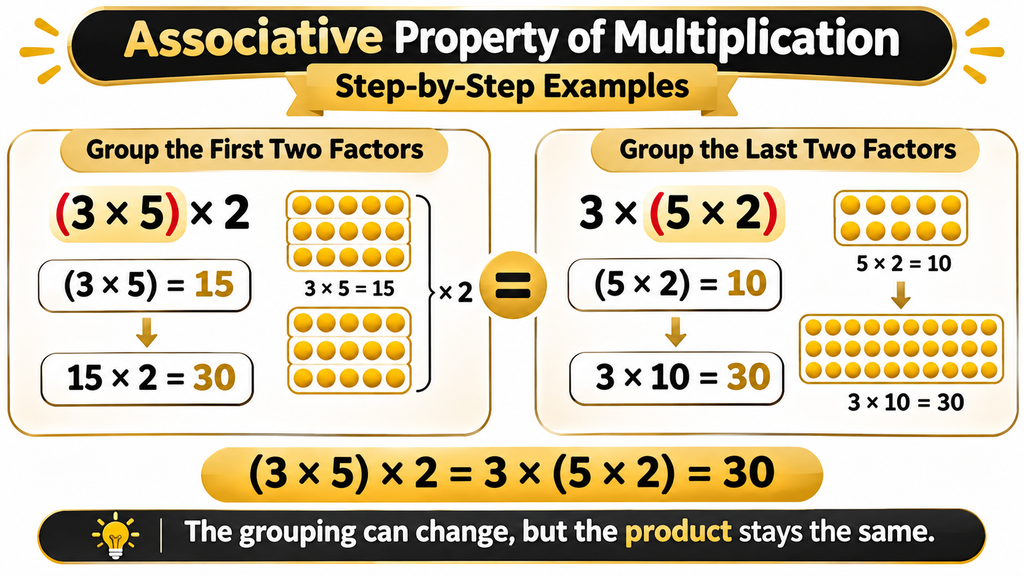
Students frequently confuse the associative and commutative properties. The easiest way to explain the difference is to focus on what actually changes.
An associative property of multiplication example uses at least three factors and shows that changing their grouping keeps the product the same.
Example 1: Solve 3 × 5 × 2
First, group the first two numbers:
(3 × 5) × 2
= 15 × 2
= 30
Now group the last two numbers:
3 × (5 × 2)
= 3 × 10
= 30
Both methods give the same answer.
The numbers remain in the same order, but the parentheses move.
Example 2: Use Easier Groups
Consider:
4 × 2 × 5
One method is:
(4 × 2) × 5 = 8 × 5 = 40
Another method is:
4 × (2 × 5) = 4 × 10 = 40
The second method may feel easier because multiplying 2 × 5 creates a familiar group of ten.
This shows why the associative property is useful for mental math.
Associative vs. Commutative Property
| Associative property | Commutative property |
|---|---|
| Changes grouping | Changes order |
| Uses three or more factors | Can use two factors |
| (2 × 3) × 4 = 2 × (3 × 4) | 2 × 3 = 3 × 2 |
A helpful classroom reminder is:
Commutative = Change the order.
Associative = Change the grouping.
Students should also understand that these rules do not work the same way for every operation. For example, changing the order of numbers in division can change the answer.
How to Teach Multiplication Properties to Elementary Students
The best way to introduce multiplication rules is to help students see what happens before expecting them to remember property names.
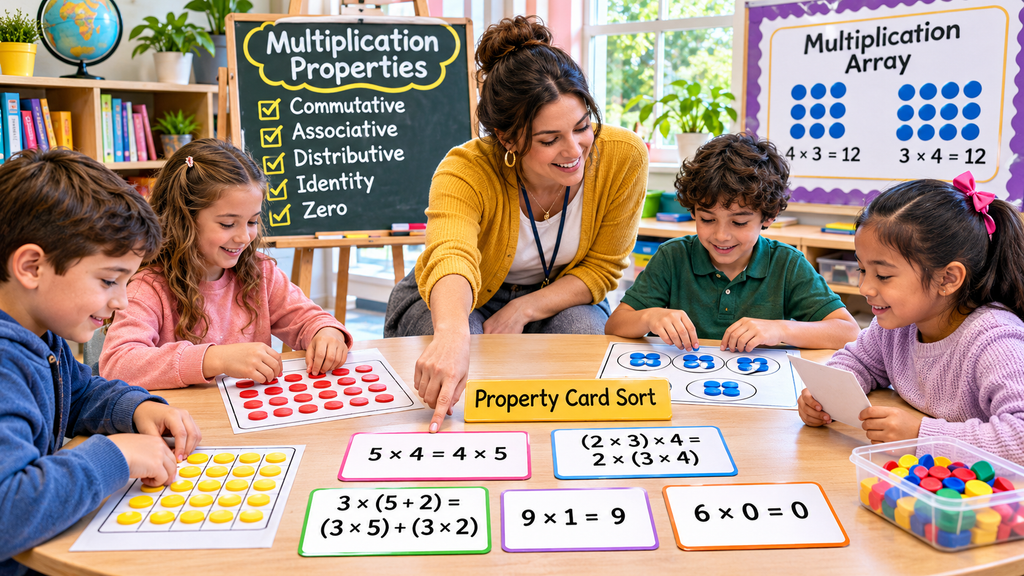
Start With Counters or Arrays
Give students 12 counters and ask them to create three rows of four.
Next, rearrange the counters into four rows of three.
Ask: “Did the total number of counters change?”
Students can see the commutative property in action.
Use Grouping to Explain the Associative Property
Write:
(2 × 3) × 4
Ask students to solve the problem.
Then show:
2 × (3 × 4)
Have them calculate both expressions and explain why the answers match.
Use groups of objects or drawings if students need a visual explanation.
Try a Multiplication Property Card Sort
Prepare cards with these equations:
- 5 × 4 = 4 × 5
- (2 × 3) × 4 = 2 × (3 × 4)
- 3 × (5 + 2) = (3 × 5) + (3 × 2)
- 9 × 1 = 9
- 6 × 0 = 0
Students sort the equations according to the property they demonstrate.
For younger learners, provide a short reminder of each rule. Older students can explain their choices without the reminders.
Ask Students to Explain Their Thinking
Instead of asking only for an answer, try questions such as:
- Why does changing the order of factors work?
- Which two numbers would you multiply first?
- Can you break this multiplication problem into easier parts?
- Which multiplication property did you use?
These questions help reveal whether students understand the rule or are simply remembering a label.
Multiplication Properties Practice Questions With Answers
Use these questions for independent practice, partner work, or a short classroom review.
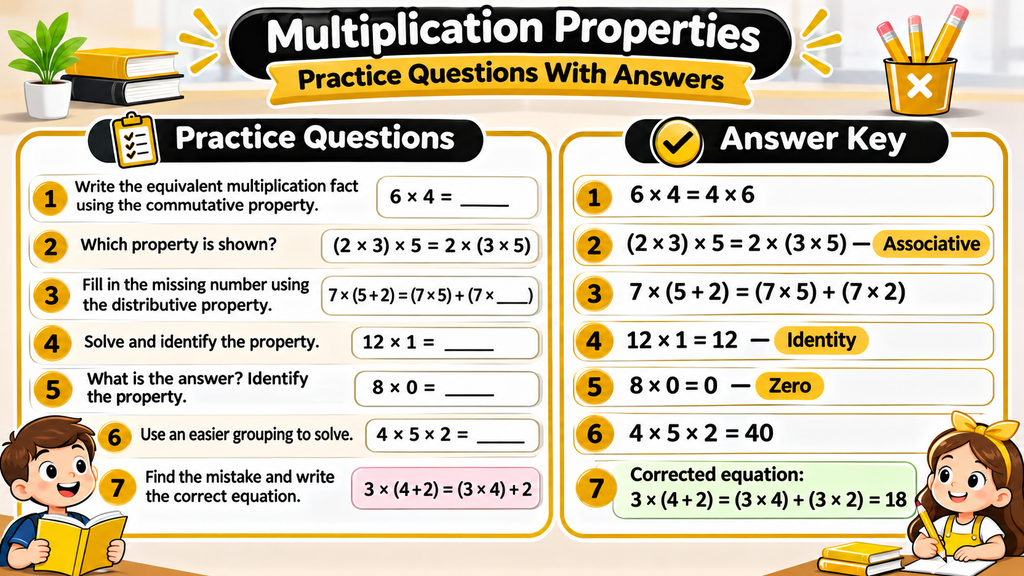
Question 1
Complete the equation:
6 × 4 = 4 × ___
Question 2
Which property is shown?
(2 × 3) × 5 = 2 × (3 × 5)
Question 3
Fill in the missing number:
7 × (5 + 2) = (7 × 5) + (7 × ___)
Question 4
Solve and identify the property:
12 × 1 = ___
Question 5
What is the answer?
8 × 0 = ___
Question 6
Use an easier grouping to solve:
4 × 5 × 2
Question 7: Find the Mistake
A student writes:
3 × (4 + 2) = (3 × 4) + 2
Is the student correct? Explain your answer.
Answer Key
| Question | Answer | Explanation |
|---|---|---|
| 1 | 6 | Commutative property |
| 2 | Associative | Only the grouping changes |
| 3 | 2 | Distributive property |
| 4 | 12 | Identity property |
| 5 | 0 | Zero property |
| 6 | 40 | Group 5 × 2 first to make 10 |
| 7 | Incorrect | Multiply 3 by both 4 and 2 |
For Question 7, the correct calculation is:
3 × (4 + 2) = (3 × 4) + (3 × 2) = 12 + 6 = 18
A useful follow-up is to ask students to create their own example of each property and exchange problems with a partner.
Understanding multiplication properties gives students more than a set of rules to memorize. It helps them recognize patterns, choose efficient calculations, and explain their mathematical thinking.
Start with concrete examples, introduce the rules gradually, and provide regular opportunities to practice. When students understand why the properties work, they can apply those ideas to increasingly challenging math problems.