Learning new words should involve more than copying definitions into a notebook. Students remember vocabulary better when they hear words, discuss their meanings, connect them to familiar ideas, and use them in different situations.
But finding vocabulary activities that keep elementary students engaged without creating hours of preparation can be challenging.
The good news is that you don’t need expensive materials or complicated lessons. Picture cards, classroom objects, familiar stories, and short word games can help students build their vocabulary.
Here are 15 practical activities for Grades 1–5, with examples and simple ways to adapt them to different learning needs.
How to Choose Words for Vocabulary Practice
Before planning a game, decide which words are worth teaching.
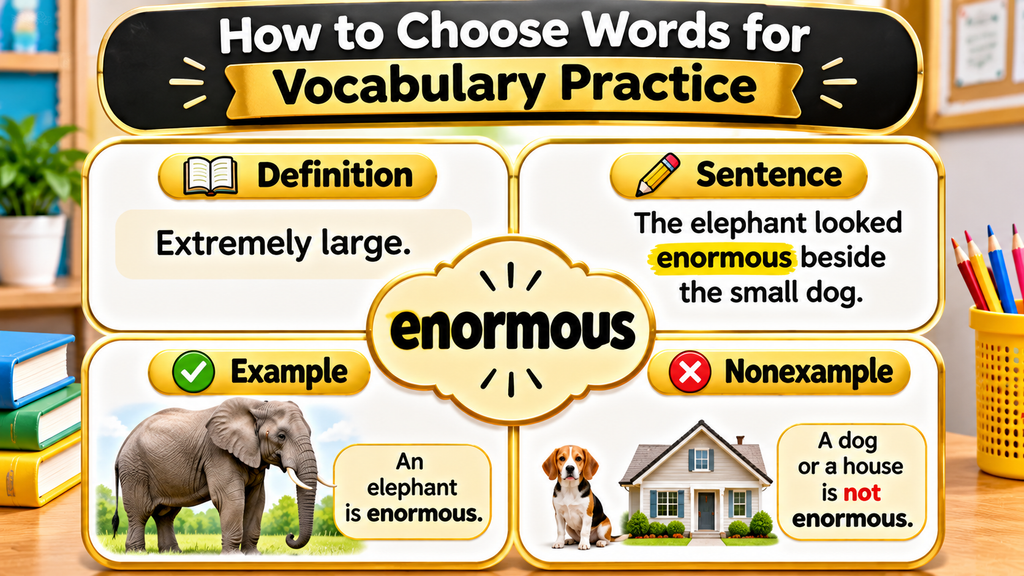
Choose words students will encounter in their reading, use in classroom discussions, or need for an upcoming lesson. Words such as enormous, investigate, and predict can be useful because students can apply them in different situations.
Start with a small, manageable set rather than introducing too many unfamiliar words at once.
For each word, provide a student-friendly explanation, an example, and an opportunity to use it.
For example:
Word: Enormous
Meaning: Extremely large.
Example: The elephant looked enormous beside the small dog.
Check understanding: Is an enormous building bigger or smaller than a house?
Once students understand the words, choose activities that help them practice their meanings in different ways.
Vocabulary Activities to Introduce New Words
These five activities work particularly well when students are learning unfamiliar words for the first time.
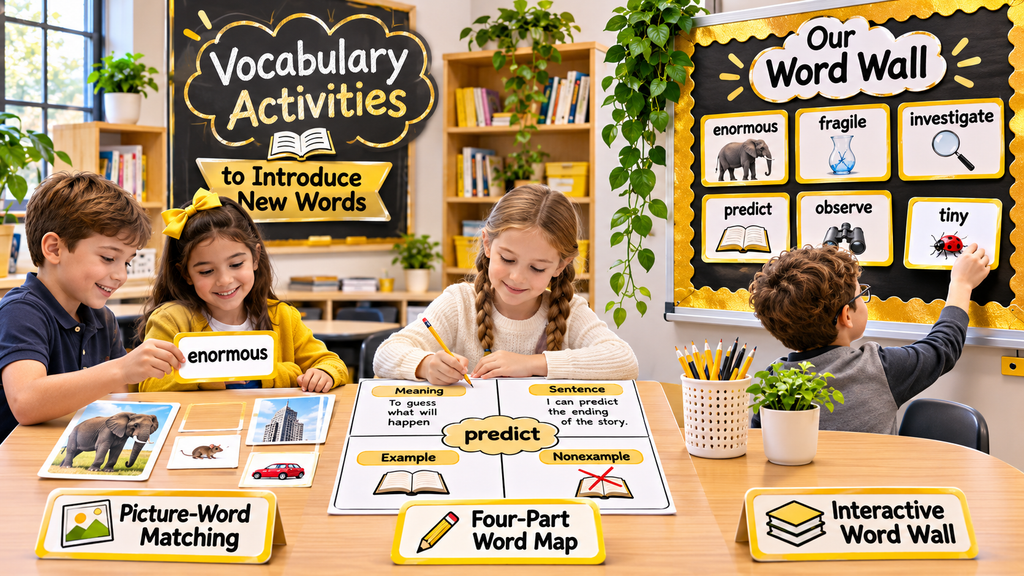
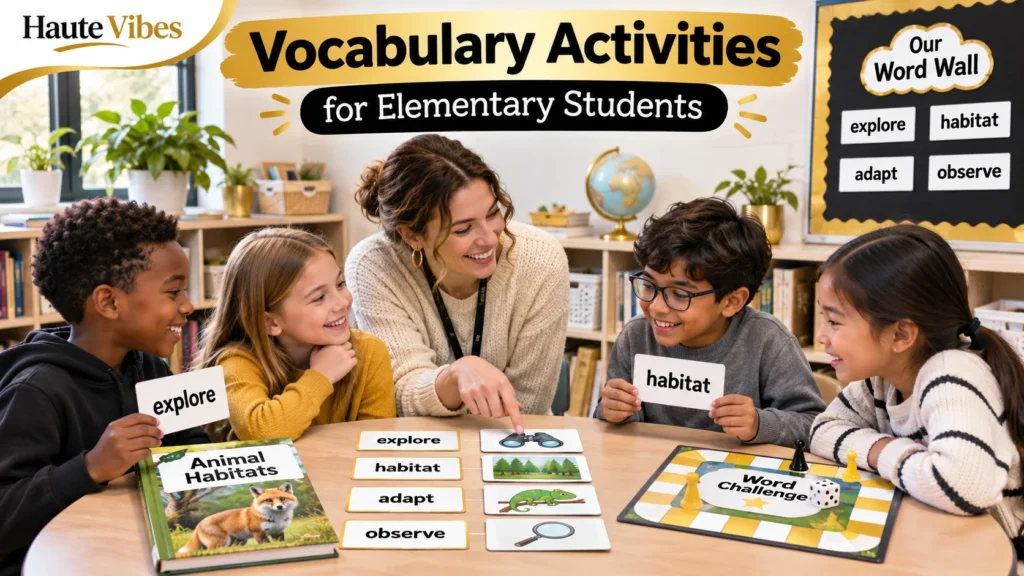
1. Picture and Word Matching
Best for: Grades 1–3
Materials: Picture cards and word cards.
Choose words that can be illustrated clearly, such as enormous, tiny, fragile, or enormous objects contrasted with small ones. Place pictures and vocabulary cards on a table.
Students match each word with a suitable picture and explain their choice.
For example, a student might match fragile with a glass ornament and explain why it could break easily.
2. Four-Part Word Maps
Best for: Grades 2–5
Materials: Paper divided into four sections.
Write one vocabulary word in the center. Ask students to add its meaning, a sentence, an example, and a nonexample.
For the word predict, an example might be guessing the ending of a story using clues. A nonexample would be describing an ending after reading it.
This encourages students to think beyond a memorized definition.
3. Examples and Nonexamples
Best for: Grades 1–5
Materials: Spoken statements or sentence cards.
Introduce a word and give students several situations to consider.
For enormous, you might describe an elephant, a grain of rice, and a tall skyscraper.
Students identify which examples fit the meaning and explain why. Clarify that something can be large without necessarily being enormous.
4. Act Out the Word
Best for: Grades 1–3
Materials: Vocabulary cards.
Choose words that describe visible actions or emotions, such as tiptoe, stretch, or shiver.
Demonstrate the word before asking students to act it out.
Afterward, invite students to describe what happened using the target word in a complete sentence.
5. Interactive Word Wall
Best for: Grades 1–5
Materials: Word cards and a bulletin board.
Display recently taught words where students can see them.
Instead of leaving the cards untouched, ask students to find related words, identify examples in classroom reading, or use a displayed word during a discussion.
A word wall becomes more useful when students interact with it regularly.
Fun Vocabulary Games for Classroom Practice
Once students understand the basic meanings, games provide opportunities to revisit and apply familiar words.
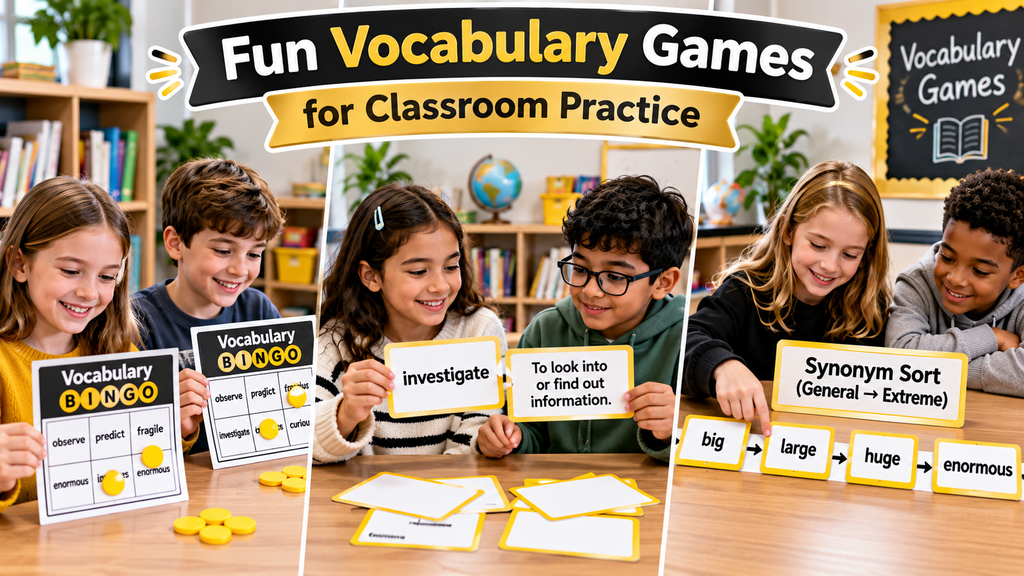
6. Definition Bingo
Best for: Grades 2–5
Materials: Bingo grids containing vocabulary words.
Give students grids with previously taught words.
Read a student-friendly definition rather than saying the word itself. Students identify and mark the matching word.
For example, say, “To look at something carefully,” and students mark observe.
Ask the winner to explain a few marked answers before confirming the game.
7. Vocabulary Charades
Best for: Grades 1–5
Materials: Action-word cards.
Students take turns silently demonstrating a word while classmates guess.
Use words such as whisper, march, balance, or celebrate.
After guessing, ask someone to use the word in a sentence. Choose an alternative activity for words that cannot be acted out meaningfully.
8. Vocabulary Partner Match
Best for: Grades 2–5
Materials: Matching word and definition cards.
Give half the students vocabulary cards and the others matching explanations.
Students move around the classroom to find their partners.
After matching, each pair creates a sentence using its word and shares it with the class.
9. Synonym Strength Sort
Best for: Grades 3–5
Materials: Cards containing related descriptive words.
Give students a set such as small, tiny, and microscopic.
Ask them to discuss how the words differ and arrange them from a general description to increasingly extreme size.
Have students explain when each word would be appropriate. The discussion matters more than memorizing an exact order for words with overlapping meanings.
10. Vocabulary Category Challenge
Best for: Grades 2–5
Materials: Word cards or a short word list.
Provide words such as whale, sparrow, oak, and dolphin.
Students sort them into meaningful categories and explain their choices.
You can increase the challenge by asking students to identify a word that fits more than one possible category, or to create their own sorting rule.
Vocabulary Activities for Reading, Speaking, and Writing
These activities help students move from recognizing definitions to using new words in meaningful contexts.
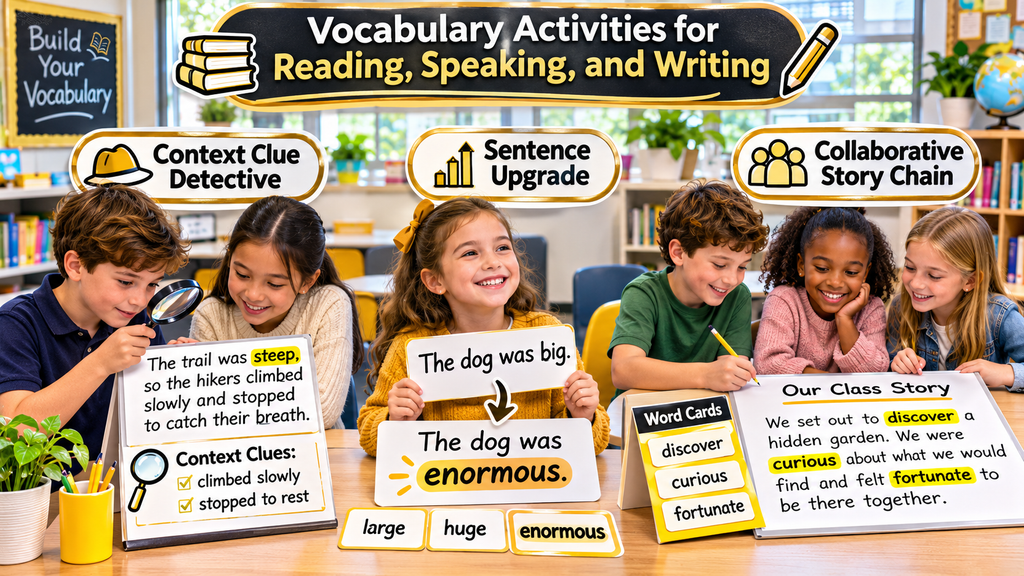
11. Context Clue Detective
Best for: Grades 3–5
Materials: Short reading passages.
Give students a sentence containing an unfamiliar word.
For example:
“The trail was steep, so the hikers climbed slowly and stopped to catch their breath.”
Ask students to identify clues, suggest a possible meaning, and check it against the rest of the passage or a dictionary.
Explain that not every sentence provides enough clues to determine an exact meaning.
12. Sentence Upgrade
Best for: Grades 2–5
Materials: Simple sentences and a familiar word bank.
Write: “The dog was big.”
Ask students to choose a more precise word, such as enormous, if it matches the intended meaning.
Then discuss how the word changes the reader’s mental picture.
This gives students practice selecting vocabulary that improves their writing rather than replacing words randomly.
13. Collaborative Story Chain
Best for: Grades 3–5
Materials: Three to five familiar vocabulary words.
Begin a short story with one sentence. Students take turns adding another sentence, using a target word when it fits naturally.
For instance, students might use discover, curious, and fortunate in a story about a missing classroom pet.
At the end, reread the story and discuss whether each word was used correctly.
14. Word Hunt During Reading
Best for: Grades 2–5
Materials: A classroom book or short passage.
Choose a target word or a word family students have studied.
Ask students to notice it while reading and record the sentence where it appears.
Discuss how the surrounding text helps explain its meaning. If the word has multiple meanings, compare how it is used in different sentences.
15. Two-Minute Vocabulary Exit Ticket
Best for: Grades 2–5
Materials: Small slips of paper.
At the end of a lesson, ask students to complete one short task.
They might write a sentence using observe, explain the difference between tiny and enormous, or choose the correct word for a situation.
Review the answers to see which words need another explanation or more practice.
How to Adapt Vocabulary Activities and Check Progress
Not every student needs the same level of support. A matching game that helps a first grader learn a new word might be too simple for an older student who already understands it.
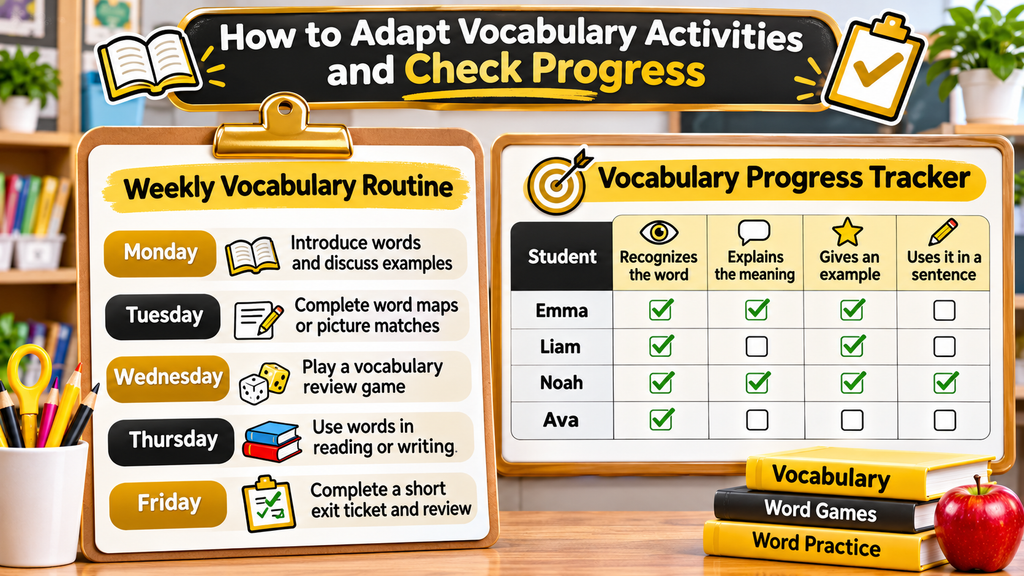
Use the same vocabulary goal while changing the activity’s difficulty.
| Student need | Helpful adjustment |
|---|---|
| Needs language support | Include pictures, gestures, and clear spoken examples |
| Beginning reader | Read directions and definitions aloud |
| Developing vocabulary knowledge | Practice words in familiar sentences |
| Ready for a challenge | Compare similar meanings and justify word choices |
| Needs additional review | Revisit a smaller group of words in different activities |
For students learning English, allow extra opportunities to hear the word, discuss examples, and connect new vocabulary to familiar concepts or home-language knowledge.
Try a Simple Weekly Vocabulary Routine
You can organize practice without creating a new activity every day.
| Day | Classroom task |
|---|---|
| Monday | Introduce words and discuss examples |
| Tuesday | Complete word maps or picture matches |
| Wednesday | Play a vocabulary review game |
| Thursday | Use words in reading or writing |
| Friday | Complete a short exit ticket and review |
This is an example routine, not a required schedule. Adjust it to match your class.
How Can You Tell Whether Students Are Learning?
Look beyond whether students can repeat a definition.
Ask them to recognize the word, explain it in their own words, identify an appropriate example, and use it in a meaningful sentence.
A student who can explain fragile and use it correctly to describe a glass vase is showing deeper understanding than one who simply copies the definition.
Keep brief notes about words that students understand and those that need more review.
The best vocabulary activities are not necessarily the loudest games or the most elaborate worksheets. They are the ones that encourage students to think about word meanings and use new language.
Start with a few important words, teach their meanings clearly, and revisit them through conversation, reading, writing, and purposeful games. Over time, these small opportunities can help students build stronger vocabulary knowledge.