Some students can solve 7 + 6 almost immediately. Others count one number at a time, forget familiar answers, or struggle when the same fact appears in a different problem.
Building math fact fluency helps students move from counting everything to understanding number relationships and recalling familiar facts more efficiently.
For elementary teachers, the goal isn’t simply to make children answer faster. It’s to help them calculate accurately, choose useful strategies, and feel more confident working with numbers.
This guide explains what fluency means, how to teach it, and which simple games and activities can make daily practice more meaningful.
What Is Math Fact Fluency?
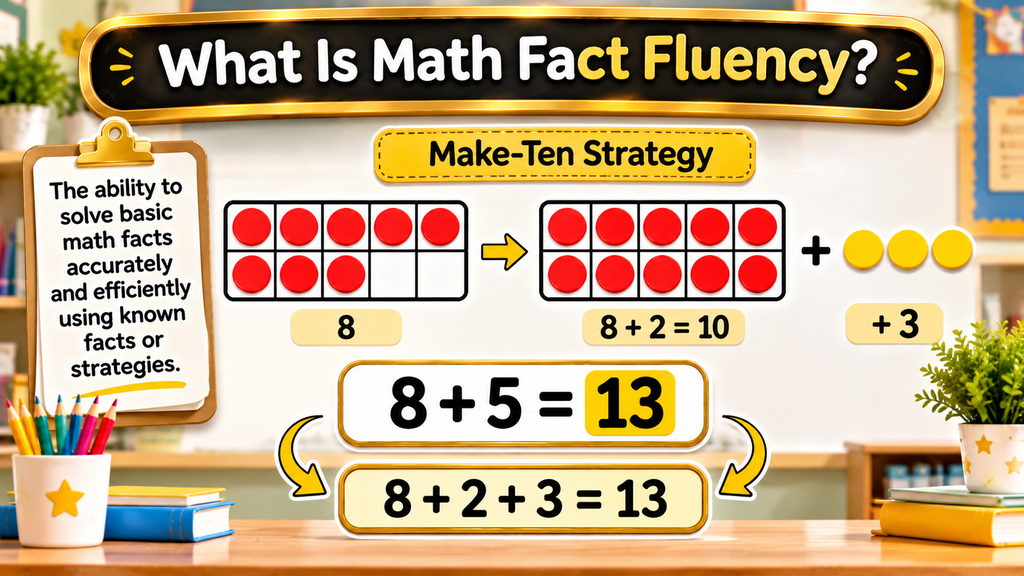
Math fact fluency is the ability to solve basic arithmetic facts accurately and efficiently, using known facts or appropriate strategies with increasing ease.
These facts include addition, subtraction, multiplication, and division.
For example, consider the problem 8 + 5.
A student might count forward five numbers from eight. Another student may recognize that eight needs two more to make ten, then add the remaining three:
8 + 5 = 8 + 2 + 3 = 13
Both students can find the correct answer, but the second student uses a helpful number relationship.
As students develop fluency, they become better at selecting efficient strategies and recalling familiar answers without repeatedly counting from the beginning.
Is math fluency the same as memorization?
Not exactly. Remembering basic facts is useful, but fluency also involves understanding how numbers relate and knowing what to do when an answer isn’t immediately remembered.
Students should have opportunities to explain their thinking, use visual models, and practice recalling facts.
Why Is Math Fact Fluency Important?
When students spend considerable effort solving basic facts, more complex math problems can become harder to manage.
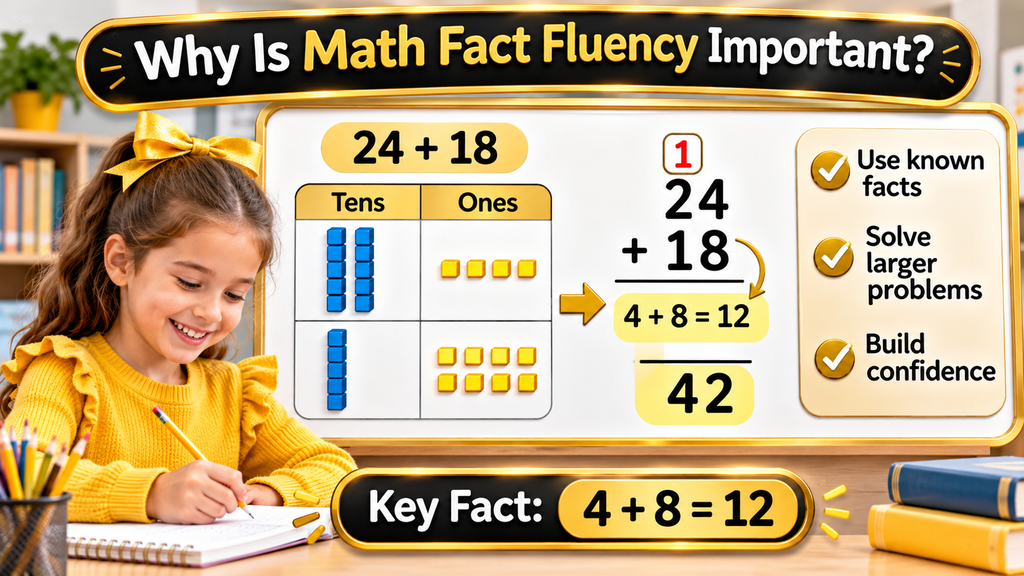
For example, a student solving 24 + 18 needs to work with place value and addition. Knowing that 4 + 8 = 12 allows the student to focus more attention on regrouping.
Fluent fact knowledge can support:
- Multi-step calculations: Students can concentrate on new mathematical ideas.
- Mental math: Familiar facts help students calculate without always writing every step.
- Problem-solving: Students can spend more effort understanding the question.
- Confidence: Regular progress can make unfamiliar problems feel more manageable.
Fluency develops at different rates. A student who still uses counters or number lines may be building important understanding.
Instead of comparing children only by their speed, focus on how accurately they solve problems and whether their strategies become more efficient over time.
How to Build Math Fact Fluency Step by Step
Students need more than repeated worksheets. Effective practice begins with understanding and gradually moves toward efficient recall.
Start With Visual Number Models
Use ten frames, counters, number lines, or simple drawings to demonstrate how numbers work together.
For instance, place seven counters in a ten frame and ask, “How many more do we need to make ten?”
Students can see three empty spaces instead of relying only on a memorized answer.
Teach Useful Math Strategies
Introduce one strategy at a time, demonstrate it, and let students practice with related facts.
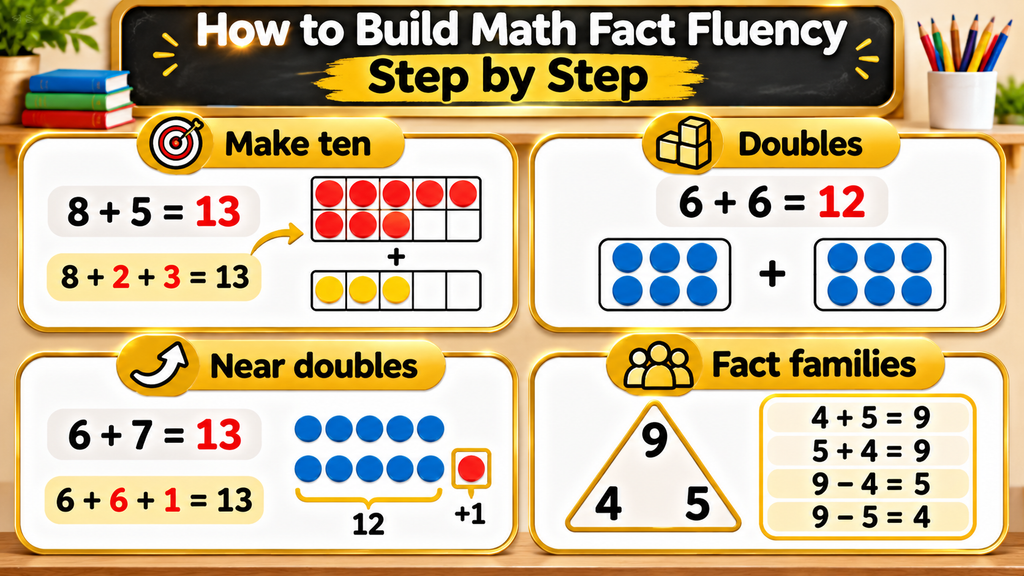
| Strategy | Example | How it works |
|---|---|---|
| Make ten | 8 + 5 = 13 | Make 10, then add 3 |
| Doubles | 6 + 6 = 12 | Add two equal numbers |
| Near doubles | 6 + 7 = 13 | Double 6, then add 1 |
| Fact families | 4 + 5 = 9 | Connect addition and subtraction |
For multiplication, students can also use known facts to solve unfamiliar ones.
For example:
6 × 4 = (5 × 4) + (1 × 4) = 24
This helps children recognize relationships rather than treating every multiplication fact as an unrelated problem.
Practice Small Groups of Facts
Instead of giving students an entire page of mixed questions, begin with a manageable group connected to the strategy being taught.
For example, a doubles practice set might include 3 + 3, 4 + 4, 5 + 5, and 6 + 6.
Once students understand these facts, introduce related near-doubles problems.
Revisit Previously Learned Facts
Return to familiar problems across different lessons. Mix a few older facts with new practice so students continue using what they’ve learned.
Provide corrective feedback when mistakes occur, including a brief explanation or visual model when needed.
Math Fact Practice Activities and Games
Math fact practice can be simple, inexpensive, and easy to include in an elementary classroom routine.
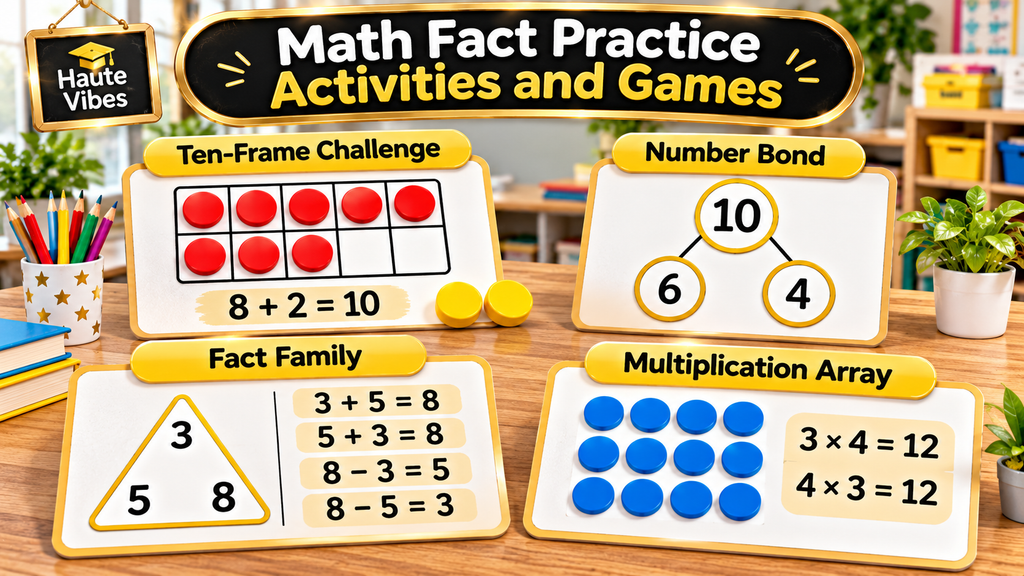
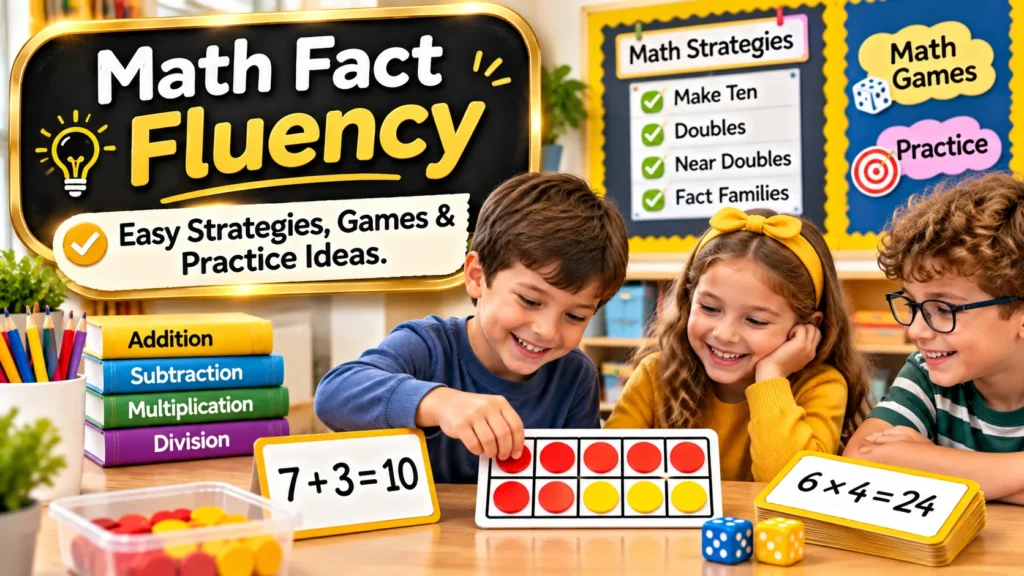
1. Ten-Frame Challenge
Give students a ten frame and counters.
Show a number such as seven and ask students to fill the remaining spaces.
Then ask them to explain how they know that 7 + 3 = 10.
This activity helps children visualize number combinations.
2. Number Bond Match
Prepare cards showing two parts and a whole.
For example, place 6 and 4 on two cards and 10 on another.
Students match the parts to the whole, then write the related addition or subtraction equations.
3. Fact Family Cards
Give students three numbers, such as 3, 5, and 8.
Ask them to write the related facts:
- 3 + 5 = 8
- 5 + 3 = 8
- 8 − 3 = 5
- 8 − 5 = 3
This helps students connect the two operations instead of memorizing four separate problems.
4. Solve and Show Your Strategy
Write a problem such as 7 + 6 on the board.
Ask students to solve it and show their thinking using a drawing, number line, counters, or equation.
One student might use near doubles:
7 + 6 = 6 + 6 + 1 = 13
Discuss how different approaches reach the same correct answer.
5. Multiplication Array Game
Give students counters or grid paper and ask them to create equal rows.
For 3 × 4, students arrange three rows of four counters.
They can then rotate the array and observe that four rows of three also make twelve.
Use the activity to connect multiplication facts with visual patterns.
A Simple Daily Math Practice Routine
You can combine these activities into a short routine without making the entire math lesson about fact drills.
| Time | Activity |
|---|---|
| 2 minutes | Review a familiar strategy |
| 3 minutes | Practice a small set of facts |
| 3 minutes | Play a matching or number game |
| 2 minutes | Discuss one strategy or error |
This ten-minute routine is a practical starting example, not a required schedule. Adjust the activities and time according to students’ needs.
How to Check Math Fluency Without Relying Only on Speed
Teachers need to know whether students are becoming more accurate, flexible, and efficient.
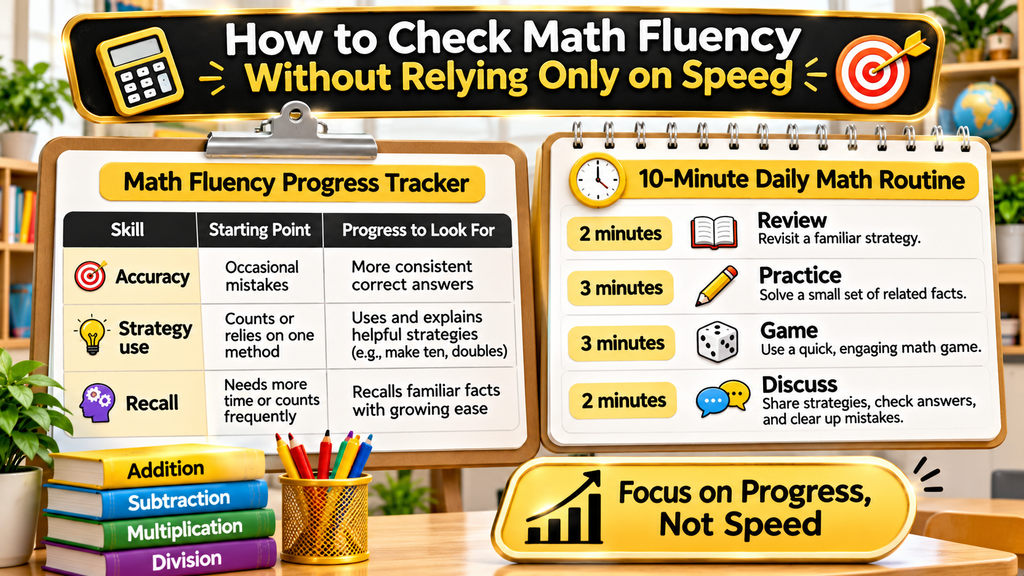
A correct answer alone doesn’t always reveal how a student reached it.
During practice, observe three things:
Accuracy: Does the student consistently produce correct answers?
Strategy use: Can the student explain a useful method or use a known fact to solve a related problem?
Recall: Are familiar facts becoming easier to retrieve with less effort?
A simple progress tracker can help.
| Skill | Starting point | Progress to look for |
|---|---|---|
| Addition within 10 | Counts most objects | Uses known combinations |
| Addition within 20 | Counts on repeatedly | Uses make-ten or doubles |
| Subtraction facts | Recounts or guesses | Connects subtraction to addition |
| Multiplication facts | Draws every group | Recalls or derives familiar facts |
These descriptions are examples, not fixed grade-level requirements.
Should teachers use timed math practice?
Short timed activities can be one useful part of fluency instruction after students have learned the underlying concepts and strategies.
However, a timed worksheet should not be the only measure of success.
When using timed practice, focus on accuracy, useful feedback, and individual improvement rather than public comparisons between students. Offer appropriate adjustments for learners who need additional support.
If a child repeatedly struggles with the same facts, return to a visual model or a smaller group of related problems before increasing the difficulty.
The purpose of math fact fluency is to help students work with numbers more confidently and efficiently.
Start with understanding, teach useful strategies, provide regular practice, and recognize progress along the way. A few focused activities used consistently can be more valuable than a large collection of repetitive worksheets.