
Are sensory toys for focus actually helpful in classrooms? Many teachers use fidget spinners, stress balls, and textured sensory tools to help students manage restlessness and stay engaged during lessons. However, research shows mixed results. Some children may find particular tools useful, while others become distracted. Understanding which fidget toys are appropriate, how they affect classroom attention, and when to use them can help teachers make informed decisions.

Understanding these differences can help teachers choose appropriate sensory toys for focus without turning learning time into playtime.
What Are Fidget Spinners and Sensory Toys?
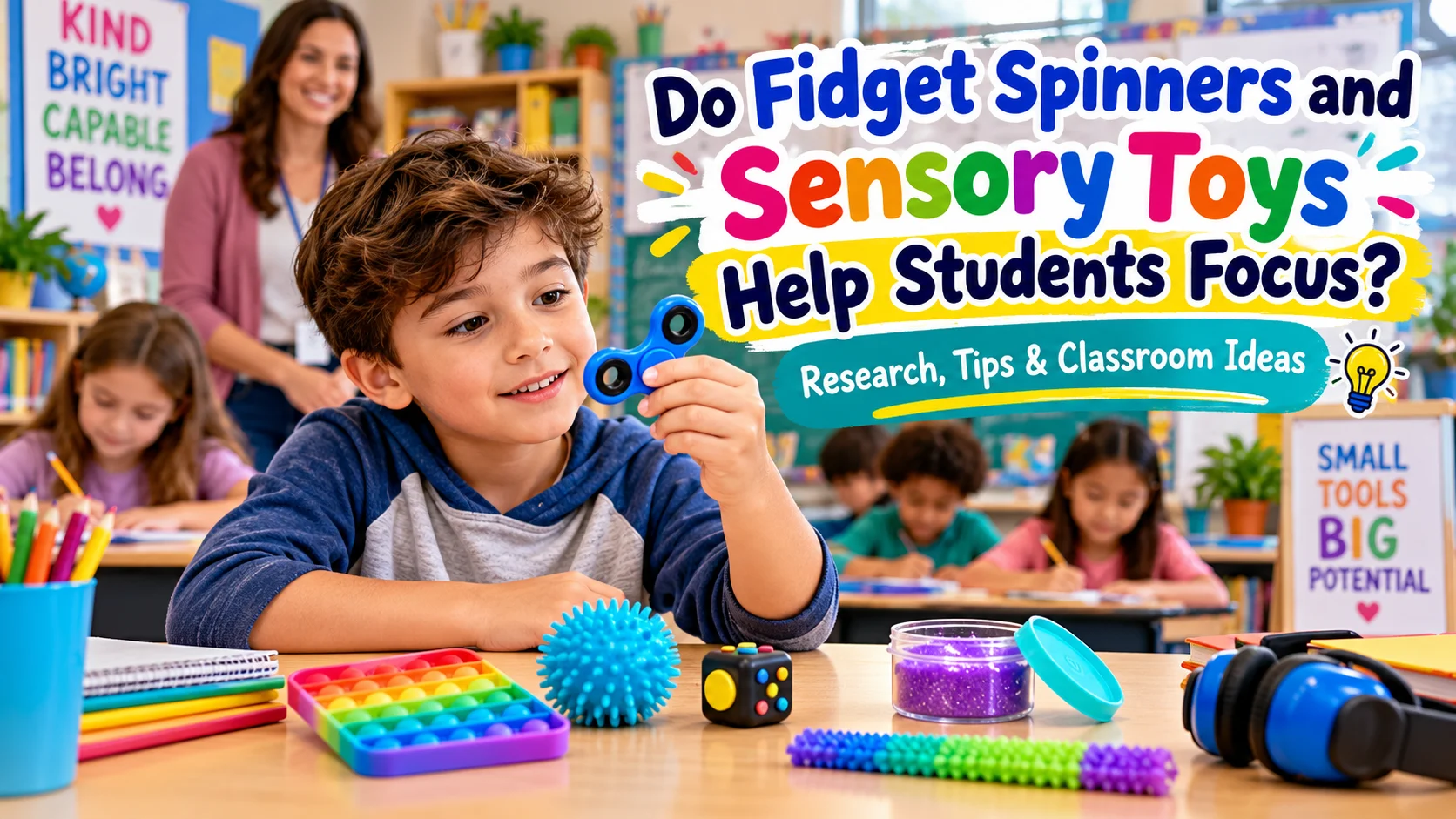
Fidget spinners and sensory toys are small objects designed to provide physical or sensory engagement through movement, touch, pressure, or manipulation.
A traditional fidget spinner has a central bearing and rotating arms. Children hold the center and spin the outer section with their fingers.
Sensory toys include a wider variety of objects that provide different tactile experiences.
Common examples include:
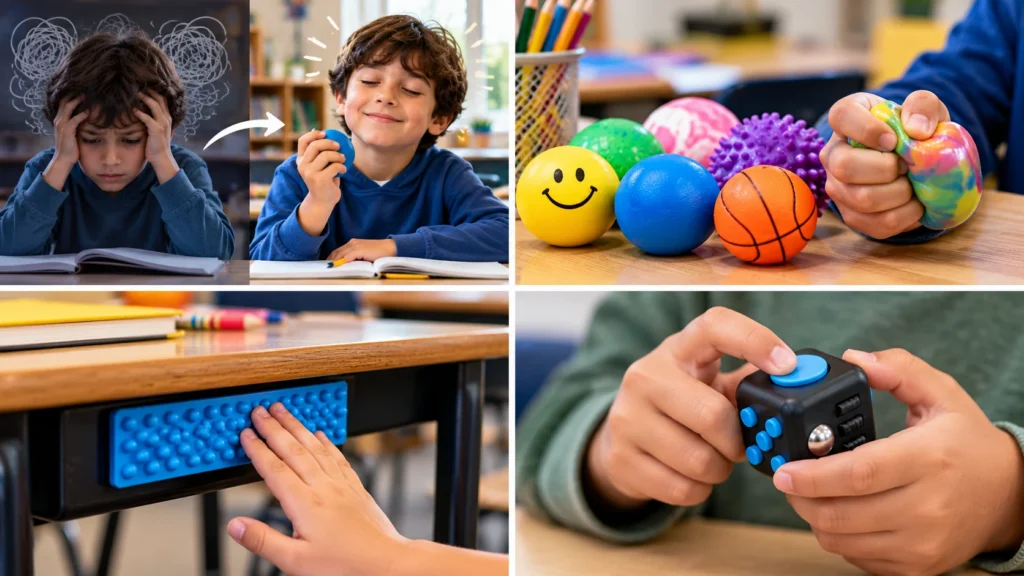
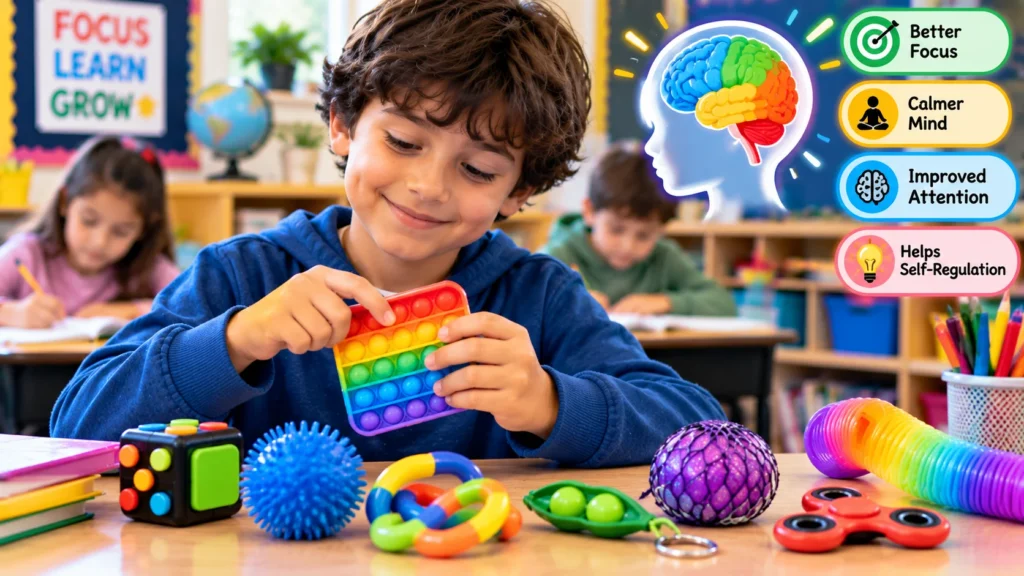
- Stress balls: Soft objects students squeeze and release.
- Fidget cubes: Small devices with buttons, switches, or rotating components.
- Pop-it toys: Silicone objects with bubbles that can be pressed repeatedly.
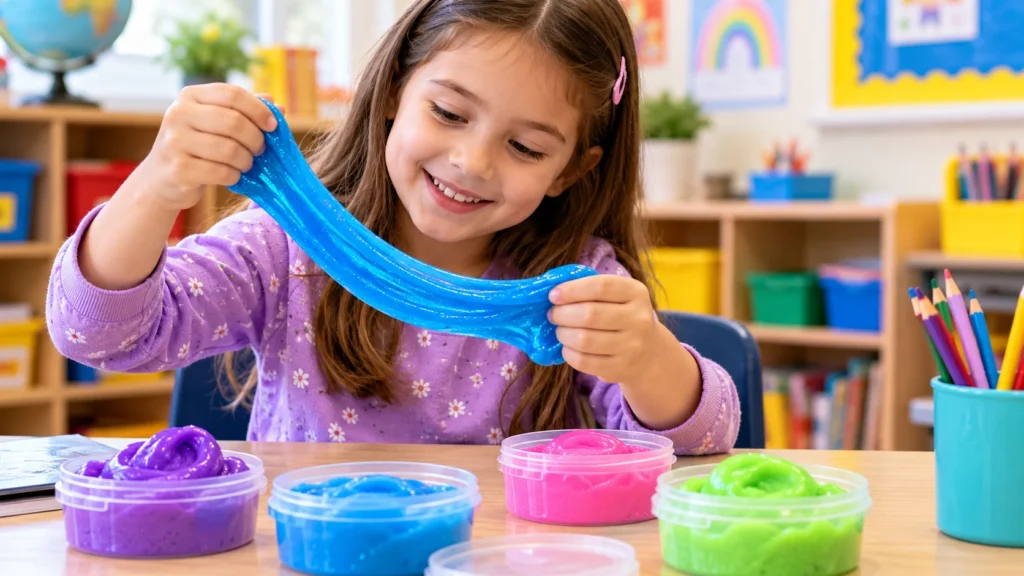
- Sensory putty: Moldable material that children stretch, squeeze, and manipulate.
- Textured sensory strips: Small surfaces students rub with their fingers.
- Tangle toys: Connected curved pieces that twist into different shapes.
These objects provide different types of movement and sensory input. However, enjoying a sensory experience does not automatically mean a child is concentrating better.
Why Do Students Like Fidget Toys?
Children naturally explore their environments through movement and touch. During lessons, some students find it uncomfortable to keep their hands completely still.
Repetitive movements may feel familiar, enjoyable, or calming. A child might squeeze a soft ball while listening to a story or quietly move their fingers against a textured surface while completing a worksheet.
Other students may become fascinated by a toy’s colors, movement, or texture.
The important distinction is whether the object supports participation in the lesson or competes for the student’s attention.
Do Fidget Spinners Actually Help Students Focus?
Research suggests that fidget spinners are not a reliable solution for improving student concentration.
A meta-analysis published in School Psychology Review in 2025 examined 10 studies involving 509 participants. Researchers investigated the academic and behavioral effects of fidget devices, including handheld toys and stability balls.
The overall effects were negligible, suggesting that providing fidget devices to groups of students does not consistently improve classroom learning or behavior.
Individual studies have also produced different results.
One small study involving three second-grade students with ADHD reported increased on-task behavior when the children used fidget spinners under structured classroom rules.
However, another investigation involving young children with ADHD found that fidget spinner use was associated with poorer attention.
These findings highlight an essential point:
“A tool that appears helpful for one student may not benefit another.“

Why Might Fidget Toys Help Some Students?
A small object may provide a manageable activity for a student’s hands during a lesson.
For example, consider two hypothetical students:
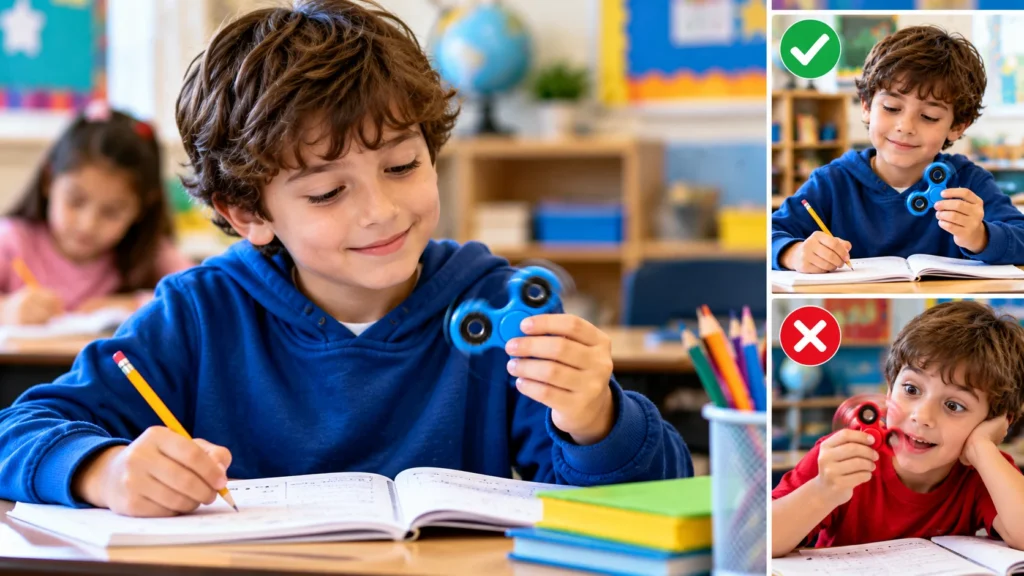
Student A: During reading time, Mia repeatedly taps her pencil against the desk. Her teacher offers a quiet textured strip attached beneath the desk. Mia rubs the surface occasionally while continuing to read.
Student B: During the same activity, Noah receives a colorful fidget spinner. He repeatedly watches the spinning blades and invites classmates to look at them.
Both students are using sensory objects, but their engagement with the academic task is different.
Mia’s tool may be worth evaluating because it allows her to continue reading without creating an obvious distraction. Noah’s spinner appears to interfere with the activity.
These examples are illustrations, not proof that one type of sensory toy will always work better.
Does Less Fidgeting Mean Better Concentration?
Not necessarily.
A child who stops moving is not automatically paying more attention. Similarly, a child who occasionally shifts position may still be listening, understanding instructions, and completing assignments.
Teachers should evaluate meaningful learning behaviors rather than judging concentration by physical stillness alone.
Useful indicators include whether students:
- Follow instructions and begin assignments.
- Remain engaged with the learning activity.
- Complete work with appropriate accuracy.
- Respond when the teacher checks understanding.
- Avoid distracting themselves or their classmates.
The goal is not to eliminate movement. It is to create conditions that support successful learning.

Can Fidget Spinners Help With Anxiety?
The relationship between fidget spinners and anxiety is another common concern among parents and educators.
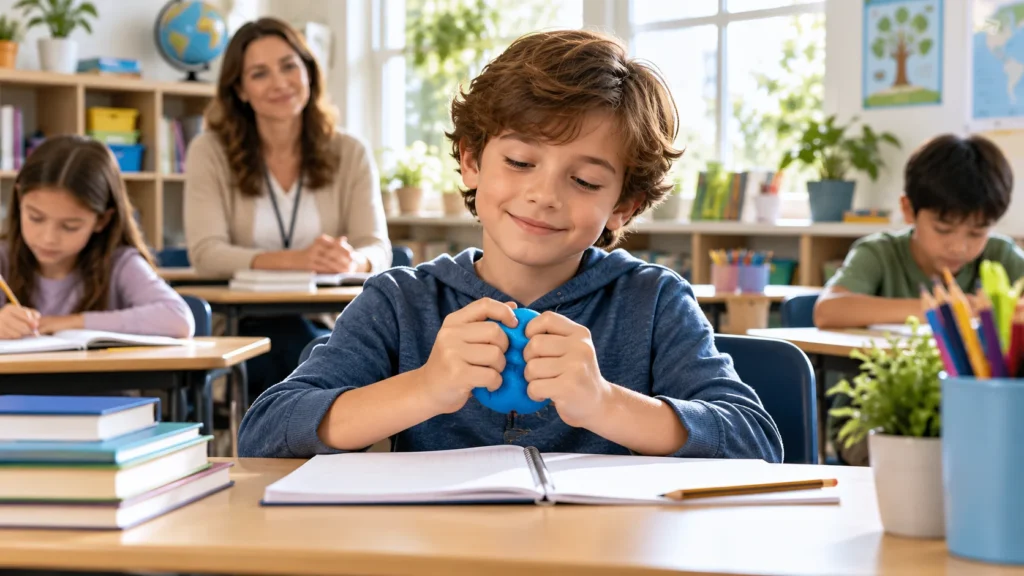
Some children describe repetitive movements as comforting. Squeezing a soft object or moving a small toy may give them a familiar activity during stressful situations. For example, a student waiting to give a classroom presentation might find it comforting to hold a soft stress ball.
However, feeling calmer in a particular situation is different from demonstrating a measurable reduction in anxiety symptoms.
There is insufficient strong evidence to recommend fidget spinners as a treatment for anxiety disorders.
Why Might Repetitive Movement Feel Calming?
Repeating a familiar movement can provide a predictable sensory experience.
Some children prefer squeezing soft materials. Others enjoy gently pressing textured surfaces or moving their fingers across an object.
These preferences differ widely.
A sensory toy may serve as a personal comfort item, but it should not replace emotional support, anxiety-management strategies, or professional care when needed.
When Should Teachers Be Concerned?
Occasional nervousness before a test or classroom presentation is common.
However, if a student frequently experiences intense worry, avoids school activities, or has anxiety that significantly interferes with learning, teachers should communicate with parents and appropriate school support professionals. A fidget toy can be considered as one possible comfort tool, not as a diagnosis or treatment.
Sensory Toys for Focus: Which Options Are Classroom-Friendly?
Not all sensory toys are equally practical in a learning environment.
Some make noise, require visual attention, or contain materials that need frequent cleaning. Others are discreet enough to use without interrupting nearby students.
Teachers should consider the learning activity, the child’s age, and individual preferences before choosing a sensory tool.
| Sensory toy | Classroom characteristics | Possible drawbacks |
|---|---|---|
| Soft stress ball | Usually quiet and simple to squeeze | May be thrown or rolled |
| Textured sensory strip | Discreet and generally silent | May not appeal to every student |
| Fidget cube | Provides several finger movements | Clicking features can make noise |
| Sensory putty | Offers stretching and squeezing activities | Can leave residue or require cleanup |
| Pop-it toy | Provides repetitive pressing movements | Some models make noticeable sounds |
| Fidget spinner | Easy to manipulate | Spinning motion may attract visual attention |
| Tangle toy | Allows continuous twisting movements | Pieces may detach, depending on design |
1. Stress Balls for Quiet Hand Movement
Soft stress balls are simple objects that students can squeeze without needing to watch them continuously.
They may be convenient during listening activities or independent work.
Choose durable, age-appropriate options and inspect them regularly for damage. Avoid products with detachable components or contents that could create safety concerns.

2. Textured Sensory Strips for Discreet Use
Textured strips can be attached to a desk or another approved classroom surface.
Students can touch the material without holding a separate object.
This reduces the need to pick up, share, or display a toy during instruction.
Before introducing textured strips, check that the materials are comfortable, cleanable, and suitable for the student’s sensory preferences.

3. Fidget Cubes for Finger Movement
Fidget cubes provide several small movements, such as rolling, pressing, and switching.
A student might prefer one movement over another.
However, some cube features make clicking sounds, which may distract classmates during silent reading or testing.
4. Sensory Putty for Supervised Activities
Sensory putty offers resistance when squeezed or stretched.
It may be enjoyable during scheduled sensory breaks or supervised activities.
However, putty is less convenient during writing assignments because students generally need their hands for pencils, papers, and books.
Teachers must also consider cleanliness, classroom materials, and individual safety needs.
5. Fidget Spinners for Limited Situations
Fidget spinners are visually engaging and easy to operate.
That same spinning motion can make them unsuitable for lessons requiring sustained visual attention.
If a teacher allows a spinner, its use should be intentional, limited, and evaluated against the student’s actual engagement with schoolwork.
Practical takeaway: The most appropriate sensory toy is not necessarily the most popular or colorful one. It is the tool that fits a student’s needs while interfering as little as possible with learning.
Are Fidget Toys Helpful for Students With ADHD?
Children with attention-deficit/hyperactivity disorder (ADHD) may experience challenges with sustained attention, impulse control, organization, or activity levels.
Some students with ADHD find movement helpful, while others become more distracted when additional objects are introduced.
This is why fidget toys should never be considered a universal ADHD intervention.
Research on classroom fidget devices has produced mixed results, and the strongest available evidence does not establish these toys as consistently effective attention supports.
The Centers for Disease Control and Prevention identifies behavioral classroom management and organizational training among the school-based strategies supported by research for students with ADHD.
Other classroom supports may include:
- Clear and manageable instructions.
- Predictable routines and transitions.
- Positive feedback and reinforcement.
- Opportunities for movement breaks.
- Reduced environmental distractions.
- Appropriate classroom accommodations.
Should Every Student With ADHD Have a Fidget Toy?
No. A child’s diagnosis alone does not determine which sensory tool will be useful.
One student may prefer a quiet handheld object. Another may benefit more from movement breaks, visual schedules, or changes to the learning environment.
Teachers should work with families and relevant school professionals when choosing supports.
If a student’s Individualized Education Program (IEP) or Section 504 plan includes an accommodation, classroom decisions should follow that plan and the school’s established procedures. Sensory tools should complement appropriate educational support rather than replace it.
When Do Sensory Toys Become a Classroom Distraction?
Even quiet objects can become distracting when students focus more on manipulating them than on completing assignments.
For example, a student may begin a worksheet while holding a pop-it toy but repeatedly stop writing to press every bubble.
Another student might constantly exchange fidget toys with classmates.
Neither situation demonstrates that the object is helping concentration.
Signs a Fidget Toy May Be Interfering With Learning
Teachers should look for repeated patterns such as:
- Watching the toy instead of instructional materials.
- Stopping work frequently to manipulate it.
- Making sounds that interrupt nearby students.
- Sharing or trading toys during lessons.
- Becoming upset when asked to follow established usage rules.
- Completing less work or making more errors while using the tool.
A single incident does not necessarily mean the tool is unsuitable. However, repeated disruption is a reason to reconsider how and when it is used.
Should Fidget Spinners Be Banned From Classrooms?
A blanket ban may be unnecessary in every setting, but unlimited use can also create problems.
A more practical approach is to distinguish between free-time toys and approved learning supports.
Teachers can establish rules about when particular objects may be used, where they should be kept, and how students are expected to handle them.
Individual accommodations should be considered separately from general classroom toy policies.
Are Smelly Markers Useful for Sensory Learning?
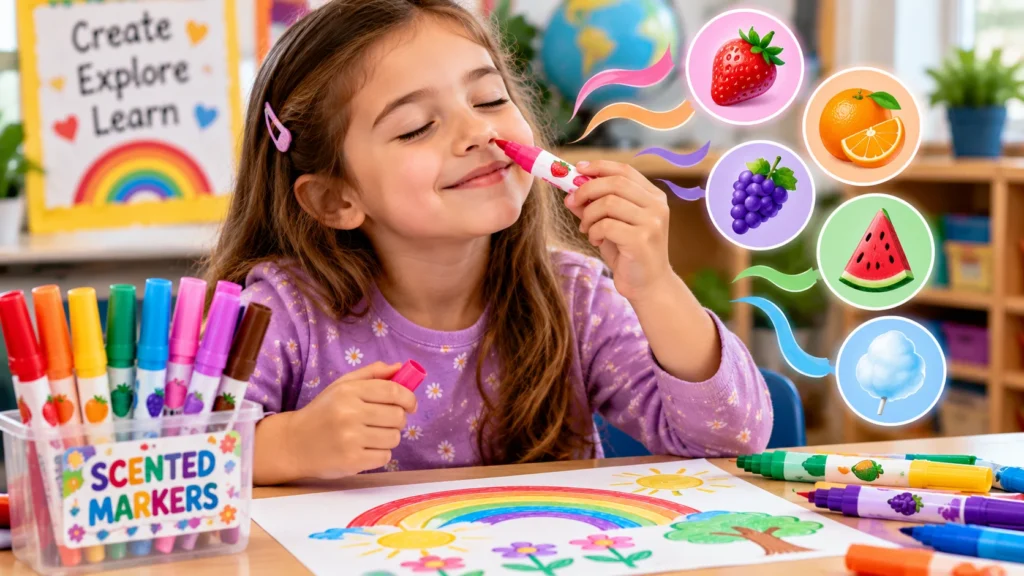
Colorful smelly markers, also called scented markers, are popular art supplies designed to release recognizable fragrances during use.
Children may enjoy matching scents with colors, drawing pictures, or using scented markers during creative activities.
Because scented markers combine color, movement, and smell, they are sometimes discussed as multisensory classroom materials.
However, there is no strong evidence that scented markers themselves improve concentration or academic performance.
Creative Activities Using Scented Markers
Where school policies permit their use, scented markers can be incorporated into ordinary art activities.
For example, children might draw fruits using matching colors or create a picture of a garden.
Teachers can also use markers for supervised color-recognition and descriptive-language activities, although scents are not necessary to achieve these learning goals.
These activities are primarily creative and educational rather than proven focus interventions.
Important Safety Considerations
Scented products may cause discomfort or respiratory symptoms for individuals sensitive to fragrances.
Students with asthma, fragrance sensitivities, or certain other health concerns may require fragrance-free classroom environments.
The American Academy of Pediatrics’ HealthyChildren guidance favors water-based, unscented markers for children.
Teachers should follow school policies, check relevant student health plans, select age-appropriate supplies, and avoid encouraging children to deliberately inhale marker fragrances.
For most classrooms, unscented washable markers are a sensible default choice.
How to Introduce Fidget Toys in the Classroom
A successful classroom sensory-tool system starts with clear expectations, not a large collection of toys.
Rather than distributing fidget spinners to every student, teachers can evaluate whether a specific tool helps a particular child during a particular activity.
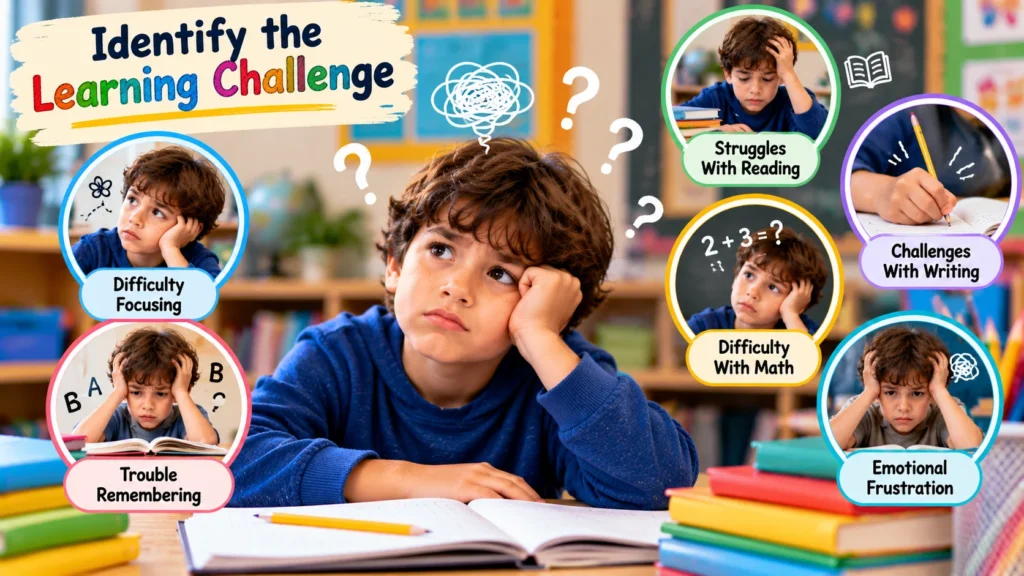
Step 1: Identify the Learning Challenge
Start by observing what makes a task difficult.
Does the student struggle to begin assignments? Become restless during long lessons? Lose attention during independent reading?
Describe the behavior without assuming the reason behind it.
For example, “The student leaves the reading task several times” is more useful than “The student cannot focus because they need a fidget toy.”
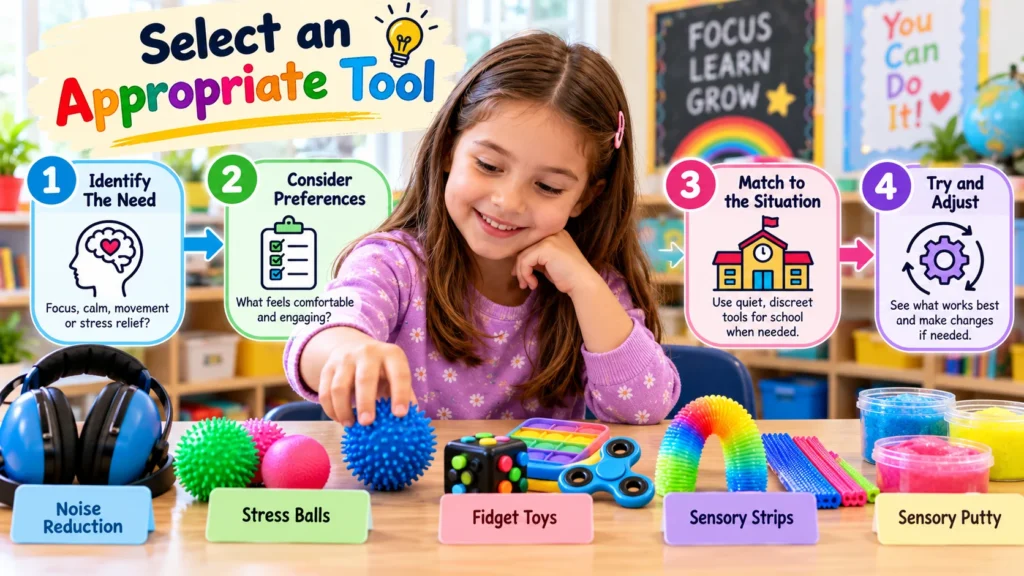
Step 2: Select an Appropriate Tool
Choose something safe, reasonably quiet, and suitable for the task.
A textured desk strip might be practical during listening activities, while sensory putty may be more appropriate during a scheduled break.
Account for age, swallowing risks, sensory preferences, cleaning requirements, and individual accommodations.
Step 3: Establish Clear Classroom Rules
Students need to understand that a learning support is not the same as a toy for unrestricted play.
Sample rules might include:
- Keep the tool in your own workspace.
- Use it without interrupting others.
- Continue listening or working while using it.
- Do not throw, trade, or dismantle the tool.
- Tell the teacher if the tool becomes distracting or uncomfortable.
Classroom rules should remain flexible enough to respect individual support plans.
Step 4: Observe What Changes
Before introducing a sensory tool, observe the student’s participation during several comparable activities.
Then introduce the tool and track the same behaviors.
A simple observation sheet may include:
| Observation | Without tool | With tool |
|---|---|---|
| Began the assignment promptly | ||
| Remained engaged during work | ||
| Completed the assigned task | ||
| Needed repeated reminders | ||
| Interrupted nearby students | ||
| Reported feeling comfortable |
Teachers might compare brief, similar reading or writing periods across several days.
The results should be interpreted cautiously because classroom performance can change due to task difficulty, fatigue, mood, teaching methods, and other factors.
This is a practical observation strategy, not a scientific experiment or diagnostic assessment.
Step 5: Review and Adjust
After a short trial, ask whether the student appears more engaged with learning.
Consider the student’s own feedback, work completion, and the effect on classmates.
If the toy causes repeated interruptions, try a different option or another type of support.
A tool does not need to remain in use simply because it was introduced.
How Can Teachers Tell Whether a Sensory Toy Is Helping?
The most useful question is not whether a student enjoys a sensory toy.
It is whether the toy helps the student participate successfully in the activity for which it was introduced.
Teachers can evaluate three important areas.
Academic Engagement
Does the student spend more time attending to instructions, reading, writing, or completing the assigned task?
Look beyond simple physical stillness.
Classroom Participation
Does the student follow established routines without repeatedly interrupting classmates?
A sensory tool should fit within the classroom environment or an agreed individual accommodation.
Student Comfort
Does the student find the tool comfortable, useful, and easy to manage?
Students should have opportunities to describe what helps them.
Their feedback should be considered alongside classroom observations.
A Practical Classroom Example
Imagine a second-grade student who frequently leaves an independent reading task unfinished.
The teacher introduces a quiet textured strip and explains how it may be used while reading.
Over the following week, the teacher observes that the student completes more of the assigned reading with fewer reminders.
This would be a reason to continue evaluating the strategy.
It would not prove that textured strips improve concentration for all second-grade students.
The teacher should also consider whether other changes, such as easier reading material or additional guidance, contributed to the improvement.
The purpose is to make a thoughtful educational decision based on the individual student.
Safety Tips for Choosing Classroom Sensory Toys
Safety should be considered before introducing any fidget or sensory device.
The U.S. Consumer Product Safety Commission has warned that some fidget spinners contain small components that may create choking hazards, particularly for young children.
Teachers and parents should follow several basic precautions:
- Check manufacturer age recommendations.
- Avoid damaged toys or objects with easily detachable components.
- Keep small parts away from children who may put objects in their mouths.
- Avoid exposed batteries, loose magnets, and other potentially hazardous components.
- Inspect shared materials and follow cleaning procedures.
- Consider allergies and sensitivities when selecting materials.
- Supervise use according to the child’s age and developmental needs.
Products should be chosen for the actual students using them rather than simply because they are marketed as sensory or educational toys.
Frequently Asked Questions
Do fidget spinners really improve concentration?
Research has not established that fidget spinners consistently improve concentration. Some small studies have found benefits for particular students, while other research has reported poorer attention or negligible overall effects.
Teachers should evaluate individual outcomes instead of assuming that spinners will help everyone.
Can fidget spinners reduce anxiety in children?
Some children may find repetitive movements comforting, but there is not enough strong evidence to recommend fidget spinners as a treatment for anxiety disorders.
Persistent anxiety should be addressed with appropriate support.
What are the best sensory toys for focus in classrooms?
Quiet, age-appropriate objects such as soft stress balls, textured desk strips, and selected tactile tools may be practical options.
However, no single sensory toy has been established as the best choice for improving classroom focus.
Are fidget toys good for students with ADHD?
They may be useful for certain students, but results vary. Research does not support using fidget toys as a replacement for evidence-based ADHD interventions.
Teachers should consider individual needs and coordinate with parents and school support staff.
Do fidget toys distract other students?
They can, particularly when they make noise, attract visual attention, or encourage sharing during lessons.
Clear usage expectations and careful tool selection can help reduce unnecessary interruptions.
Should teachers allow fidget spinners during lessons?
Teachers should consider school policies, the individual student’s needs, and the activity being taught.
A supervised trial may be appropriate in some circumstances, but unrestricted spinner use is not necessary for effective learning.
Do smelly markers help children concentrate?
There is no strong evidence that scented markers improve concentration.
They may be enjoyable art supplies, but unscented alternatives are often preferable, particularly in classrooms where students have fragrance sensitivities or asthma.
Are sensory toys suitable for kindergarten students?
Some sensory toys are suitable for kindergarten-aged children when they meet age and safety requirements.
Teachers should avoid small detachable pieces, supervise activities appropriately, and select tools that match each child’s developmental need.