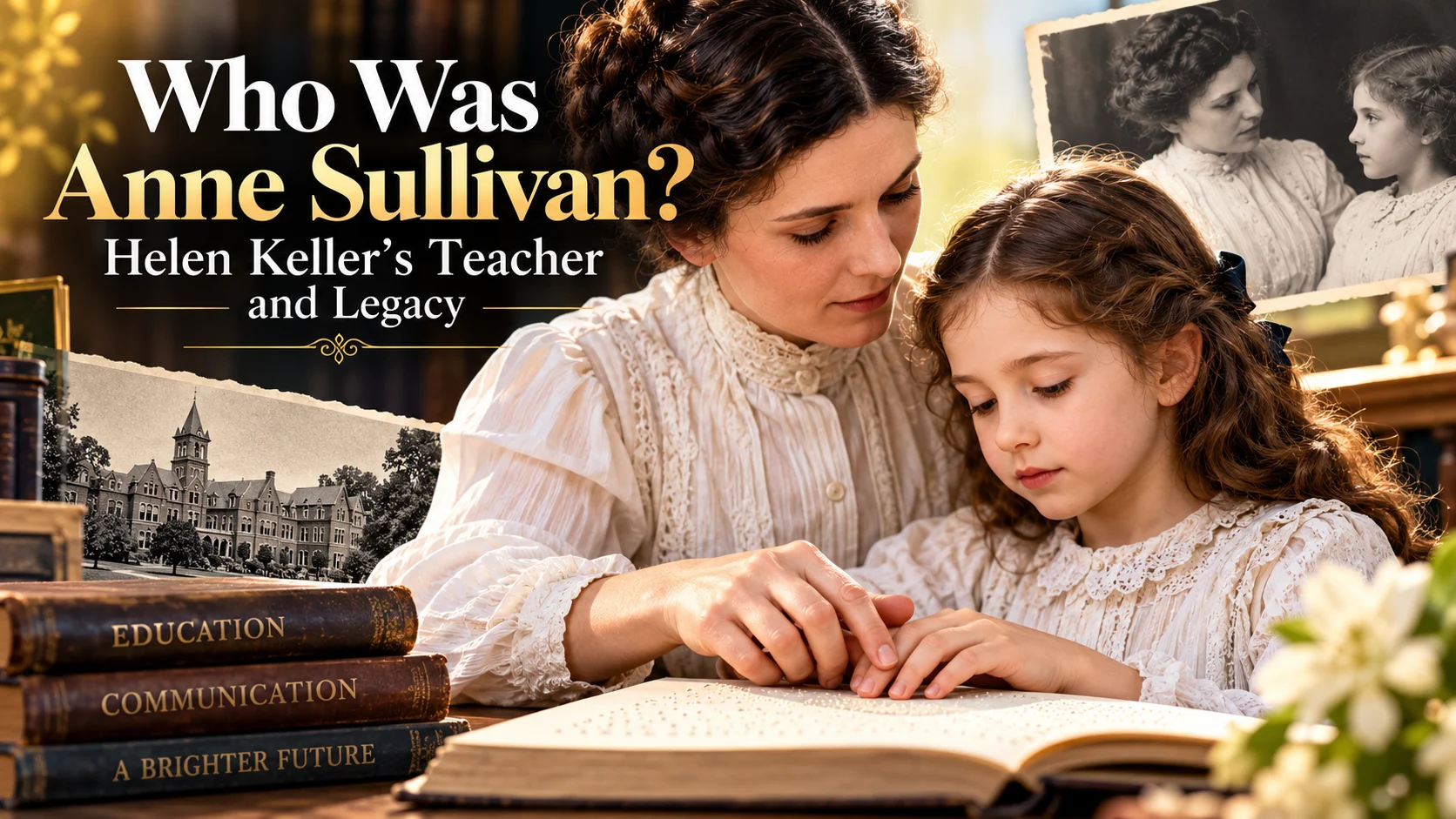

Anne Sullivan (1866–1936) was an American educator best known as Helen Keller’s teacher. Despite experiencing severe vision loss during childhood, Sullivan became a skilled teacher who helped Keller develop language, communication, and academic skills.
Born into poverty in Massachusetts, Anne Mansfield Sullivan faced serious hardships before graduating from the Perkins School for the Blind in 1886. Just one year later, she began teaching Helen Keller, a young girl who was deafblind.
Their partnership became one of the most recognized teacher-student relationships in American history. But Anne Sullivan’s life was more than the famous story of Helen Keller and the water pump. Her journey reveals the importance of accessible education, individualized teaching, and recognizing every student’s ability to learn.
Who Was Anne Sullivan?
Anne Mansfield Sullivan, often called Annie Sullivan, was an American teacher born on April 14, 1866, in Feeding Hills, Massachusetts.
She became internationally known for teaching Helen Keller, who lost her sight and hearing after an illness during infancy.
Sullivan’s success was especially remarkable because she had experienced severe visual impairment herself. Her childhood included poverty, the loss of family members, and years without a formal education.
Nevertheless, she eventually graduated at the top of her class from the Perkins School for the Blind.
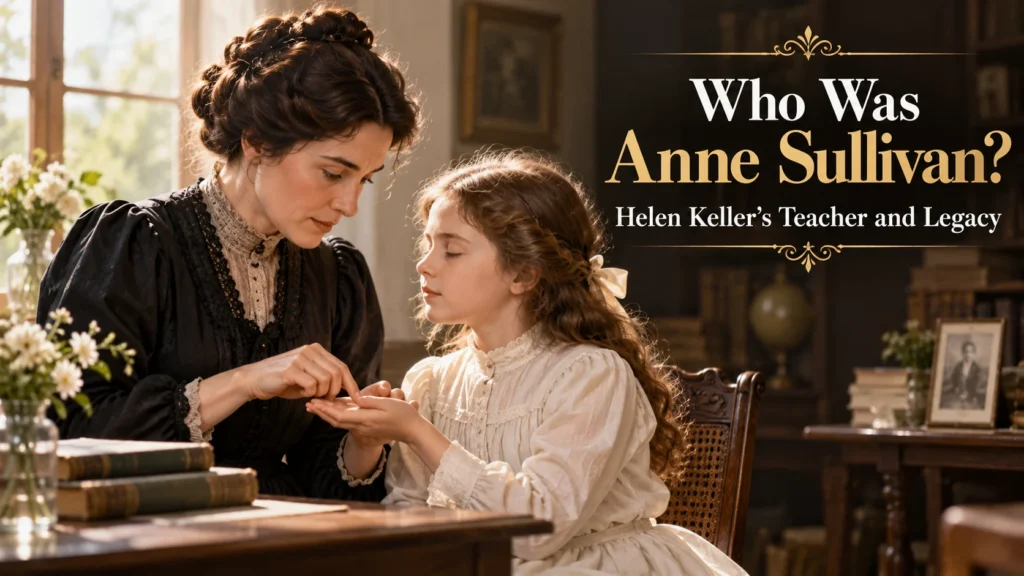
In March 1887, she traveled to Tuscumbia, Alabama, to begin teaching Helen Keller. Through tactile fingerspelling, meaningful everyday experiences, and individualized instruction, she helped Keller understand and use language.
Sullivan remained Keller’s teacher and close companion for decades. Her teaching achievements made her an important figure in the history of disability education.
Anne Sullivan: Quick Facts
| Fact | Details |
|---|---|
| Full name | Anne Mansfield Sullivan |
| Also known as | Annie Sullivan, Anne Sullivan Macy |
| Date of birth | April 14, 1866 |
| Birthplace | Feeding Hills, Massachusetts, USA |
| Nationality | American |
| Profession | Educator and teacher |
| Known for | Teaching Helen Keller |
| Education | Perkins School for the Blind |
| Began teaching Keller | March 3, 1887 |
| Spouse | John Albert Macy |
| Date of death | October 20, 1936 |
| Age at death | 70 years |
Anne Sullivan’s Early Life and Childhood Challenges
Anne Sullivan’s childhood was very different from the life people might imagine for a famous teacher.
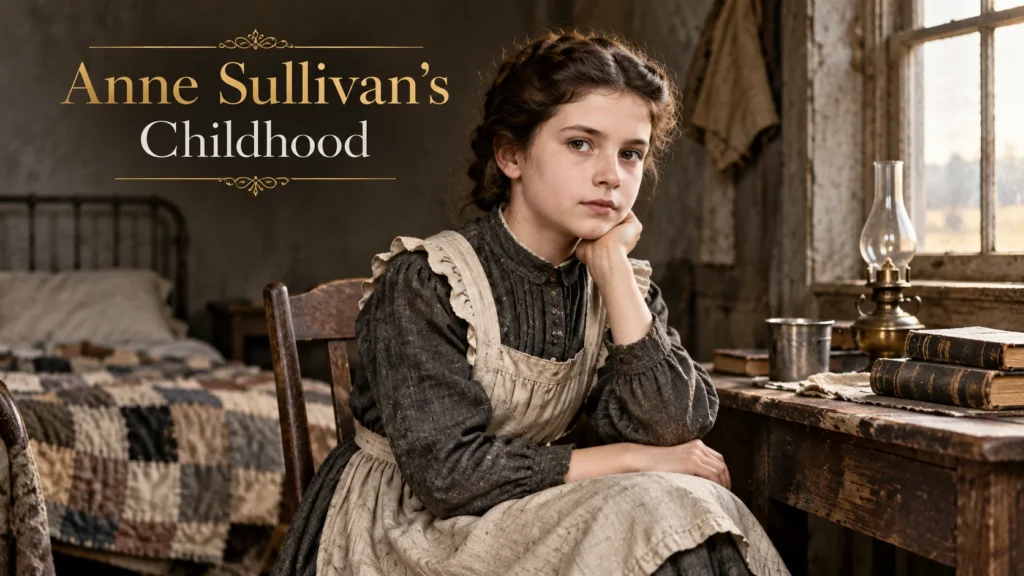
Her parents, Thomas and Alice Sullivan, were Irish immigrants who settled in Massachusetts. The family struggled financially, and Anne experienced hardship from an early age.
When she was around five years old, she developed trachoma, a serious bacterial eye infection that damaged her vision.
Life became even more difficult after her mother died when Anne was about eight. Her father later abandoned the children.
Anne and her younger brother, Jimmie, were sent to the Tewksbury Almshouse, an institution for people experiencing poverty.
Conditions there were harsh. The building was overcrowded, sanitation was poor, and the residents often lacked appropriate care.
Tragically, Jimmie died shortly after arriving.
Anne was left without close family support and with very limited educational opportunities.
How Anne Sullivan Found an Opportunity to Study
While living at Tewksbury, Anne learned that schools existed for children who were blind. The possibility of attending school gave her a new goal.
In 1880, officials visited the almshouse to investigate its conditions. Anne approached one of the visitors and explained that she wanted an education.
Her request helped secure her admission to the Perkins Institution for the Blind.
On October 7, 1880, at age 14, Anne entered Perkins.
She had little formal knowledge of reading or writing, but she was determined to learn.
That opportunity changed the direction of her life.
Anne Sullivan experienced severe vision impairment throughout her life, but her eyesight was not completely absent at every stage.
Her vision problems began when she developed trachoma during childhood.
Trachoma is a bacterial infection that can cause repeated inflammation and scarring of the eyes. Without effective treatment, the condition can result in serious vision loss.
Anne underwent several eye operations. Some treatments offered little improvement, while a later operation helped restore enough sight for her to read printed text.
Even after treatment, she continued to experience difficulties with her eyes.
Her own experiences gave her personal insight into some of the obstacles faced by people with visual impairments.
Was Anne Sullivan Blind?
However, Sullivan’s success as a teacher also came from her education, intelligence, careful observation, and willingness to adapt established teaching methods.
The important distinction: Anne Sullivan had serious visual impairment, but her level of sight changed over time.
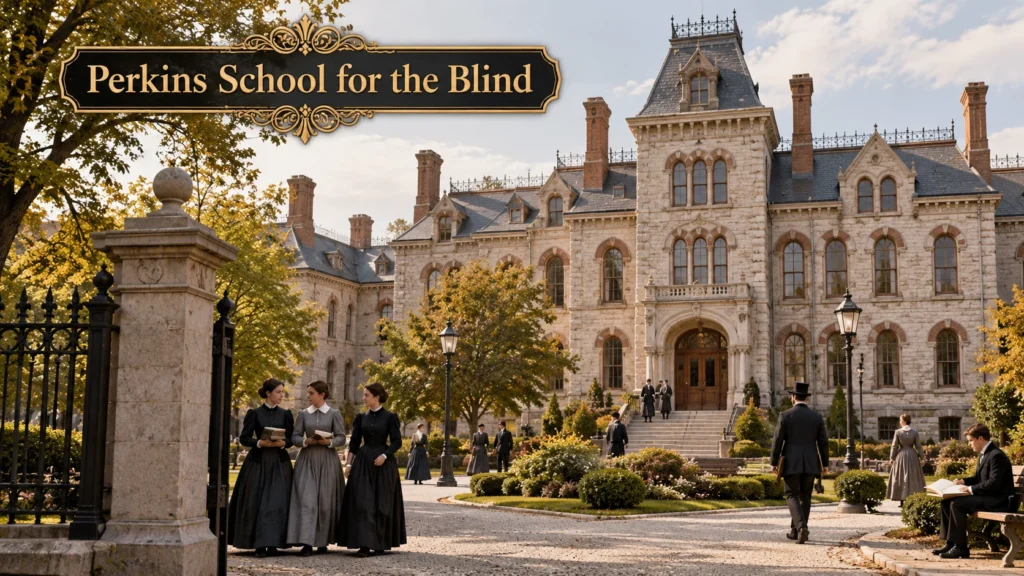
Anne Sullivan’s Education at Perkins School for the Blind
Anne Sullivan began her education at Perkins in 1880.
Adjusting to school was challenging.
Most of her classmates had received some education before arriving. Anne, however, had spent years in an almshouse without regular lessons.
She initially struggled academically and socially.
Some classmates made fun of her lack of knowledge, while certain teachers found her behavior difficult.
Despite these challenges, Anne made substantial progress.
She improved her reading and writing, developed strong academic skills, and became one of the school’s most accomplished students.
Who Helped Teach Anne Sullivan?
Several individuals played important roles in Sullivan’s education.
Sophia Hopkins, a housemother at Perkins, became an important mentor and source of emotional support.
Sullivan also developed a friendship with Laura Bridgman, a woman who was deafblind and had been educated at Perkins.
Bridgman had learned to communicate using a tactile manual alphabet. Sullivan learned this alphabet from her and gained valuable familiarity with communication methods used by people who were deafblind.
She also studied the educational work of Samuel Gridley Howe, who had taught Bridgman.
These experiences helped prepare Sullivan for the teaching opportunity that would follow.
Graduating at the Top of Her Class
In June 1886, Anne Sullivan graduated from Perkins as the class valedictorian.
This achievement was remarkable considering that she had entered the school six years earlier with almost no formal education.
Her graduation showed how much she had learned and how her determination had developed into academic excellence.
Soon afterward, Sullivan received an opportunity to teach a young girl in Alabama.
That student was Helen Keller.
How Did Anne Sullivan Become Helen Keller’s Teacher?
Helen Keller was born on June 27, 1880, in Tuscumbia, Alabama.
When she was 19 months old, an illness left her deaf and blind. The exact illness was never conclusively identified.
Helen was an intelligent and curious child who developed ways to communicate her needs through gestures and physical interaction.
However, without access to a shared language, she often became frustrated when others could not understand her.
Her parents, Arthur and Kate Keller, searched for someone who could help their daughter learn more effective communication.
They eventually consulted Alexander Graham Bell, who had experience working in deaf education.
Bell recommended contacting Michael Anagnos, the director of Perkins School for the Blind.
Anagnos selected Anne Sullivan, a recent graduate whose abilities and determination had impressed him.
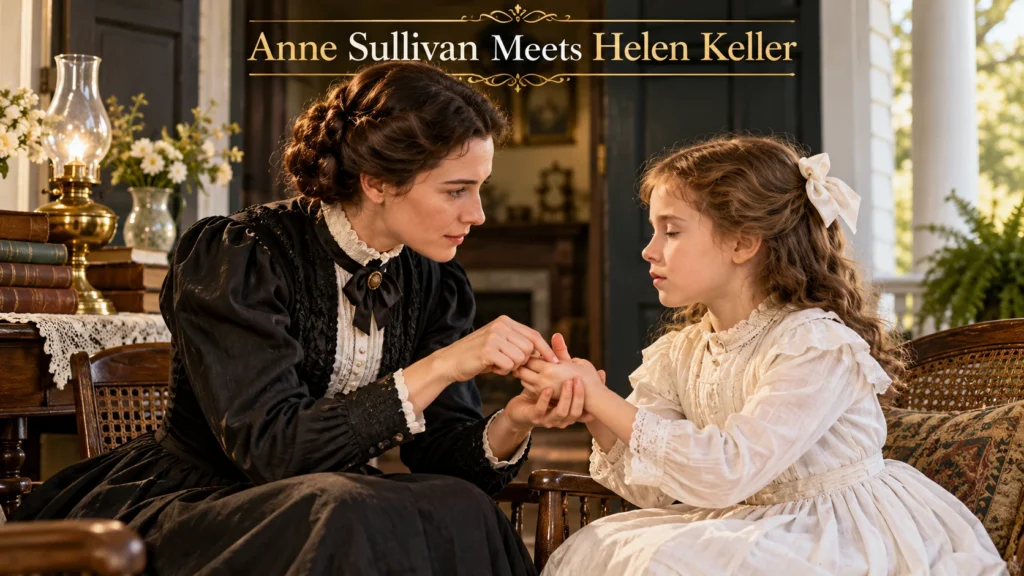
Anne Sullivan Meets Helen Keller in 1887
On March 3, 1887, Anne Sullivan arrived at the Keller family home in Alabama.
She was 20 years old, only a few weeks away from her 21st birthday. Helen was six and would turn seven that June.
Their early lessons were difficult.
Although Helen understood familiar gestures, she had not yet learned how to use a conventional language system to communicate detailed ideas.
Anne began spelling words into Helen’s hand using the manual alphabet.
Initially, Helen could imitate some of the movements without understanding that they represented meaningful words.
Sullivan needed to find a way to connect those hand movements with Helen’s experiences.
Her solution helped create a turning point in Keller’s education.
Helen Keller and Anne Sullivan: A Remarkable Partnership
The relationship between Helen Keller and Anne Sullivan developed through teaching, trust, persistence, and shared experiences.
Sullivan recognized that Keller was curious about the world and capable of learning.
Rather than expecting Helen to learn through sight or hearing, she taught language through touch.
She also discovered that Keller responded better when lessons were connected to objects, activities, and experiences that interested her.
For example, Sullivan could spell the name of an object into Helen’s hand while allowing her to touch and explore it.
This approach helped connect abstract language with physical experiences.
As Keller’s understanding developed, Sullivan continued expanding her vocabulary and introducing increasingly complex ideas.
Their work gradually moved beyond basic communication into reading, writing, mathematics, and other academic subjects.
Why Their Relationship Was Important
Sullivan did not simply teach Keller to recognize individual words.
She helped her gain access to a structured language system that made more advanced learning possible.
Over time, Keller became a successful student, author, lecturer, and advocate for the rights of people with disabilities.
Sullivan played a major role in supporting that development.
Still, Keller’s accomplishments also reflected her own intelligence, curiosity, discipline, and determination.
Their partnership is best understood as a collaboration between a highly skilled educator and an exceptionally capable student.
How Did Anne Sullivan Teach Helen Keller to Communicate?
Anne Sullivan’s teaching methods were especially effective because she connected language to experiences that Helen could understand through touch.
She used tactile fingerspelling, physical objects, repetition, and activities from everyday life.
One lesson became particularly famous.
1): The Famous Water Pump Breakthrough:
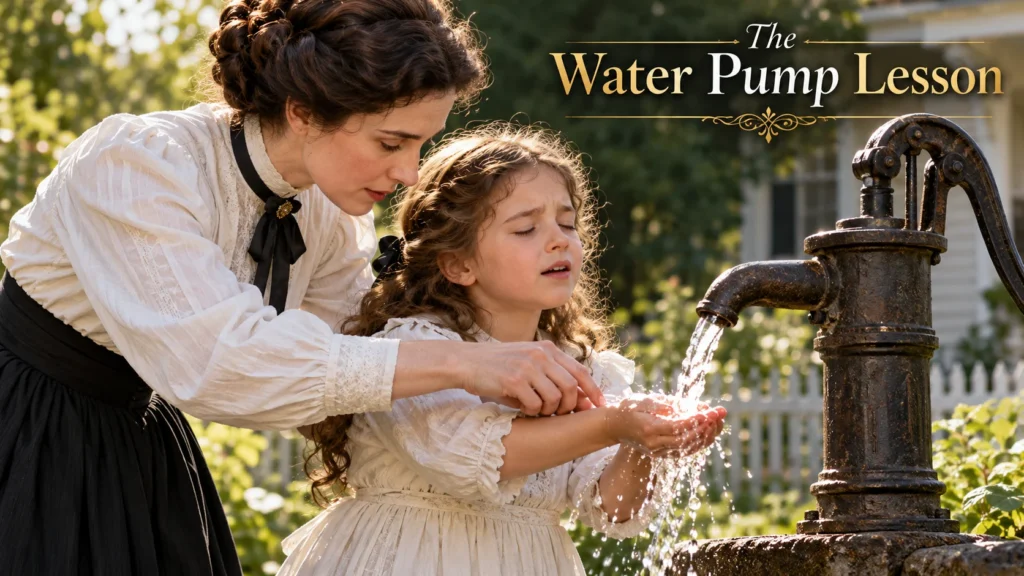
On April 5, 1887, Sullivan took Keller to a water pump outside the family home.
As water flowed over one of Helen’s hands, Sullivan spelled the letters W-A-T-E-R into her other hand.
At that moment, Keller understood that the sequence of movements represented the water she was feeling.
She began to recognize that objects and experiences could have names expressed through language.
This discovery changed how she understood communication.
Helen later described the event in her autobiography, The Story of My Life.
The experience became one of the most frequently discussed moments in educational history.
However, the water-pump lesson was not an isolated miracle.
It followed weeks of instruction and was part of a much longer process of developing language.
2): Fingerspelling and Learning Through Touch:
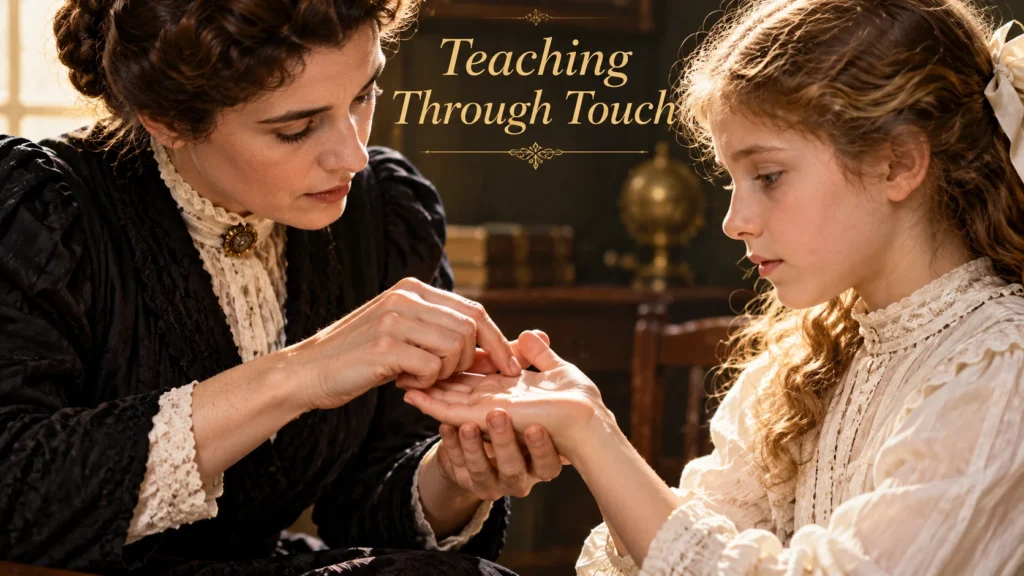
Fingerspelling uses different hand positions to represent letters.
For Helen Keller, Sullivan formed these letters against her hand so she could recognize them through touch.
For example, Sullivan could place a familiar object in Helen’s hand and then fingerspell its name.
Through repeated experiences, Keller developed connections between words, objects, actions, and ideas.
Once she understood that words had meaning, her vocabulary expanded rapidly.
Sullivan also introduced books with raised letters, Braille, writing activities, and increasingly advanced educational materials.
The goal was not simply to memorize words. It was to use language to ask questions, express ideas, and understand the surrounding world.
3): Learning Through Everyday Experiences
One of Sullivan’s most effective strategies was to make ordinary experiences part of the learning process.
Instead of relying entirely on formal lessons, she introduced vocabulary during familiar activities.
Nature, household objects, daily routines, and play became opportunities for learning.
For example, touching a flower could lead to lessons about its name, texture, parts, and relationship to other plants.
This approach allowed Keller to build knowledge through direct exploration.
Sullivan also adjusted her lessons as she observed Helen’s interests and progress.
Her work demonstrated the importance of making instruction meaningful to the individual student.
Anne Sullivan’s Teaching Methods and Major Achievements:
Anne Sullivan’s educational achievements were not limited to one famous breakthrough.
She developed a flexible approach that combined established methods of deafblind education with her own observations and innovations.
What Made Her Teaching Effective?
| Teaching approach | How Sullivan used it | Educational significance |
|---|---|---|
| Tactile communication | Spelled words into Keller’s hand | Made language accessible through touch |
| Hands-on learning | Connected words with real objects | Helped establish meaning |
| Individualized instruction | Adapted lessons to Keller’s interests | Made learning more relevant |
| Repetition and reinforcement | Used language throughout daily activities | Supported vocabulary development |
| Academic progression | Introduced reading, writing, and advanced subjects | Built upon Keller’s growing language skills |
| Continued support | Accompanied Keller through later schooling | Helped provide educational continuity |
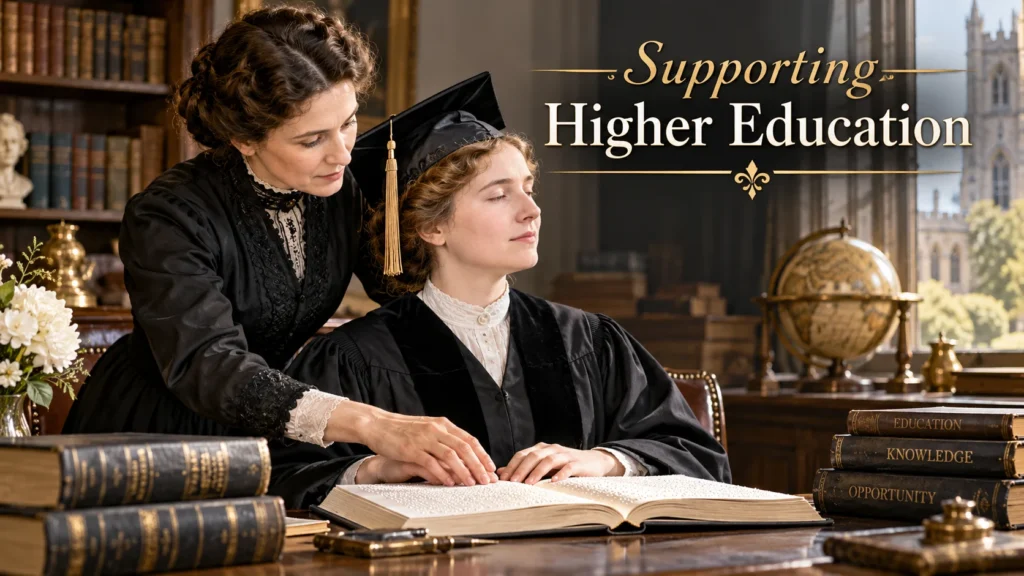
Supporting Helen Keller’s Higher Education
As Keller grew older, her education became more advanced.
She studied at different institutions and eventually attended Radcliffe College.
During her college years, Sullivan helped make classroom instruction and academic materials accessible.
In 1904, Keller graduated from Radcliffe College, becoming the first known deafblind person to earn a Bachelor of Arts degree.
This achievement represented years of effort by Keller, Sullivan, and other educators.
Sullivan’s contribution included maintaining communication access and supporting Keller’s participation in demanding academic work.
What Were Anne Sullivan’s Greatest Achievements?
Her major accomplishments included graduating as Perkins valedictorian, developing effective teaching methods for Keller, supporting Keller’s advanced education, and contributing to a wider public understanding of what students who were deafblind could achieve.
Sullivan also helped demonstrate that educational methods must account for each student’s communication needs.
Her work remains an important chapter in the history of accessible education.
Anne Sullivan’s Later Life and Death
Anne Sullivan continued working closely with Helen Keller throughout much of her adult life.
Their relationship expanded beyond the traditional roles of teacher and student.
They traveled together, participated in public events, and worked to promote opportunities for people with disabilities.
In 1905, Sullivan married John Albert Macy, a writer and literary critic who had helped edit Keller’s autobiography.
She became known as Anne Sullivan Macy.
The marriage eventually became strained, and the couple separated, although they did not divorce.
Sullivan continued living and working with Keller.
During her later years, she faced worsening health and vision problems.
Despite these challenges, she remained deeply involved in Keller’s life.
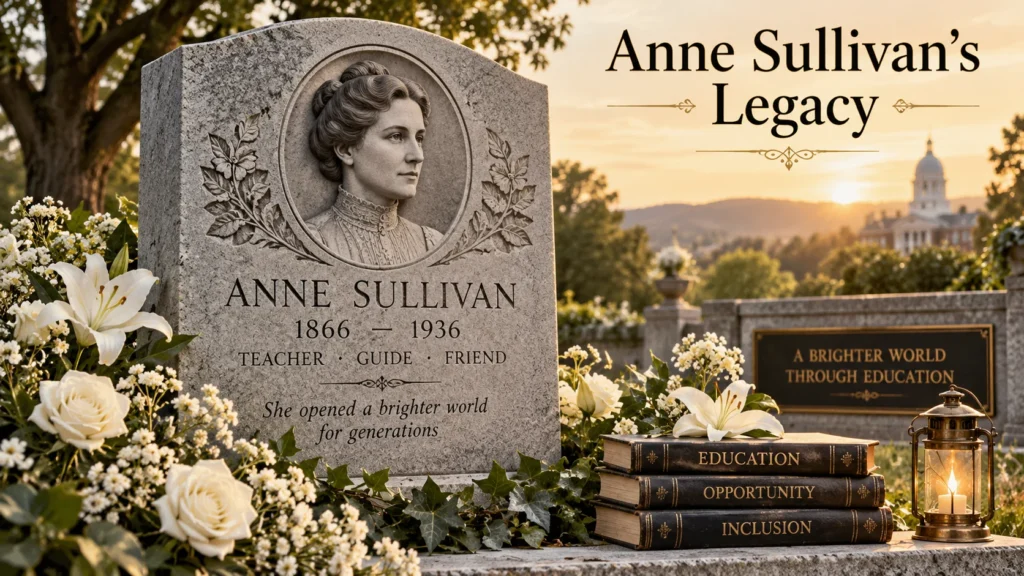
Anne Sullivan died on October 20, 1936, at the age of 70.
Her death marked the end of a remarkable teaching career, but her influence continued through Keller’s writing, advocacy, and achievements.
Anne Sullivan’s Lasting Legacy in Education
Anne Sullivan is remembered as one of the most influential teachers associated with deafblind education.
Her work demonstrated the importance of communication access, high expectations, and instruction adapted to an individual learner.
While Sullivan did not invent tactile education, she built upon existing methods and developed effective ways to apply them.
1. Recognizing Every Student’s Potential
Sullivan believed that Keller was capable of learning complex ideas.
Her approach challenged assumptions about the educational possibilities available to children with significant sensory disabilities.
She helped show that barriers to communication should not be confused with a lack of intelligence.
2. Making Learning Accessible
Sullivan connected language with Keller’s senses and experiences.
Her work provides a historical example of how accessible communication methods can support learning.
Today, specialized educators use a much wider range of evidence-informed approaches, assistive technologies, and communication systems.
Sullivan’s work remains an important part of the history that helped shape this field.
3. Adapting Teaching to the Learner
Sullivan moved away from rigid lessons when she realized that Keller learned more effectively through meaningful activities.
This flexibility remains relevant to discussions about individualized education.
A teaching method that works for one student may need to be changed for another.
4. Supporting Lifelong Learning
Sullivan continued helping Keller as her education became more advanced.
Their relationship demonstrated that communication access and educational support can remain important throughout a person’s life.
5. Inspiring Future Generations of Educators
Anne Sullivan’s story continues to appear in schools, biographies, historical collections, and educational discussions.
Her life is also remembered through The Miracle Worker, a play and film dramatization of her early work with Keller.
Although dramatic retellings simplify some historical events, they have introduced generations of viewers to this remarkable partnership.
Sullivan’s most enduring contribution was helping make education and communication accessible to a student whose abilities had not yet been fully recognized.
Anne Sullivan Timeline: Important Dates and Events
| Year | Important event |
|---|---|
| 1866 | Anne Mansfield Sullivan is born on April 14 in Massachusetts. |
| Around 1871 | She develops trachoma, causing severe visual impairment. |
| 1870s | Her mother dies, and Anne and her brother are sent to the Tewksbury Almshouse. |
| 1880 | She enters Perkins School for the Blind at age 14. |
| 1886 | She graduates from Perkins as valedictorian. |
| 1887 | She begins teaching Helen Keller on March 3. |
| 1887 | The famous water-pump breakthrough occurs on April 5. |
| 1904 | Helen Keller graduates from Radcliffe College with Sullivan’s support. |
| 1905 | Anne Sullivan marries John Albert Macy. |
| 1936 | Anne Sullivan dies on October 20 at age 70. |
Frequently Asked Questions About Anne Sullivan
Who was Helen Keller’s teacher?
Anne Mansfield Sullivan was Helen Keller’s teacher. She began working with Keller in March 1887 and helped her learn language through tactile fingerspelling, everyday experiences, and individualized instruction. Sullivan remained an important teacher and companion throughout much of Keller’s life.
Was Annie Sullivan blind?
Annie Sullivan experienced severe vision loss caused by trachoma, an eye disease she developed during childhood. Several operations affected her eyesight, and her vision improved for a time. However, she continued experiencing serious visual difficulties throughout her life.
What was Anne Sullivan’s full name?
Her full name was Anne Mansfield Sullivan. She was also known as Annie Sullivan. After marrying John Albert Macy in 1905, she became known as Anne Sullivan Macy.
How did Anne Sullivan teach Helen Keller?
Anne Sullivan taught Helen Keller primarily through tactile fingerspelling, in which letters were formed against Keller’s hand. She connected these letter patterns with objects, actions, and experiences. The famous water-pump lesson in April 1887 helped Keller understand that words represented meaningful things.
Who was Annie Sullivan’s teacher?
Anne Sullivan studied under several educators at Perkins School for the Blind. Sophia Hopkins was an important mentor, while Laura Bridgman, a woman who was deafblind, helped Sullivan learn the tactile manual alphabet. Sullivan also studied the educational methods developed by Samuel Gridley Howe.
How old was Anne Sullivan when she met Helen Keller?
Anne Sullivan was 20 years old when she met Helen Keller on March 3, 1887. She turned 21 the following month. Helen Keller was six years old at the time and celebrated her seventh birthday in June.
What was Anne Sullivan most famous for?
Anne Sullivan was most famous for teaching Helen Keller to communicate through a tactile language system. She is particularly remembered for the water-pump lesson of April 5, 1887, and her long-term educational partnership with Keller.
When did Anne Sullivan die?
Anne Sullivan died on October 20, 1936, at age 70. She had spent much of her adult life supporting Helen Keller’s education and public work.
Did Anne Sullivan invent fingerspelling?
No. Fingerspelling and tactile communication systems existed before Anne Sullivan began teaching. She learned established methods associated with Perkins and the education of Laura Bridgman, then adapted those methods to Helen Keller’s interests and learning needs.
Why is Anne Sullivan important today?
Anne Sullivan remains important because her work illustrates the value of accessible communication, individualized teaching, and recognizing the intellectual abilities of students with disabilities. Her contributions are studied as part of the history of deafblind education.
Conclusion: Why Anne Sullivan’s Story Still Matters
Anne Sullivan was much more than the teacher behind Helen Keller’s famous accomplishments.
She was a talented educator who overcame significant barriers to obtain an education and later used her knowledge to help another person access language and learning.
From her difficult childhood in Massachusetts to her groundbreaking work with Keller, Sullivan’s life demonstrates the importance of educational opportunity, effective communication, and thoughtful instruction.
Her greatest achievement was not simply teaching Helen Keller individual words. It was helping establish the language foundation that allowed Keller to develop her intellectual abilities, continue her education, and share her ideas with the world.