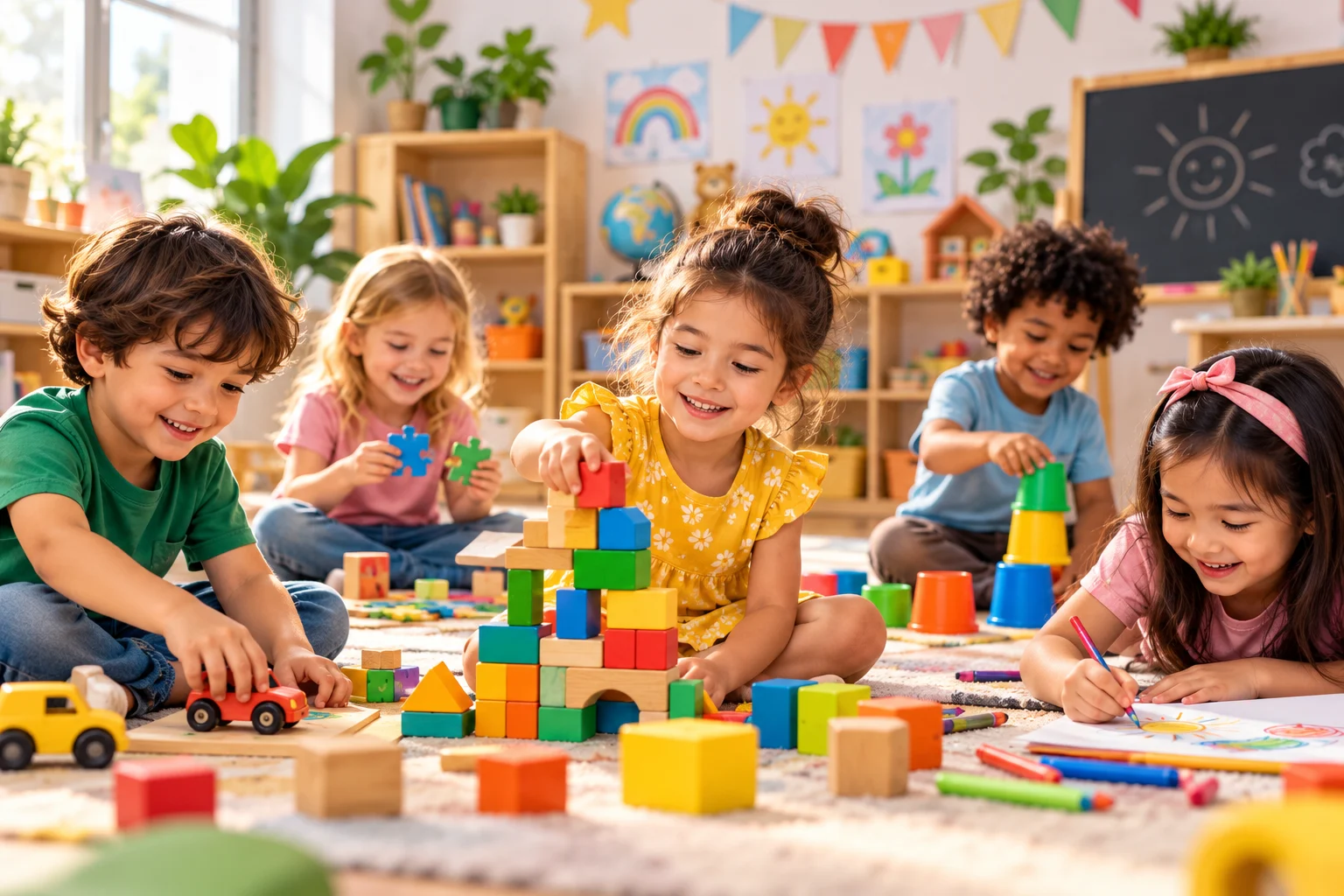

Five-year-olds can turn almost anything into a game. A cardboard box becomes a spaceship, a few cushions become an obstacle course, and a handful of colorful blocks can keep little hands busy longer than an expensive toy.
But when you’re a parent staring at a rainy afternoon—or a teacher with ten minutes left before lunch—coming up with something new isn’t always easy.
The good news? The best games kindergarteners play don’t require expensive toys, complicated rules, or hours of preparation. Many use things you already have at home, and some need no supplies at all.
In this guide, you’ll find 30 fun games for kindergarteners ages 5–6, including learning games, indoor activities, outdoor adventures, creative challenges, and cooperative games.
Each activity includes the time needed, materials, instructions, and a simple way to adjust the difficulty. Whether you need a quick five-minute game or an activity for a relaxed weekend, there’s something here to try.
Short on time? Start with I Spy for observation, Simon Says for movement, or Copy My Clap for a three-minute listening challenge. None of these needs special materials.
Quick Answer: What Games Can Kindergarteners Play?
If you need a game right now, start with one of these easy choices. The best activity depends on how much time you have, what materials are available, and what your child feels like doing.
I Spy, Simon Says, Rhyme Relay, Copy My Clap, and Animal Movement Parade.
Letter Treasure Hunt, Beginning-Sound Sort, Number Hop, Shape Detective, and Pattern Train.
What’s Missing?, Pretend Grocery Store, Draw-a-Monster, and Indoor Treasure Map.
Cooperative Picture Puzzle, Pass-the-Story Object, and Feelings Charades.
| Game | Time | Materials | Best For |
|---|---|---|---|
| I Spy | 3–7 min | None | Observation |
| Simon Says | 5–8 min | None | Listening |
| Rhyme Relay | 5–10 min | None | Early literacy |
| What’s Missing? | 5–8 min | Household objects | Memory |
| Letter Treasure Hunt | 8–12 min | Optional letter cards | Letters |
| Number Hop | 5–10 min | Number cards | Counting |
| Pretend Grocery Store | 15–25 min | Household items | Imagination |
| Sidewalk Chalk Trail | 10–20 min | Chalk | Outdoor movement |
| Sock-Ball Target Toss | 10 min | Socks and basket | Coordination |
| Feelings Charades | 8–12 min | None | Emotions |
You can start with any activity below. There’s no need to follow the games in numerical order.
Why Playing Games Matters for Kindergarteners
Kindergarten is a time when children are learning to communicate, make friends, solve problems, recognize letters, count objects, and understand simple rules.
Play gives them opportunities to practice these emerging skills in enjoyable, meaningful ways.
Developmental guidance for five-year-olds describes emerging abilities such as taking turns, recognizing rhymes, counting, and participating in short activities. Play can support children’s language, thinking, movement, and relationships.
Children experiment with counting, sorting, patterns, observation, and simple problem-solving.
Games offer opportunities to practice listening, sharing, storytelling, and taking turns.
Make-believe games let children try new ideas, make decisions, and explore their imagination.
These benefits don’t mean every activity needs to look like a lesson. Children often learn a great deal while inventing stories, pretending to run a shop, building structures, or exploring their surroundings.
The key is choosing activities that fit each child’s interests and abilities. Five-year-olds develop at different rates, so adapt the games rather than expecting every child to perform at the same level.
Find a Game That Fits Your Day
Search all 30 activities by name, type, or available time.
6 Easy No-Prep Games Kindergarteners Can Play Anywhere
Sometimes the easiest games become family favorites. These six activities work especially well when you need something quick and don’t have time to gather supplies.

I Spy
I Spy is a simple guessing game that encourages children to notice details in their surroundings.
How to Play
- Look around and silently choose an object.
- Give a clue such as, “I spy something blue.”
- Let your child guess what you’ve chosen.
- Take turns being the person who gives clues.
For example, you might choose a yellow pillow or a round clock.
Parent tip: Start with obvious objects and introduce more challenging clues as your child becomes confident.
Simon Says
Simon Says is a fun way to combine movement with careful listening.
How to Play
- Choose one person to be Simon.
- Give an instruction beginning with “Simon says.”
- Players follow the instruction only when it begins with those words.
- Occasionally give an instruction without saying “Simon says.”
- Switch leaders after a few rounds.
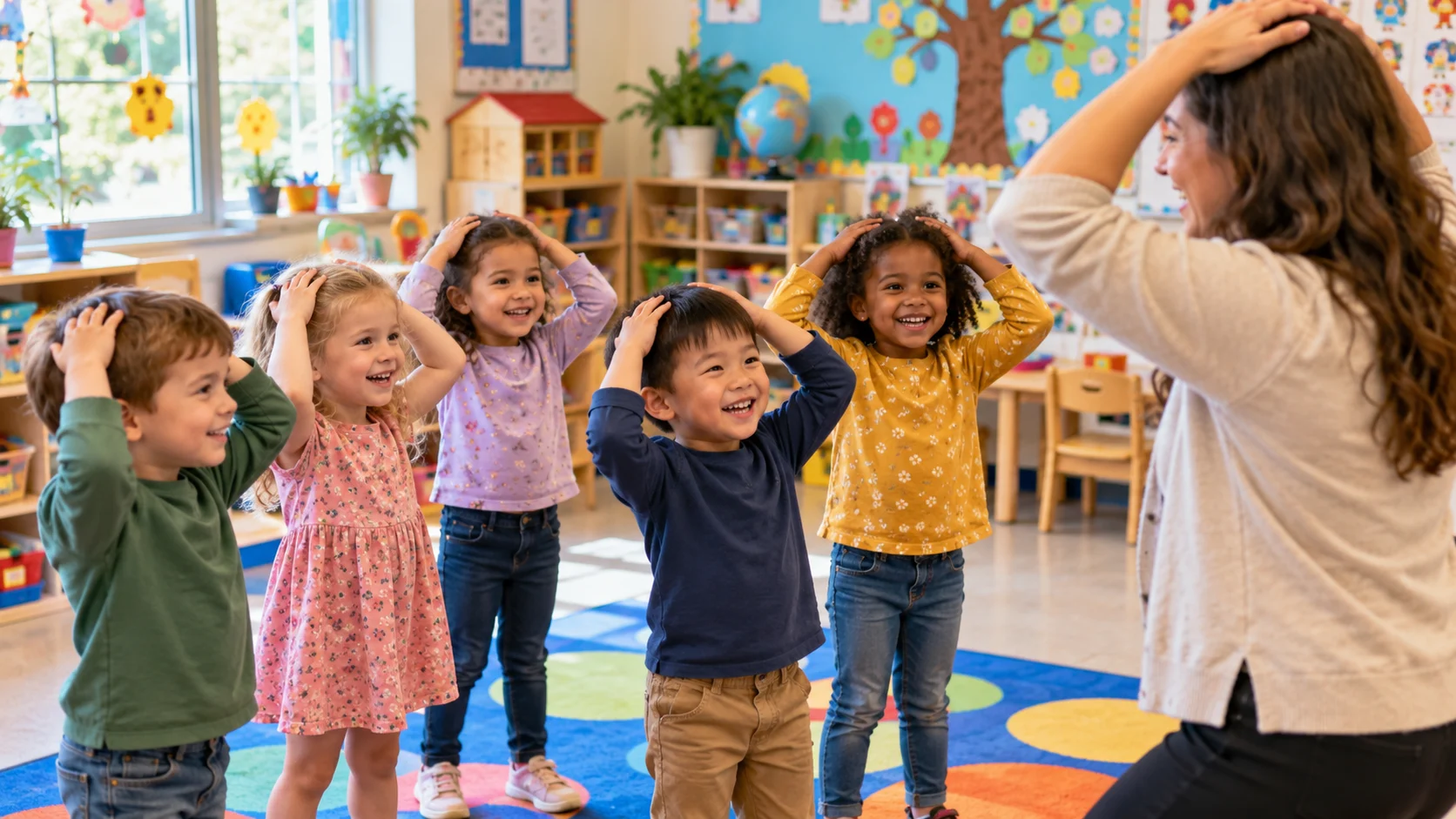
Try “Simon says touch your head,” “Simon says show five fingers,” or “Simon says stretch your arms.” Then say “Jump twice!” without the special phrase and see who remembers to stay still.
This keeps the game welcoming and enjoyable.
Rhyme Relay
Rhyme Relay turns simple word sounds into a playful challenge.
How to Play
- Say an easy word, such as cat.
- Ask your child to think of a word that rhymes.
- Take turns adding new rhyming words.
- Start a new round when you run out of ideas.
For example: cat, hat, bat, mat. Funny nonsense words are welcome too. The purpose is to explore sounds, not just memorize spelling.
Parent tip: If your child isn’t ready to invent rhymes, offer two choices: “Does cat rhyme with hat or dog?”
What’s Missing?
This guessing game feels a little like solving a mystery.
How to Play
- Place four to six familiar objects on a table.
- Let your child look at them for around 20 seconds.
- Ask them to close their eyes or turn around.
- Remove one object.
- Ask, “What’s missing?”
You might use a spoon, large toy car, crayon, sock, and book.
Parent tip: Use larger, child-safe objects, especially when younger siblings are nearby.
Copy My Clap
This game is perfect when you have only a few minutes.
How to Play
- Clap a simple rhythm.
- Ask your child to copy it.
- Repeat with a different pattern.
- Let your child become the leader.
Start with two slow claps. Then try clap-clap-pause-clap.
This activity also works well during short transitions at home or school.
Mystery Sound
Children close their eyes or face away while an adult makes a sound.
How to Play
- Collect a few objects that make recognizable sounds.
- Make one sound without showing the object.
- Ask your child to guess what made it.
- Reveal the object and switch to another sound.
Try rustling paper, jingling keys, tapping a wooden spoon, or pouring water into a cup.
Safety tip: Keep hazardous objects out of children’s reach and avoid unexpectedly loud sounds near their ears.
7 Educational Games for Kindergarteners That Feel Like Play
Educational kindergarten games don’t need to resemble classroom worksheets. Letters, numbers, shapes, sounds, and patterns can all become part of enjoyable everyday activities.
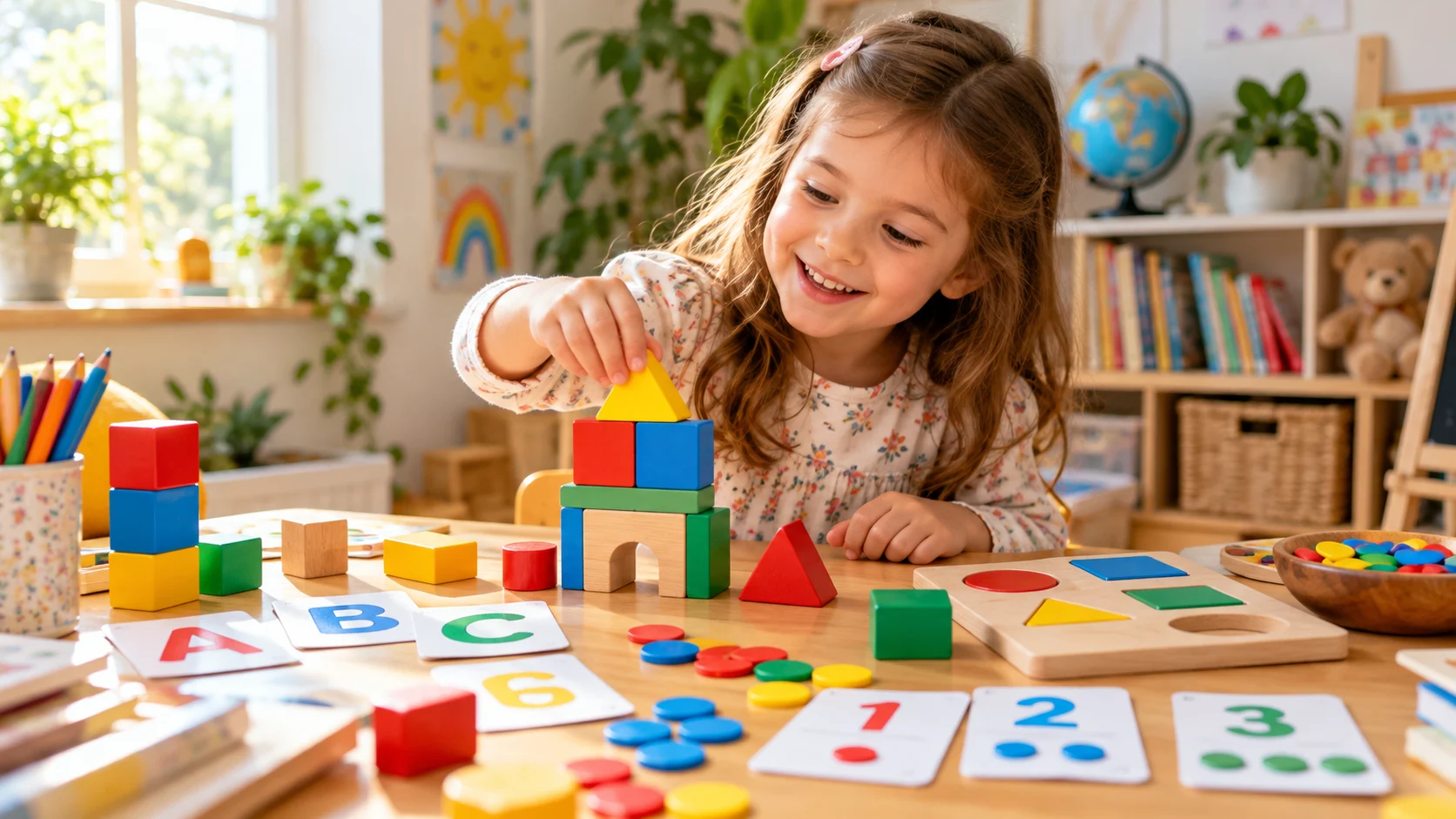
Letter Treasure Hunt
Turn your home or classroom into a letter-hunting adventure.
How to Play
- Choose a letter your child recognizes or is learning.
- Ask them to search for it on books, labels, packages, or signs.
- Celebrate each discovery.
- Switch to another letter when they’re ready.
For example, a child searching for M might find it on a magazine cover or cereal box.
Parent tip: Begin with letters in your child’s name, which may be especially meaningful to them.
Name Letter Mix-Up
Many kindergarteners enjoy seeing their own names in a game.
How to Play
- Write your child’s name in large letters.
- Make separate cards with each letter.
- Mix up the cards.
- Invite your child to arrange them in the correct order.
For example, EMMA becomes M-A-E-M before your child rearranges the letters.
This game can be played seated at a table, making it useful for quieter afternoons.
Beginning-Sound Sort
This activity introduces children to the idea that words begin with different sounds.
How to Play
- Choose two beginning sounds, such as /b/ and /m/.
- Show your child pictures or objects.
- Say each object’s name aloud.
- Ask which sound they hear at the beginning.
- Sort the items into two groups.
For example, ball and book belong in one group, while moon and mouse belong in the other.
Parent tip: Concentrate on the sound you hear, not only the letter’s name.
Number Hop
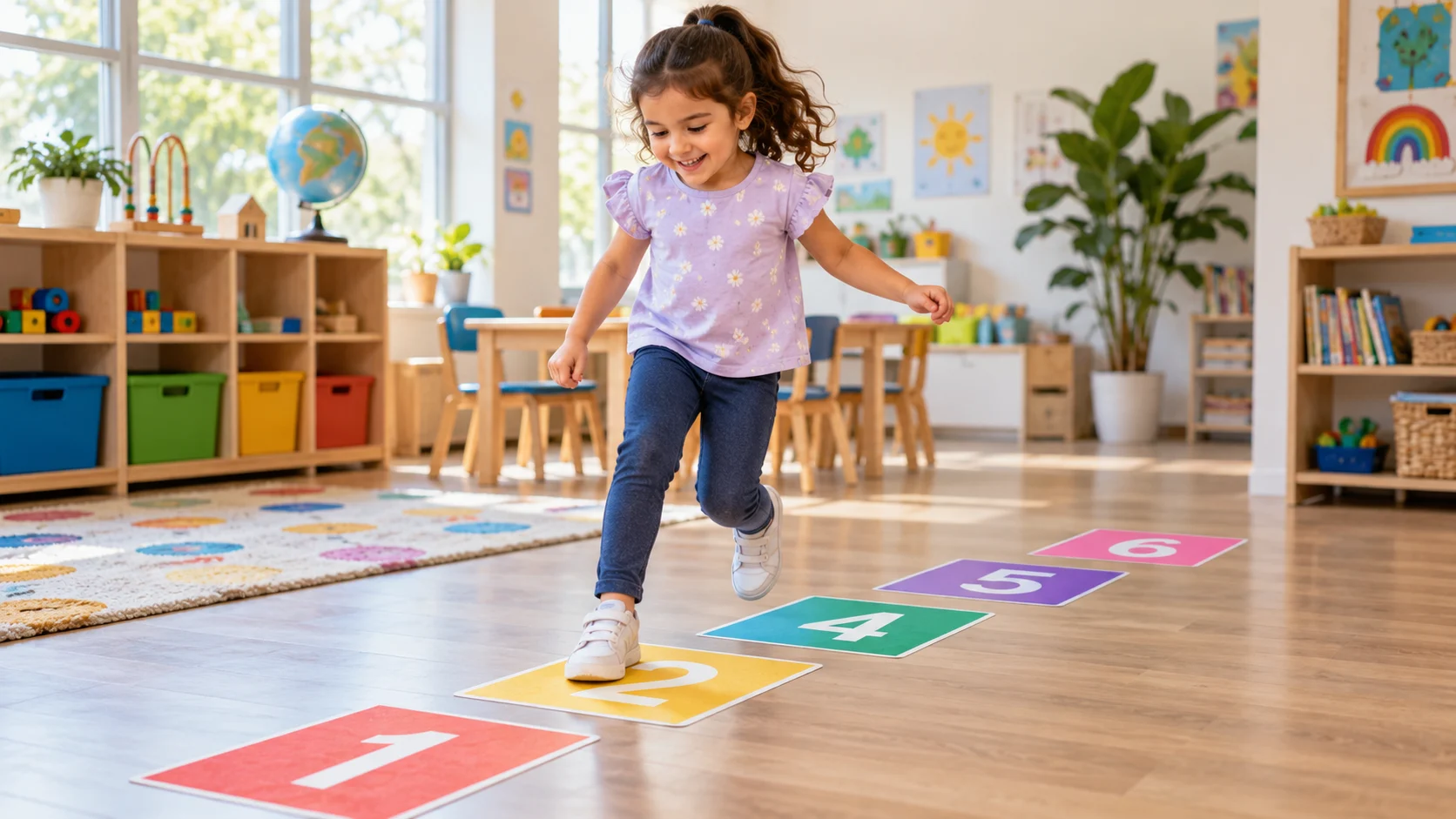
Number Hop lets kindergarteners practice numbers while moving around.
How to Play
- Place number cards from 1 to 10 on a flat, safe surface.
- Call out a number.
- Ask your child to move to the matching card.
- Change the instructions after several turns.
You could say, “Find number four!” or “Take one step to the number after six.”
Safety tip: Secure floor cards so they cannot slide. Children who prefer seated activities can point to numbers instead.
Roll, Count, and Build
This is a simple way to turn counting practice into a building challenge.
How to Play
- Give your child a collection of large blocks.
- Roll a die.
- Count the dots together.
- Add the same number of blocks to a tower.
- Repeat until the tower reaches a chosen height.
If the die shows four dots, your child adds four blocks.
Parent tip: Count each block as it is placed rather than rushing to the final answer. Use age-appropriate materials.
Shape Detective
There are shapes everywhere once children know how to look for them.
How to Play
- Choose a shape, such as a circle.
- Ask your child to find matching shapes around the room.
- Name the objects together.
- Switch to another shape.
A clock may look circular, a door rectangular, and a sandwich cut into pieces may form triangles.
Pattern Train
Young children often enjoy discovering what comes next in a sequence.
How to Play
- Arrange items in a simple pattern.
- Ask your child to look carefully.
- Invite them to continue it.
- Let your child create a pattern for you to solve.
Start with red-blue-red-blue. When that becomes easy, try red-red-blue-red-red-blue.
Learning opportunity: Ask, “How did you know what should come next?”
6 Creative Indoor Games for Kindergarteners
A rainy day doesn’t have to mean a day spent in front of a screen. These indoor games encourage imagination, communication, building, and problem-solving.
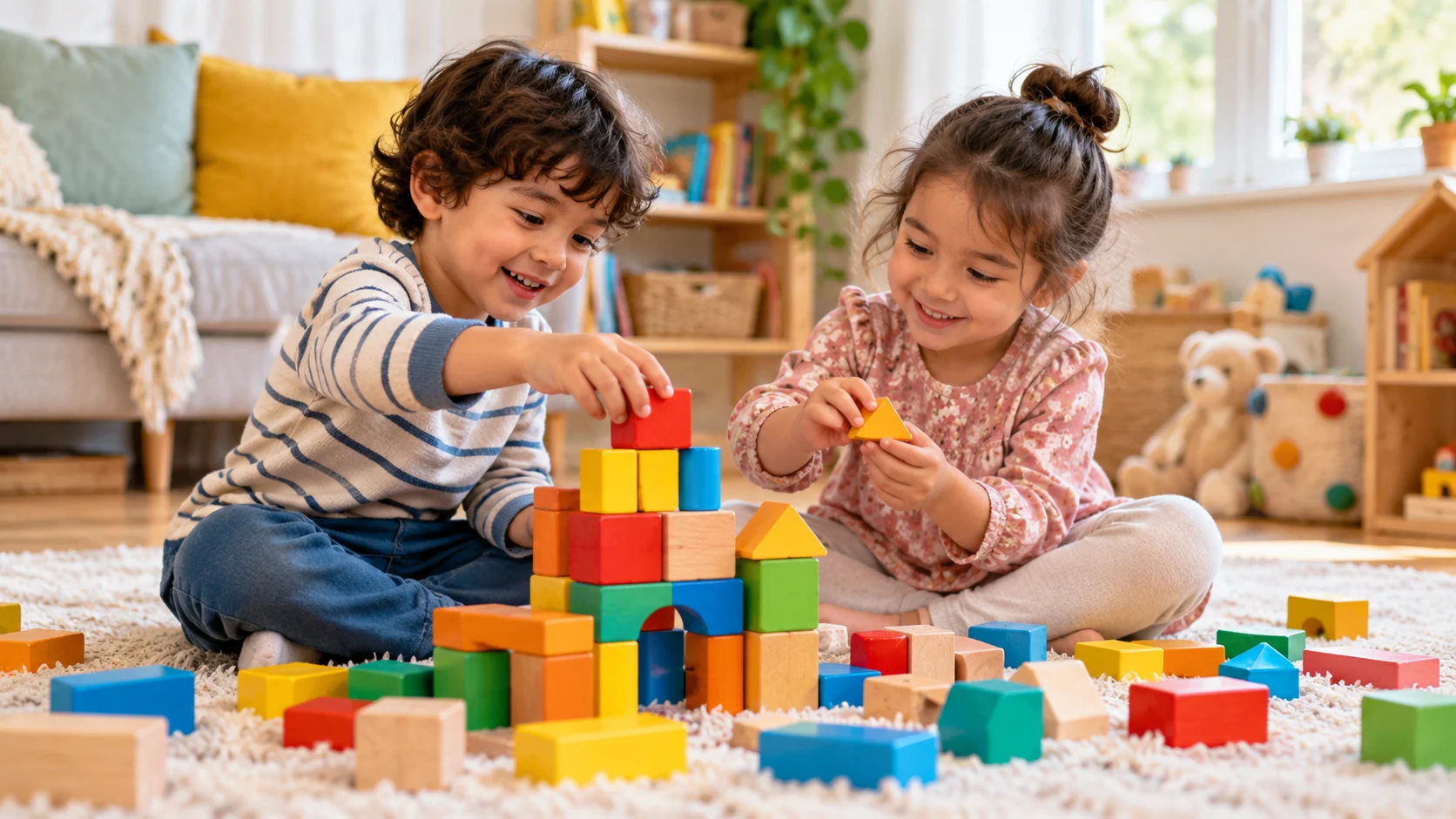
Stuffed Animal Story Circle
Let your child’s favorite stuffed animals become characters in a new adventure.
How to Play
- Choose two or three stuffed animals.
- Give each character a name and personality.
- Begin a story with a simple problem.
- Ask your child what happens next.
- Continue until the story reaches an ending.
For example, a teddy bear might lose its picnic basket, and a rabbit could help find it.
Parent tip: Avoid correcting every sentence. Focus on imagination and communication.
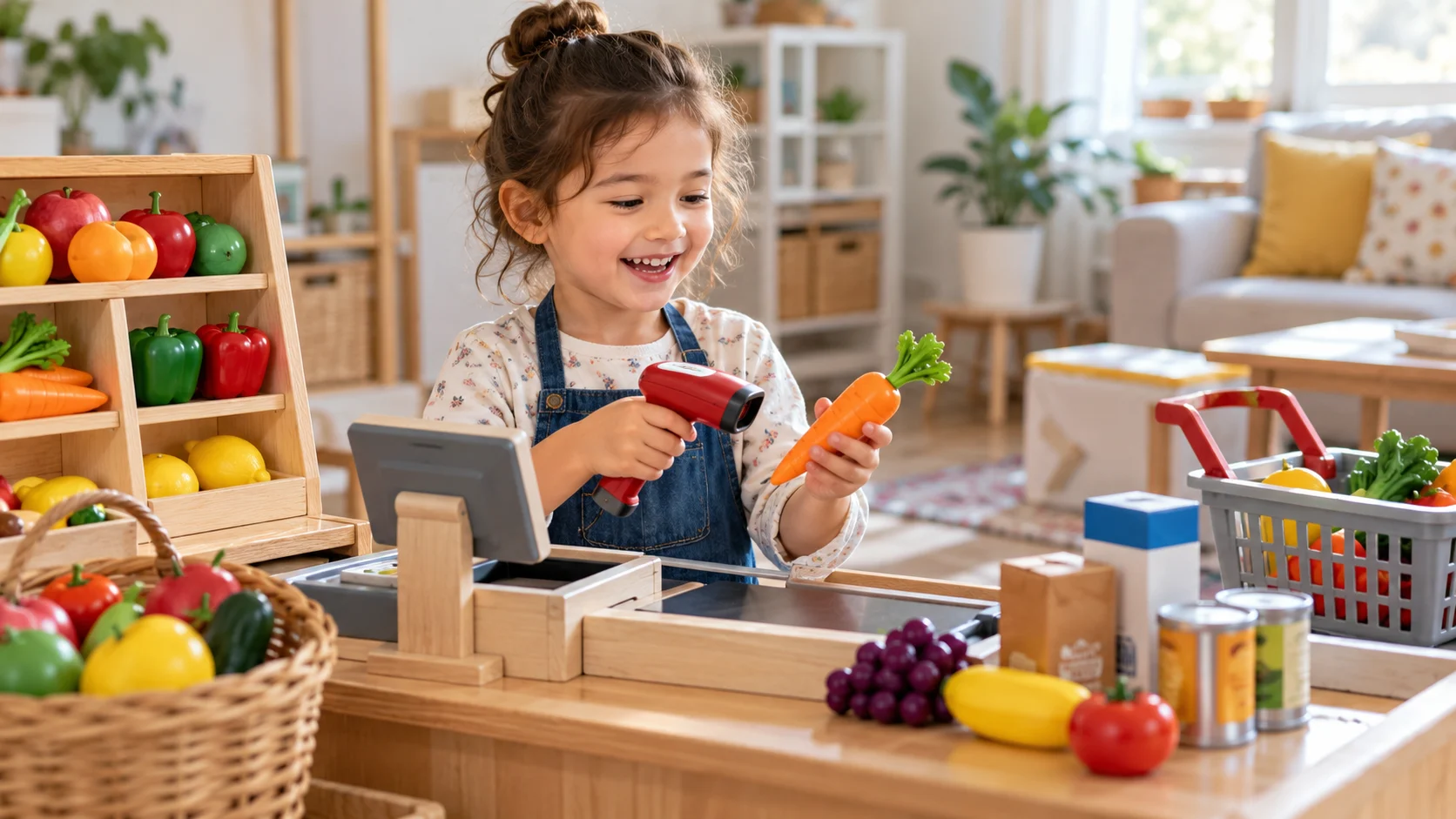
Pretend Grocery Store
A pretend grocery store can turn an ordinary living room into a busy little marketplace.
How to Play
- Arrange clean, empty food packages or pretend groceries.
- Create simple price tags using numbers from 1 to 5.
- Take turns being the customer and cashier.
- Ask your child to count the items in a basket.
- Swap roles and play again.
You might say, “I need two apples and one box of cereal. Can you help me?”
Parent tip: Don’t worry about teaching real money calculations immediately. Pretend shopping and counting items are worthwhile on their own.
Build a Bridge Challenge
What can you build that will support a toy car? This simple challenge encourages kindergarteners to experiment with structures.
How to Play
- Place two stable supports a short distance apart.
- Give your child materials for making a bridge.
- Ask them to connect the supports.
- Test the bridge with a lightweight toy.
- Change the design if the bridge doesn’t work.
Parent tip: Instead of immediately fixing a collapsed bridge, ask, “What could we change to make it stronger?” Use lightweight materials and avoid unstable structures.
Draw-a-Monster Instructions
This drawing game creates some wonderfully silly characters.
How to Play
- Give everyone a piece of paper.
- Describe a creature one feature at a time.
- Ask children to draw what they hear.
- Compare the pictures at the end.
Try saying, “Draw a monster with a round body,” followed by “Give it three eyes” and “Add two long arms and a giant smile.”
The pictures will probably look completely different, which is part of the fun.
Indoor Treasure Map
Instead of simply hiding something and asking your child to find it, create a simple treasure map.
How to Play
- Draw a basic map of one room.
- Add recognizable landmarks such as a sofa and bookshelf.
- Mark a hiding place with an X.
- Give your child the map.
- Let them search for the treasure.
The treasure might be a favorite stuffed animal or a homemade drawing.
Safety tip: Keep hiding places accessible and away from storage areas, electrical equipment, and heavy furniture.
Puppet Problem-Solver
Puppet games create a playful way to talk about everyday situations.
How to Play
- Create two simple puppet characters.
- Give one puppet a small problem.
- Ask your child how the other puppet might help.
- Act out the suggested solution.
- Invent another situation.
For example, one puppet might feel sad because its friend doesn’t want to share a toy. Your child can help them think about taking turns or finding another way to play together.
6 Active and Outdoor Games Kindergarteners Love
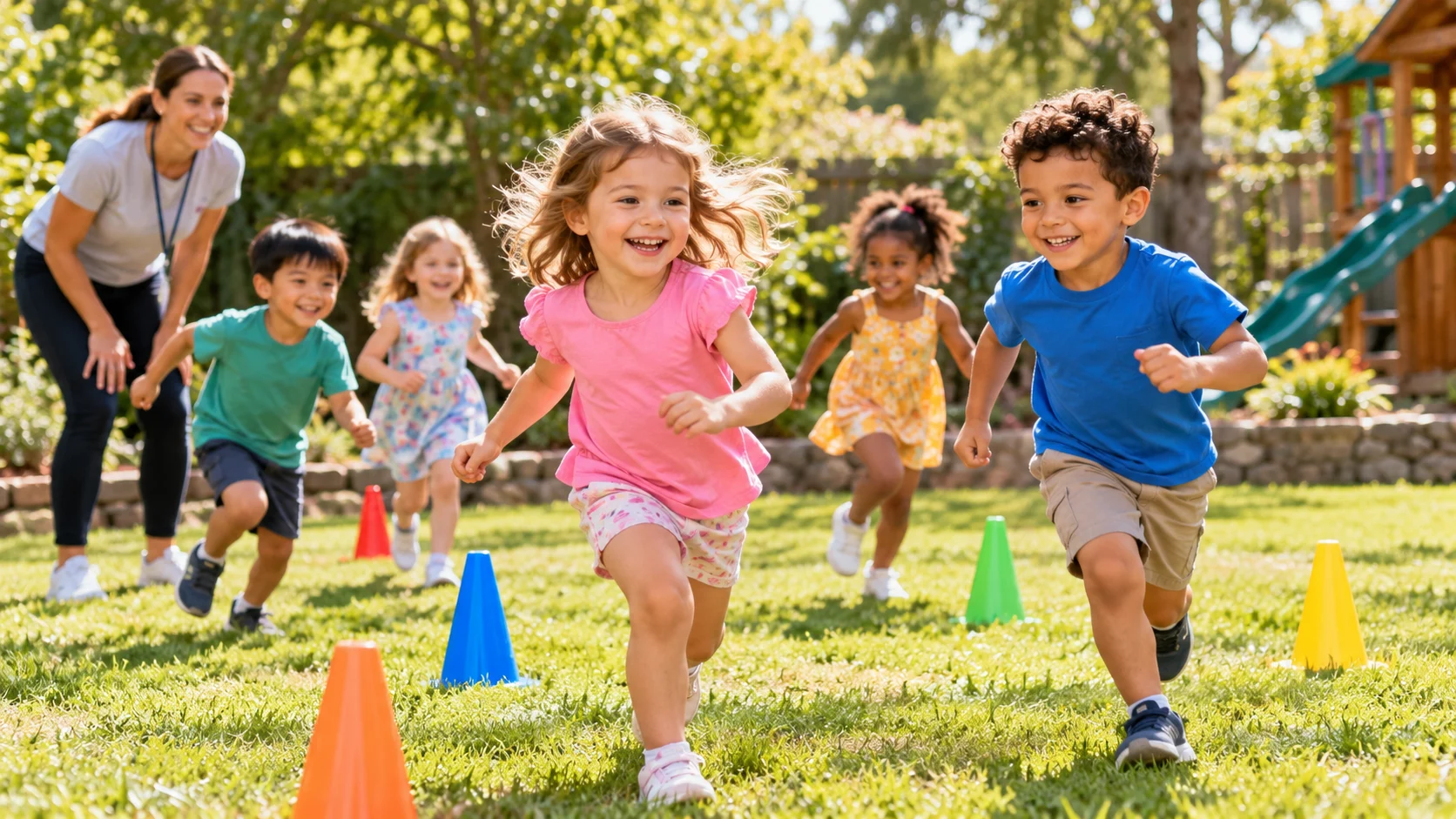
Kindergarteners often enjoy moving, exploring, and discovering things outside. These activities offer playful movement challenges that can be adapted to each child’s abilities.
Color Spot Walk
This simple activity works indoors or outdoors.
How to Play
- Call out a color.
- Ask your child to find something with that color.
- Have them walk toward it or point to it.
- Change colors and repeat.
For example, “Find something green!” Your child might point to a leaf, toy, or cushion.
Safety tip: Set clear boundaries and use walking rather than racing.
Animal Movement Parade
Imagine a parade where every participant moves like a different animal.
How to Play
- Name an animal.
- Ask your child to invent a movement inspired by it.
- Copy the movement together.
- Change animals after a short round.
Try marching like an elephant, waddling like a penguin, or stretching like a cat.
Parent tip: Adapt movements for your child’s abilities. Seated hand and arm movements work well too.
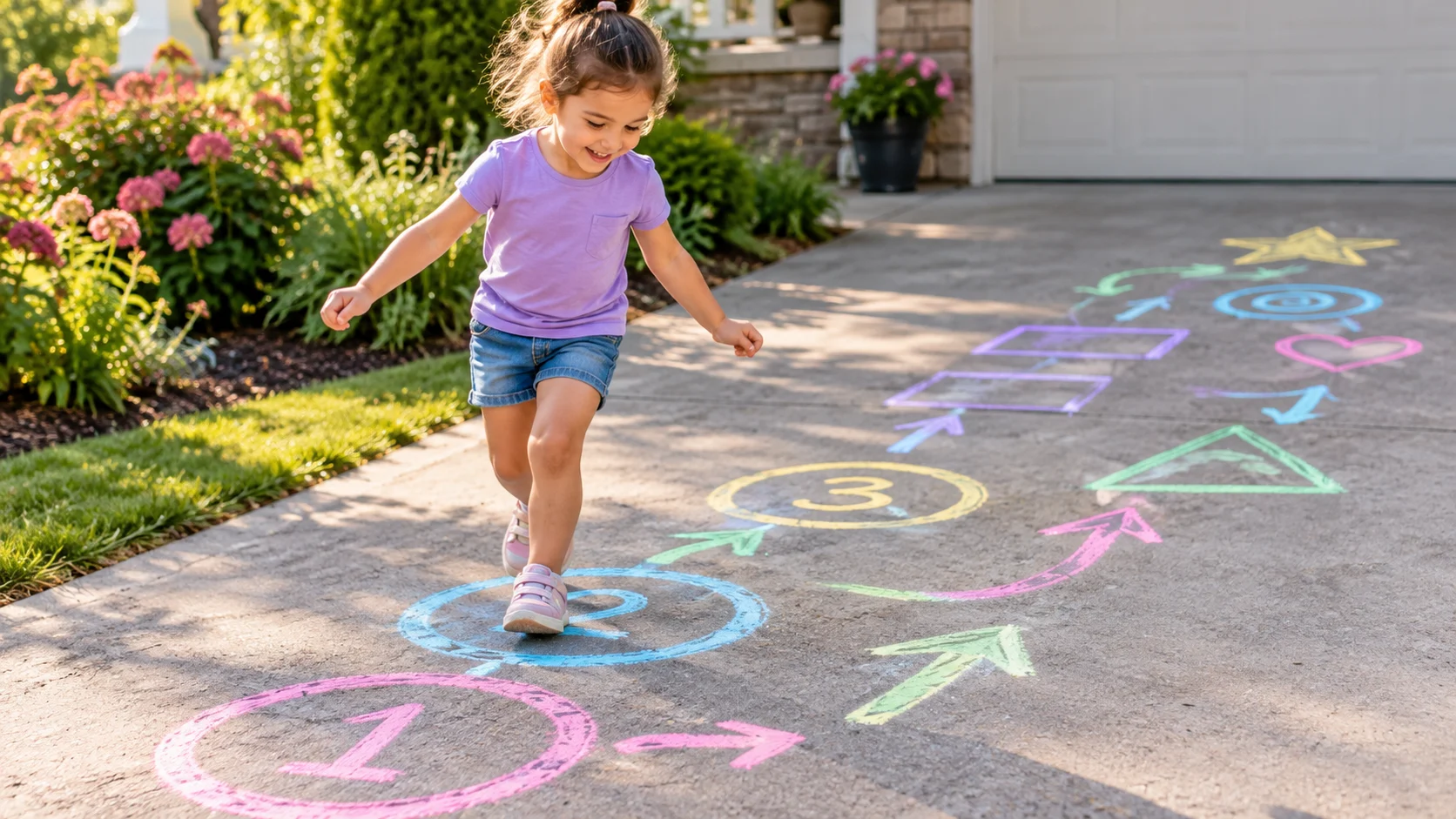
Sidewalk Chalk Adventure Trail
Turn a safe patch of pavement into a colorful adventure.
How to Play
- Draw a winding path with chalk.
- Add shapes, arrows, numbers, or simple pictures.
- Give your child a challenge at each stop.
- Follow the route together.
You might draw a circle and ask your child to stand inside it, or draw the number three and ask them to clap three times.
Safety tip: Use a flat area away from traffic and supervise outdoor play.
Nature Color and Texture Hunt
Nature offers plenty of interesting colors, patterns, and textures.
How to Play
- Walk through a garden, park, or safe outdoor space.
- Ask your child to find something with a particular color or texture.
- Talk about what they notice.
- Continue with another clue.
Examples include finding something smooth, something rough, or three different shades of green.
Safety tip: Encourage observation instead of touching or collecting unfamiliar plants, fungi, or insects.
Sock-Ball Target Toss
You don’t need sports equipment for a simple throwing game.
How to Play
- Roll clean socks into soft balls.
- Place a laundry basket a short distance away.
- Let your child toss the sock balls toward the basket.
- Count successful throws together.
- Move the basket slightly to change the challenge.
Parent tip: Praise effort rather than the final score. Use only soft objects and a clear throwing direction.
Follow the Leader Obstacle Path
Create a short path using simple, safe movements.
How to Play
- Choose a leader.
- Demonstrate movements along a clear path.
- Ask the other players to follow.
- Switch leaders after completing the route.
The leader might step around a cushion, walk along a marked line, stretch upward, and finish with a gentle turn.
Safety tip: Keep everything at floor level, remove trip hazards, and avoid unstable furniture or elevated obstacles.
3 Cooperative and Social Games for Kindergarteners
Playing with other children offers opportunities to practice communication, taking turns, negotiating rules, and working together. These activities focus on participation rather than eliminating players.
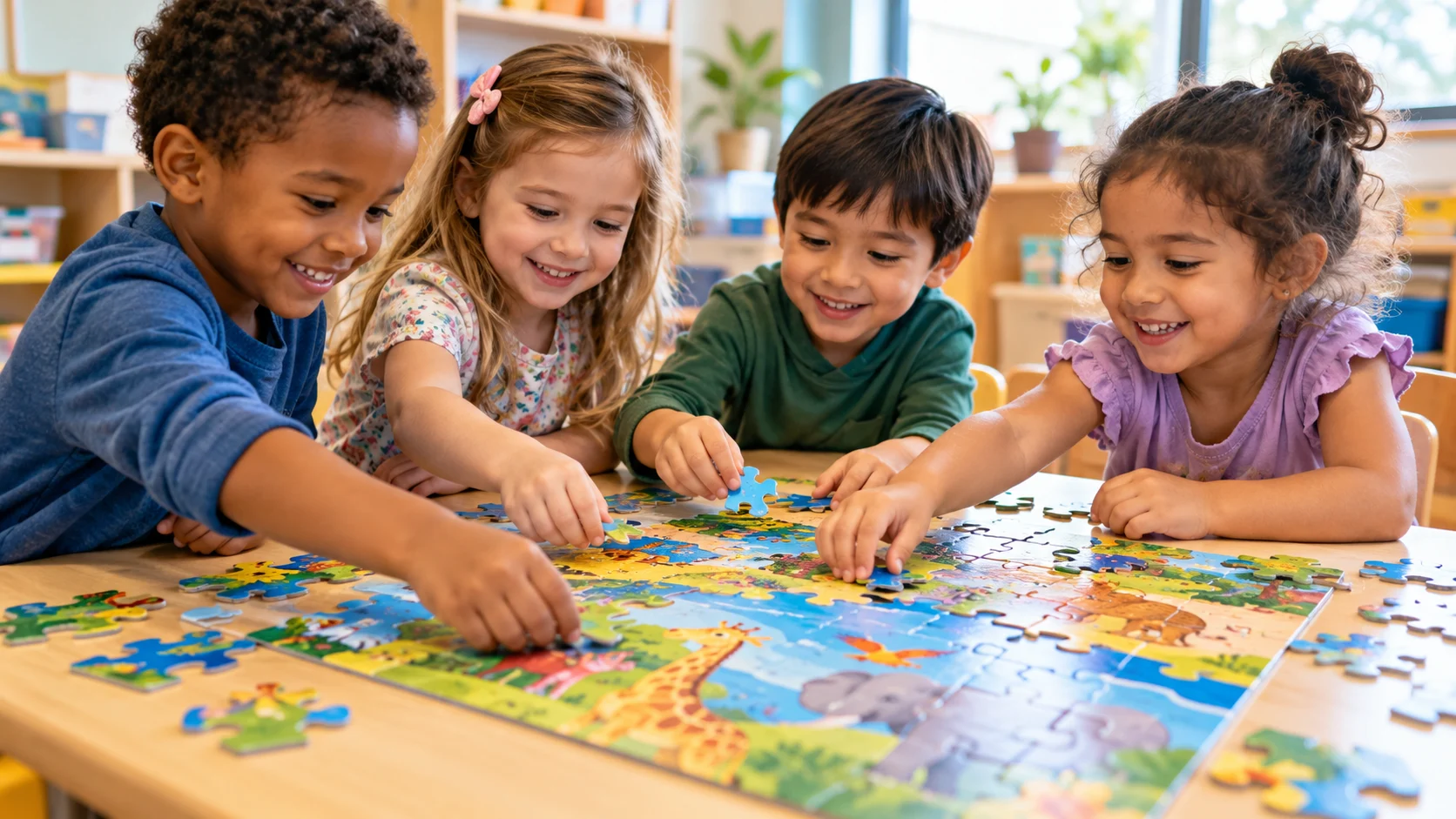
Cooperative Picture Puzzle
Instead of racing against one another, everyone works toward the same goal.
How to Play
- Place the puzzle pieces in the middle of the table.
- Give everyone a chance to choose pieces.
- Encourage players to share suggestions.
- Work together until the picture is complete.
Parent tip: Choose an age-appropriate puzzle and help quieter children participate without taking over.
Pass-the-Story Object
This imaginative group game gives everyone a chance to add to a story.
How to Play
- Sit in a circle.
- Give one child a soft toy.
- The child begins a story with one sentence.
- Pass the toy to the next person.
- Continue building the story together.
For example: “Once upon a time, a tiny dinosaur found a golden key…” The next child decides what happens.
Parent tip: There doesn’t need to be a winner. Finishing the story together is the goal.
Feelings Charades
Feelings Charades encourages children to explore how emotions can look and feel.
How to Play
- Choose an emotion such as happy, surprised, worried, or excited.
- Act it out using facial expressions and gestures.
- Ask the other players to guess.
- Discuss what might make someone feel that way.
- Switch roles.
Someone pretending to be surprised might open their eyes wide and put their hands on their cheeks.
Parent tip: People show emotions differently. More than one feeling may fit the same situation.
2 Interactive Learning Games for Kindergarteners
Screen-free activities are excellent everyday options, but carefully chosen digital games can sometimes add variety. Prioritize age-appropriate content, limited distractions, and participation with an adult.
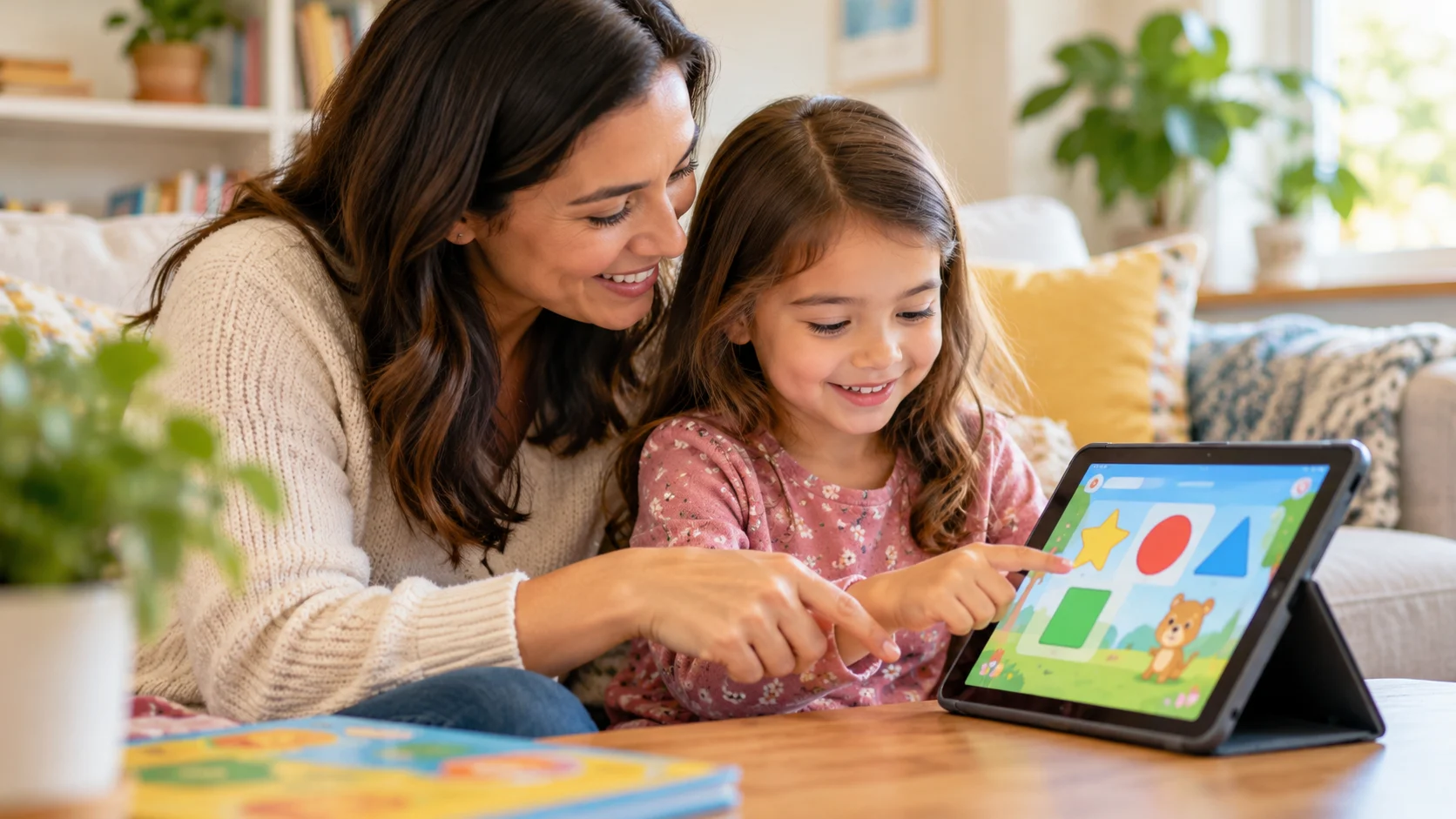
Play a PBS KIDS Learning Game Together
PBS KIDS offers games featuring familiar educational characters, including activities involving numbers, letters, stories, and problem-solving.
How to Play
- Visit the official PBS KIDS games collection.
- Choose an age-appropriate game that matches your child’s interests.
- Play alongside your child when possible.
- Ask simple questions about what they’re doing.
- Finish with a short conversation about the game.
You might ask, “What do you think happens next?” or “How did you figure that out?”
Digital-to-Real-World Match Quest
This activity combines a short digital learning experience with a hands-on search.
How to Play
- Show your child an age-appropriate picture or activity featuring letters, shapes, or colors.
- Choose one idea from the screen.
- Put the device aside.
- Ask your child to find or create a real-world example.
- Talk about what they discovered.
For example, after seeing a triangle on the screen, your child might find a triangular block or create a triangle using craft sticks.
Parent tip: The screen introduces the challenge, but most of the game happens away from the device.
Try another search word, choose a longer time, or reset the filters.
How to Choose Games for Your Kindergartener
With so many options, the most helpful game is usually the one that matches your child’s mood, interests, and current abilities.
When Your Child Has Lots of Energy
Try Animal Movement Parade, Color Spot Walk, Sidewalk Chalk Adventure Trail, or Number Hop. Choose a safe space and let children move comfortably.
When Your Child Needs Quiet Play
Choose What’s Missing?, Shape Detective, Pattern Train, or Stuffed Animal Story Circle. These games may work well after a busy day.
When You Want to Practice Learning Skills
Try Rhyme Relay for sounds, Letter Treasure Hunt for letters, Roll, Count, and Build for numbers, or Pattern Train for sequences.
When Your Child Is Playing With Friends
Try Cooperative Picture Puzzle, Pass-the-Story Object, Feelings Charades, or Follow the Leader. Prioritize shared participation.
When You Have Almost No Time
I Spy, Copy My Clap, and Simon Says are convenient because they require no special equipment or preparation.
When Your Child Wants to Lead
Try Draw-a-Monster, Pretend Grocery Store, or Stuffed Animal Story Circle and let your child invent the next rules or story.
5-Day Kindergarten Game Plan for Busy Parents
If you’re not sure how to fit play into a busy week, use this simple example schedule.
| Day | Game | Time | Focus |
|---|---|---|---|
| Monday | Letter Treasure Hunt | 10 min | Letter recognition |
| Tuesday | Simon Says | 5 min | Movement and listening |
| Wednesday | Pretend Grocery Store | 20 min | Imagination and counting |
| Thursday | Draw-a-Monster | 15 min | Creativity and language |
| Friday | Sock-Ball Target Toss | 10 min | Coordination and counting |
This is a flexible idea, not a fixed developmental requirement. If your child is enjoying an activity, you can continue. If they lose interest, switch to something else or let them invent their own game.
Remember: Free, child-led play belongs in the week too. Not every moment needs to be organized by an adult.
How to Make Kindergarten Games More Fun Without Pressure
Parents sometimes feel that every educational activity needs a measurable result. But engagement, curiosity, and enjoyment matter too.
Let Your Child Make Decisions
Give your child two or three game options and let them choose. Allow them to invent new rules or become the leader occasionally.
Keep the Rules Short
Introduce one instruction at a time and demonstrate what to do. If explaining takes longer than playing, simplify the game.
Don’t Make Winning the Main Goal
Use cooperative versions when possible, celebrate effort, and help children practice friendly responses to winning or losing.
Adapt Activities to Individual Abilities
Offer different ways to join in, including pointing, speaking, drawing, moving, or working with a partner.
Know When to Stop
A fun activity can become frustrating when it lasts too long. Watch your child’s interest rather than relying entirely on a timer.
Make Room for Imagination
Let children experiment, change the storyline, and invent challenges. Their unexpected ideas are often part of the fun.
Common Mistakes Parents Make When Choosing Kindergarten Games
Choosing Games That Are Too Difficult
Complicated rules, long waiting periods, or advanced academic tasks can take away the fun. Start with something understandable and gradually add challenges.
Buying Too Many Supplies
You don’t need specialized toys for every activity. Paper, crayons, blocks, soft toys, and everyday household items are often enough.
Making Every Game Educational
It’s fine for a game to be enjoyable without practicing a specific letter or number. Pretend play and imagination have value too.
Correcting Every Mistake
If a child’s bridge collapses or a drawing looks unusual, allow experimentation. Ask thoughtful questions rather than immediately providing the solution.
Forgetting Safety and Supervision
Check materials for age suitability and avoid choking hazards, unstable climbing structures, and outdoor play near traffic. Supervise according to your child’s needs.
Ignoring Your Child’s Interests
Don’t force the same activity repeatedly when enthusiasm has disappeared. Rotate familiar favorites with new ideas.
Frequently Asked Questions About Games Kindergarteners Play
What games do kindergarteners like to play?
Many kindergarteners enjoy guessing games, pretend play, building challenges, movement activities, and games involving letters or numbers. Popular options include I Spy, Simon Says, Pretend Grocery Store, Number Hop, and What’s Missing? Preferences vary by child.
What are the best games for five-year-olds?
Good options have simple rules, manageable challenges, and opportunities to make choices. I Spy, Rhyme Relay, Roll, Count, and Build, Shape Detective, and Follow the Leader are flexible choices.
What games can kindergarteners play at home?
Letter Treasure Hunt, Pattern Train, Stuffed Animal Story Circle, Draw-a-Monster, Indoor Treasure Map, and Pretend Grocery Store can all be played at home using familiar materials.
What games can kindergarteners play without materials?
I Spy, Simon Says, Rhyme Relay, Copy My Clap, Animal Movement Parade, and Feelings Charades require no special supplies.
What educational games are good for kindergarteners?
Letter Treasure Hunt, Beginning-Sound Sort, Number Hop, Pattern Train, Shape Detective, and Roll, Count, and Build can help children explore early learning concepts through play.
What are some fun indoor games for kindergarteners?
Indoor Treasure Map, What’s Missing?, Pretend Grocery Store, Puppet Problem-Solver, Cooperative Picture Puzzle, and Draw-a-Monster are useful rainy-day activities.
What outdoor games can five-year-olds play?
Sidewalk Chalk Adventure Trail, Nature Color and Texture Hunt, Color Spot Walk, and Sock-Ball Target Toss are fun options when children have safe outdoor space and appropriate supervision.
What are some group games for kindergarteners?
Cooperative Picture Puzzle, Pass-the-Story Object, Simon Says, Feelings Charades, and Follow the Leader work well in small groups. Keep waiting times short and allow everyone to participate.
How long should a kindergarten game last?
Many short games fit into five to fifteen minutes, although the ideal duration depends on the child and the activity. Follow the child’s attention, comfort, and enthusiasm.
Can kindergarteners play games independently?
Familiar activities such as simple puzzles, drawing, and building with age-appropriate materials may support independent play. Choose based on the child’s abilities and surroundings; independent play still requires appropriate supervision.
Do kindergarten games have to teach reading or math?
No. Games can also encourage creativity, communication, cooperation, movement, and imaginative thinking. A balanced variety of play activities is useful.
Are online games good for kindergarteners?
Some age-appropriate digital games can offer enjoyable learning experiences, particularly when adults participate. Choose suitable content and balance screen-based games with physical and hands-on activities.
Final Thoughts: Make Everyday Play Part of Learning
Finding fun games kindergarteners can play doesn’t have to be complicated.
You don’t need an overflowing toy cabinet, expensive learning materials, or a perfectly planned afternoon.
Sometimes a simple game of I Spy creates an opportunity for conversation. A pretend grocery store can turn counting into an adventure. A homemade treasure map can make an ordinary room feel exciting.
The most useful activities are the ones that fit your child’s interests and allow them to explore, create, laugh, and learn without unnecessary pressure.
Start with one or two games from this list. See what your child enjoys, adjust the rules, and let them help create new versions.
Those small moments of play can become some of the most memorable parts of your day.