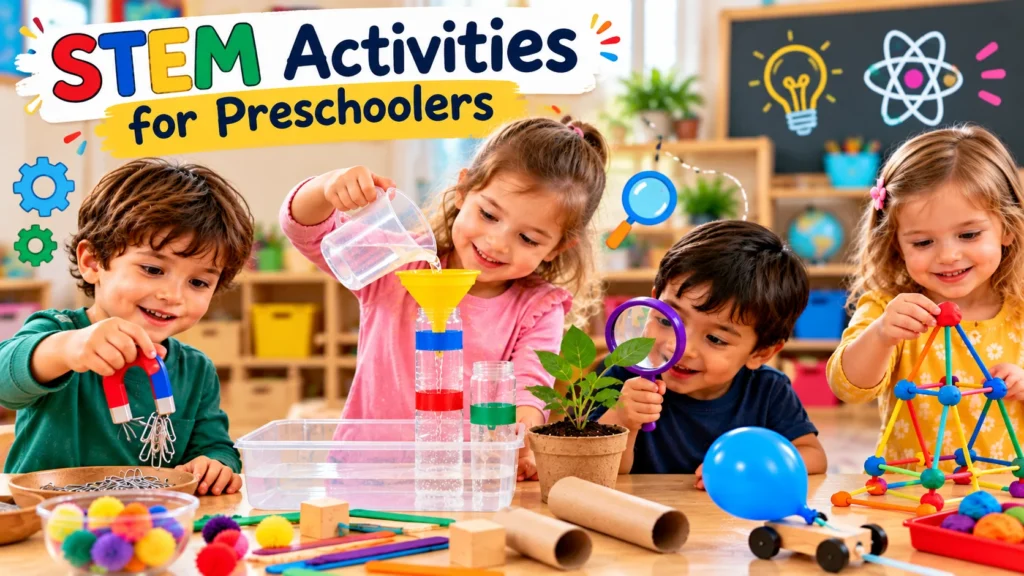
Children are natural explorers. They love mixing colors, stacking blocks, splashing water, and discovering what happens when they try something new. These everyday moments can become exciting opportunities for science, technology, engineering, and math learning.
The best STEM activities for preschoolers are simple, hands-on, and filled with discovery. You don’t need expensive science kits or complicated instructions. Everyday supplies such as paper, water, blocks, and cardboard can help children explore important concepts through play.
Whether you’re a parent, preschool teacher, or homeschool educator, these 20 easy activities offer engaging ways to introduce STEM concepts to children ages 3–5.
What Are STEM Activities for Preschoolers?
STEM stands for Science, Technology, Engineering, and Mathematics. For preschoolers, STEM learning focuses on exploration, observation, experimentation, and problem-solving through age-appropriate play.
Here’s how each subject appears in everyday preschool activities:
| STEM Subject | What Preschoolers Explore | Simple Example |
|---|---|---|
| Science | How things work and change | Testing which objects float |
| Technology | How tools and simple processes work | Exploring wheels and ramps |
| Engineering | How to build and improve designs | Constructing a block tower |
| Mathematics | Numbers, shapes, patterns, and measurement | Sorting shapes and counting blocks |
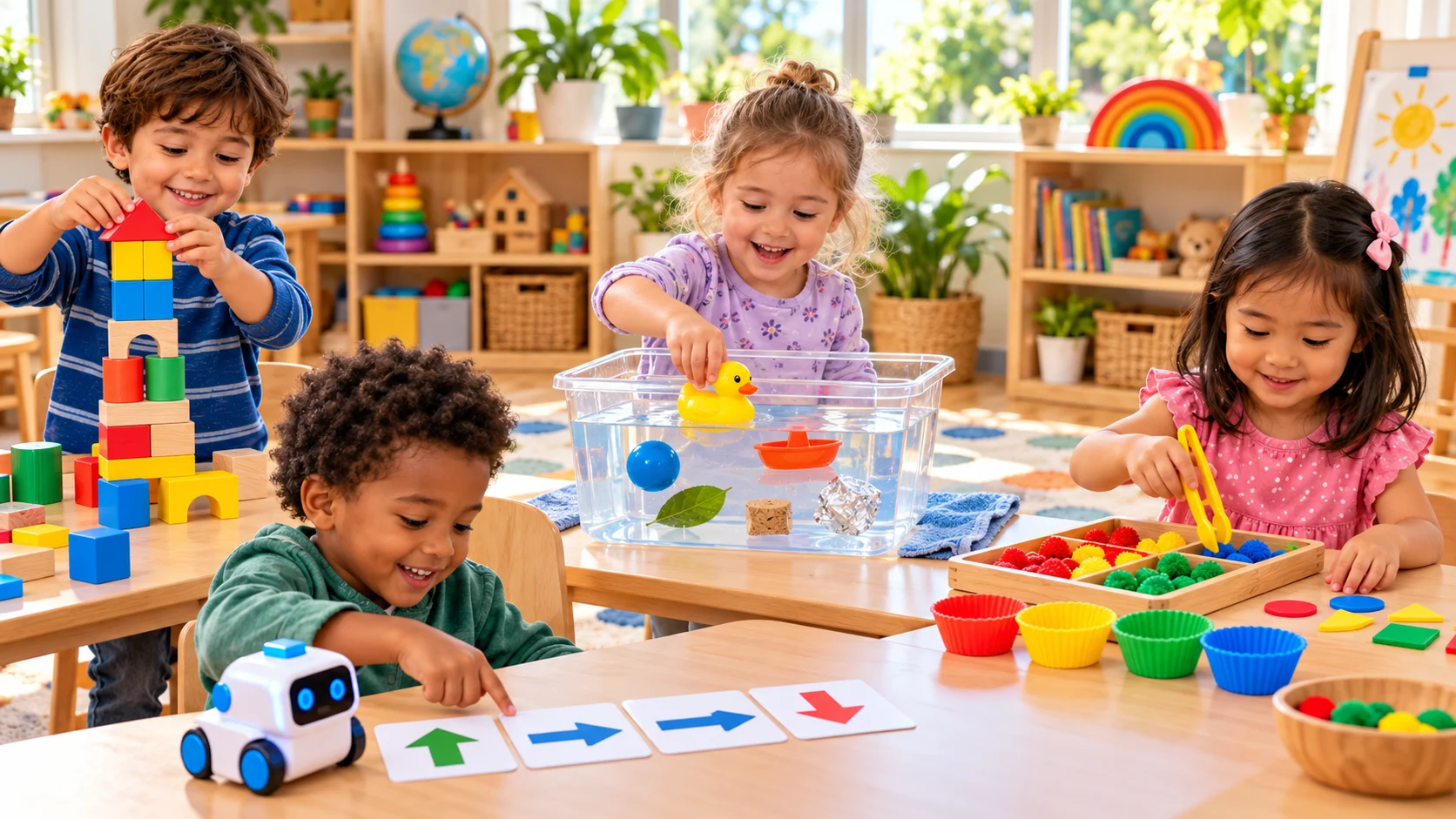
For example, building a tower with blocks combines engineering and mathematics. Children consider how to balance their structures, count the blocks, and compare different designs.
The goal isn’t to memorize scientific facts. It’s to encourage children to ask questions, make predictions, test ideas, and learn from their observations.
Why Are STEM Activities Important for Preschoolers?
Hands-on STEM experiences give children opportunities to practice skills that support learning in different subjects.
Encourage curiosity: Children naturally ask questions about their surroundings. STEM activities help them investigate possible answers.
Develop problem-solving skills: Building a bridge or testing a ramp encourages children to try different solutions when something doesn’t work.
Introduce early math concepts: Counting, sorting, measuring, and creating patterns help children become familiar with mathematical ideas.
Support creativity: Open-ended projects allow children to design structures and experiment with different materials.
Build communication skills: Explaining observations and discussing predictions encourages children to express their ideas.
Promote teamwork: Group experiments provide opportunities to share materials, take turns, and work together.
Most importantly, STEM allows preschoolers to learn by doing rather than simply listening to explanations.
Quick Guide: Choosing the Right Preschool STEM Activity
Not sure where to start? Use this table to choose an activity based on the time and materials available.
| Activity | Estimated Time | Main Skill |
|---|---|---|
| Sink or Float | 10–15 minutes | Prediction |
| Color Mixing | 10 minutes | Observation |
| Ice Melting | 10–20 minutes | Comparing changes |
| Block Tower | 10–15 minutes | Engineering |
| Paper Bridge | 15 minutes | Problem-solving |
| Toy Car Ramp | 15 minutes | Motion and measurement |
| Shape Sorting | 10 minutes | Classification |
| Color Patterns | 10 minutes | Sequencing |
| Leaf Investigation | 15 minutes | Nature observation |
| Weather Watch | 5 minutes daily | Recording information |
Times are approximate. Some children may want to continue exploring long after the initial activity ends.
20 Easy STEM Activities for Preschoolers
These preschool STEM activities use affordable materials and can be adapted for home or classroom learning.
Easy Science Activities for Preschoolers
Science activities encourage young learners to investigate everyday events, observe changes, and develop explanations.
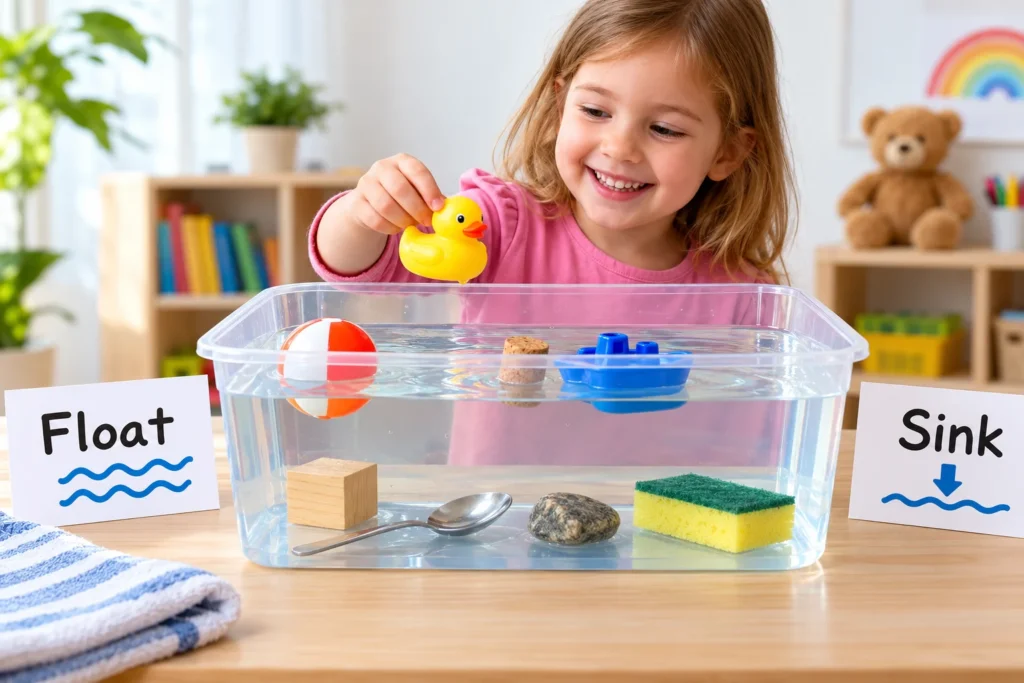
1. Sink or Float Experiment
Age: 3–5 years
Time: 10–15 minutes
STEM Focus: Buoyancy, observation, and prediction
Materials: Shallow water container, large plastic toys, sponge, wooden block, and plastic ball.
Instructions:
- Fill a shallow container with water.
- Show children one object at a time.
- Ask whether they think it will sink or float.
- Place the object in the water and observe what happens.
- Sort the tested objects into floating and sinking groups.
What Children Learn: Objects behave differently in water depending on their properties. Children practice making predictions and comparing results.
Question to Ask: “Why do you think the wooden block floated?”
Try This: Test two objects of similar size but made from different materials.
Safety: Supervise water activities continuously, even when using shallow containers.
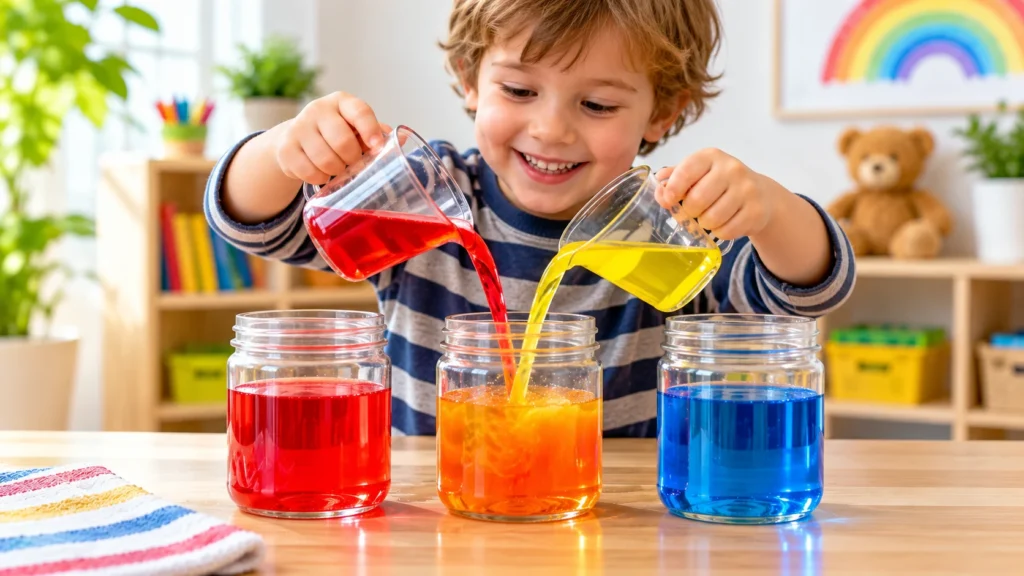
2. Color Mixing Experiment
Age: 3–5 years
Time: 10 minutes
STEM Focus: Color mixing and cause and effect
Materials: Clear plastic cups, water, washable liquid watercolors, and spoons.
Instructions:
- Fill three cups with small amounts of water.
- Add red, blue, and yellow coloring to separate cups.
- Pour small amounts of two colors into an empty cup.
- Stir gently and observe the change.
- Try other combinations to discover new colors.
What Children Learn: Mixing colors creates visible changes. Children practice observation, prediction, and experimentation.
Question to Ask: “What do you think will happen when we mix red and yellow?”
Try This: Give children a picture chart to record their color combinations.
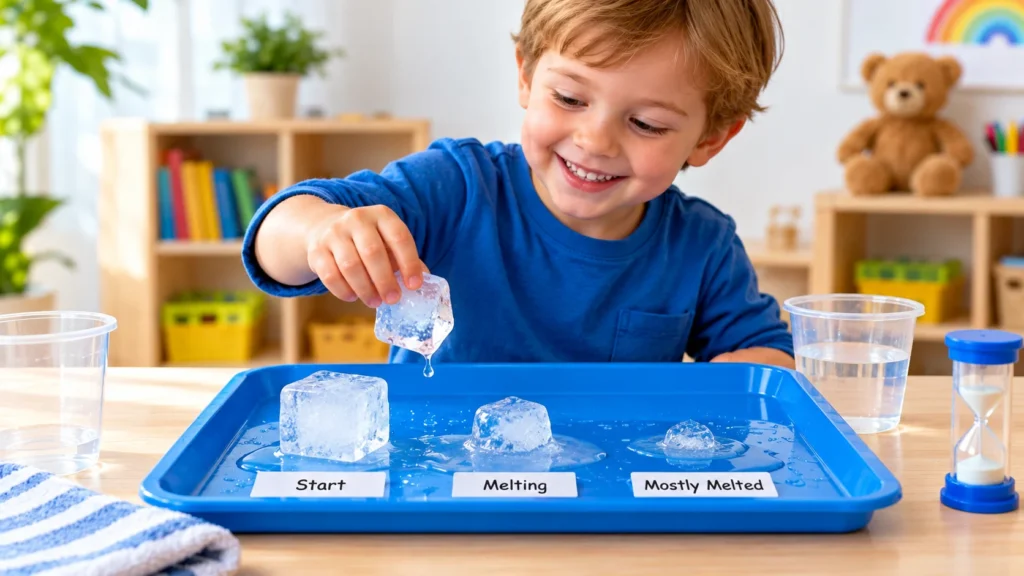
3. Ice Melting Investigation
Age: 3–5 years
Time: 10–20 minutes
STEM Focus: Temperature and changing states of matter
Materials: Ice cubes, two trays, room-temperature water, and towels.
Instructions:
- Place an ice cube on each tray.
- Leave one ice cube untouched.
- Pour a little room-temperature water over the other.
- Observe the cubes as they melt.
- Compare their sizes after several minutes.
What Children Learn: Ice changes into liquid water as it gains heat. Different surroundings can affect how quickly this happens.
Question to Ask: “What could help the ice melt faster?”
Try This: Compare ice placed in sunny and shaded locations while keeping other conditions as similar as possible.
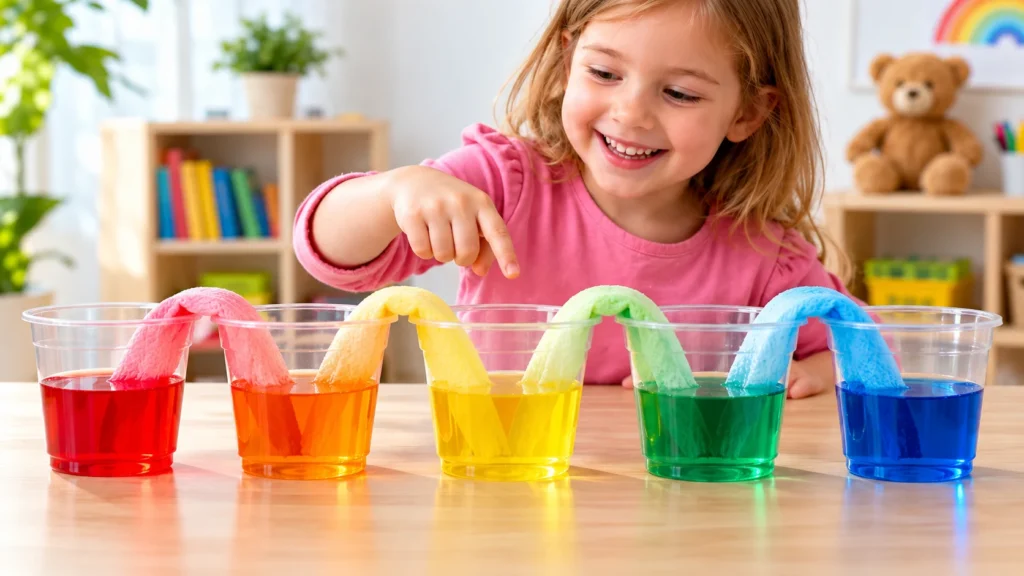
4. Walking Water Rainbow Experiment
Age: 4–5 years
Setup Time: 10 minutes
STEM Focus: Absorption and capillary action
Materials: Three clear cups, water, washable liquid watercolors, and paper towels.
Instructions:
- Arrange three cups in a row.
- Fill the first and third cups halfway with water.
- Add a different color to each filled cup.
- Leave the middle cup empty.
- Fold paper towels into strips and connect neighboring cups.
- Observe the movement of water over the next several hours.
What Children Learn: Water can travel through tiny spaces in paper towels through capillary action. As colored water reaches the middle cup, the colors may mix.
Question to Ask: “How did the water move into the empty cup?”
Try This: Compare different paper towel brands to see whether water moves at the same speed.
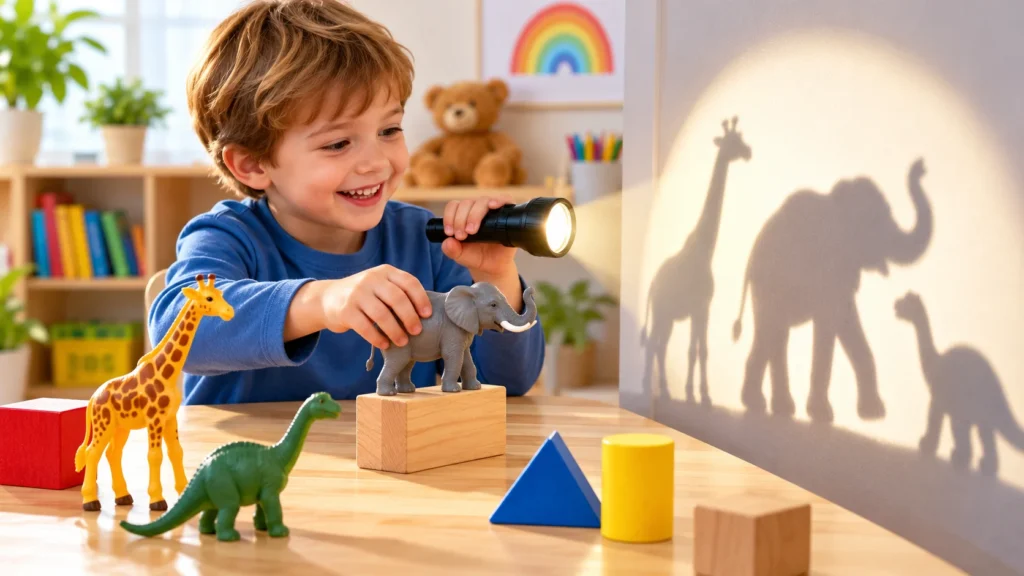
5. Light and Shadow Investigation
Age: 3–5 years
Time: 10–15 minutes
STEM Focus: Light and shadows
Materials: Flashlight, large toy animals, and a light-colored wall.
Instructions:
- Dim the room slightly.
- Shine a flashlight toward a wall.
- Place a toy between the light and the wall.
- Move the toy closer to the flashlight.
- Observe how the shadow changes.
What Children Learn: Light travels through space, and opaque objects block it to create shadows. Moving objects changes the appearance of shadows.
Question to Ask: “How can we make the shadow bigger?”
Safety Tip: Never shine flashlights directly into children’s eyes.
Simple Engineering Activities for Preschoolers
Engineering activities introduce building, testing, designing, and improving structures.
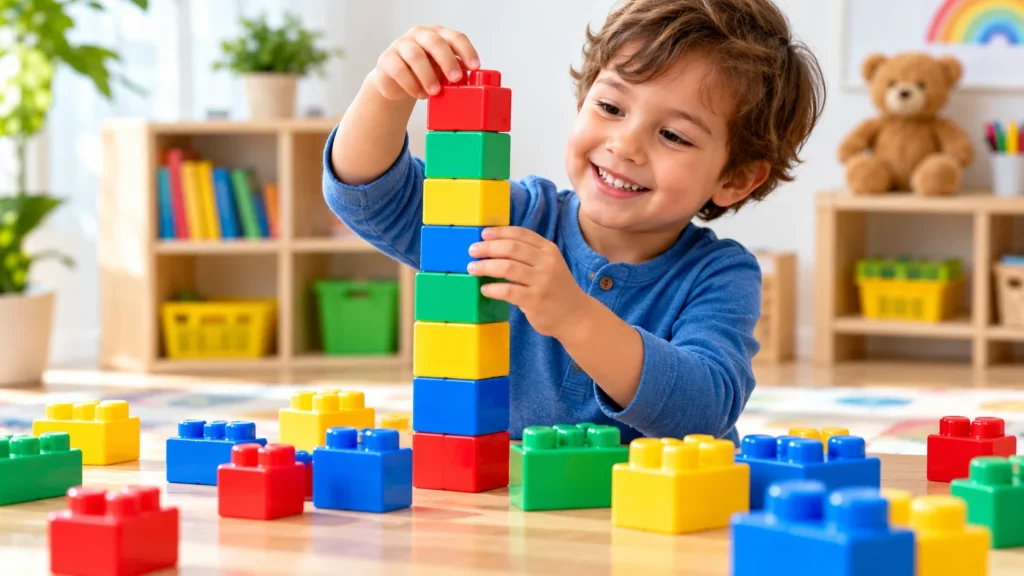
6. Build the Tallest Block Tower
Age: 3–5 years
Time: 10–15 minutes
STEM Focus: Engineering and balance
Materials: Large wooden or foam blocks.
Instructions:
- Give children blocks of different shapes and sizes.
- Challenge them to build a tall tower.
- Observe what happens when the tower becomes unstable.
- Encourage children to rebuild using a wider base.
- Compare which design remains standing.
What Children Learn: Children explore balance, stability, and structural support while practicing problem-solving.
Question to Ask: “What can we change to make the tower stronger?”
Try This: Count how many blocks each tower can hold before it falls.
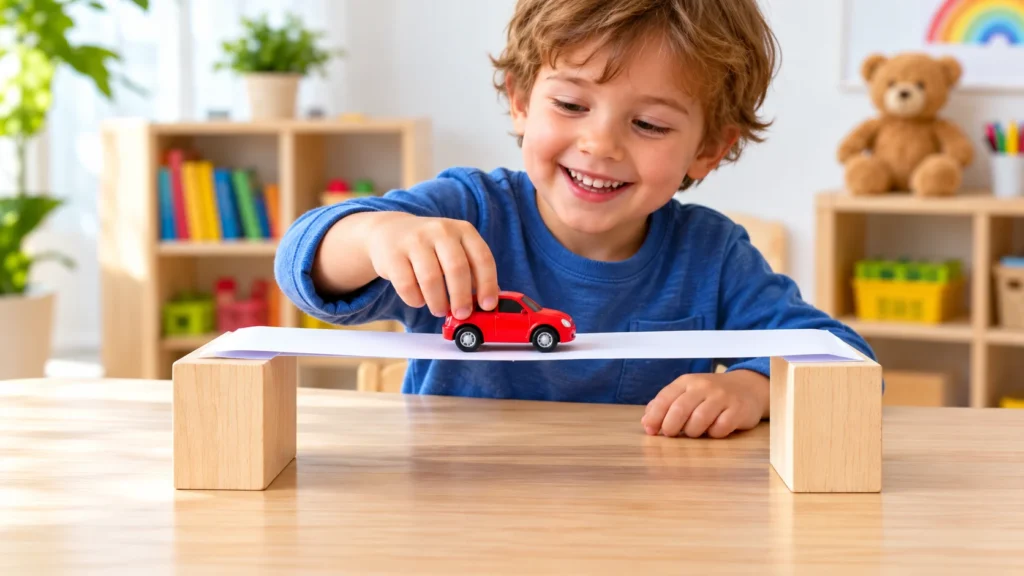
7. Paper Bridge Building Challenge
Age: 4–5 years
Time: 15 minutes
STEM Focus: Engineering and structural strength
Materials: Paper, two large blocks, and a lightweight toy car.
Instructions:
- Place two blocks a short distance apart.
- Lay a sheet of paper across the gap.
- Carefully place a toy car on the bridge.
- Observe whether the paper supports the car.
- Fold the paper like an accordion and test it again.
What Children Learn: Folding paper changes its shape and can improve its ability to support weight.
Question to Ask: “Why might the folded paper be stronger?”
Try This: Experiment with different bridge widths while keeping the same toy car.
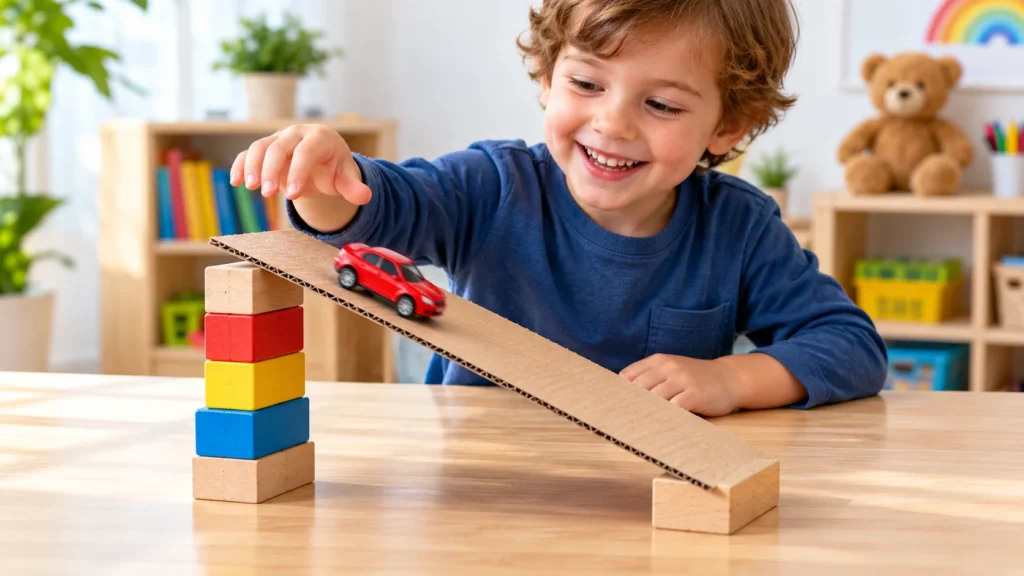
8. Toy Car Ramp Experiment
Age: 3–5 years
Time: 15 minutes
STEM Focus: Motion, slopes, and measurement
Materials: Cardboard, large blocks, and toy cars.
Instructions:
- Create a ramp by placing cardboard over a block.
- Position a toy car at the top.
- Release it without pushing.
- Observe how far it travels.
- Raise the ramp and repeat the experiment.
What Children Learn: Children investigate how ramp height affects the movement of a toy car.
Question to Ask: “What happens when we make the ramp higher?”
Try This: Mark the car’s stopping point using tape and compare the distances.
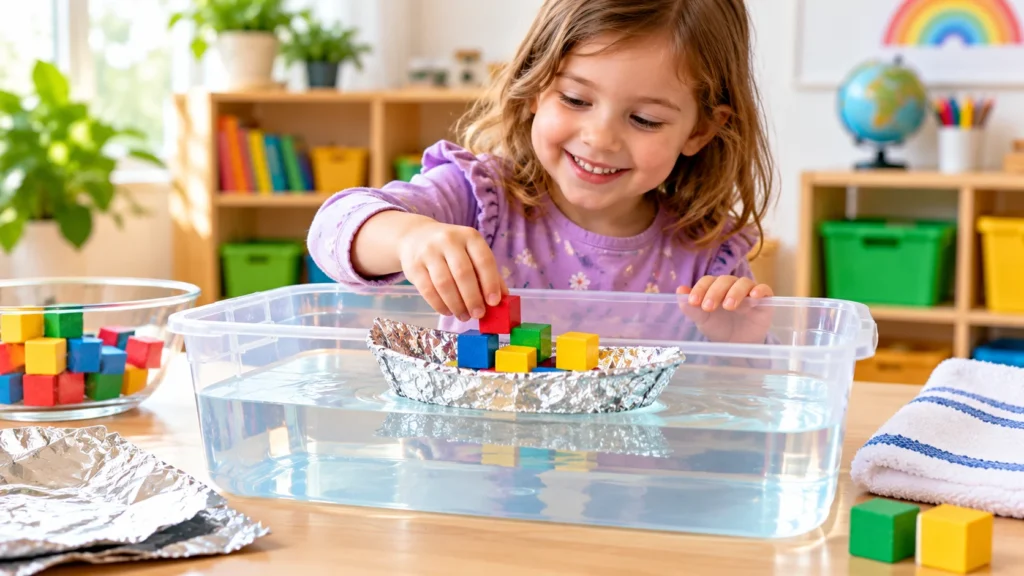
9. Aluminum Foil Boat Challenge
Age: 4–5 years
Time: 15 minutes
STEM Focus: Floating, design, and weight distribution
Materials: Aluminum foil, shallow water container, and large lightweight plastic blocks.
Instructions:
- Have an adult prepare a sheet of aluminum foil without sharp edges.
- Shape the foil into a small boat.
- Place the boat gently on the water.
- Add lightweight blocks one at a time.
- Count how many the boat holds before sinking.
- Change the boat’s shape and test it again.
What Children Learn: A boat’s shape influences how much weight it can support while floating.
Question to Ask: “How could we build a boat that carries more blocks?”
Safety Tip: Adults should prepare the foil and supervise the water activity.
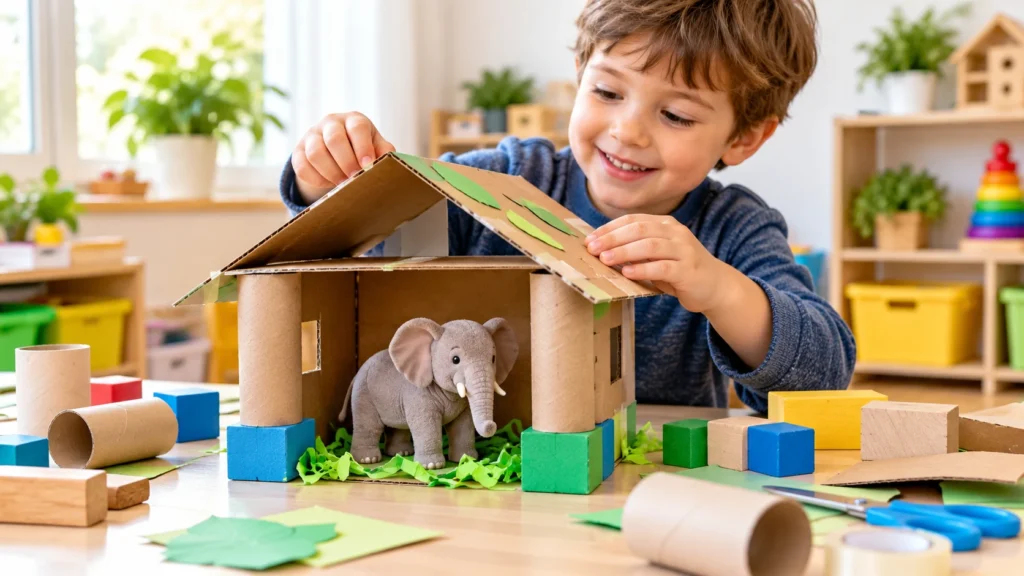
10. Build a Shelter for a Toy Animal
Age: 3–5 years
Time: 15–20 minutes
STEM Focus: Construction and spatial awareness
Materials: Small cardboard boxes, large blocks, paper, and child-safe tape.
Instructions:
- Choose a large toy animal.
- Ask children to design a shelter for it.
- Build walls using blocks or cardboard.
- Add a roof that covers the animal.
- Test whether the structure stays standing.
What Children Learn: Children explore design, planning, and the relationship between shape and stability.
Question to Ask: “What does our shelter need to keep the animal covered?”
Try This: Challenge children to make the roof wider without causing the structure to collapse.
Fun Math STEM Activities for Preschoolers
Math becomes easier to understand when children can move, count, sort, and compare real objects.
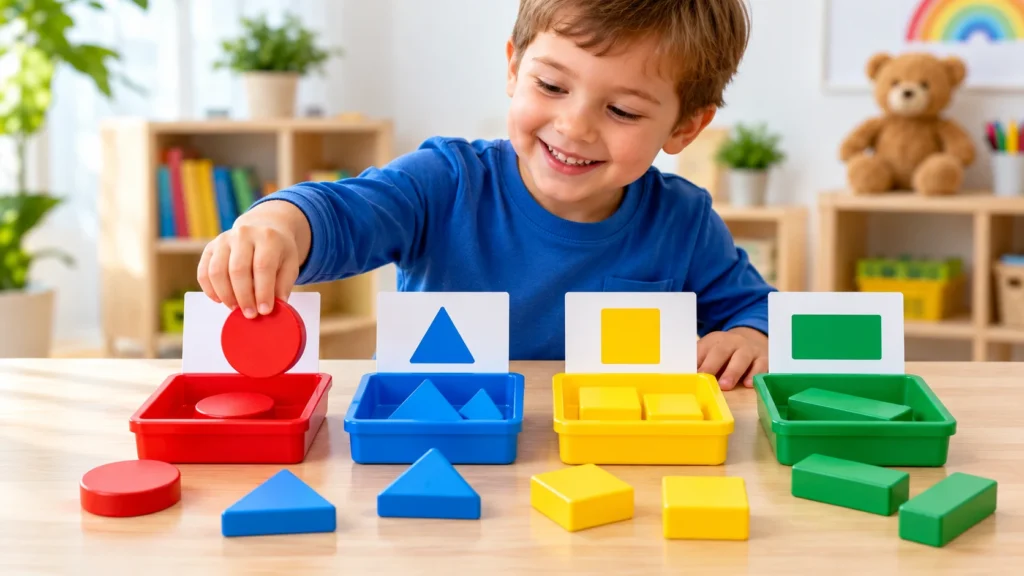
11. Shape Sorting Challenge
Age: 3–5 years
Time: 10 minutes
STEM Focus: Geometry and classification
Materials: Large foam shapes and sorting trays.
Instructions:
- Spread different shapes across a table.
- Ask children to identify circles, squares, and triangles.
- Sort matching shapes into groups.
- Count the shapes in each group.
- Sort them again by size or color.
What Children Learn: Shape recognition, counting, classification, and comparison.
Question to Ask: “How are these two shapes alike?”
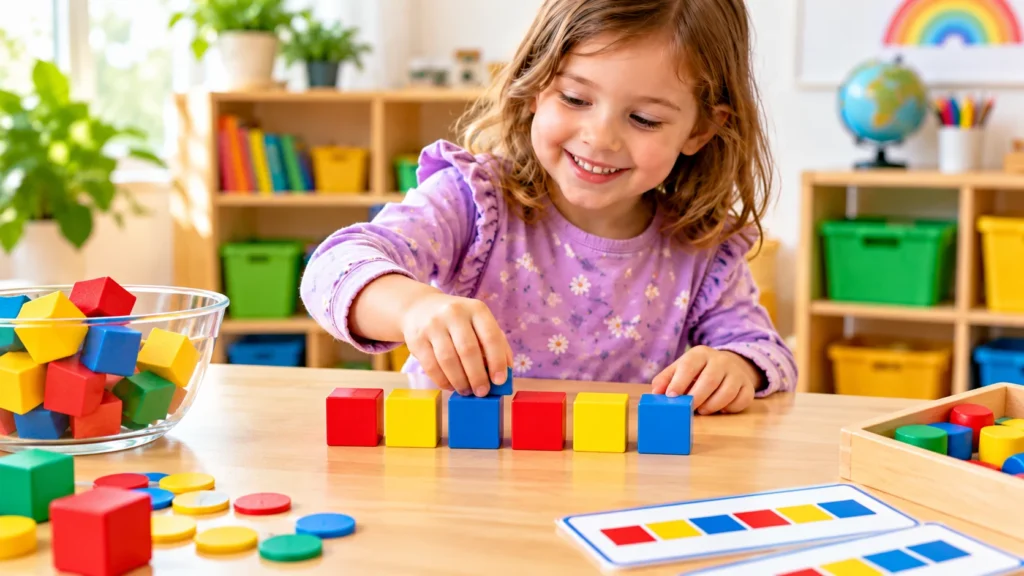
12. Create Color Patterns
Age: 3–5 years
Time: 10 minutes
STEM Focus: Patterns and sequencing
Materials: Large colorful blocks.
Instructions:
- Arrange blocks in a red-blue-red-blue pattern.
- Ask which color should come next.
- Let children continue the sequence.
- Introduce more complex patterns.
- Encourage children to design their own arrangements.
What Children Learn: Children practice recognizing and extending repeating patterns.
Question to Ask: “What comes next in your pattern, and how do you know?”
13. Measure Objects With Blocks
Age: 4–5 years
Time: 10–15 minutes
STEM Focus: Measurement and comparison
Materials: Equal-sized building blocks, books, and toys.
Instructions:
- Choose an object to measure.
- Place equal-sized blocks end to end beside it.
- Count the blocks needed to match its length.
- Repeat with another object.
- Compare the measurements.
What Children Learn: Children explore length and learn to compare objects using nonstandard measurement units.
Question to Ask: “Which object needs more blocks to measure?”
Try This: Measure the same object twice to see whether the results match.
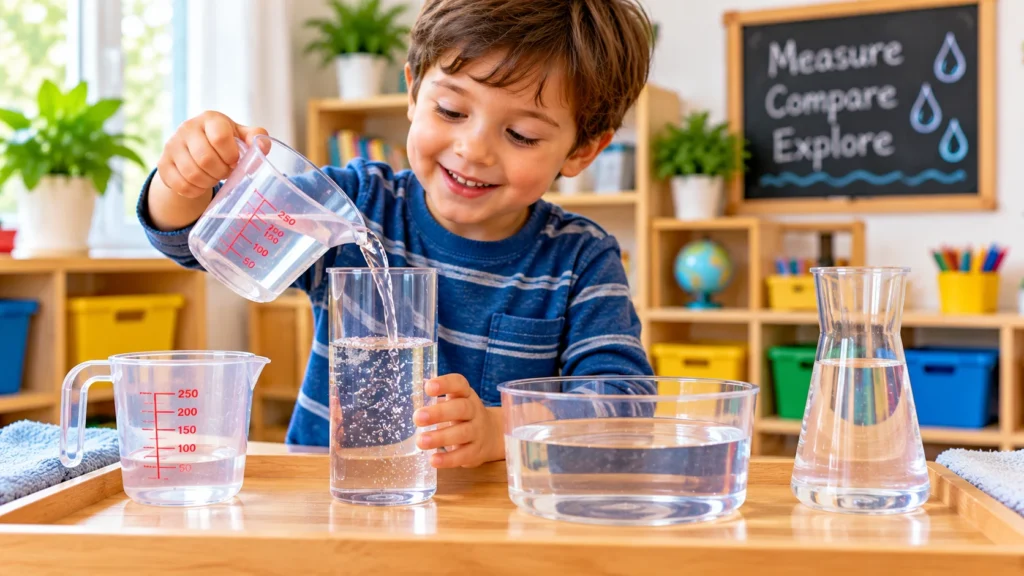
14. Water Measurement Challenge
Age: 4–5 years
Time: 15 minutes
STEM Focus: Volume and comparison
Materials: Water, plastic measuring cups, and containers of different shapes.
Instructions:
- Fill a small measuring cup with water.
- Pour it into a tall, narrow container.
- Transfer the same water into a short, wide container.
- Compare the water levels.
- Discuss whether the amount of water changed.
What Children Learn: Containers can make the same quantity of water look different. Children begin exploring capacity and volume.
Question to Ask: “Does the taller water level mean we have more water?”
Safety Tip: Use unbreakable containers, keep water shallow, and supervise continuously.
Technology and Early Coding STEM Activities
Technology for preschoolers doesn’t always involve computers or screens. Children can explore sequencing, mechanical tools, and instructions through hands-on play.
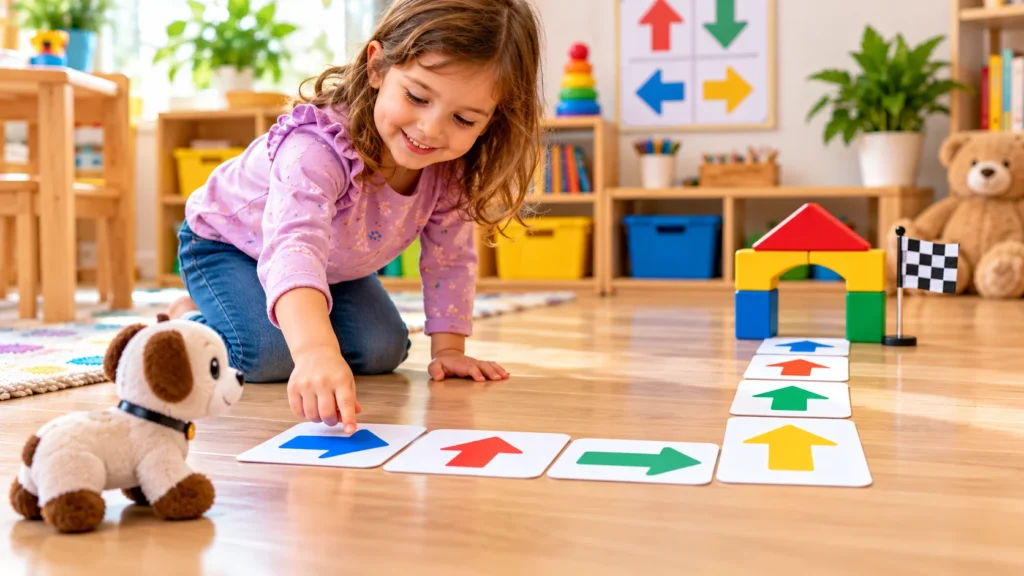
15. Follow the Arrow Coding Path
Age: 4–5 years
Time: 15 minutes
STEM Focus: Early coding and sequencing
Materials: Large paper arrow cards and a toy animal.
Instructions:
- Place the toy animal on the floor.
- Create a simple path with arrow cards.
- Move the toy according to the arrows.
- Check whether it reaches the destination.
- Change the sequence to create another route.
What Children Learn: Children explore direction, sequencing, and the idea that instructions must be followed in order.
Question to Ask: “Which arrow should we change to reach the other side?”
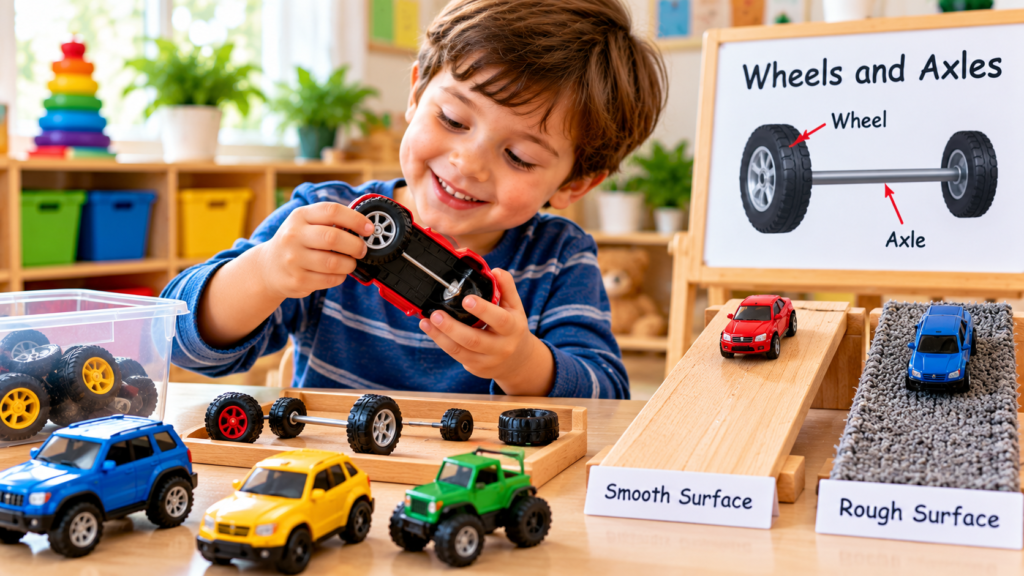
16. Explore Wheels and Axles
Age: 3–5 years
Time: 10–15 minutes
STEM Focus: Simple machines
Materials: Large toy cars and different floor surfaces.
Instructions:
- Show children a toy car with visible wheels.
- Let them examine how the wheels turn.
- Roll the car across a smooth surface.
- Repeat on a textured surface.
- Compare how easily the car moves.
What Children Learn: Wheels and axles help objects move, while different surfaces can affect rolling motion.
Question to Ask: “Why does the car move differently on the carpet?”
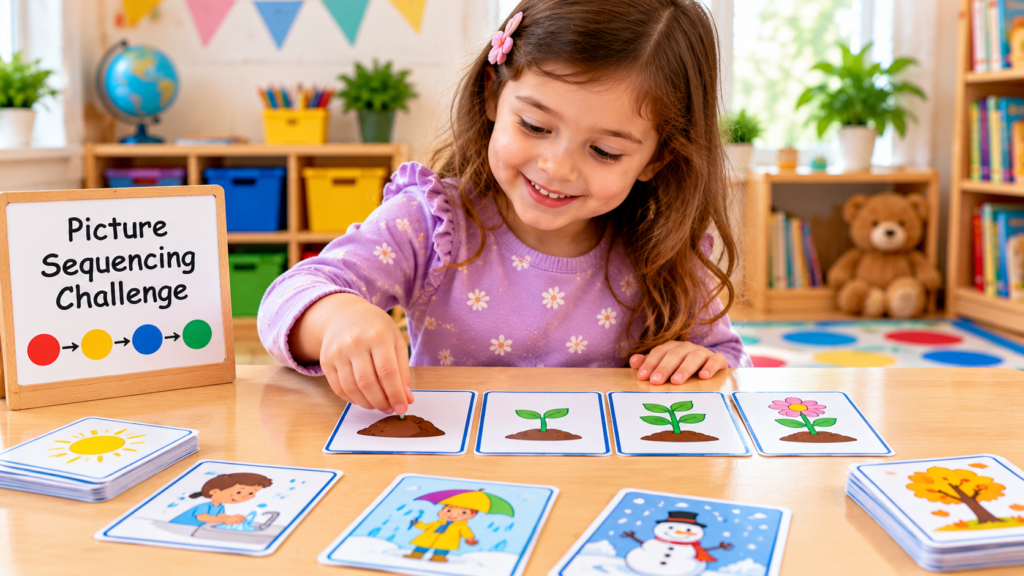
17. Picture Sequencing Challenge
Age: 3–5 years
Time: 10 minutes
STEM Focus: Logical thinking and sequencing
Materials: Large picture cards showing steps in a simple task.
Instructions:
- Prepare pictures showing the process of planting a seed.
- Mix the cards.
- Ask children to arrange the steps in order.
- Discuss what happens first, next, and last.
- Repeat using a different familiar activity.
What Children Learn: Children practice organizing information, following a process, and recognizing sequences.
Question to Ask: “What would happen if we changed these two steps?”
Outdoor and Nature STEM Activities for Preschoolers
Nature offers learning experiences that encourage children to explore living things, weather, and the environment.
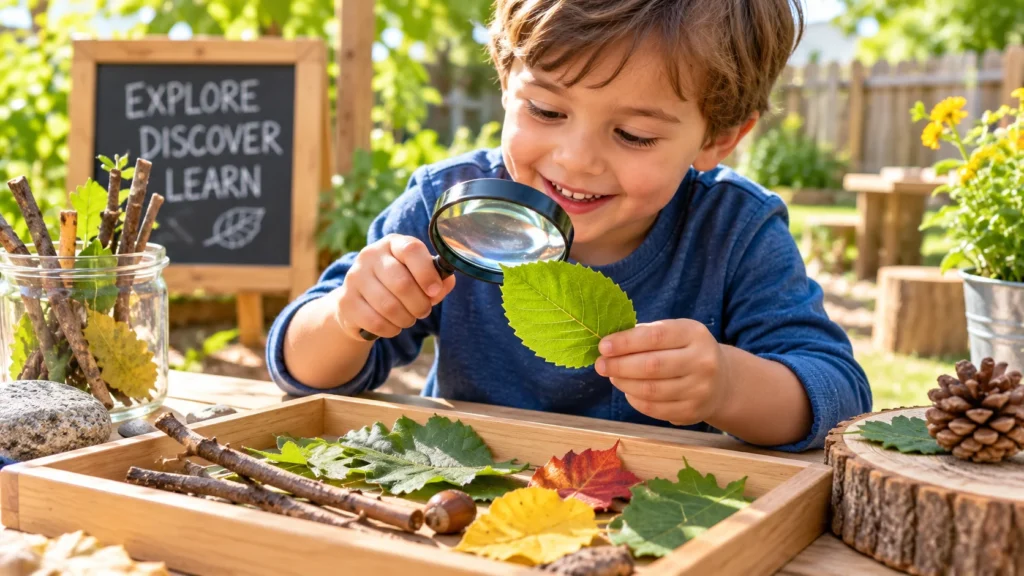
18. Leaf Investigation
Age: 3–5 years
Time: 15 minutes
STEM Focus: Observation and classification
Materials: Large fallen leaves, paper, and a magnifying glass.
Instructions:
- Collect several safe, familiar fallen leaves.
- Examine their shapes, colors, and sizes.
- Compare their textures.
- Sort leaves into matching groups.
- Count how many leaves are in each group.
What Children Learn: Children practice observation, comparing natural objects, and organizing information.
Question to Ask: “What differences do you notice between these leaves?”
Safety Tip: Avoid unfamiliar or irritating plants, and wash hands after handling outdoor materials.
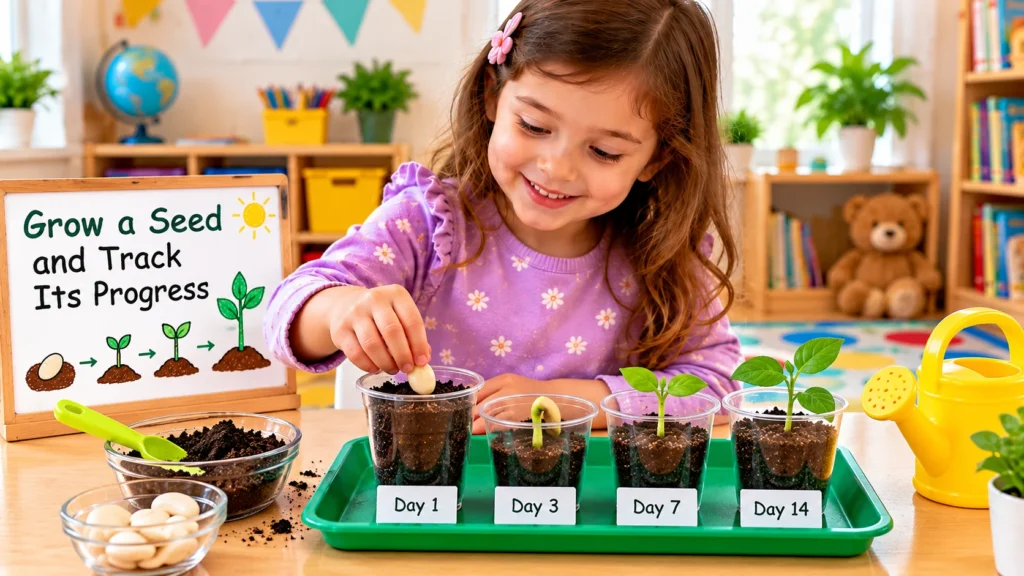
19. Grow a Seed and Track Its Progress
Age: 4–5 years
Setup Time: 15 minutes
STEM Focus: Plant growth and observation
Materials: Large bean seeds, soil, a planting container, and water.
Instructions:
- Fill a small planting container with soil.
- Help children plant a seed.
- Add a little water.
- Place the container in suitable light.
- Observe and record changes over several days.
What Children Learn: Children explore plant growth and how water, light, and suitable conditions support development.
Question to Ask: “What changes have you noticed since we planted the seed?”
Try This: Draw pictures of the plant at different stages.
Safety Tip: Seeds may pose choking risks. Supervise handling and ensure children do not put them in their mouths.
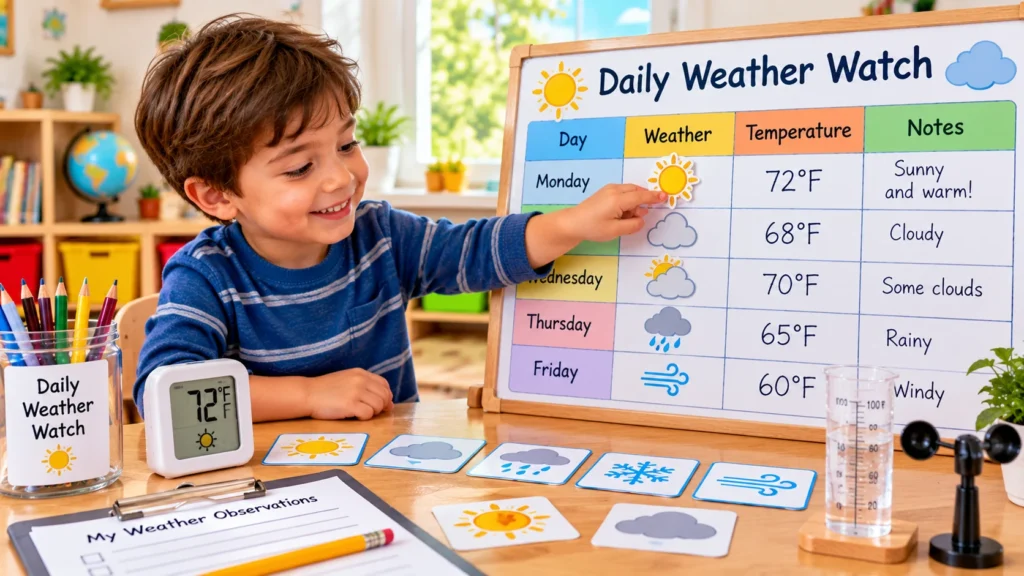
20. Daily Weather Watch
Age: 3–5 years
Time: 5–10 minutes daily
STEM Focus: Weather observation and data collection
Materials: Paper, crayons, and simple weather symbols.
Instructions:
- Look outside together each morning.
- Identify whether it is sunny, cloudy, rainy, or windy.
- Record the observation on a weather chart.
- Repeat each day for one week.
- Compare which weather conditions occurred most often.
What Children Learn: Children develop observation, data-recording, counting, and comparison skills.
Question to Ask: “What type of weather did we see most often this week?”
STEM Activities for 3-, 4-, and 5-Year-Olds
The best STEM activities match a child’s abilities and interests. The same experiment can be adapted for different ages.
| Age | Recommended Activities | How to Adapt |
|---|---|---|
| 3 years | Color mixing, block towers, shape sorting | Use large materials and short instructions |
| 4 years | Sink or float, ramps, paper bridges | Encourage simple predictions and comparisons |
| 5 years | Foil boats, measuring, early coding | Add planning, recording, and redesign challenges |
These are flexible suggestions, not strict age requirements. Children develop at different rates and may need different levels of support.
How to Make Preschool STEM Activities More Engaging
A successful STEM activity doesn’t require an impressive final product. Children benefit from opportunities to explore and change their ideas.
Ask Open-Ended Questions
Instead of immediately explaining what will happen, ask questions that encourage thinking.
For example:
- What do you notice?
- What do you think will happen next?
- How could we make this stronger?
- What might happen if we change one thing?
- How could we test your idea?
Allow Children to Experiment
Give children opportunities to try their own methods. If a tower falls, encourage them to rebuild it using a different arrangement.
Use Familiar Materials
Simple supplies help children connect STEM learning with everyday experiences. Cardboard, water, paper, and blocks can support a wide variety of investigations.
Encourage Predictions
Before starting, ask children what they think will happen. Afterward, compare their predictions with what they observed.
Celebrate Problem-Solving
Recognize children’s effort, curiosity, and willingness to try again rather than focusing only on whether an experiment worked as expected.
A Simple Five-Day Preschool STEM Activity Plan
Preschool teachers and parents can introduce one STEM activity each day without preparing complicated lessons.
| Day | Activity | Learning Focus |
|---|---|---|
| Monday | Sink or Float | Prediction and observation |
| Tuesday | Build a Block Tower | Engineering and balance |
| Wednesday | Shape Sorting | Mathematics and classification |
| Thursday | Toy Car Ramp | Motion and experimentation |
| Friday | Leaf Investigation | Nature and comparison |
Teaching Tip: End each session by asking children what they discovered and what they would like to explore next.
A simple drawing, photograph, or short conversation can help children revisit their discoveries.
Important Safety Tips for Preschool STEM Activities
Safety should always come first when planning hands-on learning experiences.
- Supervise water activities: Never leave young children unattended around water, even in shallow containers.
- Avoid choking hazards: Use large, age-appropriate objects instead of loose marbles, small magnets, button batteries, or other tiny items.
- Choose child-safe materials: Use washable colors, unbreakable containers, and supplies without sharp edges.
- Check for allergies: Review activity materials when working with plants, soil, foods, or sensory substances.
- Prepare tools in advance: Adults should handle cutting, sharp tools, electricity, and any heating.
- Maintain a clean activity area: Wipe spills promptly and wash hands after activities involving soil or shared materials.
- Avoid tasting experiment materials: Remind children that materials used in experiments are not for eating or drinking.
With appropriate supervision and preparation, preschoolers can explore many STEM concepts through safe, playful experiences.
Common Preschool STEM Mistakes to Avoid
Making Activities Too Complicated
Young children don’t need detailed scientific explanations. Introduce one simple concept at a time and use familiar words.
Expecting Every Experiment to Work Perfectly
Unexpected results provide opportunities for investigation. Encourage children to ask what happened and try a different approach.
Providing All the Answers
Allow children time to observe and think before explaining the results.
Using Too Many Materials
Start with a small selection of supplies. Introduce additional materials when they serve a clear purpose.
Focusing Only on Science Experiments
Remember that STEM includes technology, engineering, and mathematics. Building, measuring, sorting, and sequencing are valuable activities too.
Frequently Asked Questions About Preschool STEM Activities
What are the best STEM activities for preschoolers?
Some of the best STEM activities for preschoolers include sink-or-float experiments, building block towers, color mixing, paper bridges, toy car ramps, and shape sorting. These activities are easy to organize and help introduce observation, problem-solving, measurement, and basic engineering concepts.
What are easy STEM activities for 3-year-olds?
Simple STEM activities for 3-year-olds include stacking large blocks, sorting shapes, mixing colors, exploring shadows, and observing objects floating in water. Choose age-appropriate materials, provide short instructions, and supervise every activity.
How can I teach STEM to preschoolers at home?
Start with familiar materials such as water, cardboard, blocks, paper, and toy cars. Choose one simple activity, encourage your child to predict what will happen, and discuss the results together. Short, playful sessions are often more suitable than formal lessons.
What are examples of preschool engineering activities?
Preschool engineering activities include building towers, constructing paper bridges, designing toy car ramps, creating foil boats, and making shelters for toy animals. These projects introduce planning, building, testing, and improving designs.
Can preschool STEM activities be done without screens?
Yes. Many preschool STEM activities are completely screen-free. Children can investigate simple machines, follow arrow sequences, build structures, observe nature, and solve practical problems without using computers or tablets.
What materials do I need for preschool STEM activities?
Common supplies include large blocks, paper, cardboard, clear plastic cups, water, washable paint, toy cars, and safe natural materials. Most activities can be adapted using items already available at home or in the classroom.
How long should a preschool STEM activity last?
Many hands-on preschool STEM activities take approximately 10–20 minutes. However, the appropriate duration depends on children’s interests, attention, and the activity itself. Projects involving plants or weather observations can continue over several days.
How do STEM activities help preschoolers learn?
STEM activities provide opportunities for children to observe, ask questions, solve problems, practice counting and measuring, and explore different ideas. They also encourage communication and creative thinking through hands-on experiences.
Conclusion
Introducing STEM to young children doesn’t require expensive equipment or advanced scientific knowledge. Everyday activities such as building towers, mixing colors, measuring objects, and exploring nature can create meaningful learning opportunities.
These 20 easy STEM activities for preschoolers help children discover science, technology, engineering, and mathematics through play, curiosity, and experimentation.
Start with one activity, encourage children to ask questions, and give them time to explore. Sometimes, the most valuable learning begins with a simple question: “What happens if we try this?”