
Some school days go exactly as planned. Others leave you with five extra minutes, a room full of energetic students, and no activity ready to go.
That’s when a good classroom game can make all the difference.
You don’t need expensive supplies, complicated instructions, or an entire afternoon of preparation. The right game can turn an ordinary classroom moment into an opportunity for learning, movement, teamwork, or simply having fun together.
Whether you’re teaching kindergarten, planning activities for fifth graders, or looking for something to keep early finishers engaged, these 35 fun classroom games give you plenty of practical options.
You’ll find no-prep games, educational challenges, quiet activities, team-building ideas, and interactive games. Each includes clear instructions, suggested grade levels, timing, and helpful tips so you can get started with confidence.
Need a classroom game right now? Try Simon Says for a quick movement break, Category Chain for vocabulary practice, or Mirror Me for a calmer activity. All three require almost no preparation.
What Are Classroom Games?
Classroom games are structured activities that encourage students to participate, interact, solve problems, or practice skills through play. They can support academic learning, cooperation, movement breaks, and everyday classroom routines.
Some activities take just three minutes and require no supplies. Others work better as a 15-minute lesson review or small-group challenge.
The most useful classroom games are easy to explain, appropriate for students’ ages, and connected to a clear purpose. You might use a spelling game to review vocabulary, a movement game after a long reading lesson, or a quiet guessing activity when students need to refocus.

Quick Classroom Game Finder: Choose the Right Activity
Not sure where to begin? Use this quick guide to find an activity that fits your available time, students’ grade levels, and learning goals.
Mirror Me, Move and Freeze, Stand Up If, or Category Chain.
Math Bingo, Mystery Number, Vocabulary Detective, or Science Sorting.
Build-a-Story, Silent Drawing Chain, Puzzle Challenge, or Review Showdown.
| Classroom Game | Best Grades | Time | Preparation | Best For |
|---|---|---|---|---|
| 20 Questions | 2–5 | 5–10 min | None | Critical thinking |
| Simon Says | K–3 | 5–8 min | None | Listening skills |
| Category Chain | 1–5 | 3–7 min | None | Vocabulary |
| Mystery Number | 1–5 | 5–10 min | None | Math reasoning |
| One-Word Story | 2–5 | 5–10 min | None | Creativity |
| Math Bingo | 1–5 | 10–15 min | Low | Math practice |
| Classroom Pictionary | 2–5 | 10–15 min | Low | Vocabulary |
| Four Corners | K–5 | 5–10 min | Low | Movement and review |
| Memory Tray | K–5 | 5–10 min | Low | Observation |
| Mirror Me | K–5 | 3–5 min | None | Quiet movement |
| Digital Escape Challenge | 3–5 | 15–25 min | Medium | Problem-solving |
Times and grade levels are suggested starting points. Adapt the rules to your students’ needs.
Find Your Perfect Classroom Game
Search all 35 activities below, or narrow the choices by game type and available time.
7 Quick and Easy Classroom Games With No Prep
Every teacher needs a few reliable games that work with almost no warning. These activities are especially useful during transitions, unexpected free time, morning meetings, or the last few minutes before dismissal.

01 20 Questions
This classic guessing game encourages students to ask thoughtful questions and use clues to reach a logical answer.
How to Play
- Secretly choose an animal, object, place, or subject-related word.
- Tell students which broad category it belongs to.
- Invite questions that can only be answered with yes or no.
- Allow up to 20 questions before the final guess.
For example, if the mystery word is penguin, students might ask, “Is it a bird?” or “Can it fly?”
Learning benefits: Question formation, logical reasoning, vocabulary, and listening.
02 Simon Says
Simon Says combines simple movement with careful listening. It’s one of the easiest games to introduce to younger elementary students.

How to Play
- Stand where every student can see you.
- Give directions beginning with “Simon says,” such as “Simon says touch your shoulders.”
- Occasionally give a direction without saying “Simon says.”
- Students should follow only directions that begin with the correct phrase.
Learning benefits: Listening, attention, following directions, and self-control.
03 Category Chain
Category Chain is a fast vocabulary activity that works without worksheets or special preparation.
How to Play
- Choose a category such as animals, fruits, planets, or verbs.
- Ask one student to name something in that category.
- Continue around the room, avoiding repeated answers.
- Offer clues or allow help when someone gets stuck.
An animal chain might begin with elephant, tiger, rabbit, and dolphin.
Learning benefits: Vocabulary recall, memory, and verbal fluency.
04 Mystery Number
Give students a secret number to discover using mathematical clues.
How to Play
- Choose a number suitable for your class.
- Provide one mathematical clue at a time.
- Ask students to think of possible answers.
- Continue until the mystery number is identified.
Example clues: My number is greater than 20, less than 40, even, a multiple of 6, and its digits add to 6. The answer is 24.
Learning benefits: Number sense, reasoning, and mathematical vocabulary.
05 One-Word Story
What happens when an entire class creates one story together, one word at a time? Usually something wonderfully unexpected.
How to Play
- Start with a simple word such as “Yesterday.”
- Invite the next student to contribute one word.
- Continue around the room, building a sentence or story.
- Pause occasionally to read the developing story aloud.
For example: “Yesterday / a / tiny / dragon / visited / our / school.”
Learning benefits: Sentence structure, creativity, listening, and collaboration.
06 Odd One Out
Odd One Out asks students to identify which item differs from the others and explain their reasoning.
How to Play
- Present four words, pictures, or numbers.
- Give students a moment to decide which one doesn’t belong.
- Invite students to explain their choices.
- Accept different answers when the reasoning is valid.
Example: Apple, banana, carrot, orange. Carrot is the obvious choice because it’s a vegetable in a group of fruits.
Learning benefits: Classification, comparison, reasoning, and communication.
07 True or False Challenge
This quick game helps teachers check what students remember without introducing another worksheet.
How to Play
- Read a statement from a recent lesson.
- Ask students to show thumbs up for true and thumbs down for false.
- Reveal the answer.
- Invite a student to explain the reasoning.
Examples: “A triangle has four sides” is false. “Plants need water to grow” is true.
Learning benefits: Knowledge recall, reasoning, and active participation.
10 Educational Classroom Games That Make Learning Fun
Educational classroom games can reinforce math, reading, spelling, science, and other subjects while giving students a welcome change from traditional exercises.
08 Spelling Relay
In Spelling Relay, students work in small teams to spell words correctly.
How to Play
- Divide students into small groups.
- Give each group a spelling word.
- Have students take turns writing one letter at a time.
- Ask the team to check the completed word together.
Learning benefits: Spelling, letter sequencing, and cooperation.
09 Sight Word Detective
Turn familiar reading words into clues for a classroom detective challenge.
How to Play
- Display several familiar sight words.
- Give clues about one of the words.
- Ask students to identify and read the matching word.
- Invite someone to use the word in a sentence.
For example: “Find the four-letter word that begins with TH and means something is nearby.” Answer: this.
Learning benefits: Word recognition, reading fluency, and phonics awareness.
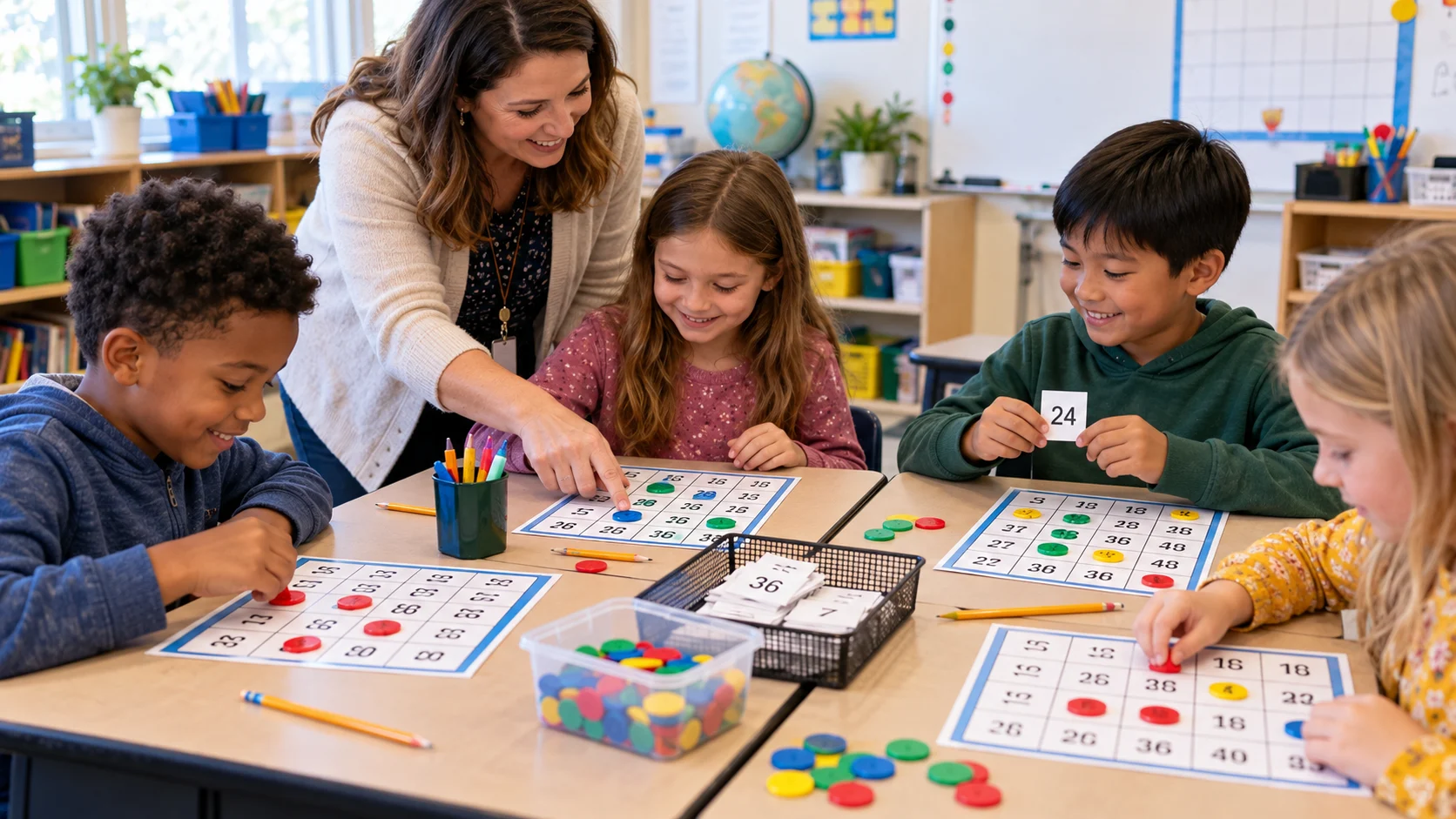
10 Math Bingo
Math Bingo turns ordinary number practice into a familiar classroom challenge.
How to Play
- Give students a grid containing possible answers.
- Read a math problem aloud.
- Students solve the problem and mark the matching answer.
- Continue until someone completes the agreed bingo pattern.
If you say “Seven plus five,” students mark the number 12.
Learning benefits: Number fluency, mental math, and listening.
11 Number Talk Challenge
This classroom game focuses on different ways to solve a mathematical problem rather than rewarding only the fastest answer.
How to Play
- Write a problem such as 18 + 17.
- Give students quiet thinking time.
- Invite them to share their strategies.
- Challenge the class to find another correct method.
One child might calculate 18 + 10 + 7. Another might think of 20 + 15. Both methods give 35.
Learning benefits: Mental math, flexible thinking, and mathematical communication.
12 Vocabulary Detective
Students become word detectives by identifying a mystery word from its meaning and other clues.
How to Play
- Choose a word from a recent lesson.
- Provide clues about its meaning or spelling.
- Ask students to record or share their guesses.
- Reveal the correct word and review its meaning.
Example: “I describe someone who wants to discover new things. I begin with C and have seven letters.” Answer: curious.
Learning benefits: Vocabulary comprehension, context clues, and word recognition.
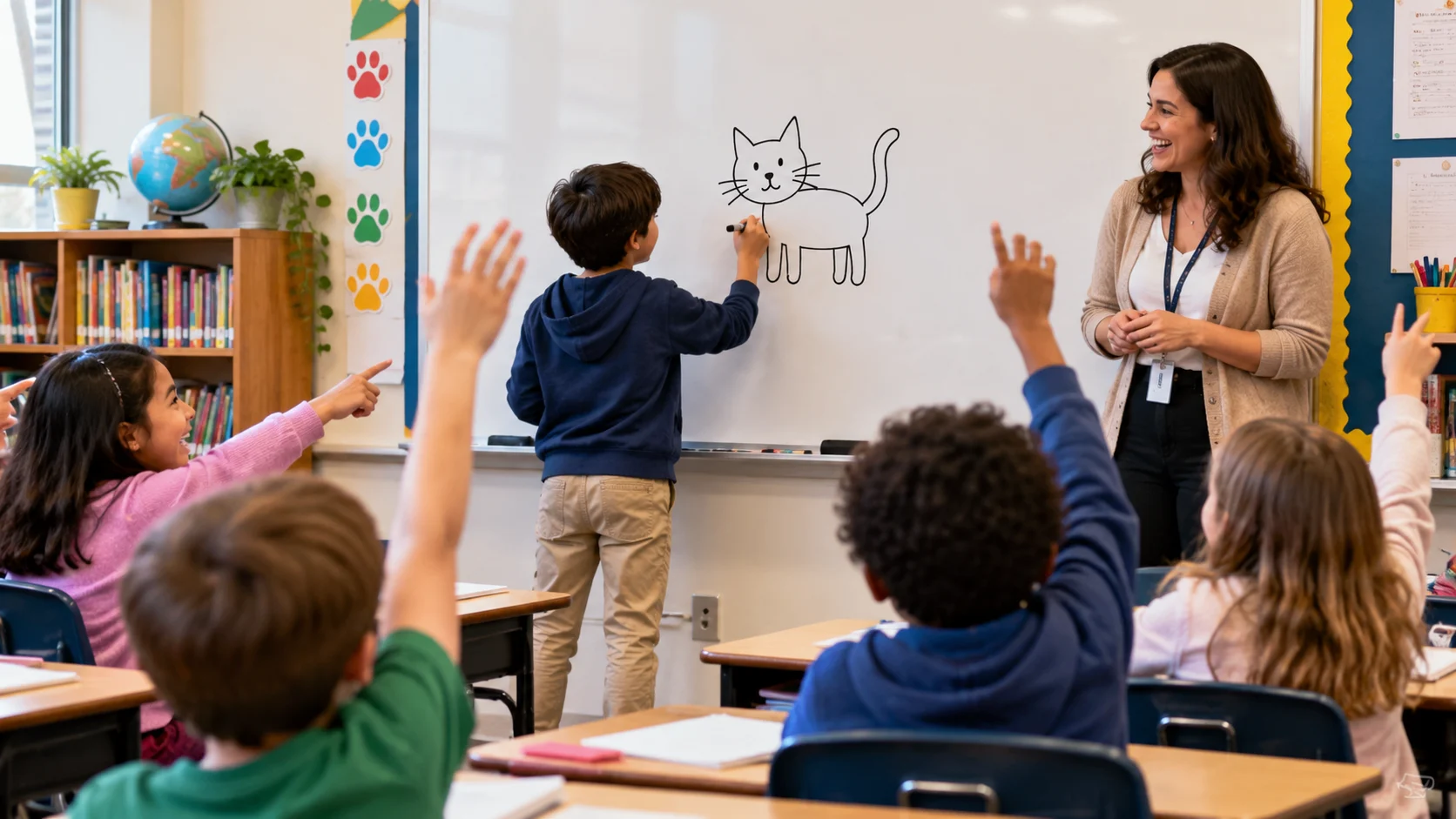
13 Classroom Pictionary
Pictionary encourages students to communicate concepts through drawings instead of written definitions.
How to Play
- Prepare words related to your current subject.
- Invite a student to draw one word without writing letters.
- Ask classmates to guess the word.
- Rotate artists after each round.
Science words like volcano, butterfly, and magnet work especially well.
Learning benefits: Visual communication, vocabulary, and concept recall.
14 Vocabulary Charades
Bring vocabulary words to life through simple actions and nonverbal clues.
How to Play
- Choose a word that can be demonstrated safely.
- Invite a volunteer to act it out without speaking.
- Ask classmates to guess the answer.
- Connect the word to its meaning or lesson context.
Action verbs such as jumping, stretching, and whispering are great for younger learners.
Learning benefits: Vocabulary, nonverbal communication, and comprehension.
15 Timeline Shuffle
Timeline Shuffle helps students review historical events or the stages of a process.
How to Play
- Write important events or steps on separate cards.
- Shuffle and distribute the cards to groups.
- Ask students to arrange them in the correct order.
- Review the sequence and discuss their reasoning.
For a science variation, students can arrange the life cycle of a butterfly.
Learning benefits: Sequencing, chronology, reasoning, and cooperation.
16 Science Sorting Challenge
Students learn to classify scientific concepts by sorting picture or word cards into categories.
How to Play
- Create cards showing objects, organisms, or scientific terms.
- Choose categories such as living and nonliving things.
- Ask small groups to organize the cards.
- Have students explain their choices.
Learning benefits: Classification, observation, and scientific reasoning.
17 Classroom Review Showdown
Turn the end of a lesson into a collaborative quiz challenge.
How to Play
- Divide students into teams.
- Ask a question from the current lesson.
- Give teams time to discuss and record their answers.
- Reveal the answer and award a point for accuracy.
- Rotate the student who explains each answer.
Learning benefits: Recall, discussion, teamwork, and explanation.
7 Fun Movement Classroom Games for Active Students
After several seated lessons, children may benefit from a short movement break. These games create opportunities for physical activity without requiring a gym. Check the space first and provide seated alternatives when needed.
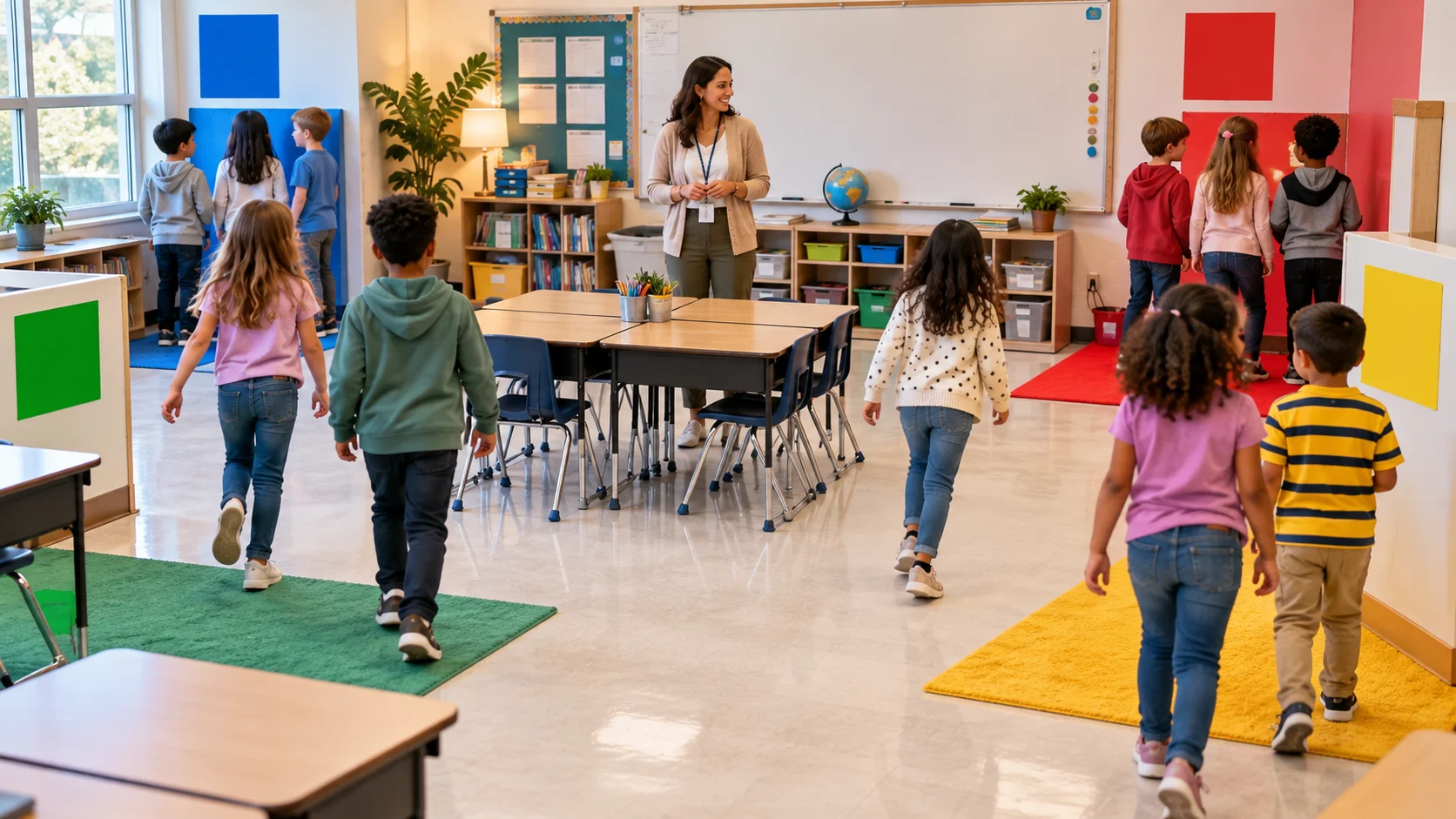
18 Four Corners
Four Corners combines classroom movement with decision-making and academic review.
How to Play
- Assign each classroom corner an answer choice.
- Ask a question with four possible answers.
- Students move calmly toward their chosen corner.
- Reveal the answer and discuss the reasoning.
Learning benefits: Decision-making, lesson review, and active participation.
19 Stand Up If…
This simple activity helps students move, learn about classmates, and review ideas from class.
How to Play
- Say “Stand up if…” followed by a statement.
- Students stand when the statement applies to them.
- Invite students to sit before the next prompt.
Example: “Stand up if you think 15 is an odd number.”
Learning benefits: Listening, recall, and connection.
20 Move and Freeze
Move and Freeze provides a brief burst of energy with clear stopping points.
How to Play
- Ask students to move safely within their personal space.
- Give directions such as marching or stretching.
- Call “Freeze!” at unexpected moments.
- Students stop until the next instruction.
Learning benefits: Listening, self-regulation, and coordination.
21 Alphabet Actions
Alphabet Actions combines letter recognition with simple physical movements.
How to Play
- Select a letter.
- Ask students to think of a word beginning with it.
- Choose a safe movement inspired by the word.
- Repeat with another letter.
For example, B could represent butterfly, with children slowly moving their arms like wings.
Learning benefits: Letter recognition, phonics, and vocabulary.
22 Human Number Line
Turn the classroom into a giant number line and let students demonstrate number order.
How to Play
- Give several students number cards.
- Ask them to arrange themselves from smallest to largest.
- Invite classmates to check the order.
- Repeat with a more challenging set of numbers.
Learning benefits: Number order, comparison, and mathematical reasoning.
23 Classroom Scavenger Hunt
A classroom scavenger hunt gives students a fun reason to observe their surroundings.
How to Play
- Prepare a few short clues.
- Ask students to point to or record matching objects.
- Allow them to explore within an assigned area.
- Review their discoveries together.
Possible clues: Find something shaped like a rectangle, or find an object beginning with P.
Learning benefits: Observation, problem-solving, and vocabulary.
24 Mirror Me
Mirror Me is a good choice when students need movement without a noisy activity.
How to Play
- Choose a leader.
- The leader makes slow, simple movements.
- Everyone tries to mirror those movements.
- Change leaders after a short round.
Learning benefits: Attention, observation, and coordination.
7 Quiet and Team-Building Classroom Games
Not every classroom game needs cheering or competition. These activities encourage students to listen, cooperate, and solve problems together.
25 Silent Drawing Chain
Students create a group drawing without spoken instructions.
How to Play
- Give each group a blank sheet.
- Ask the first student to draw one simple element.
- Pass the sheet to the next student to add something.
- Continue until everyone contributes.
- Invite groups to explain their final pictures.
Learning benefits: Creativity, cooperation, observation, and turn-taking.
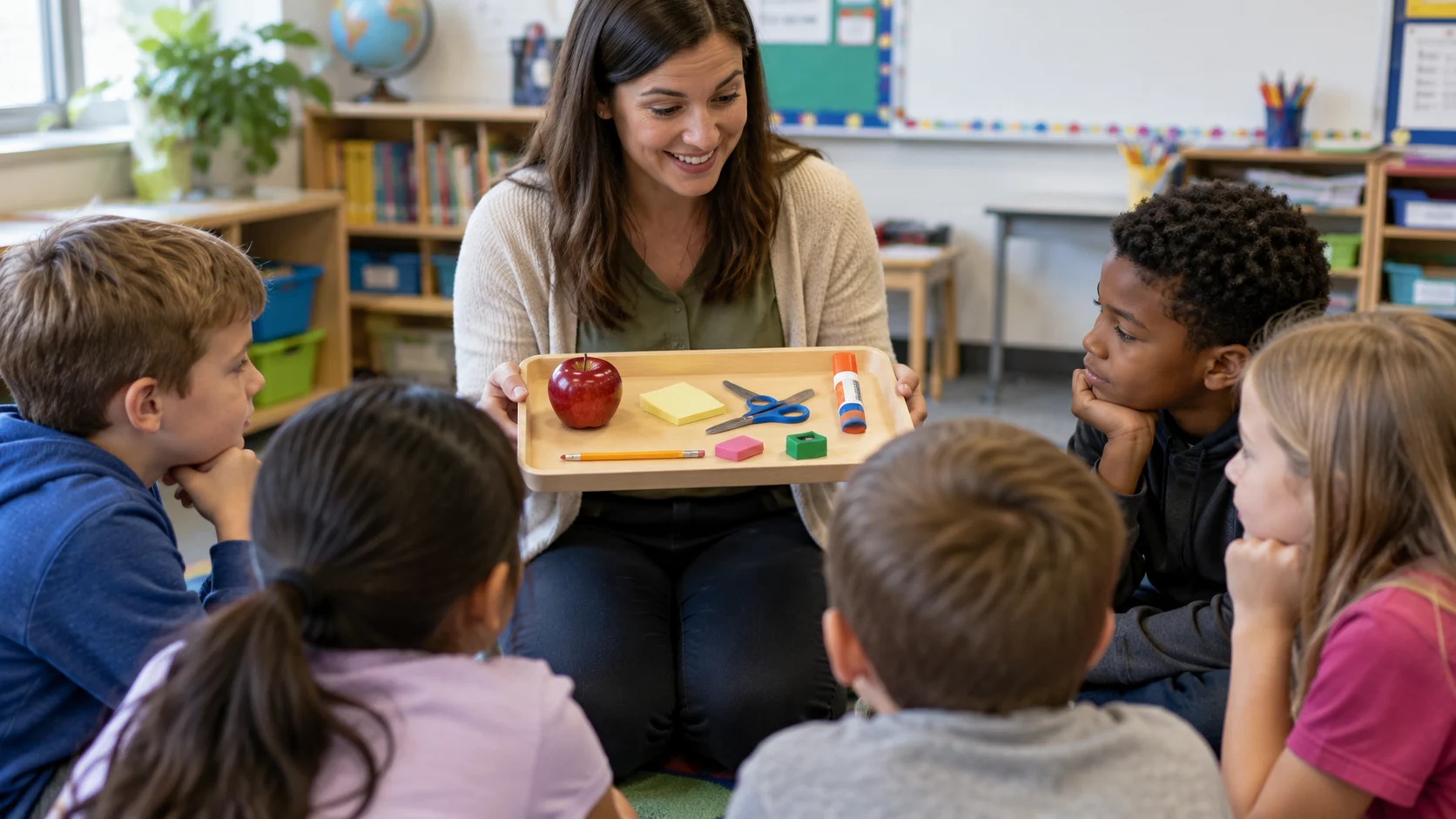
26 Memory Tray
Memory Tray is an observation challenge that becomes more difficult as students improve.
How to Play
- Place five to ten safe, familiar objects on a tray.
- Give students around 30 seconds to observe them.
- Cover the tray.
- Ask students to write, draw, or name the objects they remember.
Possible items include an eraser, pencil, ruler, or small toy.
Learning benefits: Observation, attention, and memory.
27 Draw and Describe
This partner activity shows why clear communication matters.
How to Play
- Give one student a simple picture their partner can’t see.
- Ask the student to describe it using words.
- The partner draws what they hear.
- Compare the two pictures.
Learning benefits: Listening, descriptive language, and spatial vocabulary.
28 Classroom Puzzle Challenge
Students work together toward a shared result instead of solving a puzzle alone.
How to Play
- Print or draw a picture and cut it into pieces.
- Divide students into small groups.
- Give each group a mixed puzzle set.
- Ask everyone to contribute to completing the image.
Learning benefits: Collaboration, visual reasoning, and problem-solving.
29 Compliment Circle
Compliment Circle builds classroom connection through appreciation and kindness.
How to Play
- Invite students to sit in a circle.
- Model a specific, respectful compliment.
- Ask volunteers to recognize a helpful action by a classmate.
- Continue until several students have contributed.
Example: “I appreciated when Jordan helped clean up the art supplies.”
Learning benefits: Empathy, communication, and classroom belonging.
30 Build-a-Story Team Challenge
This group storytelling activity encourages imagination and shared decision-making.
How to Play
- Divide students into small groups.
- Give each group a story starter.
- Each student contributes one sentence.
- Ask the group to create a final ending.
- Invite groups to share their stories.
Example starter: “One morning, our classroom door opened to reveal…”
Learning benefits: Creativity, sequencing, teamwork, and speaking.
31 Who Am I?
Students identify a mystery person, animal, or object using clues.
How to Play
- Choose a secret identity.
- Provide a series of clues.
- Let students discuss possible answers.
- Reveal the identity after the final clue.
Example clues: “I’m a mammal, I live in the ocean, and I use clicks and whistles.” Answer: dolphin.
Learning benefits: Inference, recall, and critical thinking.
4 Interactive Classroom Games Using Technology
Digital classroom games can add variety when your school has a projector, smartboard, or student devices. Choose activities that support learning goals without creating unnecessary setup problems, and follow your school’s technology and privacy policies.
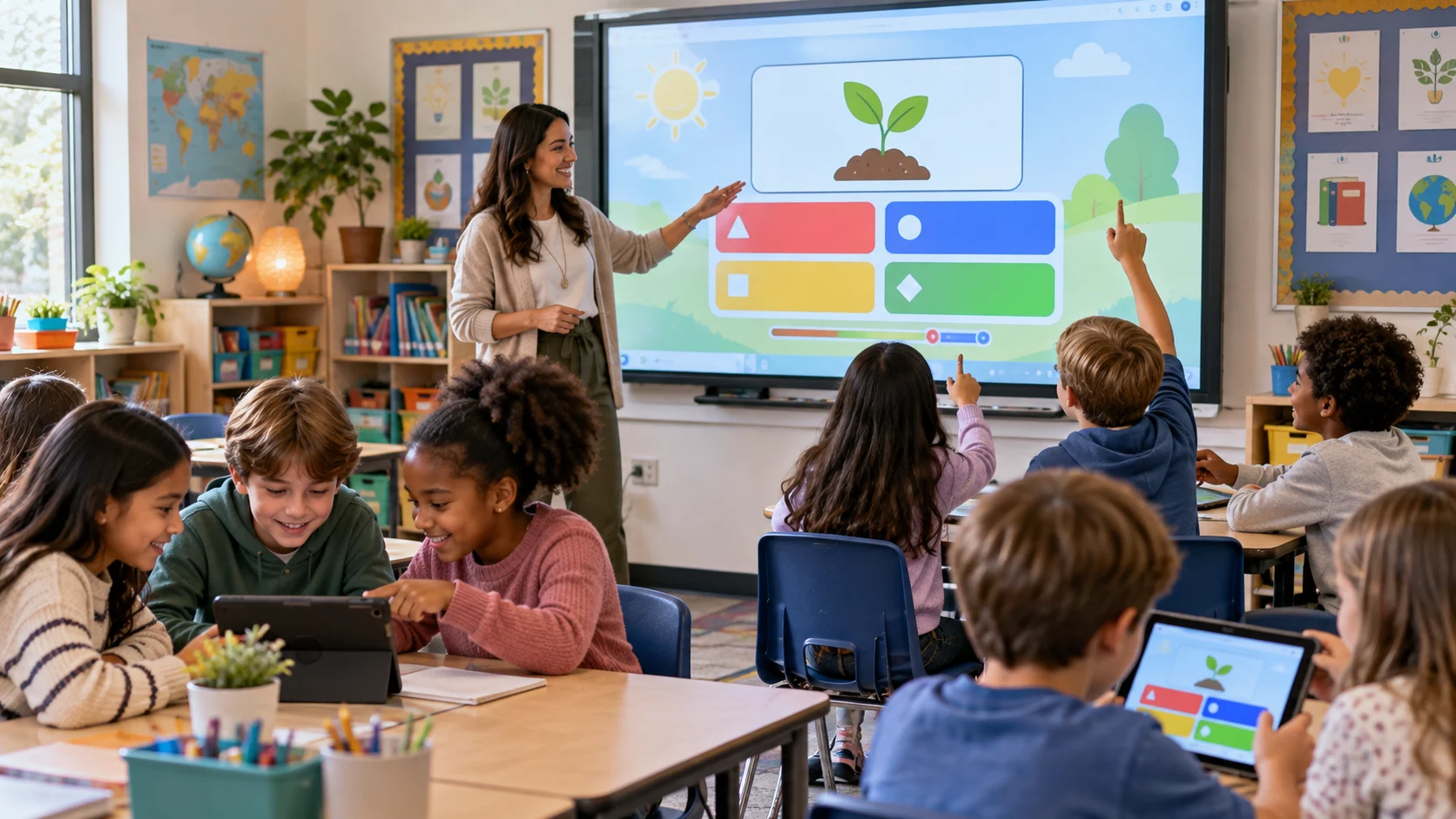
32 Live Classroom Quiz
A live quiz turns a lesson review into a whole-class activity.
How to Play
- Prepare five to ten questions.
- Display one question at a time.
- Students answer individually or in teams.
- Reveal the answer and explain it before continuing.
Learning benefits: Recall, formative assessment, and discussion.
33 Mystery Picture Reveal
This visual guessing game builds curiosity one clue at a time.
How to Play
- Choose a picture related to your lesson.
- Cover it with several shapes or paper squares.
- Reveal one section at a time.
- Invite students to predict what it shows.
- Discuss the clues after the full reveal.
Learning benefits: Prediction, observation, and visual reasoning.
34 Interactive Classroom Poll
Classroom polls let students explore the opinions of classmates while practicing data collection.
How to Play
- Ask a question with two to four choices.
- Students vote using answer cards, a digital tool, or paper.
- Count the responses together.
- Discuss the results.
A question like “Which classroom pet would you prefer?” can lead into a graphing lesson.
Learning benefits: Data interpretation, communication, and mathematics.
35 Digital Escape Challenge
A digital escape challenge connects several academic tasks into one exciting problem-solving adventure.
How to Play
- Create a short story about unlocking a mystery door or recovering a missing item.
- Prepare three to five academic challenges.
- Give students a clue or code after each correct solution.
- Ask them to combine the clues to solve the final challenge.
Students might solve multiplication problems, interpret a reading passage, and identify science vocabulary to discover the final code.
Learning benefits: Problem-solving, collaboration, and knowledge application.
Try a different keyword, game type, or time limit.
Best Classroom Games by Grade Level
An activity that excites kindergarten students may not interest fifth graders in the same way. Choosing an appropriate challenge helps children stay involved without feeling overwhelmed.
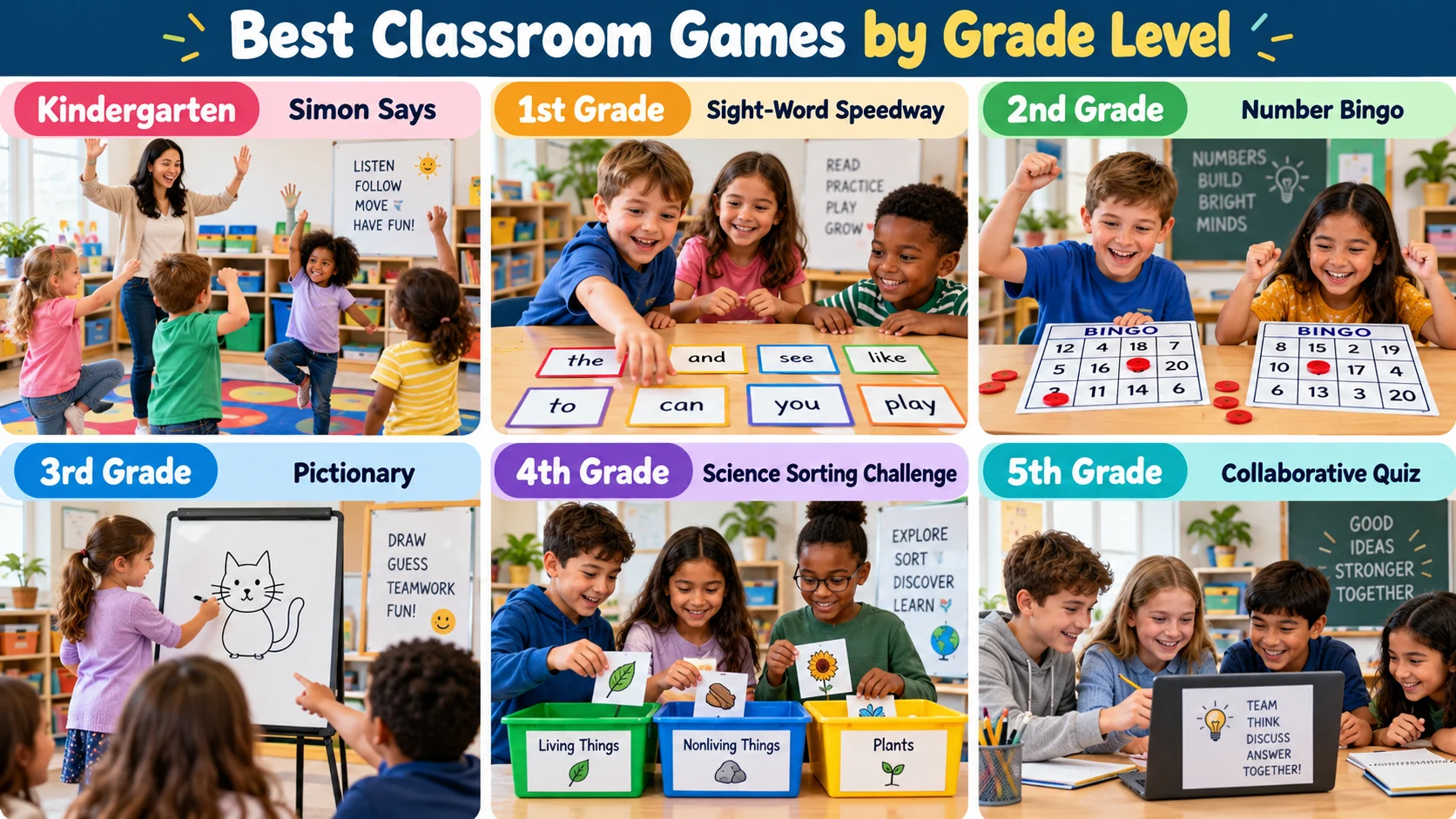
| Grade Level | Recommended Games | Learning Focus |
|---|---|---|
| Kindergarten | Simon Says, Alphabet Actions, Mirror Me, Memory Tray | Listening, letters, observation |
| 1st Grade | Sight Word Detective, Math Bingo, Category Chain | Early literacy, number skills |
| 2nd Grade | Mystery Number, Pictionary, Four Corners | Reasoning, communication |
| 3rd Grade | 20 Questions, Spelling Relay, Timeline Shuffle | Vocabulary, critical thinking |
| 4th Grade | Science Sorting, Review Showdown, Number Talk | Problem-solving, cooperation |
| 5th Grade | Digital Escape Challenge, Human Number Line, Odd One Out | Advanced reasoning, application |
These are flexible recommendations. You can often use the same game across several grades by adjusting questions, vocabulary, or difficulty.
How to Choose the Best Classroom Game
Before starting a classroom activity, consider what your students need and what you want them to gain from the experience.
1. Consider the Time Available
For a five-minute transition, choose simple games such as Category Chain or Mirror Me. A 15-minute review session can accommodate Math Bingo or Pictionary.
2. Match Your Learning Goal
Mystery Number strengthens mathematical thinking, while Vocabulary Detective helps with word meanings. Cooperative activities can encourage classroom connection.
3. Think About Classroom Energy
After a long seated lesson, a movement game may help. When students need a calmer activity, choose Memory Tray or a quiet guessing challenge.
4. Check Materials and Space
Not every classroom has extra supplies, reliable technology, or open floor space. Maintain a collection of games that work with what you already have.
5. Make Participation Accessible
Allow children to speak, point, write, draw, or choose answer cards. Use alternatives to standing or fast-response activities when appropriate.
6. Keep the Rules Simple
A classroom game should be easy to explain and enjoyable to follow. Demonstrate a round before expecting students to play independently.
How to Manage Classroom Games Without Losing Control
Even a simple activity can become distracting when students don’t understand the expectations. A few consistent routines help games stay enjoyable and purposeful.
Explain the Rules Before You Begin
Use short instructions and model one example. If the game involves movement, explain classroom boundaries and safe movement rules.
Set a Clear Time Limit
Tell students how long the activity will last. A visual timer or countdown can help them understand when the game is ending.
Use a Consistent Attention Signal
Choose a familiar signal such as raising your hand or giving a short verbal cue. Practice it before starting a noisy activity.
Avoid Unnecessary Elimination
Whenever possible, use rules that allow everyone to continue playing. Recognize teamwork, thoughtful explanations, and improvement instead of speed alone.
Finish With a Quick Reflection
Ask students what they practiced or learned. This connects the activity to a meaningful classroom outcome.
A Simple 15-Minute Classroom Game Plan
Need to fill part of a lesson without creating an elaborate project? This simple sequence combines preparation, practice, and reflection.
| Time | Activity | Purpose |
|---|---|---|
| 0–2 minutes | Explain the rules and model a round | Prepare students |
| 2–5 minutes | Category Chain | Activate prior knowledge |
| 5–12 minutes | Classroom Pictionary | Practice vocabulary |
| 12–15 minutes | Discuss answers and learning | Reinforce understanding |
Adjust the Plan for Your Students
For younger learners, replace Pictionary with Simon Says or Alphabet Actions. For older students, choose Mystery Number or Vocabulary Detective.
The objective is to keep the experience organized while giving every student an opportunity to participate.
Common Classroom Game Mistakes to Avoid
Choosing Games That Are Too Complicated
An activity requiring five minutes of explanations may not be appropriate for a short classroom break. Choose games with clear goals and a few straightforward rules.
Making Every Game Competitive
Competition can be exciting, but constant pressure to win may discourage students. Balance competitive games with group challenges and cooperative storytelling.
Using Activities Without a Purpose
Not every activity must focus on academic learning. Movement breaks and classroom connection are valuable too. Know what you want each game to accomplish.
Ignoring Different Learning Needs
Students may require different response methods or additional time. Adapt the game so participation is accessible and comfortable.
Forgetting How the Game Will End
Explain what happens when the timer finishes, where materials should go, and how students should transition to the next activity.
Frequently Asked Questions About Classroom Games
What are the best games to play in a classroom?
Some versatile classroom games include Simon Says, 20 Questions, Math Bingo, Classroom Pictionary, Four Corners, and Mystery Number. The best choice depends on student age, learning goals, and available time.
What classroom games require no preparation?
Simon Says, Category Chain, One-Word Story, 20 Questions, Mirror Me, and True or False Challenge can be played with little or no preparation.
What are fun five-minute classroom games?
Stand Up If, Mirror Me, Simon Says, and quick rounds of Category Chain are useful for five-minute activities. Choose games students already understand.
What classroom games are best for elementary students?
Kindergarten and first-grade students may enjoy Alphabet Actions and Simon Says. Older elementary students can try Mystery Number, Pictionary, Four Corners, and team-based review games.
How can classroom games be educational?
Games become educational when the questions or activities reinforce learning. Math Bingo supports calculation practice, Vocabulary Detective develops word knowledge, and storytelling games encourage communication.
Which classroom games work without technology?
Most games in this guide do not need technology. Popular options include 20 Questions, Memory Tray, Four Corners, Spelling Relay, Classroom Pictionary, and Science Sorting.
How do you keep classroom games from becoming too noisy?
Explain noise expectations before playing, use a familiar attention signal, and select quiet activities such as Mirror Me, Silent Drawing Chain, or Memory Tray when students need a calmer environment.
What games work well for large classrooms?
Whole-class games such as Simon Says, True or False Challenge, Four Corners, and Classroom Review Showdown can work with large groups. Provide opportunities for everyone to respond.
Can classroom games help shy students participate?
Games can support participation when students have options such as partner activities, small groups, written responses, and optional speaking roles. Avoid pressuring students to perform alone.
How often should teachers use classroom games?
There is no single ideal schedule. Short games can support everyday transitions, while longer educational games work well when they fit lesson objectives. Choose frequency according to student needs and instructional priorities.
Final Thoughts: Make Classroom Learning Fun and Meaningful
A successful classroom game doesn’t have to be elaborate.
Sometimes five minutes of Simon Says is enough to help students reconnect with a lesson. A quick round of Mystery Number can make math practice more interesting, while a collaborative story can encourage children to share ideas they might otherwise keep to themselves.
The most valuable games are the ones students understand, can participate in comfortably, and want to try again.
Start with two or three activities from this list. Explain the rules, watch how students respond, and adjust the difficulty or timing as needed.
Over time, you’ll build a collection of reliable classroom games that makes teaching easier and learning more enjoyable.